
Our readers keep the lights on and the weekend projects moving. As an Amazon Associate, I earn from qualifying purchases.
The struggle with behind-the-ear hearing aids has always been the same: you pay for amplification, but you get a wall of noise where every rustle, hum, and chair scrape competes with the voice you actually want to hear. The difference between a good day and a frustrating one comes down to how well the device separates speech from chaos.
I’m Rikta — the founder and writer behind FitlyFast. I’ve spent hundreds of hours cross-referencing real-user data, audiology specs, and clinical feedback to separate the devices that genuinely improve daily life from those that just add volume.
This roundup analyzes nine of the most competitive models on the market so you can find the best behind ear hearing aids that match your specific hearing profile, lifestyle, and budget.
How To Choose The Best Behind Ear Hearing Aids
Every behind-ear device promises clearer sound, but the real-world results depend on three distinct factors: the chip that processes audio, the physical design that sits behind your ear, and the battery system that keeps it running. Understanding these before you buy saves months of frustration.
Speech Processing and Noise Reduction
The most critical specification isn’t the maximum gain in decibels — it’s the algorithm that differentiates between a conversation partner’s voice and background rumble. Look for models that use dynamic noise reduction that adjusts in real time, not static filters that flatten everything. VocClear AI (found in ELEHEAR models) and the Powered by Bose algorithms in Lexie units represent two distinct approaches; one prioritizes speech enhancement, the other manages multiple noise sources simultaneously.
Form Factor: BTE vs. RIC
Traditional Behind-the-Ear (BTE) designs house all electronics in a case behind the ear, with a tube delivering sound into the ear canal. Receiver-in-Canal (RIC) designs place the speaker directly inside the ear canal, connected by a thin wire. RIC models offer more natural sound quality and are less prone to feedback at high volumes, but they require more careful dome selection. If you have very small ear canals or dexterity issues, a BTE with a larger control surface can be easier to handle.
Battery Life and Charging Ecosystem
Rechargeable lithium-ion batteries are now standard, but the total runtime between charges varies wildly. A device that advertises 20 hours per charge may drop to 15 hours under Bluetooth streaming. More important than single-charge life is the backup capacity of the charging case — some models provide four or five full recharges, meaning a week away from a wall outlet is feasible. Fast-charge capabilities (15 minutes for six hours of use, as seen on the ELEHEAR-Beyond Pro) are a genuine daily convenience.
Quick Comparison
On smaller screens, swipe sideways to see the full table.
| Model | Category | Best For | Key Spec | Amazon |
|---|---|---|---|---|
| Jabra Enhance Select 500 | Premium | Clinical-grade with audiologist support | Audiology services + 3-year warranty | Amazon |
| Lexie B3 | Premium | Bose-powered speech clarity in noise | 128-hour total battery life | Amazon |
| iBstone AuraLink | Premium | IP68 durability with AI adjustment | Bluetooth 5.4 + UV-sanitizing case | Amazon |
| Lexie B2 Plus | Mid-Range | Bose algorithms on a mid-tier budget | Powered by Bose noise management | Amazon |
| ELEHEAR-Beyond Pro | Mid-Range | 30% clearer speech + music mode | VocClear 2.0 + 15-min fast charge | Amazon |
| Vivtone Xpure 2.0 | Mid-Range | App-controlled fine-tuning on a budget | RIC design + EQ adjustment app | Amazon |
| ELEHEAR-Beyond | Mid-Range | Entry-level OTC with strong speech focus | 50 dB max gain + AI translation | Amazon |
| Vivtone Lucid508 | Budget-Friendly | First-time users needing clear speech | 41 dB gain + 125-hour backup case | Amazon |
| iBstone Nova | Budget-Friendly | Almost invisible CIC alternative | 1.4g weight + 100-hour total power | Amazon |
In‑Depth Reviews
1. Jabra Enhance Select 500
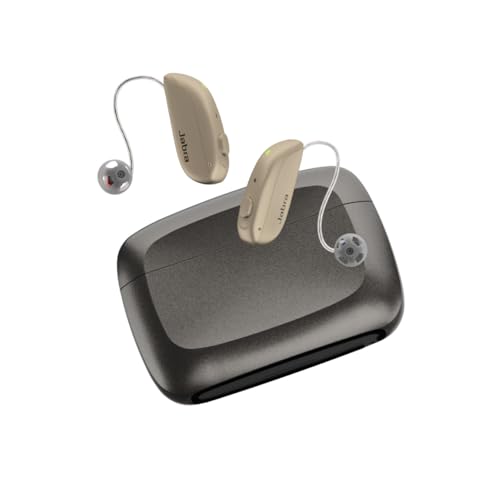
Jabra Enhance packs clinic-quality hardware into the smallest “micro” RIC body they have ever built, and then backs it with something no other OTC device offers: real audiology services included in the price. The Select 500 uses dual microphones and a speech-focused algorithm that handles complex listening situations — think trying to follow one voice across a loud restaurant table — better than any other device at this tier. The 2.12-gram weight makes it nearly invisible, and the ergonomic shape stays put during movement.
Bluetooth LE Audio and Auracast support mean this device is future-proofed for the next generation of hearing aid streaming. The tap-control for hands-free calls works on both iOS and Android, and battery life comfortably covers a full day with the charging case holding several extra days. App-based adjustments are responsive, and the audiology team can remotely fine-tune your profile if you need beyond what the self-fit offers.
Some users report the initial setup process, which involves multiple apps, is less intuitive than it should be. The lack of a physical off switch on the device itself is a minor irritation when you need to mute quickly without the case. And while the app performs well domestically, users outside the US have noted occasional connectivity hiccups that make offline controls a welcome future update.
Why it’s great
- Audiology support and remote tuning are included
- Smallest, most discreet RIC design in this class
- Bluetooth LE Audio and Auracast compatible
Good to know
- Setup requires navigating multiple apps
- No physical power-off switch on the aid
- App can be unstable outside the US
2. Lexie B3
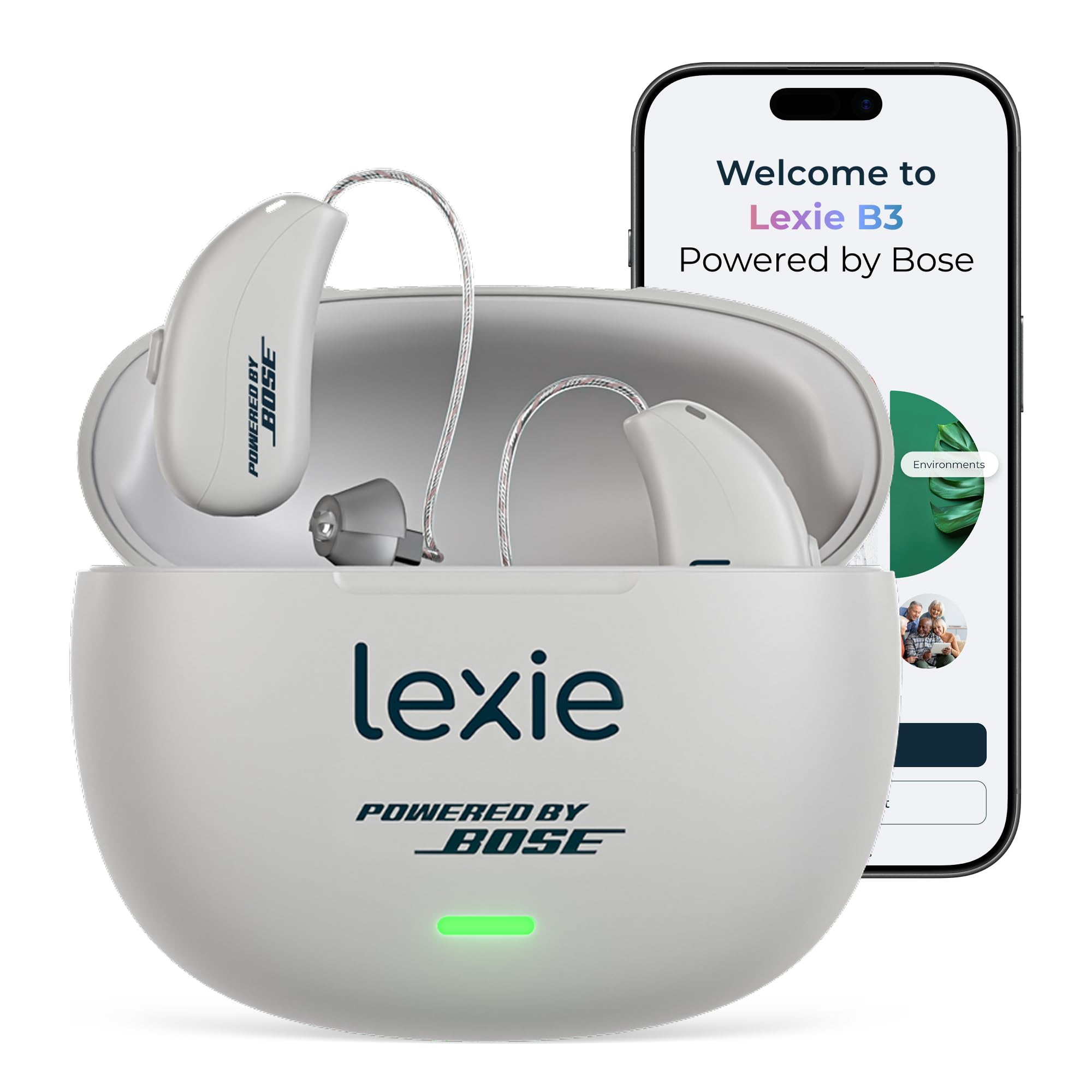
Lexie B3 is the most complete execution of the Bose-powered hearing aid platform to date. Unlike the B2 Plus, the B3 adds automatic sound focus — dual microphones that physically steer toward speech while reducing surrounding noise in real time. The custom-engineered receiver-in-canal design delivers speech clarity that multiple users have described as superior to prescription units. Six listening programs (four environments plus two streaming modes) cover home, outdoor, restaurant, and TV scenarios without needing to open the app.
The battery math is best-in-class: 32 hours per charge plus three full recharges from the case equals over 128 hours of total power. The FDA-cleared self-fitting technology uses an in-app hearing test to build a personalized profile, and the Lexie app gives you independent left/right control over volume, treble, mid, and bass. The Lexie support team proactively calls during the first 45 days to check on adjustment progress.
The app itself can be buggy, with some users experiencing disconnects that require re-pairing. The Bluetooth range also appears shorter than some competitors, and the larger battery makes the device slightly bulkier behind the ear than the B2 Plus. For pure sound processing, however, the B3 is the most refined OTC option available.
Why it’s great
- Bose automatic sound focus reduces noise directionally
- 128-hour total battery life is unmatched
- FDA-cleared self-fitting with audiologist-grade results
Good to know
- App intermittent connectivity issues
- Bluetooth range is shorter than advertised
- Slightly larger behind-ear profile
3. iBstone AuraLink
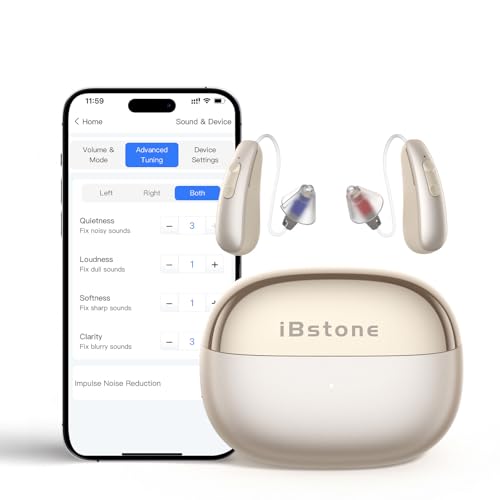
iBstone AuraLink brings a rare combination of rugged durability and AI-driven personalization to the RIC market. With an IP68 rating — the highest in this roundup — these aids shrug off sweat, rain, and dust, and they are SGS-certified to survive drops. The UV-sanitizing charging case is a thoughtful addition that keeps the domes clean between uses. Bluetooth 5.4 ensures low-latency streaming with lower power draw than earlier versions, so calls and music remain stable even in congested radio environments.
The AuraFit app runs an in-app hearing check and lets you input an audiologist’s test results directly for precise customization without a clinic visit. Tinnitus masking, echo cancellation, and adaptive intelligence tailoring mean the device continuously adjusts to your environment rather than switching between preset modes. With a frequency range of 20 Hz to 20,000 Hz, it covers the full audible spectrum, which matters if you value music quality alongside speech clarity.
The wire connecting the behind-ear unit to the earpiece is stiffer than some competitors, which can make seating the dome more finicky. While the device has been selected for a US physician-led cognitive health study, some users note the fit takes longer to dial in compared to simpler designs. The support team is US-based and responsive, but the learning curve is real.
Why it’s great
- IP68 dust/water resistance for active lifestyles
- UV-sanitizing case reduces maintenance
- Bluetooth 5.4 delivers reliable low-power streaming
Good to know
- Wire stiffness makes dome seating tricky
- Longer learning curve for ideal fit
- No physical volume control on the device
4. Lexie B2 Plus
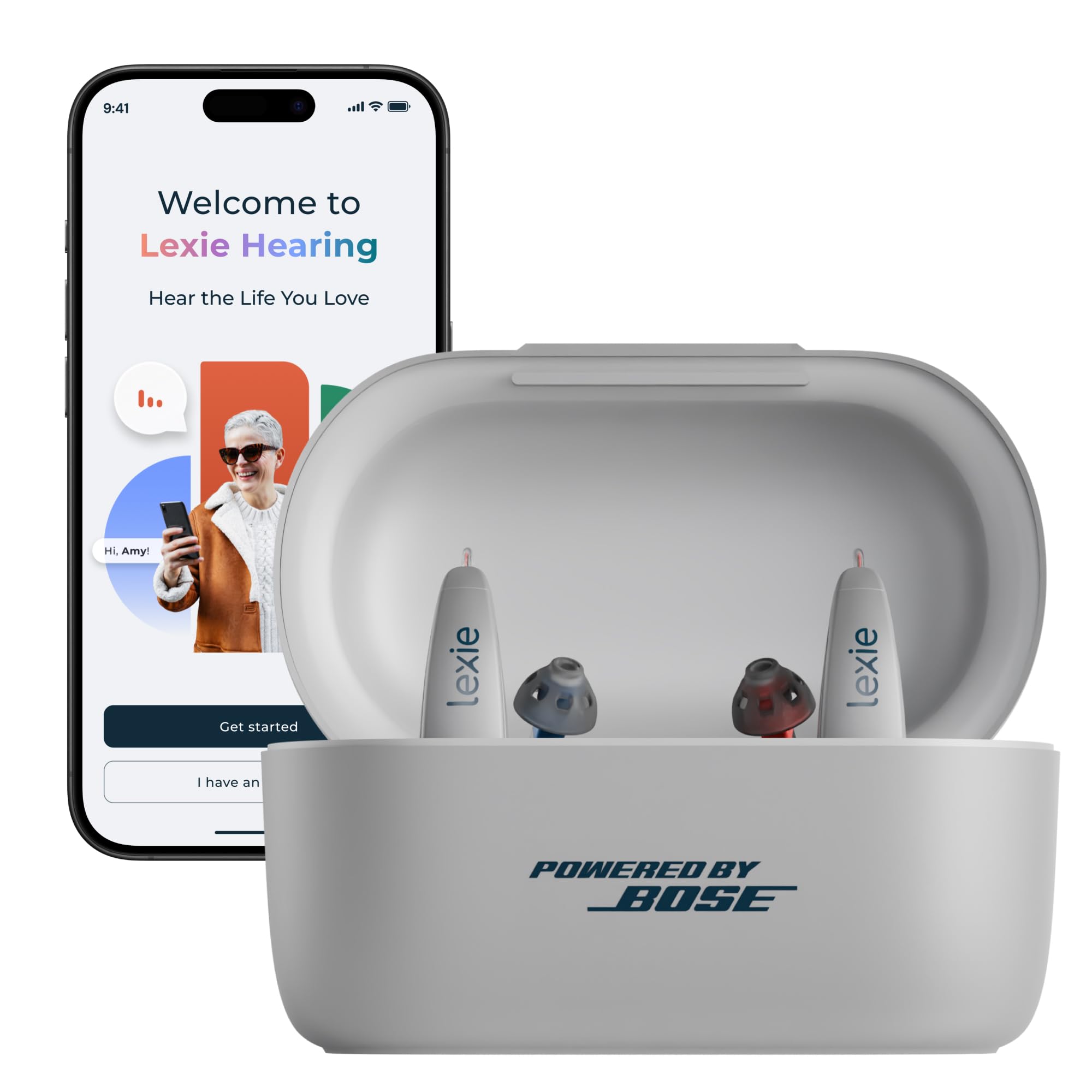
Lexie B2 Plus is the smart money pick for buyers who want Bose sound processing without stepping up to the B3. The Powered by Bose algorithms — wind noise management, impulse noise reduction, and feedback management — deliver genuinely comfortable listening in environments where lesser devices whistle and hiss. The self-fitting app is clinically proven to produce audiologist-quality customization, and you can save up to 10 environment programs, which is more than most users will ever need.
The wireless charging case is a convenience feature that matters more in daily life than specs suggest: no plugs to align, just drop the case on a Qi pad. The device works with open domes for mild loss and closed domes for more significant loss, and the four environment programs (create your own up to 10) cover everything from quiet TV watching to windy outdoor walks. Lexie coach, an in-app hearing coach, helps first-time users acclimate with personalized tips.
Reliability has been a concern for some users. After several months, some units develop a swishing noise or start dropping Bluetooth connections sporadically. Customer service is responsive but the need for replacements within the first year is higher than with premium-tier competitors. The app also removed some environment presets during a forced update, frustrating users who had carefully tuned their settings.
Why it’s great
- Bose algorithms for wind and impulse noise reduction
- Wireless charging case for effortless daily power
- Up to 10 customizable environment programs
Good to know
- Some units develop noise issues after months of use
- App updates can remove customized settings
- Mixed long-term reliability reports
5. ELEHEAR-Beyond Pro
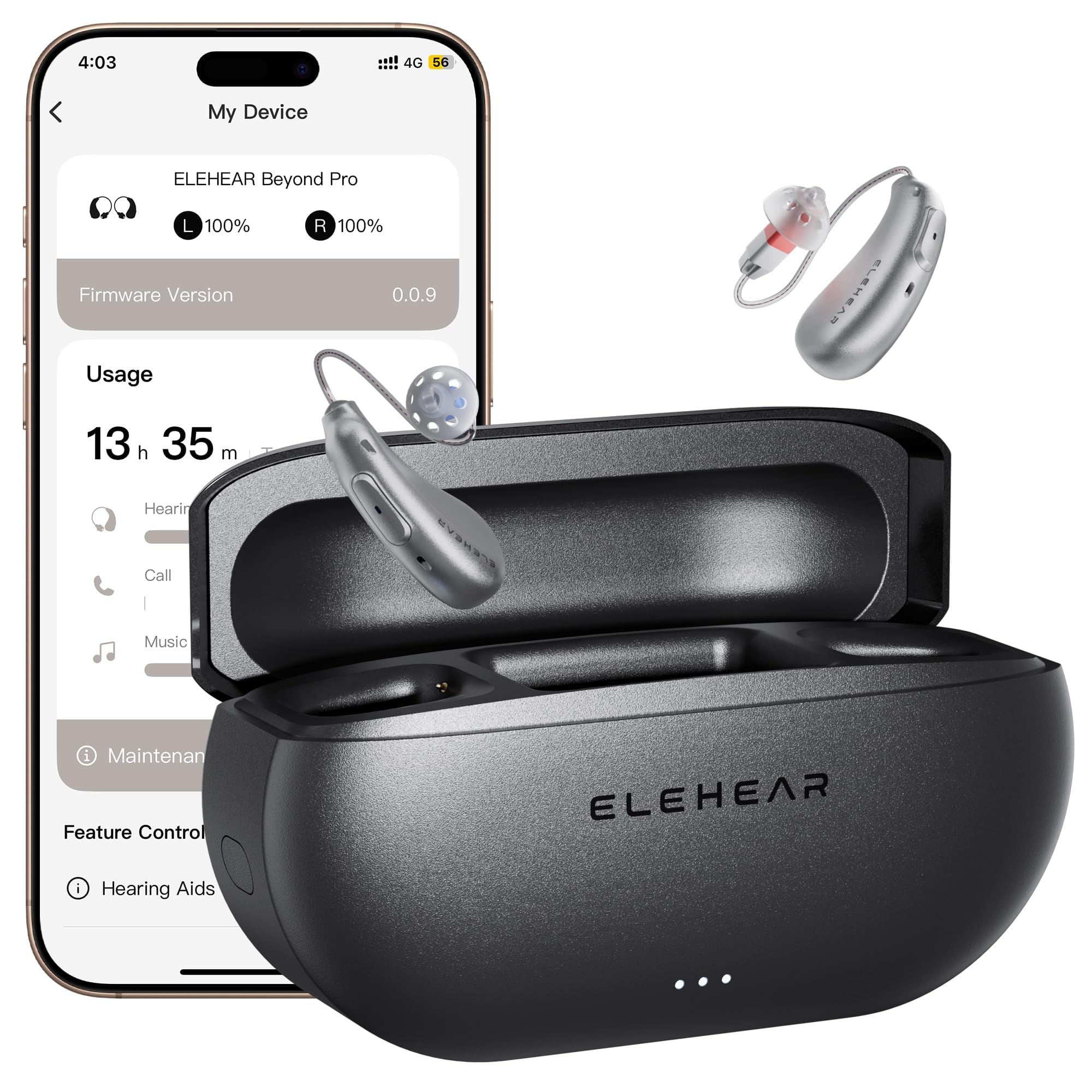
ELEHEAR-Beyond Pro uses VocClear 2.0 to deliver 30 percent clearer speech than its predecessor, with enhanced high-frequency detail reaching up to 8500 Hz and ultra-low latency of just 8 milliseconds. This is the best-sounding device in the mid-range category for anyone who values music — the dedicated Music Mode reveals instrument separation and tonal richness that most hearing aids smother. The 15-minute fast charge that provides 6 hours of playback is genuinely useful when you forget to charge overnight.
Built-in real-time AI translation supports 11 languages, transforming the device into a travel companion that works without an interpreter. The app’s redesigned interface includes one-tap actions and 20 immersive soundscapes (rain, breeze, vinyl crackle) for relaxation or focus. The featherlight RIC design with multiple dome sizes means most users achieve a comfortable all-day fit without irritation.
Durability has been inconsistent: some units develop constant feedback (a crinkling sound) after two months, and warranty replacements can take over a month when shipped from China. The battery life is closer to 17 hours than the advertised 20 under normal streaming use. Customer support eventually resolves issues but the process can be frustrating if you rely on the aids daily.
Why it’s great
- Music Mode with genuine high-frequency detail
- 15-minute fast charge for 6 hours of use
- Real-time AI translation in 11 languages
Good to know
- Some units develop feedback after a few months
- Warranty replacements ship from China (slow)
- Real-world battery life ~17 hours under streaming
6. Vivtone Xpure 2.0

Vivtone Xpure 2.0 proves that precise app control does not require a premium budget. The companion app lets you fine-tune volume and frequency independently for each ear, and the on-board equalizer sliders mimic the kind of audiogram boost you would get from prescription aids. The RIC design minimizes distortion and feedback, and the Bluetooth connectivity for phone calls and music streaming works reliably with both iOS and Android.
Multi-scenario modes (quiet, noisy restaurant, outdoor) are accessible through both the device buttons and the app, so you are never stuck cycling through 20 volume levels to find the right setting. The 2.5-hour charge delivers 24 hours of hearing aid use or 3 hours of streaming, and the case provides enough backup for a week of standby. Real-human phone support is available if the manual leaves you confused.
The ear domes included in the box cover most sizes, but the fit can be finicky for smaller ear canals, and the device does not include as many dome varieties as some competitors. The app, while powerful, requires some time to learn if you want to use the equalizer rather than just the presets. For buyers willing to invest an hour in initial tuning, the payoff in sound personalization is significant.
Why it’s great
- App-based equalizer for per-ear fine-tuning
- RIC design reduces feedback compared to BTE
- Reliable Bluetooth calling and music streaming
Good to know
- Fewer dome size options than some competitors
- App has a learning curve for advanced settings
- Fit can be uncomfortable in very small ear canals
7. ELEHEAR-Beyond

ELEHEAR-Beyond is the entry point into the VocClear ecosystem and delivers 50 dB of maximum gain with 24 dB of noise attenuation — enough for mild to moderate hearing loss. The AI-powered speech enhancement cuts background noise sharply, and users with moderate loss have found them superior to prescription units. The Bluetooth connectivity works with both iOS and Android for calls and music, and the AI translation feature (while less polished than the Pro version) is a functional bonus.
The charging case provides four extra cycles for a total of 100 hours of run time, and the auto on/off feature when removing from the case simplifies daily use. The app allows customization of volume, serene sound relief, and telephone speech enhancement settings. Multiple dome sizes are included, and the lightweight RIC design is comfortable for all-day wear once you find the right dome.
Some users report that the noise cancellation is less effective in very loud environments like restaurants, where it can struggle to separate multiple voices from clattering dishes. Bluetooth connection issues that require power cycling have been noted, and the music streaming quality has been described as “slightly underwater” due to noise cancellation interference. These are acceptable compromises at this price point, but worth knowing before buying.
Why it’s great
- 50 dB gain handles moderate hearing loss well
- 100-hour total battery with charging case
- App customization for volume and tone per ear
Good to know
- Noise reduction weakens in crowded restaurants
- Music streaming quality suffers from NC interference
- Occasional Bluetooth dropout requires power cycling
8. Vivtone Lucid508
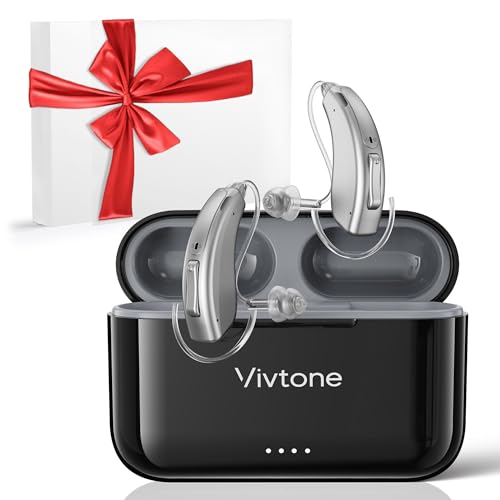
Vivtone Lucid508 punches well above its weight for buyers entering the behind-ear hearing aid market. The 41 dB peak gain covers mild to significant loss, and the multi-channel digital processing keeps background noise and whistling to a minimum — a genuine achievement at this tier. The auto-on/off feature triggered by the charging case means no fumbling with tiny switches, and the three listening modes (quiet, noisy, tinnitus masking) cover the essential scenarios most users face daily.
The charging ecosystem is the standout feature here: 2 hours to full charge, 25 hours of use per charge, and a case that holds 4 extra full charges for a total of 125 hours of backup power. That is enough for two weeks of daily use without touching a wall outlet. The lightweight, smaller BTE design is nearly invisible behind the ear, and the medical-grade materials prevent skin irritation during extended wear. A free anti-lost lanyard and clip are included if you use the promotion.
The plastic build feels less robust than premium competitors, and the button controls require some finger dexterity to cycle through volume levels and modes. The included domes cover average ear sizes well, but users with very small or very large canals may need to experiment with third-party tips. Customer service is responsive by phone, email, and text, which is reassuring for first-time users.
Why it’s great
- 125-hour backup gives two weeks of power
- Effective background noise reduction for the price
- Tinnitus masking mode included
Good to know
- Plastic build feels less durable than metal options
- Button controls require good finger dexterity
- Limited dome sizes for extreme canal shapes
9. iBstone Nova
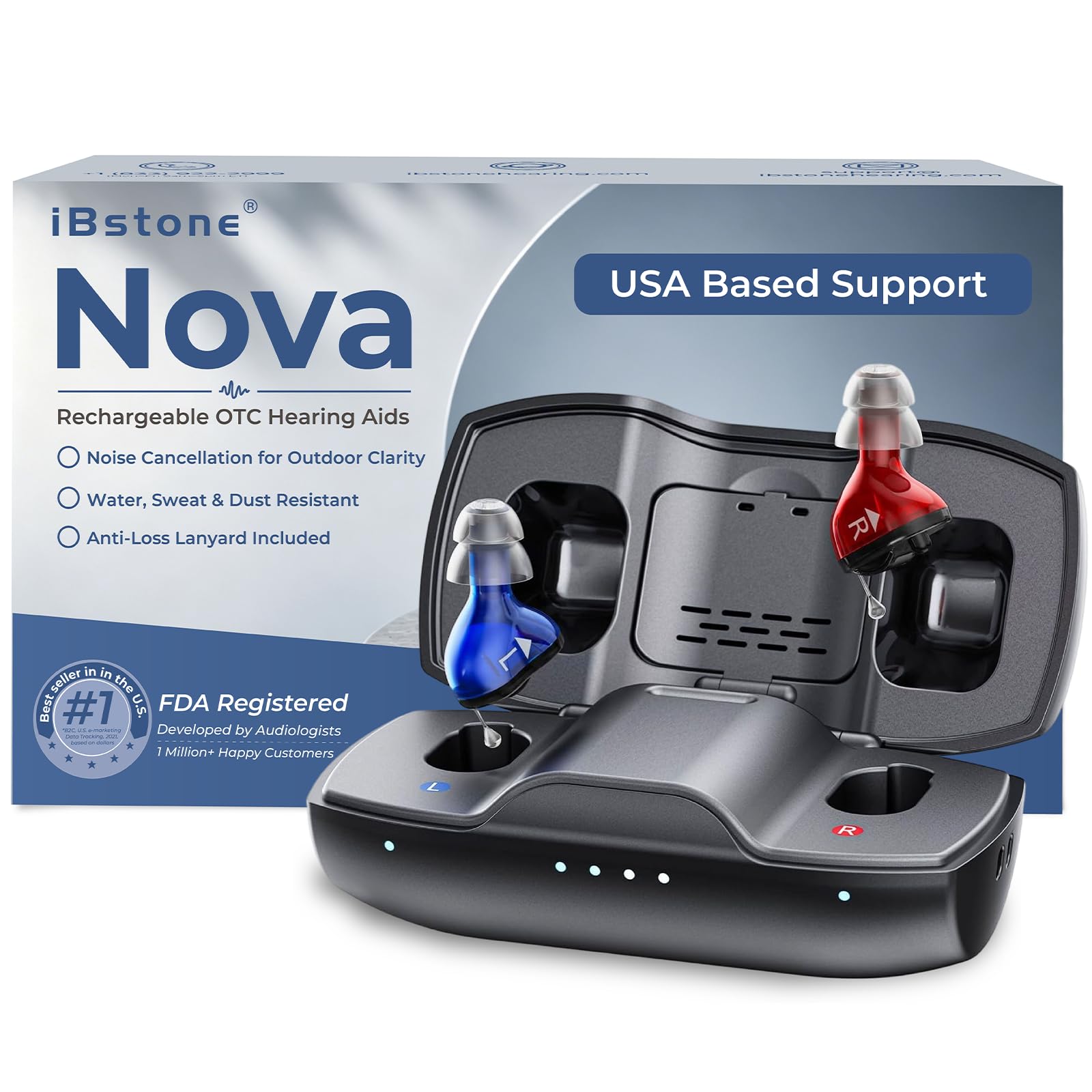
iBstone Nova is designed for those who prioritize discretion: at 1.4 grams, it is lighter than a feather and sits completely in the canal, making it invisible to others. The 1.5-hour fast charge provides 20 hours of use, and the case offers four extra charges for 100 hours total. The smart noise-canceling chip eliminates 99 percent of whistling feedback, and the 9 pairs of ear tips in three shapes (S/M/L) ensure 99 percent of ear canals find a secure fit.
The moisture and sweat resistance handles daily commutes and light exercise without issue, and the built-in dehydrator in the charging case automatically dries the aids overnight — a feature usually reserved for much more expensive devices. The raised button design prevents accidental taps, and the softer pull cords tuck comfortably without causing pain. The device works well for mild to moderate loss, and most users report significant improvement in hearing family conversations.
The completely-in-canal design means the Nova is not technically a “behind the ear” hearing aid in the traditional sense — it sits fully inside the canal. This restricts its use to users with mild to moderate loss, as there is no space for the larger receiver needed for severe loss. The volume control cycles through all levels sequentially, which can be cumbersome, and there is no way to turn the device off while wearing it without removing it from the ear.
Why it’s great
- 1.4g weight is the lightest in this roundup
- 9 tip sizes for near-universal fit
- Built-in case dehydrator for overnight maintenance
Good to know
- CIC design limits use to mild-moderate loss only
- Volume control cycles all levels sequentially
- Cannot power off without removing from ear
FAQ
How do I know if I need a behind ear hearing aid or an in-canal device?
Can I stream phone calls and music through OTC behind ear hearing aids?
How long do rechargeable behind ear hearing aids last before needing replacement?
Final Thoughts: The Verdict
For most users, the behind ear hearing aids winner is the Jabra Enhance Select 500 because it combines clinic-grade hardware with audiology support at half the cost of traditional clinics. If you want Bose-powered speech clarity in noisy environments, grab the Lexie B3. And for active users needing IP68 durability with AI-driven adjustments, nothing beats the iBstone AuraLink.