
Our readers keep the lights on and the weekend projects moving. As an Amazon Associate, I earn from qualifying purchases.
The difference between a pressure washer that dies after two seasons and one that still starts on the first pull years later often comes down to one feature you never see on the spec sheet: the drive system. Belt drive pressure washers separate the pump from the engine with a belt and pulley, which isolates the pump from the engine’s vibration and heat, dramatically extending its lifespan compared to direct-drive units. If you’re looking at models in the – range, you’re already past the throwaway consumer tier, and the choice between belt-driven and direct-driven is the single most important durability decision you’ll make.
I’m Rikta — the co-founder and writer behind FitlyFast. My deep research for this guide involved analyzing the pump architecture, GPM-to-PSI ratios, and long-term service records of over a dozen models to separate the ones built for years of heavy use from the ones that merely look good on paper.
Whether you’re a contractor cleaning multiple properties a week or a homeowner who wants to buy once and never worry again, you need a machine that can handle sustained run times without overheating or burning out its seals — and that’s exactly why we focused this guide on the best belt drive pressure washer.
How To Choose The Best Belt Drive Pressure Washer
Choosing the right belt-drive machine means looking past the headline PSI number and focusing on the pump construction, the engine’s real-world reliability, and the total cleaning units it can sustain over long cleaning sessions. A belt-driven setup isn’t a magic bullet — it’s a foundation that only pays off if the rest of the machine is built to match.
Pump Type: Triplex vs. Axial
Belt-drive machines almost exclusively use triplex plunger pumps, which have three ceramic plungers moving in an oil-bathed crankcase. These pumps handle higher pressures and longer run times than axial cam pumps (common in direct-drive units) without overheating. Look for forged brass or stainless steel manifold heads and replaceable seals — these are signs the pump can be rebuilt rather than replaced entirely.
Cleaning Units (CU): The Real Power Metric
Multiplying PSI by GPM gives you Cleaning Units, a far better measure of real-world cleaning speed than either number alone. A 3,600 PSI washer running at 2.5 GPM produces 9,000 CU, while a 4,200 PSI machine with 4.0 GPM delivers 16,800 CU. For belt-drive machines, you typically see CU between 8,000 and 17,000 — the higher end being necessary for commercial concrete cleaning and heavy equipment.
Engine Quality and Serviceability
Honda GX-series engines (GX200, GX390) are the gold standard in belt-drive pressure washers for a reason: they start reliably for years, have readily available replacement parts, and include low-oil shutdown to protect the engine from operator neglect. Lower-cost engines from brands like Westinghouse or generic Chinese 209cc motors can work well, but they often have shorter warranty periods and less parts availability long-term.
Belt Drive vs. Direct Drive: The Durability Gap
A direct-drive pump bolts straight to the engine crankshaft, spinning at the engine’s RPM (typically 3,400). That high speed generates heat and vibration that wears pump seals quickly. A belt-drive setup uses a pulley system to reduce pump speed to around 1,725 RPM — half the speed — which means dramatically less heat, less vibration, and pump seals that last three to five times longer. The tradeoff is size and weight: belt-drive units are heavier.
Quick Comparison
On smaller screens, swipe sideways to see the full table.
| Model | Category | Best For | Key Spec | Amazon |
|---|---|---|---|---|
| SIMPSON ALH4240 | Gas | Heavy Commercial Use | CAT Triplex Pump 4.0 GPM | Amazon |
| Westinghouse WPX4400 | Gas | High-Flow Residential | 420cc Engine 4.2 GPM | Amazon |
| Kärcher G 3600 P | Gas | Professional-Grade Reliability | Triplex/Crankshaft Pump | Amazon |
| Kärcher HD 5/17 CX Plus | Electric | Continuous Commercial Duty | Long-Life Induction Motor | Amazon |
| SIMPSON PS3228 | Gas | Reliable Mid-Range Pro | Honda GX200 Engine | Amazon |
| Tecoloy PM Inverter | Electric | Ultra-Quiet Cleaning | Horizontal Triplex Pump | Amazon |
| Giraffe Tools Crossfalls | Electric | Space-Saving Commercial | All-Copper Pump 60dB | Amazon |
| Canpump CE 3650 S | Pump Only | High-Flow Replacement | 24 mm Solid Shaft | Amazon |
| Westinghouse WPX3400e | Electric | Powerful Electric Option | 3400 PSI Brushless Motor | Amazon |
| IvyBess 4200 PSI | Gas | Budget High-Pressure Gas | 209cc 4-Stroke Engine | Amazon |
| Generac 8888 | Electric | Entry-Level Residential | 1.2 GPM Electric Motor | Amazon |
In‑Depth Reviews
1. SIMPSON ALH4240
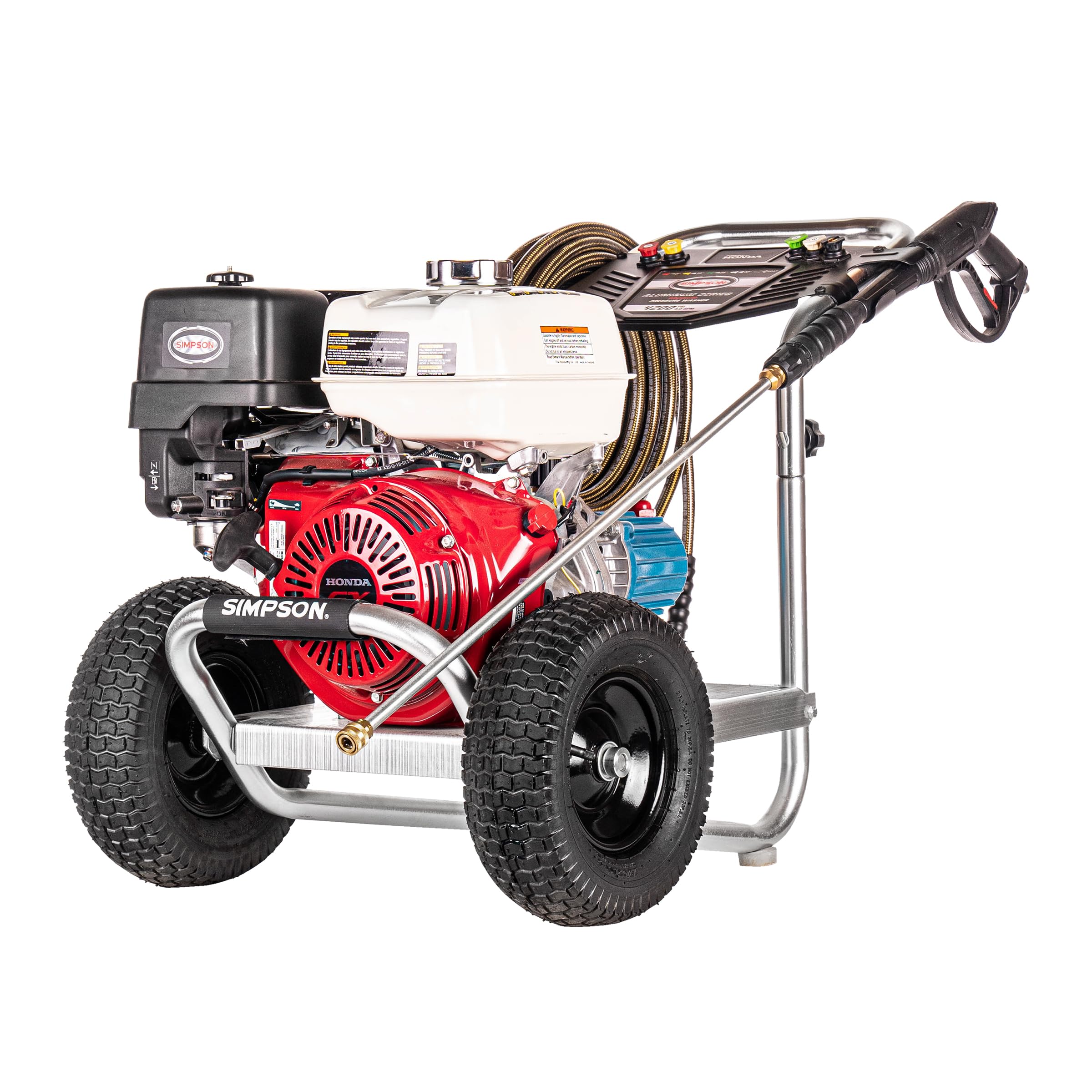
The SIMPSON ALH4240 is the reference standard for belt-drive pressure washers in the serious commercial category. Its Honda GX390 engine is widely regarded as the most reliable small engine ever built, and the CAT triplex plunger pump with ceramic-coated pistons and advanced oil seal technology handles sustained high-pressure work without the seal degradation that plagues lower-tier pumps. The 4.0 GPM flow rate at 4,200 PSI produces 16,800 Cleaning Units — enough to strip paint, clean heavy equipment, or restore large concrete areas quickly.
The aircraft-grade aluminum frame keeps the overall weight manageable at 133 lbs, and the 13-inch pneumatic tires roll smoothly over gravel and grass. The 50-foot dual-braided hose provides plenty of reach, though owners note the hose is quite stiff and can transfer some vibration to the operator during extended use. The five quick-connect tips cover the full range from 0-degree paint stripping to 40-degree rinsing and a soap nozzle.
Some users report shipping damage due to inadequate packaging, and the engine mounting bolts have been known to loosen during initial use — these are tighten-before-use items rather than design flaws. The warranty is excellent: 3 years on the engine, 5 years on the pump, and 1 year on the frame, which reflects the manufacturer’s confidence in the build quality.
Why it’s great
- Honda GX390 starts first pull every time even after storage
- CAT triplex pump with 5-year warranty handles daily commercial use
- Aluminum frame resists corrosion better than steel
Good to know
- High-pressure hose is very stiff and can be difficult to coil
- Shipping packaging insufficient for the weight — inspect thoroughly on arrival
- Plastic spray wand feels cheap relative to the rest of the machine
2. Westinghouse WPX4400
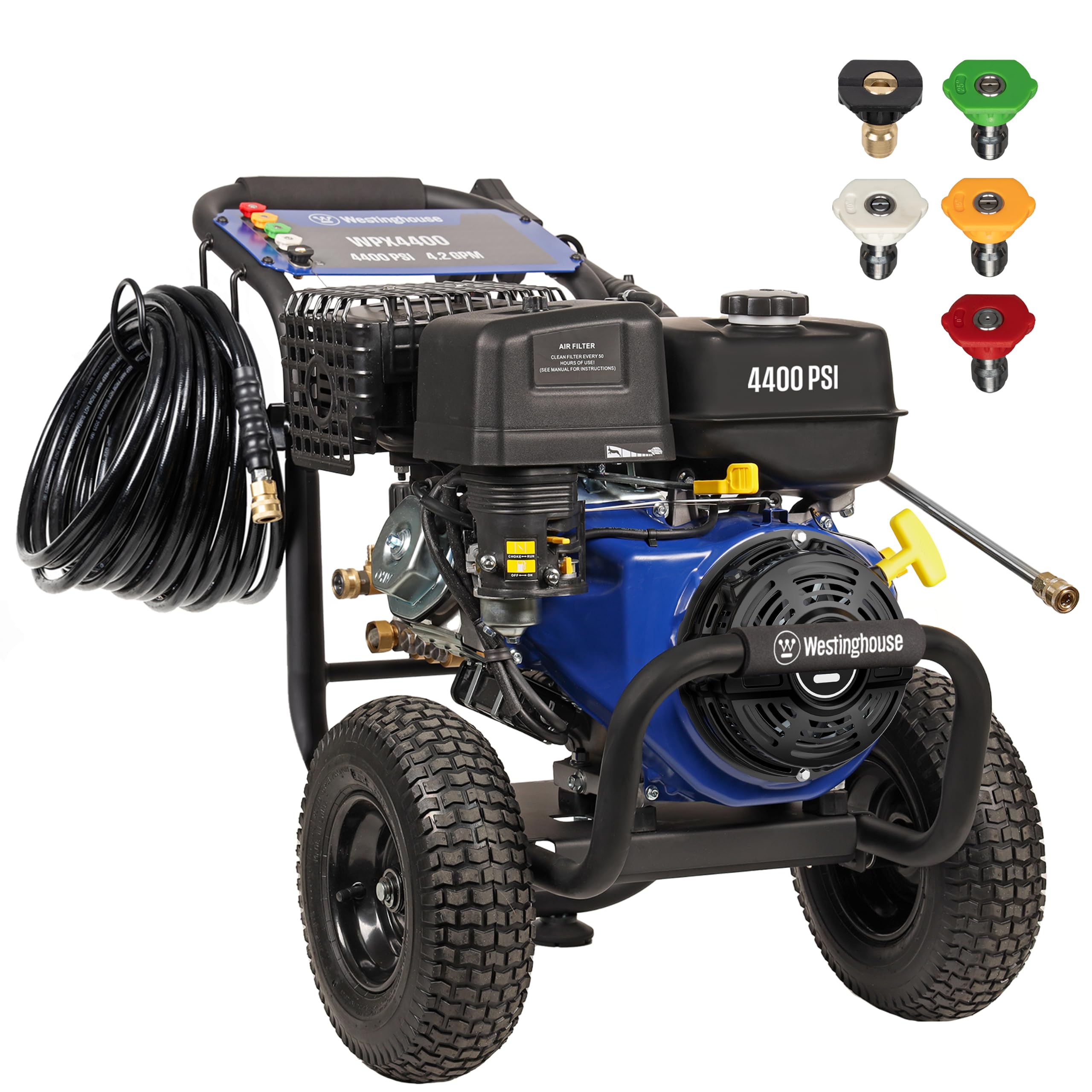
The Westinghouse WPX4400 delivers the highest flow rate in this list at 4.2 GPM combined with 4,400 PSI — producing over 18,480 Cleaning Units. That makes it faster at cleaning large surfaces than any other machine here. The 420cc Westinghouse OHV engine is paired with a commercial-grade triplex brass head pump, and the belt-drive configuration runs the pump at reduced RPM for longer seal life.
The 50-foot abrasion-resistant Super-Flex hose is noticeably more flexible than the stiff hoses on the SIMPSON units, and the 12-inch pneumatic tires make this 142-pound machine easier to maneuver than its weight suggests. The 1.7-gallon fuel tank provides decent run time, and the three-year limited warranty on parts, service, and labor is generous for this price tier.
Customer experiences are mixed on reliability: while many owners report flawless performance over months of regular use, there are reports of defective units requiring replacement — particularly wheel assembly issues and engines that shut off intermittently. The QC seems less consistent than Honda-powered units, but when the machine works, it works exceptionally well.
Why it’s great
- Highest cleaning units in the review — cleans faster than anything else here
- Flexible 50-foot hose improves reach and reduces operator fatigue
- Three-year warranty covers service, labor, and parts
Good to know
- Quality control is inconsistent — inspect thoroughly and test immediately
- Heavy at 142 lbs — not ideal for frequent loading into trucks
- No trigger holder on the spray wand, which is annoying during pauses
3. Kärcher G 3600 P

Kärcher brings its reputation for German engineering to the gas-powered market with the G 3600 P, which pairs a 5.9 HP 212cc engine with a professional-grade triplex/crankshaft pump. At 3,600 PSI and 2.6 GPM, it produces 9,360 Cleaning Units — not the highest in this review, but the real value here is in the pump’s construction. The crankshaft-driven triplex design is inherently more durable than axial pumps, and Kärcher’s oil seal technology minimizes maintenance between services.
The 35-foot hose is longer than average for this PSI range, which helps when working around large properties or multi-story homes. The included four quick-connect nozzles cover the essential spray angles, and the spray gun and wand feel solid in the hand. The machine weighs 64 lbs, making it one of the lighter gas-powered belt-drive options here.
Kärcher’s accessories ecosystem is a major advantage: the G 3600 P works seamlessly with their surface cleaners, extension wands, and undercarriage cleaners. The main downside is that the 2.6 GPM flow rate means slower cleaning on large horizontal surfaces compared to higher-GPM competitors like the WPX4400, but the reliability and parts availability make it a strong choice for consistent professional use.
Why it’s great
- Crankshaft-driven triplex pump is built for long service intervals
- Lightweight at 64 lbs — easy to transport and maneuver
- Full ecosystem of Kärcher accessories available with perfect fit
Good to know
- 2.6 GPM flow is lower than premium competitors — slower on big jobs
- Engine lacks the parts network of Honda GX series
- Only four nozzles included; some users want a turbo nozzle
4. Kärcher HD 5/17 CX Plus
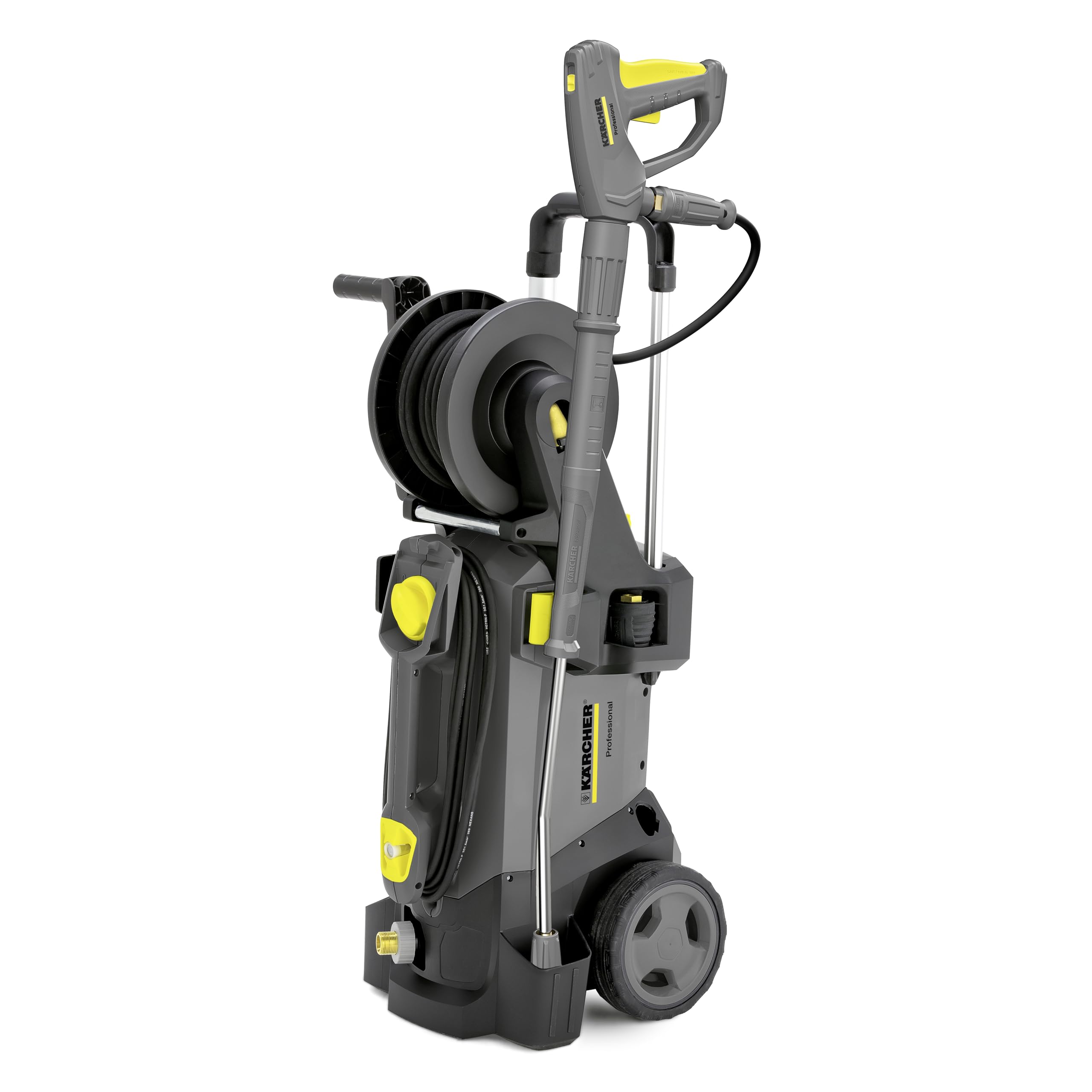
The Kärcher HD 5/17 CX Plus is an electric belt-drive machine designed for commercial applications where continuous operation is non-negotiable. The induction motor runs at lower RPM than typical electric motors, and the belt-drive isolates the pump from motor heat, allowing this unit to run for 7+ hours straight without thermal shutdown — something no consumer-grade electric washer can match. It delivers 1,740 PSI at 5.3 GPM, prioritizing flow over pressure for applications like fleet washing and building maintenance.
The construction is fully industrial: stainless steel manifold, ceramic pistons, and a heavy-duty frame that can handle daily abuse. Maintenance is straightforward with easily accessible oil fill and drain points. The 5/17 CX Plus is compatible with all Kärcher professional accessories, including surface cleaners, foam nozzles, and extension wands.
European users consistently report 7+ year service lives with regular use in professional cleaning businesses. The investment is substantial, but the total cost of ownership over a decade is lower than replacing mid-tier washers every two years. The only caveat is that it requires a dedicated 15-amp circuit and is not portable in the same way as a gas-powered unit — it’s designed to live in a workshop or commercial cleaning bay.
Why it’s great
- Runs 7+ hours continuously without overheating — real commercial endurance
- Induction motor is virtually maintenance-free compared to brushed motors
- Proven 7+ year service life in professional cleaning operations
Good to know
- Requires a dedicated 15-amp circuit — not plug-and-play everywhere
- Low pressure (1,740 PSI) — not suitable for paint stripping or heavy grime
- Very heavy at 62 lbs — not designed for frequent transport
5. SIMPSON PS3228
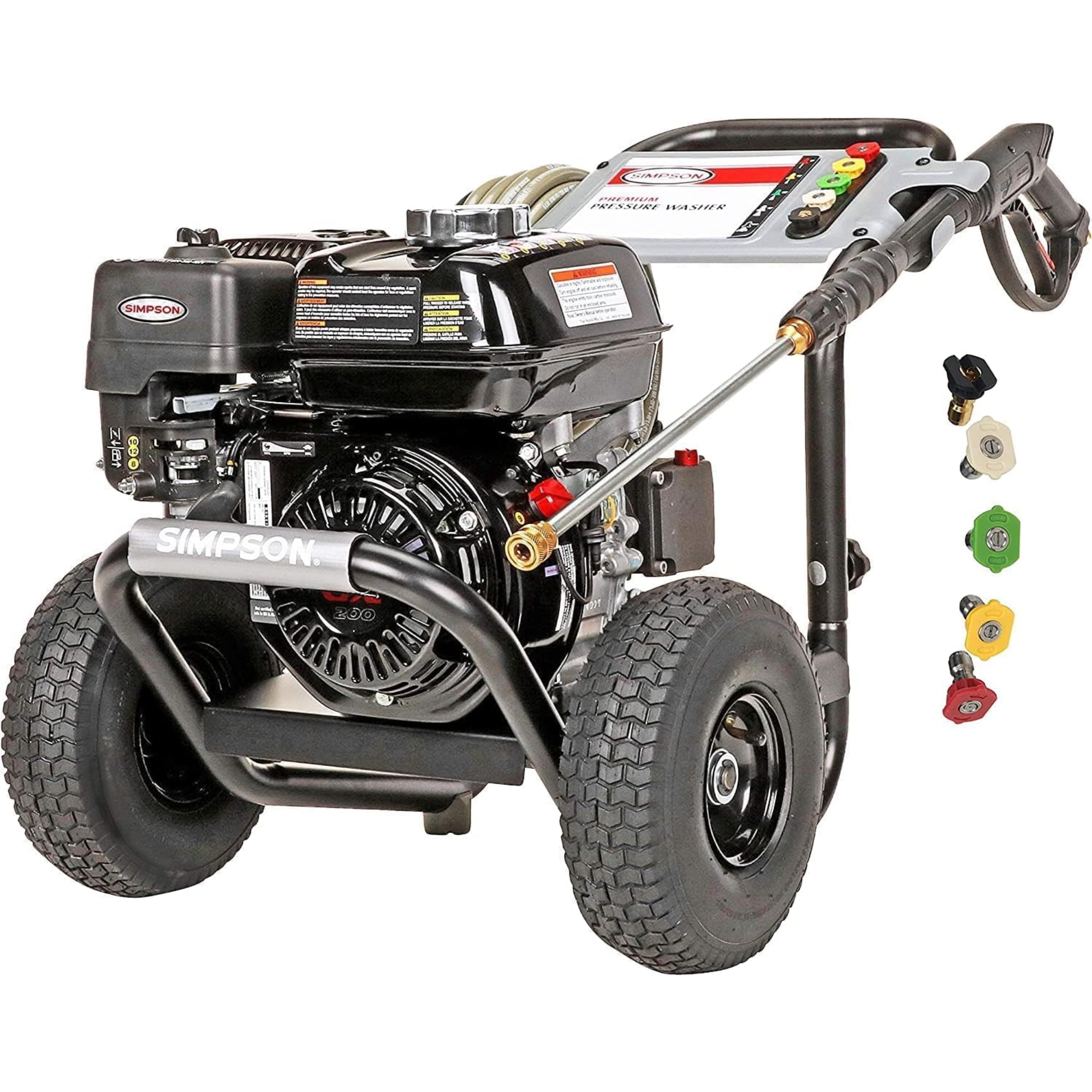
The SIMPSON PS3228 is the entry point into genuine prosumer belt-drive territory. The Honda GX200 engine is a smaller displacement than the GX390, but it still starts on the first pull and has the same legendary parts availability. Paired with an AAA triplex plunger pump producing 3,300 PSI at 2.5 GPM (8,250 CU), this machine is perfect for homeowners who want professional durability without commercial-level flow rates.
The welded steel frame with powder-coated finish holds up well against corrosion, and the 10-inch pneumatic tires roll easily over uneven ground. The 25-foot MorFlex hose is kink-resistant and non-marring, though it’s shorter than the premium units. The five quick-connect tips cover every spray angle, and the rear-load gun is comfortable for extended use.
The main compromises are the handle height — tall users find it too low for comfortable operation — and the wand holder, which is poorly designed and doesn’t secure the wand properly when the hose is attached. The engine mounting nuts also tend to loosen during the first few uses and need to be re-tightened. These are minor ergonomic issues on an otherwise well-engineered machine.
Why it’s great
- Honda GX200 engine is the most reliable small engine available for this price bracket
- AAA triplex pump provides commercial-grade pump durability
- Easy to maintain with readily available replacement parts
Good to know
- Handle is too low for users over 6 feet tall
- Wand holder is non-functional with the hose connected
- 25-foot hose is short — may require moving the unit frequently
6. Tecoloy PM Inverter
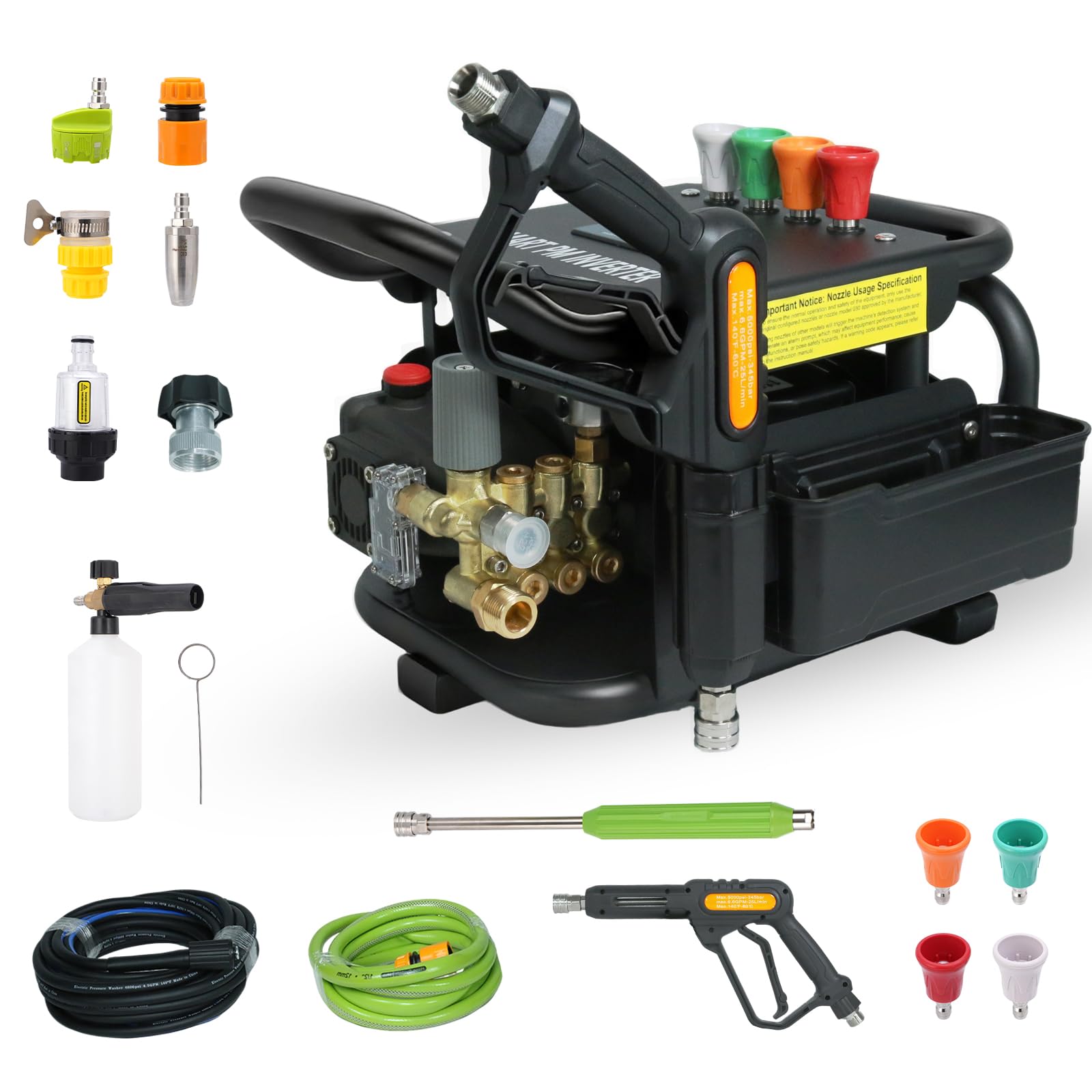
The Tecoloy PM Inverter is an electric pressure washer that brings belt-drive-like durability to a quieter form factor. The permanent magnet motor with inverter technology operates at 65 dB — quiet enough for early morning residential cleaning without disturbing neighbors. The horizontal triplex pump with ceramic plungers from Japan is rated for 500+ service hours, far exceeding typical axial cam pumps found on direct-drive electric washers.
Delivering 1,450 PSI at 2.3 GPM (3,335 CU), this isn’t a machine for concrete stripping or heavy industrial cleaning. But for residential tasks — cars, patio furniture, fences, decks, and driveways — it provides more than enough pressure with a flow rate that speeds up rinsing. The 47-foot hose and 40-foot cord give exceptional reach, and the wall-mountable design with smart LED display is a space-saver for garage installations.
The self-priming system draws water from buckets when a hose connection isn’t available, adding flexibility for apartment dwellers or jobsites without spigots. However, some users report electrical connection failures when the unit gets wet — a concern for any pressure washer, but worth noting here given the control panel’s position. The one-year warranty on motor and pump is short compared to premium gas units.
Why it’s great
- 65 dB noise level allows cleaning any time without disturbing neighbors
- Horizontal triplex pump with ceramic plungers for long life
- Self-priming capability draws water from buckets
Good to know
- 1,450 PSI is not enough for paint stripping or heavy concrete work
- Some reports of electrical components failing if unit gets wet
- Only 1-year warranty — short for a machine in this price range
7. Giraffe Tools Crossfalls Retractable
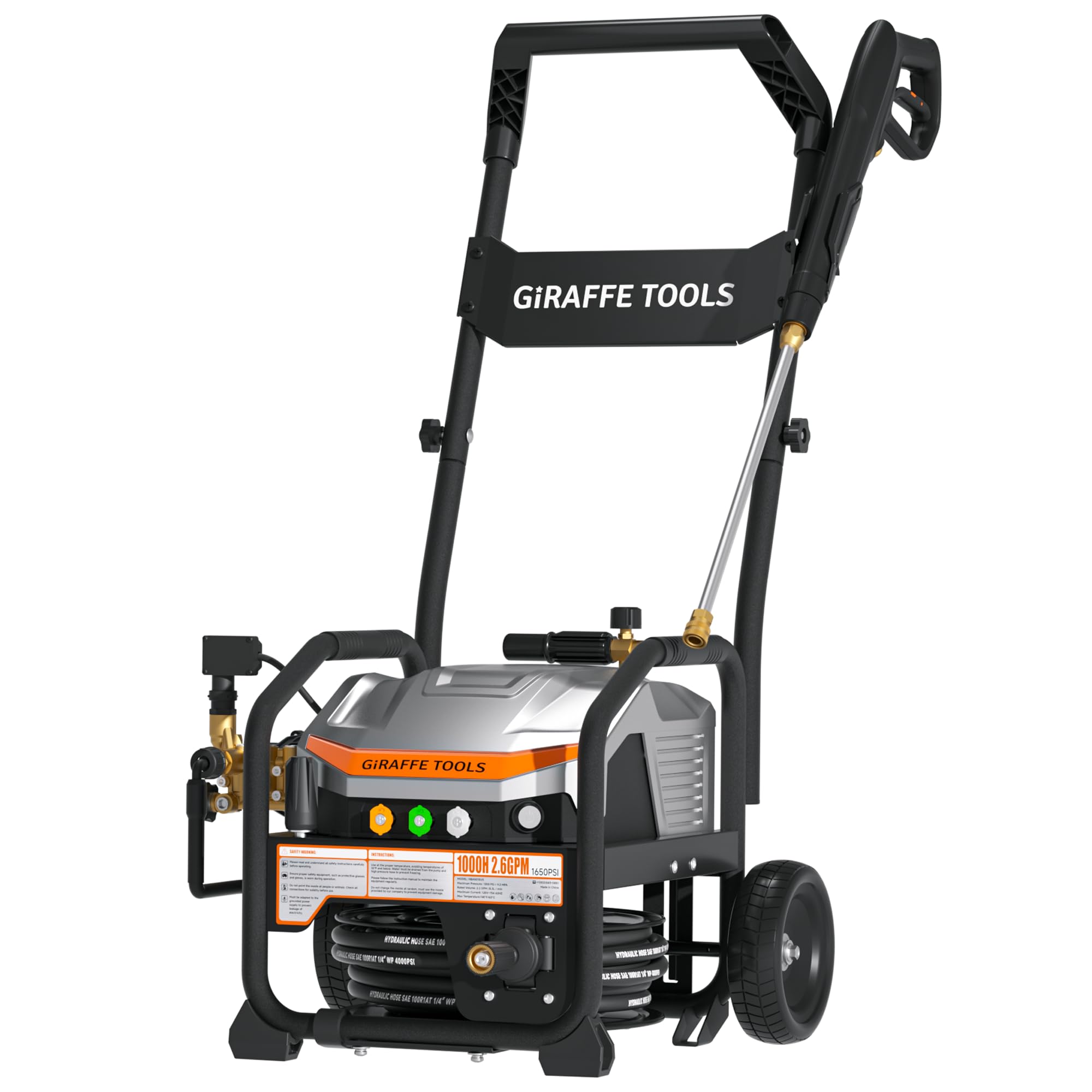
The Giraffe Tools Crossfalls Retractable is an innovative design that combines an electric belt-drive pressure washer with an auto-retractable hose system. The all-copper pump core resists heat and corrosion better than aluminum-alloy pumps, and the brushless motor is rated for 2.6 GPM at up to 4,000 PSI — though in practice, the sustained output is closer to 1,650 PSI at that flow rate. The real differentiator is the 60 dB noise level, making it one of the quietest commercial-grade electric washers available.
The 3-in-1 versatility — wall mount, trolley cart, or freestanding — is genuinely useful for businesses that need to reconfigure their cleaning setup regularly. The auto-retractable 50-foot hose eliminates the frustration of manual coiling and saves significant time during multi-job days. The 98-pound weight is substantial, but the integrated trolley wheels make it manageable for one person.
Long-term reliability is the main question mark. Some users report hose-end failures after a year of use, and while the copper pump is durable, the overall build quality doesn’t feel as robust as the SIMPSON or Kärcher options. The warranty and customer service experience appears to be mixed based on user reports.
Why it’s great
- Auto-retractable hose eliminates coiling time and tangling
- 3-in-1 mounting system works for wall, cart, or freestanding use
- Very quiet at 60 dB — suitable for noise-sensitive environments
Good to know
- Long-term reliability is unproven — some hose failures reported after 1 year
- Advertised PSI is misleading; sustained output is much lower
- Heavy unit at 98 lbs despite the trolley wheels
8. Canpump CE 3650 S
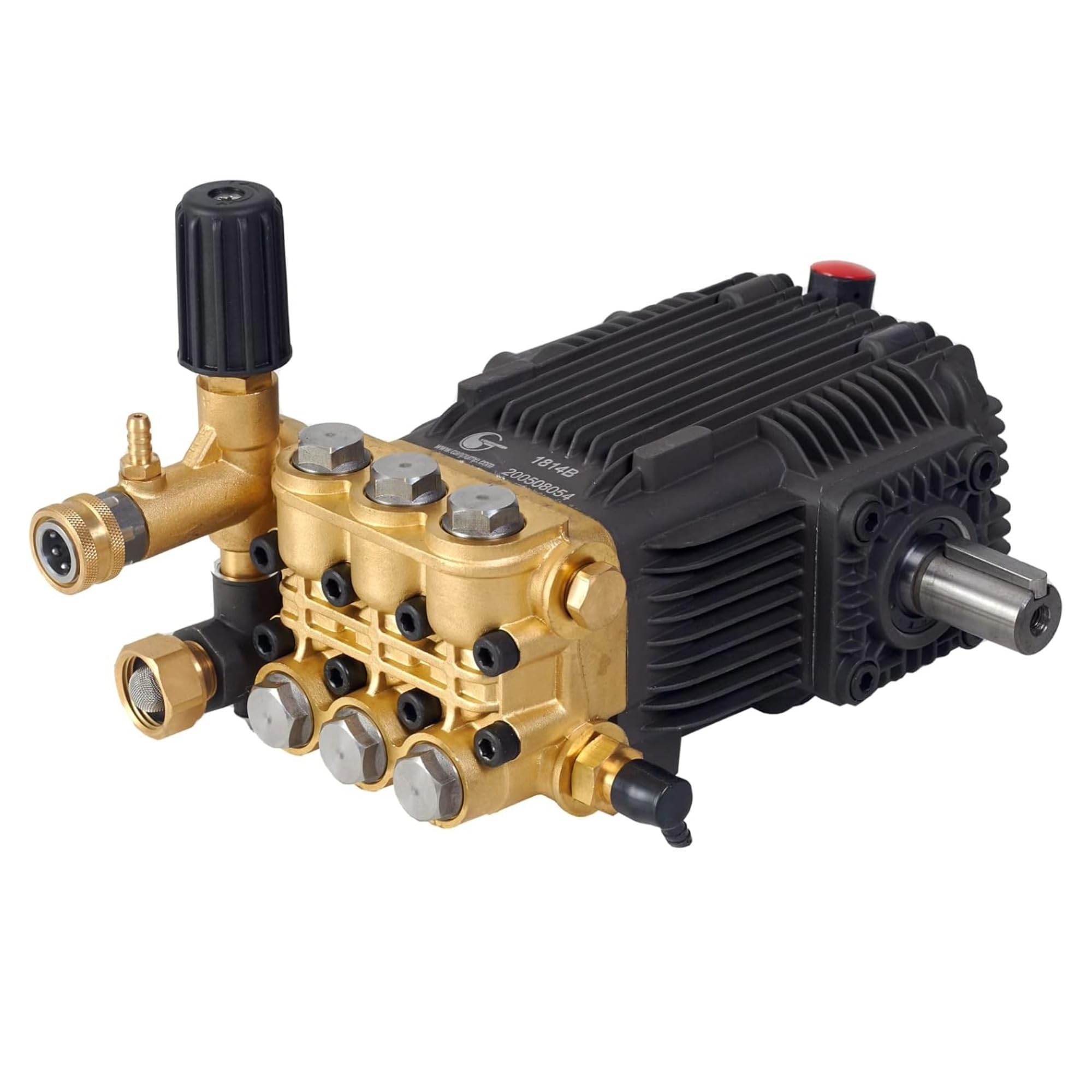
The Canpump CE 3650 S is a replacement pump, not a complete pressure washer — but it deserves inclusion here because it’s one of the most popular belt-drive triplex pumps for rebuilding existing machines. With a 24 mm solid shaft, forged brass manifold, anodized aluminum crankcase, ceramic-coated stainless steel plungers, and German-made seals, this pump is built to outlast the engine driving it. It delivers up to 3,600 PSI at 5.0 GPM on a 10 HP belt-drive system.
The external unloader with built-in detergent injector and water filter makes pressure adjustment and maintenance straightforward, and the integrated sight glass eliminates the need for a dipstick — a small but appreciated convenience. The pump ships prefilled with SAE 15W-40 oil, so it’s ready to bolt onto a compatible shaft and run after checking the rotation direction.
Users who run this pump in commercial car washes and agricultural settings consistently report excellent durability, with one user noting it outlasted their previous commercial unit at half the price. The price point is exceptional for a pump of this spec range, making it a go-to option for anyone looking to convert a direct-drive machine to belt-drive or replace a worn belt-drive pump.
Why it’s great
- Forged brass manifold and ceramic plungers for extreme wear resistance
- External unloader with detergent injector simplifies maintenance
- Excellent value for a pump running 5.0 GPM on belt drive
Good to know
- Pump only — requires a compatible 10 HP belt-drive engine or motor
- Not a standalone pressure washer; installation requires mechanical skill
- Max inlet temperature of 122°F — cannot use with hot water
9. Westinghouse WPX3400e
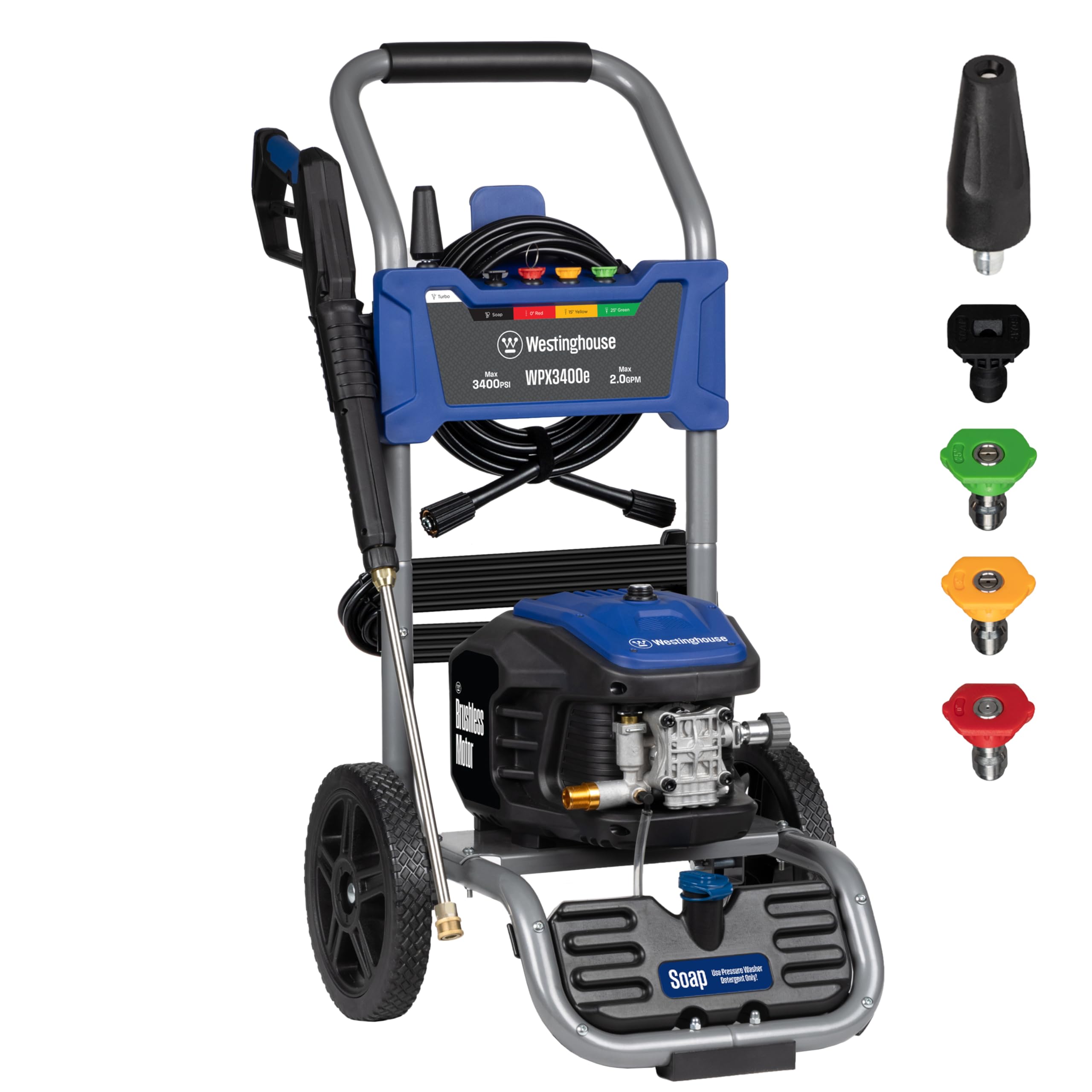
The Westinghouse WPX3400e is an electric pressure washer that uses a true brushless motor coupled with an axial 3-piston auto-stop pump. While not a traditional belt-drive in the mechanical sense, it delivers the kind of low-maintenance, long-life performance that belt-drive buyers value — the brushless motor eliminates brush replacement, and the auto-stop pump reduces wear when the trigger is released. It produces 3,400 max PSI at 2.0 GPM (6,800 CU) at lowest pressure, with a rated output of 3,000 PSI at 1.1 GPM.
The rugged steel frame with 10-inch never-flat wheels handles stairs and patio transitions well, and the 35-foot GFCI cord provides good reach without an extension cord. The 25-foot abrasion-resistant hose is high quality, and the five quick-connect nozzles cover the full spray spectrum. Assembly takes about 15 minutes with clear instructions.
Owners consistently praise the machine for its power-to-quiet ratio — it’s significantly quieter than gas units while providing enough force for driveway cleaning, siding work, and patio furniture. The three-year warranty is strong for an electric model. The only real limitation is the 2.0 GPM max flow, which means slower cleaning on large horizontal surfaces compared to higher-GPM units.
Why it’s great
- Brushless motor eliminates brush replacement and extends motor life
- Very quiet operation compared to any gas-powered belt-drive unit
- 3-year warranty provides peace of mind for an electric machine
Good to know
- 2.0 GPM flow rate is lower than premium gas belt-drive units
- Axial pump is not as durable as a triplex plunger pump for heavy use
- Not suitable for continuous commercial cleaning — designed for residential use
10. IvyBess 4200 PSI Gas
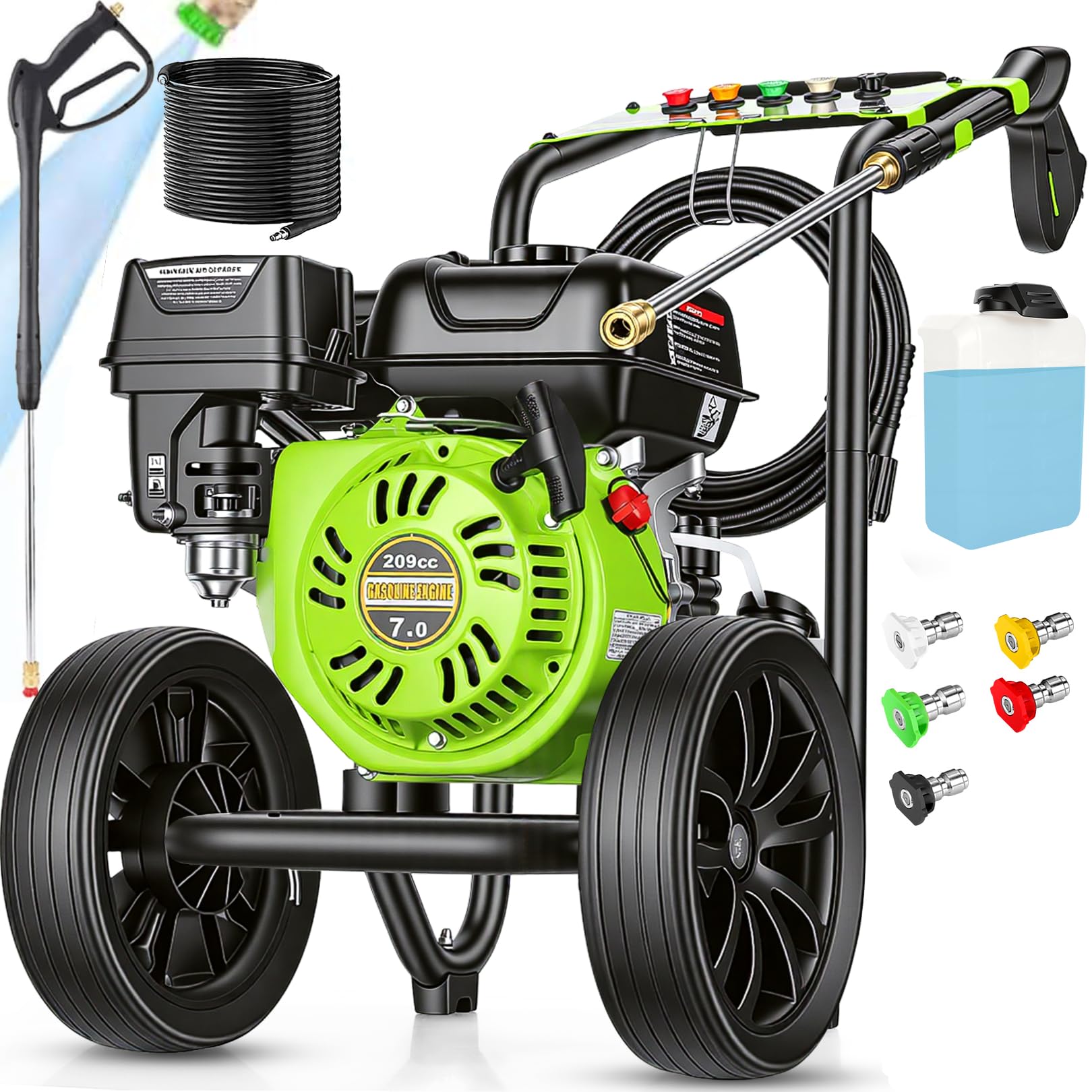
The IvyBess 4200 PSI Gas pressure washer offers a 209cc 4-stroke engine with a rated 4.0 GPM output on paper, making it one of the most affordable entry points into high-flow gas belt-drive territory. The steel frame with never-flat tires is basic but functional, and the 25-foot high-pressure steel-braided hose is kink-resistant and non-marring. The five quick-connect nozzles plus a soap nozzle give good task flexibility.
Real-world performance is decent for the price point — owners report it handles driveway cleaning and siding work well. The engine starts reliably after initial setup, and the unit is lighter than premium models at 66 lbs. The 1.5-liter detergent tank is smaller than some competitors but includes an adjustable switch for soap-to-water ratio control.
There are notable compromises: the included soap dispenser hose must be purchased separately if missing from the box, and some units arrive with minor issues like loose fittings. The axial cam pump is not a triplex plunger, so it won’t last as long under heavy use as a belt-driven triplex. This machine is best for budget-conscious homeowners who need a high-PSI gas machine for occasional use and understand it’s not built for daily professional duty.
Why it’s great
- Very affordable entry point for a gas-powered pressure washer
- Lightweight at 66 lbs compared to pro belt-drive units
- EPA/CARB/ETL certified for 50-state compliance
Good to know
- Axial cam pump is less durable than a belt-driven triplex plunger pump
- Some units arrive with missing parts or minor defects
- Smaller detergent tank at 1.5 liters — requires more refills
11. Generac 8888

The Generac 8888 is a residential electric pressure washer designed for light-duty tasks around the home. Its brushless electric motor and 2,700 PSI at 1.2 GPM output (3,240 CU) make it suitable for washing cars, patio furniture, siding, and fences — but it lacks the pump isolation and triplex construction that define belt-drive machines. The auto-stop switch shuts off the pump when the trigger isn’t engaged, extending pump life, and the 1-gallon onboard detergent tank is convenient for soap application.
The 25-foot non-marring hose is kink-resistant, and the large wheels make rolling across grass or gravel manageable. The maintenance-free pump requires no oil changes, which appeals to homeowners who want a simple, no-maintenance cleaning tool. Assembly is straightforward with the included manual.
The main concern with the Generac 8888 is reliability: several users report pump failure or power loss after just a few uses. The 1.2 GPM flow rate is low even by electric standards, making cleaning large surfaces slow. This machine is best understood as a budget-friendly entry-level option for small home tasks, not a long-term investment for serious cleaning work.
Why it’s great
- Auto-stop switch saves energy and reduces pump wear
- Brushless motor is quieter and lower maintenance than brushed alternatives
- One-gallon onboard detergent tank is generous for an electric unit
Good to know
- 1.2 GPM flow rate makes cleaning large surfaces painstakingly slow
- Reliability is inconsistent — multiple reports of early pump failure
- Not a true belt-drive machine; axial pump is less durable
FAQ
Can I convert a direct-drive pressure washer to belt drive?
What belt length and pulley size do I need for a belt-drive setup?
How often should I change the oil in a belt-drive pressure washer pump?
Is a belt-drive pressure washer worth the extra cost for home use?
What’s the difference between an axial cam pump and a triplex plunger pump?
Final Thoughts: The Verdict
For most users, the best belt drive pressure washer winner is the SIMPSON ALH4240 because it combines the most reliable engine (Honda GX390) with a CAT triplex pump, high 4.0 GPM flow, and strong warranty coverage in a corrosion-resistant aluminum frame. If you want the highest possible cleaning speed for large commercial jobs, grab the Westinghouse WPX4400 with its 4.2 GPM flow and generous 3-year warranty. And for a rebuild-and-replace pump solution that opens up belt-drive upgrades for existing machines, nothing beats the value of the Canpump CE 3650 S.