
Our readers keep the lights on and the weekend projects moving. As an Amazon Associate, I earn from qualifying purchases.
That faint hum you hear between songs isn’t on the record — it’s your turntable’s motor vibrating through the platter. Budget decks often transfer motor noise straight into the stylus, robbing your vinyl of its quiet background and dynamic slam. A well-engineered belt-drive system decouples the motor from the platter using an elastic belt, which absorbs the motor’s pulse before it reaches the record groove. That isolation is the mechanical secret behind the genre’s signature warm, black-silence floor and why serious listeners choose belt-drive over direct-drive for home hi-fi.
I’m Rikta — the co-founder and writer behind FitlyFast. My approach to this guide involved cross-referencing motor specs, tonearm geometry, and cartridge compliance across nine distinct turntable designs, then mapping those technical decisions to the real-world listening experience. I analyzed customer feedback on vibrations, platter stability, and speed consistency to build a trustworthy ranking.
Whether you’re digitizing a family record collection or chasing the last ounce of clarity from a 180-gram pressing, finding the right belt drive turntable determines whether your system delivers rich, silent playback or a noisy compromise you’ll want to upgrade in twelve months.
How To Choose The Best Belt Drive Turntable
Belt-drive turntables vary from all-in-one suitcase players with plastic tonearms to precision instruments with carbon-fiber arms and isolated motors. Before you buy, focus on the four specs that determine whether your records will sound clean or compromised.
Adjustable Counterweight & Anti-Skate
A fixed-weight tonearm applies a single force to every record regardless of groove condition. An adjustable counterweight lets you dial the tracking force to match your cartridge’s recommended range (typically 1.5 to 2.0 grams for a moving magnet). Anti-skate applies an opposite force to prevent the tonearm from pulling toward the center of the record. Without both, you risk excessive record wear, inner-groove distortion, and stylus skipping on loud passages.
Cartridge Quality & Upgrade Path
The cartridge is the transducer that converts groove vibrations into electrical signals. Budget decks often use a ceramic cartridge with a conical stylus that sounds dull and tracks poorly. A moving magnet cartridge, such as the Audio-Technica AT-VM95E, provides a standard half-inch mount that can be upgraded later with a better stylus (microline, Shibata, or nude elliptical) without replacing the entire cartridge. A removable headshell makes this swap even easier.
Built-In Phono Preamp
Turntables output a very low signal that requires RIAA equalization before it can enter a standard aux input. A built-in switchable phono preamp lets you connect directly to powered speakers or a receiver’s line input. If you already own a dedicated phono stage, you can switch the preamp off. Missing this feature means you must buy an external phono preamp separately for the turntable to produce any audible sound at all.
Speed Stability & Platter Mass
Belt-drive motors are inherently quieter than direct-drive, but not all motors deliver consistent rotational speed. A low-cost DC motor without feedback control can drift over time, causing audible pitch fluctuations. A servo-controlled motor with an optical speed sensor holds 33-1/3 and 45 RPM with high accuracy. A heavier platter, ideally die-cast aluminum, acts as a flywheel that resists speed variations and absorbs motor-induced vibrations before they reach the record.
Quick Comparison
On smaller screens, swipe sideways to see the full table.
| Model | Category | Best For | Key Spec | Amazon |
|---|---|---|---|---|
| Pro-Ject Debut EVO 2 | Premium | Audiophile listening | 1.7 kg TPE-damped aluminum platter | Amazon |
| Technics SL-100C | Premium | Upgrade-friendly heirloom | Aluminum S-shape tonearm, 6mm VTA | Amazon |
| Pro-Ject Debut Carbon EVO | Premium | Class-leading clarity | Carbon fiber tonearm, 68dB S/N | Amazon |
| YAMAHA TT-S303 | Mid-Range | Hi-fi system component | 67dB S/N, built-in phono preamp | Amazon |
| Audio-Technica AT-LPW40WN | Mid-Range | Rich warm sound | Carbon-fiber tonearm, anti-resonance platter | Amazon |
| Audio-Technica AT-LP70X | Mid-Range | Fully automatic ease | J-shaped tonearm, integrated AT-VM95C | Amazon |
| Crosley C100A-SI | Mid-Range | Entry-level analog control | Aluminum tonearm, adjustable pitch control | Amazon |
| DIGITNOW M485 | Budget | Digitizing vinyl records | AT3600L cartridge, USB digital output | Amazon |
| FEKTIK M508 | Budget | All-in-one convenience | 10-in-1: CD, cassette, FM radio | Amazon |
In‑Depth Reviews
1. Pro-Ject Debut EVO 2
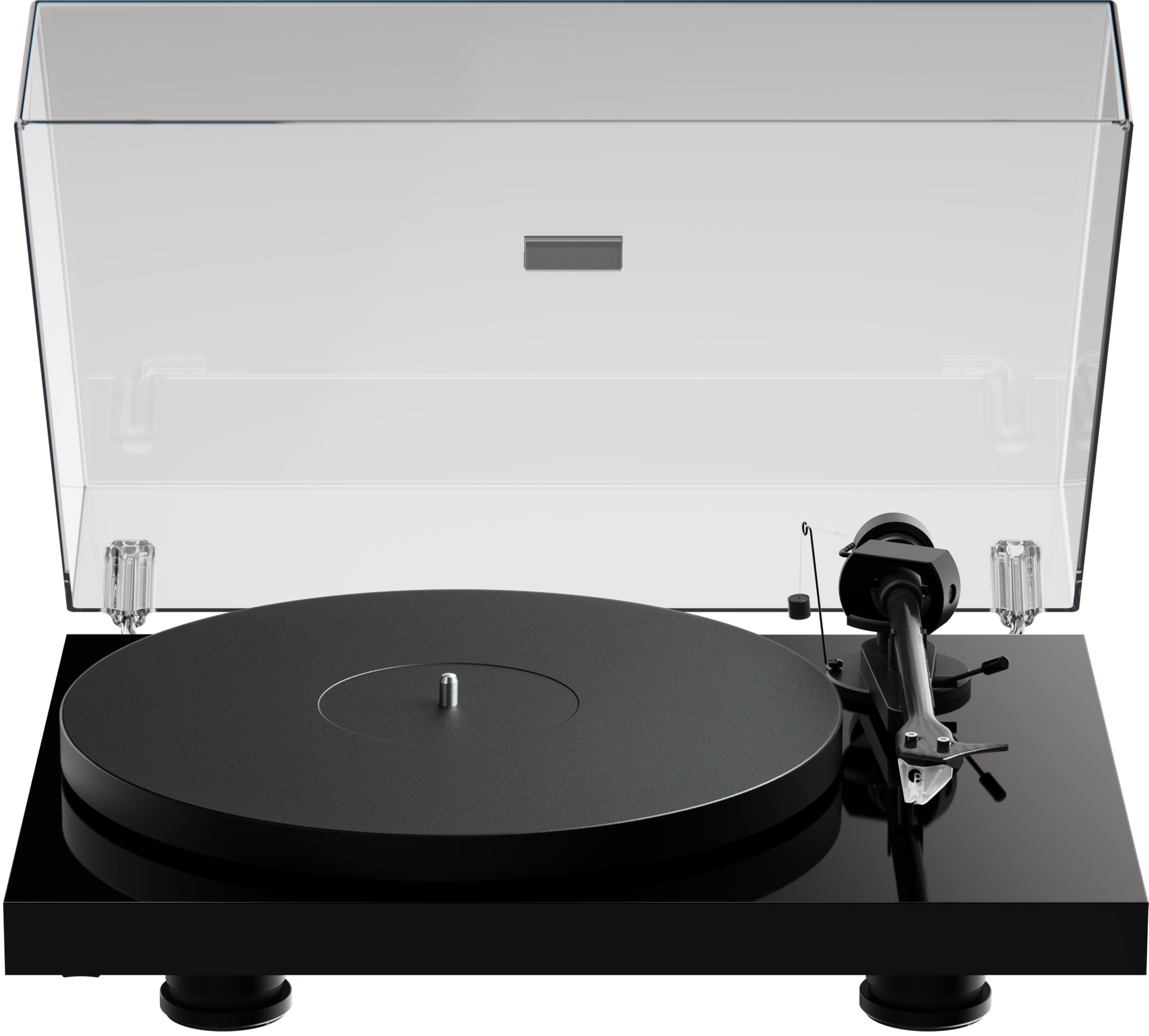
The Pro-Ject Debut EVO 2 takes everything audiophiles loved about the Carbon EVO and refines it further. The standout upgrade is the 1.7 kg anti-magnetic die-cast aluminum platter with integrated TPE damping, which acts as a low-pass filter for motor vibrations, giving you a noise floor so quiet you’ll hear the mastering engineer’s breath between tracks. The included Pick it MM EVO cartridge tracks with noticeably better clarity and instrument separation than the previous Sumiko Rainier, which reviewers consistently describe as a genuine step up.
The carbon-fiber tonearm is a genuine carbon-fiber wrap, not a painted tube, which keeps effective mass low (6g) and resonance virtually nonexistent. The anti-skate weight system is adjustable, though careful users note the weight can detach if bumped during cleaning. Setup takes about 30 minutes for a first-timer, with the tonearm balancing being the only finicky step. The motor is speed-sensor controlled, so you will not need the stylus strobe that budget decks rely on.
True Balanced Ready means you can later convert to a fully balanced signal path from cartridge to preamp, a feature usually seen in turntables costing twice as much. Owners upgrading from a Fluance RT85 or the previous Debut Carbon report a clear improvement in soundstage depth and transient attack. If your budget stretches this far, the EVO 2 is the most future-proof belt-drive turntable under four figures.
Why it’s great
- 1.7 kg TPE-damped aluminum platter eliminates motor noise
- Pick it MM EVO cartridge provides exceptional clarity and dynamics
- True Balanced Ready for future upgrades
Good to know
- Anti-skate weight can detach if bumped
- No built-in phono preamp (requires external phono stage)
2. Technics SL-100C

Technics brings its legendary direct-drive heritage into the belt-drive world with the SL-100C, a turntable that feels every bit as robust as the SL-1200 series. The coreless brushless DC motor is servo-controlled for steady rotation, and the belt-drive configuration ensures zero cogging noise, giving you a neutral, detailed sound that reveals information you never noticed on lesser decks. The aluminum S-shape tonearm is adjustable for vertical tracking angle within a 6mm range, which matters when you swap cartridges with different body heights.
The pre-installed Audio-Technica AT-VM95C cartridge is competent but clearly the weak link in the chain. Owners uniformly recommend upgrading to the AT-VM95SH or VM95ML stylus to unlock the turntable’s true potential. The Auto Lifter raises the tonearm at the end of the record without using any motor power, so there’s zero electrical interference. Some users note the auto-lift takes up to 60 seconds and can engage early on some records, but the feature is easily disabled if you prefer manual operation.
At roughly 22 pounds, the SL-100C is the heaviest turntable in this guide, and that mass provides outstanding footfall isolation. The build quality is heirloom-grade, with a metal chassis and damped plinth that rejects vibrations. This deck is for buyers who want one turntable for the next 20 years and plan to experiment with multiple cartridges over that lifetime.
Why it’s great
- Heavy, rigid construction eliminates vibration interference
- Adjustable VTA for cartridge-swapping flexibility
- Auto-lifter protects records and stylus without motor noise
Good to know
- Stock AT-VM95C cartridge benefits from stylus upgrade
- Auto-lift can engage slightly early on some records
3. Pro-Ject Debut Carbon EVO

The Debut Carbon EVO has been the benchmark mid-range belt-drive turntable for years, and for good reason. The one-piece carbon-fiber tonearm eliminates the resonance problems inherent in aluminum or alloy arms, delivering a cleaner midrange and more precise stereo imaging. The included Sumiko Rainier cartridge uses an elliptical stylus that tracks high-frequency detail without the harshness typical of budget conical needles. Owners consistently remark on the low noise floor — the 68dB signal-to-noise ratio means you hear only the record, not the table.
The motor is completely decoupled from the plinth via a separate motor suspension unit, which is rare at this price level. Reviewers who upgraded from a basic Crosley or an older direct-drive report a night-and-day improvement in background silence. The 33/45 speed change is electronic, and you must lift the platter to swap the belt position, which is slightly less convenient than a speed switch but ensures the belt tracks correctly. The three adjustable feet make leveling easy even on uneven surfaces.
Setup requires installing the counterweight, balancing the tonearm, and setting anti-skate — a process that takes about 20 minutes the first time. Some early-production units had overly tight dust cover hinges that could damage the plinth, though Pro-Ject has addressed this. For the price, no other turntable delivers this combination of tonearm rigidity, motor isolation, and cartridge quality.
Why it’s great
- Carbon fiber tonearm eliminates resonance and improves imaging
- Isolated motor suspension delivers a very low noise floor
- Sumiko Rainier elliptical stylus provides excellent detail retrieval
Good to know
- Speed changes require manually moving the belt
- Early units had tight dust cover hinges; check revision
4. YAMAHA TT-S303
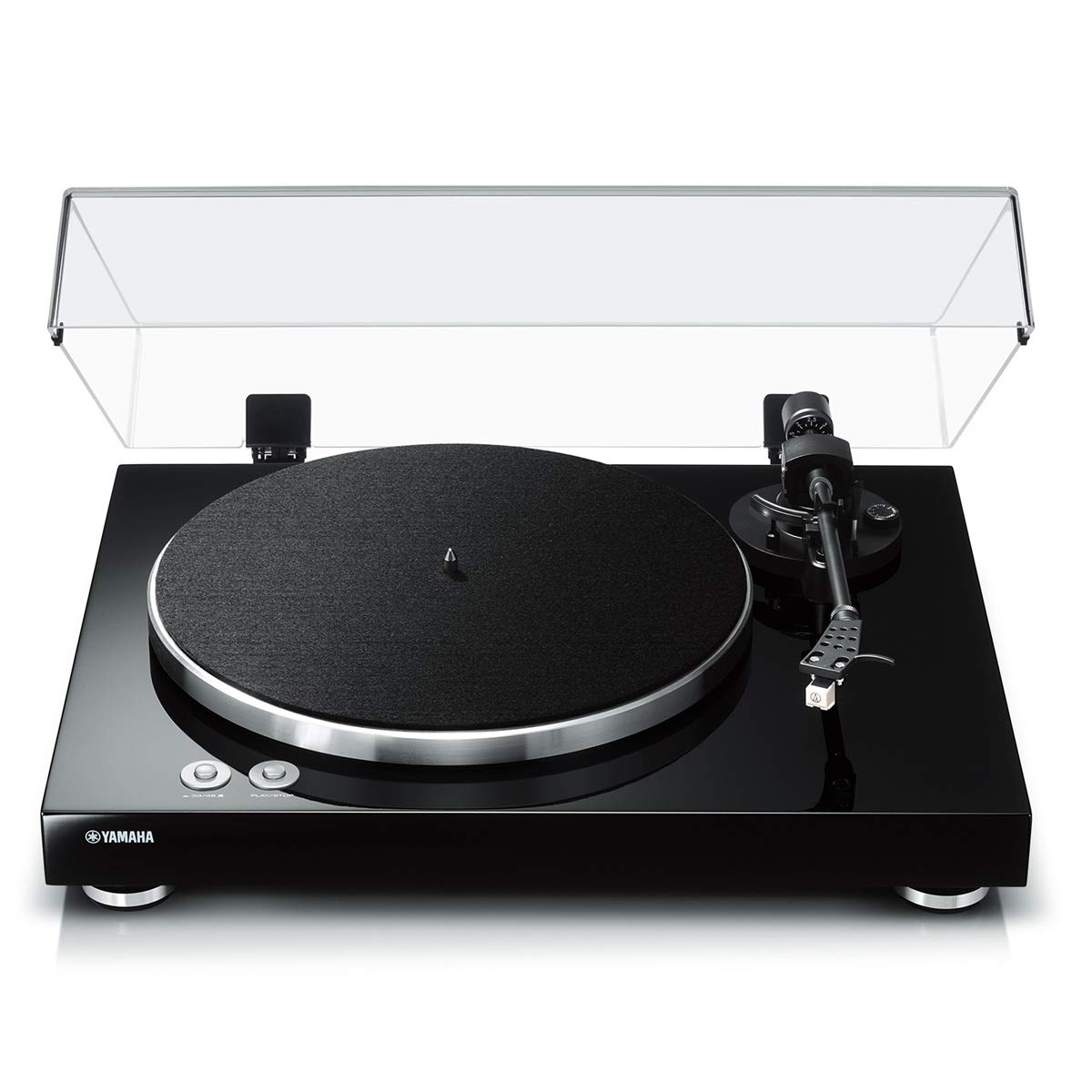
Yamaha’s TT-S303 is designed to integrate seamlessly into a modern hi-fi system. The built-in phono preamp is switchable, so you can output line-level to a standard aux input or phono-level to a dedicated stage. The DC motor drives a high-inertia platter through a ground belt, and the heavy cabinet uses a large internal loss structure to absorb vibrations. The signal-to-noise ratio is rated at 67dB, which is competitive for the price and ensures you hear only the record surface noise, not motor hum.
The static-balanced straight tonearm is a departure from the S-shape or J-shape designs common in this category, and it tracks accurately when correctly balanced. Some owners report the stock cartridge is the weakest link, recommending an upgrade to an Ortofon Red to unlock the turntable’s true potential. The anti-skating dial is vague, lacking detents, so you will need a scale to set it precisely. Speed adjustment is done via a recessed screw on the underside, which requires trial and error if the turntable runs fast out of the box.
The Piano Black finish is elegant and fingerprint-prone, but it looks stunning in a dedicated audio rack. An important omission is the lack of auto-stop or auto-return — you must manually lift the tonearm at the end of the record. For buyers with a Yamaha receiver who want a matching aesthetic and a reliable turntable that sounds spacious and detailed, the TT-S303 is a strong contender.
Why it’s great
- Switchable built-in phono preamp for flexible system integration
- Rigid cabinet with high internal loss suppresses vibrations effectively
- High-inertia platter combined with DC motor provides stable rotation
Good to know
- No auto-stop or auto-return function
- Anti-skate control lacks detents; needs a scale for accuracy
5. Audio-Technica AT-LPW40WN

Audio-Technica’s AT-LPW40WN brings genuine high-end features to a price point that serious listeners can stomach. The speed-sensor system constantly monitors the DC motor’s rotational speed and corrects drift instantly, so your records always play at the correct pitch. The carbon-fiber tonearm is the same design used in AT’s more expensive models, offering high rigidity with low mass for precise tracking. The professional anti-resonance die-cast aluminum platter with rubber mat sits on a heavy MDF plinth wrapped in a walnut wood veneer.
The built-in phono preamp is switchable, letting you bypass it if you have a better external stage. The VM95E cartridge is a moving magnet design with an elliptical stylus that tracks well and sounds balanced, with a slight warmth that flatters older, worn records. Owners upgrading from lower-tier turntables report a significant improvement in detail retrieval and a much quieter background. The AT-LPW40WN is fully manual, so you must cue the tonearm yourself and lift it at the end of the side — purists prefer this.
The walnut finish is a thin wood veneer over MDF, not solid wood, but it looks rich and complements mid-century decor. The adjustable feet allow precise leveling, and the removable hinged dust cover fits snugly. If you’re between this and the cheaper AT-LP70X, the speed-sensor motor, heavier platter, and carbon-fiber arm make the jump worthwhile for anyone who takes vinyl seriously.
Why it’s great
- Speed-sensor motor maintains accurate rotation at 33-1/3 and 45 RPM
- Carbon-fiber tonearm provides rigidity without added mass
- Switchable built-in phono preamp for flexible output options
Good to know
- Fully manual operation with no auto-stop feature
- Wood veneer over MDF is attractive but not solid wood
6. Audio-Technica AT-LP70X

The AT-LP70X is Audio-Technica’s latest automatic belt-drive turntable, replacing the long-running AT-LP60X with genuine improvements. The J-shaped tonearm is engineered to minimize tracking errors, a design borrowed from AT’s higher-end models, and it comes pre-fitted with the AT-VM95C conical stylus. The cartridge is compatible with the entire VM95 series, so you can upgrade to an elliptical or microline stylus later without replacing the whole cartridge — a huge advantage over fixed-cartridge decks.
Operation is fully automatic: one button starts the platter and cues the tonearm at the outer groove, and auto-stop lifts the tonearm when the record finishes. This convenience makes the LP70X ideal for casual listeners or those who want to relax on the couch without worrying about stylus damage. The built-in phono preamp is switchable, supporting both phono-level and line-level outputs. The three-piece chassis construction dampens resonance better than the LP60X’s all-plastic body.
Sound quality is very good for the price, with a clean midrange and decent treble extension. The conical stylus is not as detailed as an elliptical, but it tracks warped records well and produces less surface noise. Some users report that the automatic mechanism can be slightly clunky on the first few uses but settles in. If you want a worry-free, family-friendly turntable that still offers an upgrade path, the LP70X is an excellent choice.
Why it’s great
- Fully automatic operation for easy, worry-free playback
- J-shaped tonearm reduces tracking errors for cleaner sound
- AT-VM95C cartridge can be upgraded with better stylus profiles
Good to know
- Conical stylus lacks the fine detail of an elliptical tip
- Automatic mechanism can feel slightly clunky on initial uses
7. Crosley C100A-SI

The Crosley C100A-SI is an honest attempt by a legacy brand to build a proper entry-level audiophile turntable rather than a novelty all-in-one. The two-speed belt-drive system uses a synchronous AC motor with low vibration, and the aluminum strobe platter combined with adjustable pitch control lets you fine-tune the speed visually. The pre-mounted Audio-Technica moving magnet cartridge is a significant upgrade from Crosley’s usual ceramic offerings, producing a much fuller sound with acceptable detail retrieval.
The aluminum tonearm features a cueing lever, adjustable counterweight, and anti-skate control — the holy trinity for proper tracking. The built-in phono preamp is switchable, so you can connect directly to powered speakers or route it through a receiver’s phono input. The resonance-dampening feet help isolate the chassis from floor vibrations, which is a thoughtful inclusion at this price point. The clear dust cover protects the unit when not in use.
Owners consistently praise the value proposition, noting that it sounds significantly better than any suitcase player and is easy to set up. The tonearm’s cueing lever can graze the record label if not set correctly, and some users find the tonearm clamp flimsy. There is no auto-return, so you must be present when a side ends. For listeners on a budget who want genuine adjustability and a viable path toward better sound, the C100A is the best Crosley has ever made.
Why it’s great
- Adjustable pitch control and strobe platter for accurate speed
- Audio-Technica moving magnet cartridge provides genuine hi-fi sound
- Resonance-dampening feet reduce floor vibration interference
Good to know
- No auto-return or auto-stop; must lift tonearm manually
- Cueing lever can contact record label if not properly set
8. DIGITNOW M485
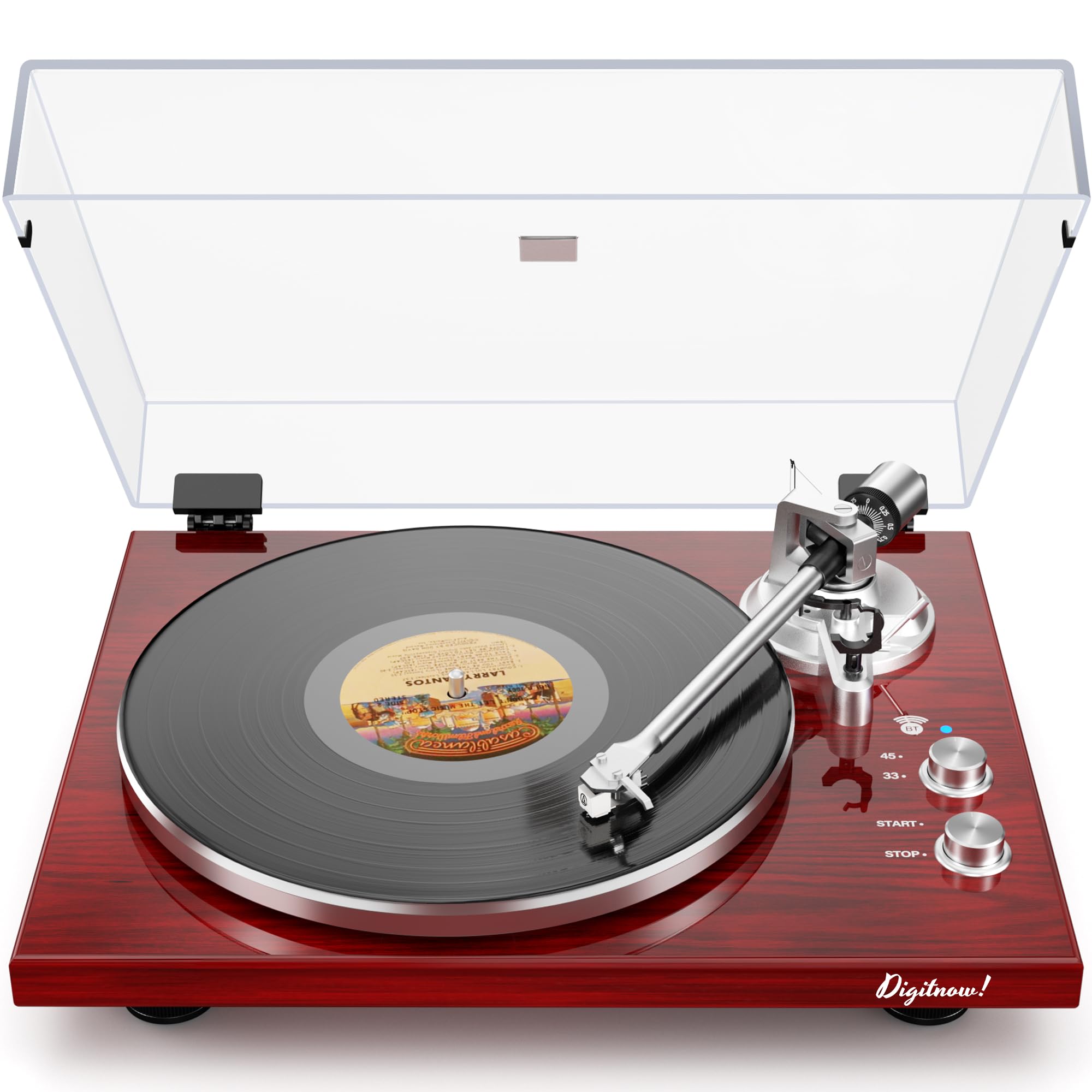
The DIGITNOW M485 is designed for a specific job: digitizing your vinyl collection. The built-in USB output connects directly to a PC, and the bundle includes a cartridge alignment protractor and USB cable to make the transfer process straightforward. The AT3600L moving magnetic cartridge is a standard OEM component that produces better sound than the ceramic cartridges found in budget all-in-one units. The adjustable counterweight and anti-skate control let you fine-tune tracking force for optimal playback.
This turntable has no built-in speakers, so you must connect it to external active speakers, a receiver, or Bluetooth headphones. The Bluetooth output works with a variety of protocols, and reviewers report a stable, dropout-free connection. The piano lacquer wood finish in red is visually striking — it is not a subtle piece, but it commands attention in a listening room. The tonearm base feels solid, and the chassis has enough heft (12.5 pounds) to resist most footfall vibrations.
Some owners note that the belt can slip if not seated perfectly during setup, but re-seating it solves the problem. The speed stability is acceptable for casual listening, but audiophiles may notice slight pitch variations on sustained piano notes. The primary audience here is the collector who wants to preserve old records on a hard drive and does not need a reference-grade listening deck. For that mission, the M485 delivers exceptional value.
Why it’s great
- USB output makes digitizing vinyl records simple and direct
- Adjustable counterweight and anti-skate for proper tracking
- AT3600L moving magnet cartridge outperforms ceramic alternatives
Good to know
- No built-in speakers; requires external active speakers or receiver
- Belt can slip if not seated correctly during assembly
9. FEKTIK M508
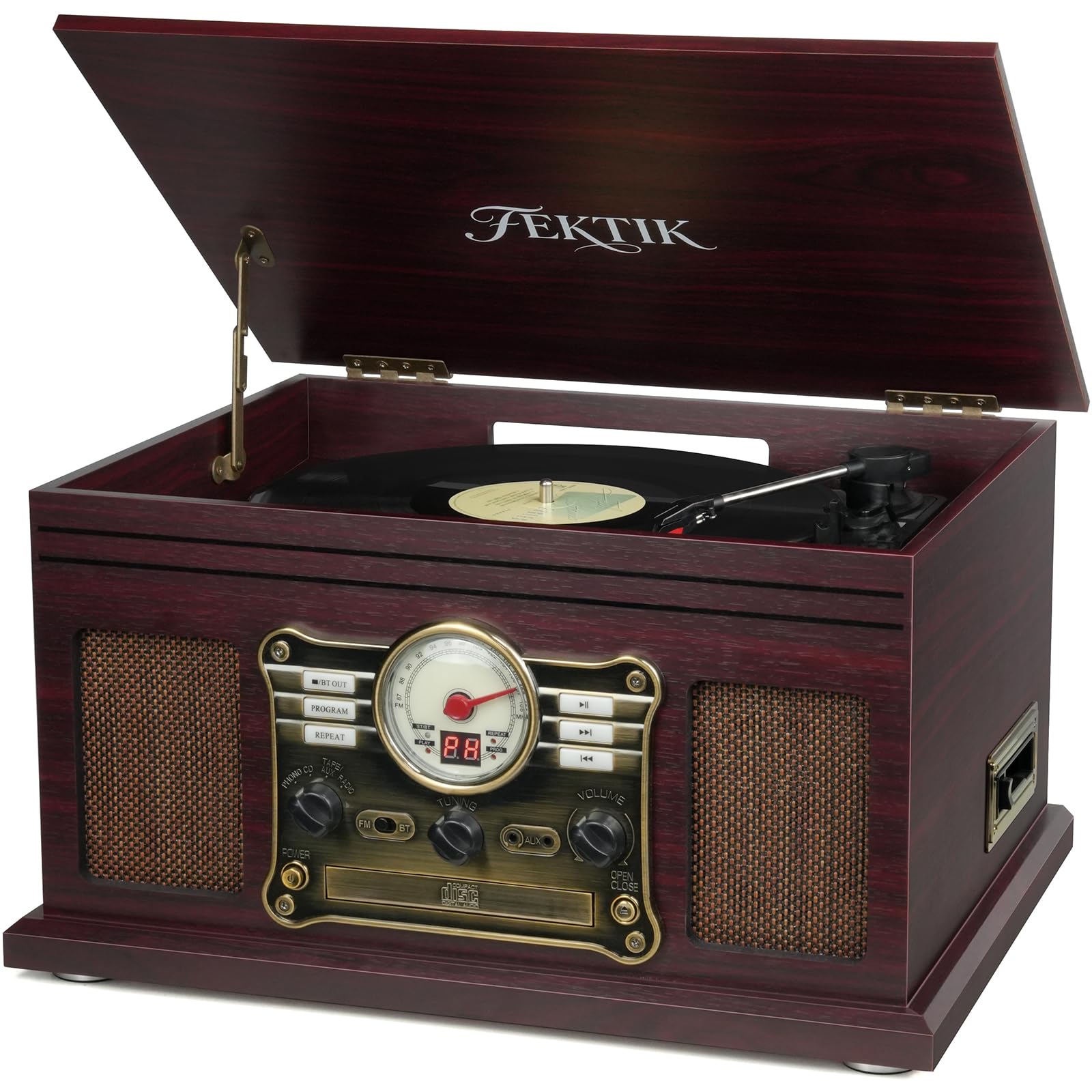
The FEKTIK M508 is a 10-in-1 entertainment center designed for maximum convenience. It combines a three-speed belt-drive turntable with a CD player, cassette deck, FM radio, Bluetooth input, Bluetooth output, and aux/headphone jacks. The mahogany wood cabinet houses built-in stereo speakers, so you can play vinyl right out of the box without any external equipment. For entry-level listeners, this is the simplest way to get into records.
The Bluetooth output function streams vinyl audio wirelessly to a Bluetooth speaker or headphones, though reviewers note the sound quality is adequate rather than impressive. The built-in speakers are serviceable for background listening but lack bass extension and clarity. The 33-1/3, 45, and 78 RPM support covers almost all vinyl pressings, including older shellac records. The tonearm is a basic fixed-weight design with no counterweight adjustment, which limits cartridge upgrade options.
Some units have experienced spinning issues due to the drive belt misaligning in shipping, but reseating the belt generally fixes the problem. The sound is described as “good enough” by owners, with understandable lyrics but limited high-frequency detail. For the price, the M508 is best suited for someone who wants occasional vinyl playback alongside CD and cassette functionality in a single, furniture-style unit. It is not a path toward audiophile-quality sound, but it is a versatile all-in-one solution.
Why it’s great
- 10-in-1 functionality: turntable, CD, cassette, FM radio, Bluetooth
- Built-in speakers allow immediate playback with no setup
- 3-speed support includes 78 RPM for shellac records
Good to know
- Fixed-weight tonearm with no adjustable counterweight or anti-skate
- Built-in speakers provide only adequate sound quality for casual listening
FAQ
What is the difference between belt-drive and direct-drive turntables?
Do I need a separate phono preamp for a belt drive turntable?
Why does my belt drive turntable sound distorted on inner grooves?
Final Thoughts: The Verdict
For most users, the belt drive turntable winner is the Pro-Ject Debut EVO 2 because it combines a TPE-damped platter, a high-quality Pick it MM EVO cartridge, and future-proof Balanced Ready connectivity into one cohesive package that outperforms everything below its price. If you want fully automatic convenience with an upgradeable cartridge, grab the Audio-Technica AT-LP70X. And for digitizing a lifelong record collection without breaking the bank, nothing beats the DIGITNOW M485.