
Our readers keep the lights on and the weekend projects moving. As an Amazon Associate, I earn from qualifying purchases.
Specs are compiled from manufacturer listings and verified buyer reviews and can change over time — please confirm the key details on the product page before buying.
A hernia belt is supposed to let you move without thinking about it — no readjusting, no bulging under your shirt, no rubbing raw. The problem is that most either slide around or feel like a medieval corset. This guide picks the belts that vanish under your clothes while delivering the exact compression you need, whether you are managing a groin hernia or recovering from umbilical surgery.
I’m Rikta — the founder and writer behind FitlyFast. This guide is built by comparing the manufacturers’ published specifications and the patterns across verified customer reviews, so you get each pick’s real strengths and trade-offs instead of marketing spin.
You want a belt for hernia that stays put, feels comfortable, and hides under your shirt. These picks are ranked from the most trusted by owners to the most affordable — each judged on fit, pad quality, and how discreet it really is — so you can skip the endless scrolling.
Our Picks at a Glance

How To Choose The Best Belt For Hernia
The wrong belt is worse than no belt — it slips, digs in, or barely touches the problem. Focus on three things and you will nail it: the hernia type, the pad material, and how you measure.
Match the belt to your hernia type
An inguinal hernia needs a belt with a groin strap and a pad that sits low, near the crease of your leg. An umbilical hernia needs a wider abdominal binder with a pad centered on your belly button. Bilateral belts have two pads and work for hernias on both sides. Buying the wrong shape means the pressure misses the spot entirely.
Pad material is everything
The pad is what actually holds the hernia in. Silicone pads offer firm, consistent pressure and hold their shape all day. Memory foam pads are softer and better for mild discomfort. Polyether or plastic pads are rigid — they work but many owners swap them for something softer. If you are active, a firm pad stays put. If you sit all day, a soft pad is more comfortable.
Measure your hips, not your waist
Almost every hernia belt sizes by hip circumference — around the widest part of your hips, not your belly button. Measuring at your waist guarantees a belt that rides up. Most belts have a sizing chart in the product images. If you fall between two sizes, go up for comfort or down for maximum compression.
Quick Comparison
| Model | Best For | Hernia Type | Included Pads | Material | Amazon |
|---|---|---|---|---|---|
| BLITZU Inguinal Belt★ Best Overall | Overall winner | Inguinal / Femoral | 1 removable pad | Neoprene | Amazon |
| Abdomencare Umbilical BeltTwo-Pad Power | Umbilical with two pad choices | Umbilical / Incisional | 2 pads (silicone + memory foam) | Cotton / Spandex | Amazon |
| ENLUNTRA Inguinal BeltFour-Pad System | Double inguinal with 4 pads | Single / Double Inguinal | 4 pads (2 firm, 2 medium) | Nylon mesh | Amazon |
| BLITZU Bilateral Belt | Double-side support | Bilateral / Inguinal | 2 removable pads | Neoprene | Amazon |
| Velpeau Umbilical Belt | Skin-friendly, latex-free | Umbilical / Epigastric | 1 ventilated polyether pad | Nylon / Polyester / Spandex | Amazon |
| Fitomo Umbilical Belt | 3D dome pad for umbilical | Umbilical | 1 3D dome pad | Nylon | Amazon |
| ORTONYX Umbilical Belt | Premium umbilical coverage | Umbilical / Ventral | 1 silicone pad with lining | Polyester / Latex | Amazon |
| ORTONYX Inguinal Belt | Left-side premium inguinal | Left-side Inguinal | 1 silicone pad | Polyester / Spandex / Nylon | Amazon |
| FlexaMed Inguinal Truss | Lightweight daily wear | Left-side Inguinal | 1 removable pad | Cotton / Polyester | Amazon |
In‑Depth Reviews
1. BLITZU Inguinal Hernia Belt for Men & Women
Our pick — over 4★ from 600+ verified ratings; the strongest balance of quality and price.
The belt owners call “well made and helps as advertised” — a crowd favorite for inguinal hernia relief.
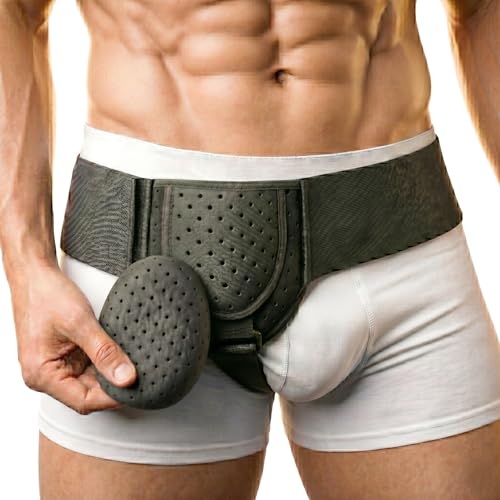
This is the one that keeps you moving without second-guessing. It is a neoprene belt with a removable compression pad that targets groin or femoral hernias on either your left or right side. The waist strap is wide and comfortable, and owners note that it stays put during the day — no constant tugging it back into place. The wide hook-and-loop closure gives you precise tension control, while the slim profile means it disappears under jeans or work pants without that telltale bulge.
A few owners mention that the included pad can feel a little thick for a small hernia, and some prefer the pad to sit on the inside for more direct pressure. The fix is easy — swap in a thinner pad from another belt or use the internal pocket to shape your own support. For a belt that checks every important box — fit, discretion, adjustability — this is the most reliable pick of the bunch.
What wins people over
- Wide, non-slip waist strap holds compression all day without slipping
- Removable pad lets you target left or right inguinal hernia
- Breathable neoprene stays cool during active work or walking
Who should size up
- External pad bulge is visible under very tight clothing
- Some owners find the extra pad too stiff for a small hernia
Reach for this if: you manage an inguinal hernia and need a belt that fits securely under ordinary clothes for work, walking, or daily life.
Look elsewhere if: you want a bilateral belt for both sides, or you prefer a padless design with a lower profile.
2. Abdomencare Umbilical Hernia Belt for Men and Women
Two different pads — silicone for firm pressure, memory foam for gentler support — all in one belt.
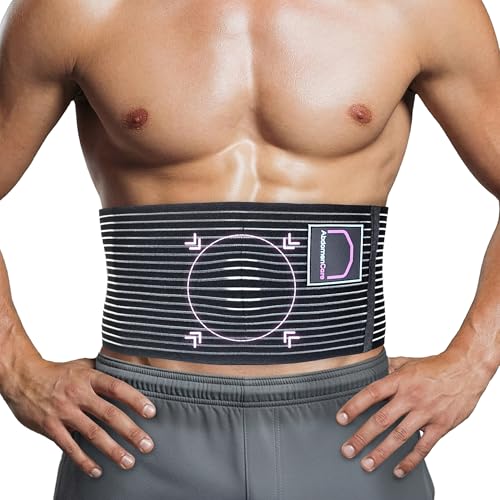
Unlike most belts that give you one pad and one level of firmness, the Abdomencare belt comes with both a silicone pad and a memory foam pad so you can choose the feel that matches your comfort level. The silicone pad offers firmer, more consistent pressure. The memory foam is softer, which many owners prefer for mild discomfort or all-day wear at a desk. The belt itself is made from a cotton-spandex blend with mesh side panels that let air flow — owners consistently note it stays breathable even during warmer days.
The thing everyone raves about is the comfort. “Comfortable, good stretch, sewn-in pad near one end for easy closure” sums up the consensus. The wide Velcro closure makes it easy to put on and take off. A recurring note: the top edge can roll slightly after a few hours. It does not affect support, but it is worth knowing if you are sensitive to fabric rolling against your skin. Going up a size usually helps.
The edge over others
- Two compression pads let you dial in pressure from firm to soft
- Cotton-spandex blend with mesh sides keeps skin dry
- True-to-size fit with easy Velcro closure
The small nuisance
- Top edge can roll up slightly during extended wear
- L/XL may be too large for some — measure abdomen circumference carefully
Grab this for: an umbilical or incisional hernia where you want the flexibility to switch between firm and soft pressure.
Think twice if: you have an inguinal hernia — this is an abdominal binder, not a groin-support truss.
3. ENLUNTRA Hernia Belts for Men, Adjustable Inguinal Support
Four removable pads, individual sizes, and a mesh build that breathes — one owner called it the best of the four belts they tested.
The ENLUNTRA belt solves the problem of one-size-fits-most designs by offering S, M, and L sizes with a hip circumference range from 30 to 47 inches. It is built with an all-mesh surface, so the entire belt breathes, and the touch-fastener closure lets you stick the pad exactly where you need it. The four pads include two medium and two large firm pads, giving you plenty of options for a single or double inguinal hernia. Owners unanimously praise the effectiveness — it keeps the hernia in place and significantly reduces pain during daily activities.
Here is the honest trade-off: the pads are firm. Several owners mention they are “too hard and rigid” from the start. The consensus fix is to wear the belt for a few days to let the pads soften, or swap in a softer pad from another belt if you have one. The Velcro is strong, the fit is tight, and for the price, you get a versatile system that works for both pre-surgery management and post-surgery recovery.
Built for versatility
- Four pads let you mix firm and medium support across both sides
- Full-mesh construction prevents overheating during active use
- Individual S/M/L sizes provide a more precise fit than one-size belts
Know before you buy
- Pads are very firm from the start; some owners find them uncomfortable initially
- Adjustability and overall comfort get mixed reviews — test the fit before committing to all-day wear
Best for: managing a double inguinal hernia where you want multiple pad options and a breathable, size-specific fit.
Skip if: you need a softer pad right away and do not want to break in or swap pads.
4. BLITZU Bilateral Hernia Belt for Men, Double Inguinal Support
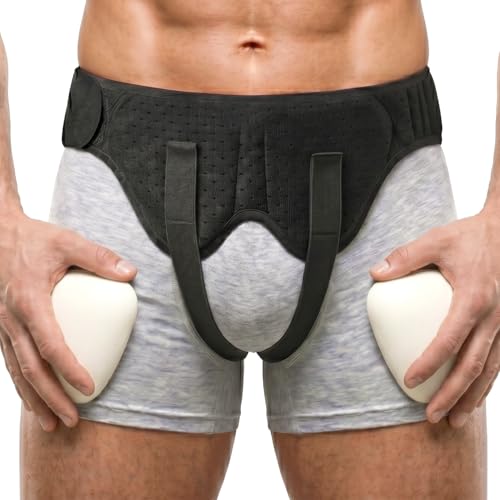
Designed for double-side inguinal hernias, this belt adds compression pads on both sides without the bulk of wearing two separate belts.
If you have a bilateral inguinal hernia (a hernia on both the left and right sides), this belt covers both in one piece. It has two removable compression pads — one for each groin area — so you get support where you need it. The neoprene (a stretchy, water-resistant synthetic rubber) body is thin enough to wear under clothes. Buyers report it “works perfectly for before hernia surgery and after.” The foam pads stay in place without bending when you move, and the adjustable straps let you set the tension separately for each side.
The biggest split in owner feedback is around fit and durability. Some find the elastic loses tension after a couple of months of daily use. Others say sizing can be tricky — going a size down gives more compression, but the wrong size might not give enough support. If you are between sizes and want maximum hold, size down for a snugger fit.
Why it works
- Two pads allow independent compression on each side
- Low profile fits under clothing for all-day wear
- Firm foam inserts do not bend or roll during movement
The durability concern
- Elastic can lose tension with months of daily use
- Some owners find sizing inconsistent — measure carefully
Reach for this if: you need a bilateral belt for hernias on both sides and want a single integrated design rather than two separate supports.
Look elsewhere if: you only need support on one side — the extra pad adds unnecessary bulk.
5. Velpeau Umbilical Hernia Belt for Women & Men
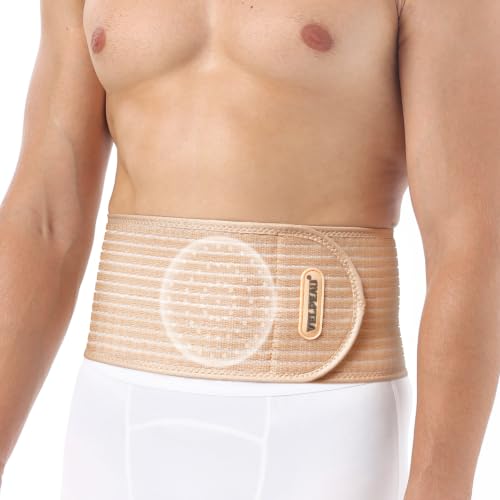
No neoprene, no latex — just a soft, ventilated belt that owners say is comfortable enough to wear all day.
The Velpeau belt is built for people whose skin reacts to standard elastic or neoprene. It uses nylon, polyester, spandex, and a polyether compression pad with ventilation holes that prevent sweat from building up against the skin. Owners consistently describe it as “softer than other belts,” and the removable patch makes it easy to wear for full eight-hour stretches. The hook-and-loop closure lets you adjust tightness on the fly, and the open-structure design makes putting it on simple even if you have limited mobility.
The catch: the Velcro coverage can be tight for larger body types. A few owners note the largest size barely fits and the Velcro edge can feel scratchy against the skin if the pad shifts out of place. For plus-sized buyers, altering the belt with stretchy fabric is a common workaround. The belt itself feels high quality, and the support it gives for umbilical, epigastric, and incisional hernias is excellent — “very effective” is a frequent refrain.
What makes it different
- Neoprene-free and latex-free — no skin irritation or allergic reactions
- Ventilated compression pad and mesh fabric keep the area dry
- Soft, low-profile band fits invisibly under underwear
One thing to know
- Velcro coverage may not be enough for plus-sized builds — consider carefully if you are at the high end of the range
- Hand wash only; machine washing may damage the pad
Perfect for: anyone with sensitive skin who needs a latex-free, ventilated belt for umbilical, epigastric, or incisional hernias.
Not ideal if: you have a larger abdomen — the largest size may still be a squeeze.
6. Fitomo Umbilical Hernia Belt with 3D Pressure Pad

A raised 3D dome pad that mimics the pressure of a fingertip — no sliding, no shifting, just targeted relief.
Most umbilical belts use a flat pad that can slide away from the belly button during movement. The Fitomo uses a 3D dome-shaped pad that stays centered even when you bend, twist, or lift. The front-wearing design means you can adjust the tension quickly without help — a big deal for post-surgery recovery or limited mobility. Owners say it is “NOT at all bulky” and easy to put on, with strong Velcro that holds the pad in place. It also works as a lumbar support belt when you remove the hernia pad, adding versatility.
A few owners mention the belt can roll or curve at the edges during active days, and some want a second support strap to prevent that. The pad pressure is gentle — effective for mild to moderate hernias, but if you need very firm compression, this may feel too soft. Totally unobtrusive under clothes, and the pink-stripe color option adds a bit of personality to medical gear.
Smart design choices
- 3D dome pad stays put during movement — no repositioning needed
- Front-wearing design is easy to adjust yourself post-surgery
- Doubles as a lumbar support belt when pads are removed
Where it falls short
- Edges can roll or curve during heavy physical activity
- Gentle pressure may not be enough for reducible hernias needing firm hold
Reach for this if: you want a stable, no-slip pad for an umbilical hernia, especially during light activity or recovery.
Skip if: you need firm compression that does not allow any shifting — this is a gentler support.
7. ORTONYX Ergonomic Umbilical Hernia Belt for Women and Men

A silicone pad with a soft lining that delivers firm, localized pressure — and never itches.
The ORTONYX umbilical belt uses a removable silicone pad with a soft lining and an adhesive layer that keeps it exactly where you place it. The fabric is a durable, lightweight cotton-polyester blend (73% polyester, 27% latex) that wicks moisture and stretches without restricting movement. Owners consistently call it “excellent compression and support,” noting that it stays in place under regular clothes and does not ride up during the day. The slim ergonomic design means you can wear it for extended periods — some owners log eight-hour shifts without needing to readjust.
This belt includes latex, which is a dealbreaker for anyone with a latex allergy. It is also hand-wash only. A few owners find the belt shifts slightly during high-intensity workouts like running, so it is better suited for daily activity than heavy exercise. The quality-to-price ratio gets strong praise: “best binder I have used, excellent quality, especially for the price.”
Outstanding features
- Silicone pad with soft lining provides firm, targeted pressure on umbilical hernias
- Breathable cotton-polyester blend keeps skin cool during long wear
- Slim ergonomic design disappears under regular clothing
Consider this
- Contains latex — not suitable for those with latex allergies
- Can shift slightly during intense exercise or running
Best for: daily umbilical hernia management where you need consistent, firm support and a discreet profile under clothes.
Avoid if: you have a latex sensitivity or need a belt for high-intensity sports.
8. ORTONYX Inguinal Hernia Belt for Men and Women

A dedicated left-side truss with a silicone pad that owners call “durable and reliable” for pre- and post-surgery use.
This ORTONYX belt is purpose-built for left-side inguinal hernias. It uses flexible elastic material (50% polyester, 30% spandex, 20% nylon) with adjustable straps that let you control the compression. The silicone pad sits in a holder pocket inside the belt, delivering localized pressure to the groin area. Owners consistently call out the “great unslippable Velcro” and note it stays in place for full workdays — one owner reports wearing it for eight hours with no problem, compared to 15 minutes of pain without it.
The recurring gripe is the pad: owners find it “kind of bulky” or “too hard.” The common fix is swapping it with a thinner pad from an old belt. The crotch strap can feel uncomfortable for some, but owners say it is necessary to keep the belt from riding up. If you have a left-side inguinal hernia and need a durable, all-day belt, this is a top contender — just plan to swap the pad if it feels too rigid.
What stands out
- Strong, unslippable Velcro that holds tension all day
- Elastic material provides freedom of movement during daily tasks
- Keep hernia in place for 8-hour workdays
The trade-off
- Pad is bulky and hard for some — plan to swap for a softer one
- Crotch strap is necessary but can be uncomfortable initially
Ideal for: left-side inguinal hernia sufferers who need a sturdy, long-wearing belt for work or daily activity.
Might not suit: anyone with a right-side hernia only — this is a dedicated left-side truss.
9. FlexaMed Left Inguinal Hernia Truss Belt
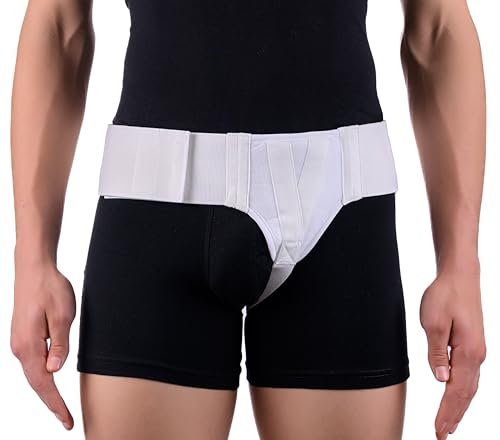
The classic cotton truss that makes hernia life bearable before surgery — at a weight you forget you are wearing it.
The FlexaMed is a cotton and polyester belt with a removable compression pad, made specifically for left-side inguinal hernias (a hernia in the lower abdomen on the left). Owners describe it as a “lifesaver” — one reviewer with a heavy-lifting job wore this before surgery and “felt relief, is able to walk without slouching in pain.” The hook-and-loop closures (like Velcro) make it easy to put on and adjust. The belt has no rigid plastic or metal parts, so it bends and moves with your body.
The biggest owner complaint is the stitching. The belt uses a running stitch, not a lock stitch, and a few owners mention it starts unraveling after 12 days of wear and washing. For short-term use while waiting for surgery, it holds up fine. For extended daily use, owners recommend buying an anti-fray product or getting a second belt for rotation. The pad works well for keeping the hernia in place, though some find it does not fully close the hernia — it provides comfort and support more than total reduction.
Why owners love it
- Lightweight cotton-polyester construction breathes and moves naturally
- Effective support allows walking and light activity without pain
- Adjustable hook-and-loop closures make it easy to dial in tension
The durability note
- Stitching can begin to unravel after two weeks of daily use
- Some customers note it supports without fully closing the hernia
Best for: temporary use while awaiting surgery — it is comfortable, adjustable, and effective for daily relief.
Look elsewhere if: you need a belt that will last months of heavy daily wear without stitching issues.
Understanding the Specs
Hernia Type Compatibility
Every belt is designed for a specific hernia location — inguinal, umbilical, incisional, or femoral. An inguinal belt has a groin strap and low pad. An umbilical belt is a wide abdominal binder with a centered pad. Bilateral belts support both sides. Picking the wrong type means the pad misses the hernia entirely, so match the belt shape to where your hernia sits.
Pad Material & Firmness
The pad does all the work. Silicone pads provide firm, consistent pressure and hold their shape all day. Memory foam is softer and better for mild discomfort. Polyether or rigid plastic pads offer strong support but can feel too hard — many owners swap them. Ventilated pads with holes prevent sweat buildup, which matters if you plan to wear the belt for full workdays in warm conditions.
Hip vs. Waist Measurement
Hernia belts almost always size by hip circumference — around the widest part of your hips, not your belly button. Measuring your waist guarantees a belt that rides up. Always compare your hip measurement to the product size chart. If you fall between sizes, choose the larger size for comfort or the smaller size for maximum compression.
Material & Care
Neoprene is durable and stretches well but does not breathe as much as cotton-spandex blends. Cotton and polyester blends are lighter and more breathable but may lose elasticity over time. Most belts are hand-wash only. Machine washing can break down the elastic and damage the compression pad, so follow the care instructions to extend the belt’s lifespan.
FAQ
What is the difference between an inguinal and an umbilical hernia belt?
How tight should a hernia belt be?
Can I wear a hernia belt under my clothes?
How long does a hernia belt last with daily use?
Will a hernia belt fix my hernia?
Can I exercise while wearing a hernia belt?
How do I know what size hernia belt to buy?
Can I wear a hernia belt after surgery?
Is the ORTONYX umbilical belt better than the Abdomencare umbilical belt?
What should I do if the compression pad is too hard?
Final Thoughts: The Verdict
For most people, the belt for hernia winner is the BLITZU Inguinal Hernia Belt because it balances firm neoprene support, a removable pad, and a discreet profile that hundreds of owners have trusted for daily relief. If you manage an umbilical hernia and want the flexibility to switch between firm and soft pressure, grab the Abdomencare Umbilical Belt with its two-pad system. And if you need a lightweight truss to get you through the weeks before surgery, the FlexaMed Left Inguinal Truss is the one to reach for.
How We Picked
We do not accept paid placement. Every pick is matched to a real buyer and a real use-case; we do not hands-on test units.
Sources & Methodology
Specifications: manufacturer listings and product documentation. Review insights: verified customer reviews, as of July 2026. Pricing: not shown on this page (it changes often); check the current price via the retailer link.
As an Amazon Associate, FitlyFast earns from qualifying purchases. This does not affect which products we feature.