
Our readers keep the lights on and the weekend projects moving. As an Amazon Associate, I earn from qualifying purchases.
The difference between a blade that slips and one that cleanly cuts through strapping, rope, or leather comes down to the sharpening system you carry. Belt sharpeners occupy a specific niche: they must be compact enough to stash in a pack or pocket yet equipped with aggressive enough abrasives to restore a working edge on high-carbon steel after a day of heavy use.
I’m Rikta — the co-founder and writer behind FitlyFast. I’ve spent hundreds of hours analyzing sharpening hardware, studying diamond vs. ceramic abrasive performance, and comparing guided-angle systems to find the models that deliver repeatable results without guesswork.
This guide breaks down the top contenders across price tiers, from compact field sharpeners to more comprehensive guided kits, to help you zero in on the best belt knife sharpener for your specific carry and cutting needs.
How To Choose The Best Belt Knife Sharpener
A belt knife sharpener must balance abrasive aggression with portability. Unlike kitchen sharpeners, units intended for EDC and field use face the challenge of restoring edges on blades that have been used for cutting wood, rope, webbing, or fabric — often with nicks or rolled edges. The best options combine guided-angle systems for consistency with at least two grit stages for repair and refinement.
Guided Angles vs. Freehand Sharpening
A guided-angle system locks the blade into a preset angle — typically 20 degrees — so that every stroke reinforces the same edge profile. Freehand sharpening introduces variability that can round the apex over time. For most belt knife users, a sharpener with a physical angle guide removes the guesswork and produces a sharper, more durable edge in fewer strokes.
Abrasive Material Matters
Diamond plates cut fast and are ideal for repairing nicks and reshaping damaged edges. Ceramic hones refine the edge and remove burrs but are less aggressive. Some sharpeners use carbide pull-through slots for rapid edge restoration, though carbide removes more steel and should be reserved for heavily damaged blades. A quality field sharpener typically includes diamond for repair and ceramic for honing.
Portability and Build Quality
Weight and size are critical for a tool meant to live in a pocket or pack. Look for a compact footprint — under 6 inches in length — with a storage system that keeps abrasives secure. A lanyard hole or storage pouch adds convenience. The housing should be robust enough to withstand drops and rough handling without the sharpening surfaces detaching or breaking.
Quick Comparison
On smaller screens, swipe sideways to see the full table.
| Model | Category | Best For | Key Spec | Amazon |
|---|---|---|---|---|
| Work Sharp Guided Field Sharpener | Premium Guided | Comprehensive field kit | 5 abrasives, 20-25° guides | Amazon |
| Wicked Edge Venture WE20 | Premium Portable | Ultra-compact angle guidance | 4 oz, 20° patent-pending guide | Amazon |
| Smith’s 50933 Electric Belt Sharpener | Electric Belt | Fast repair at home or shop | 3 replaceable belts, 120V | Amazon |
| Orange Ninja Pocket Field Sharpener | 8-in-1 EDC | Multi-tool outdoor scenarios | 220/600 grit diamond, strop | Amazon |
| USELUCK Knife Sharpener | Kitchen & Pocket | Adjustable-angle versatility | 6 angles, coarse/fine stones | Amazon |
| Work Sharp Folding Field Sharpener | Ultra-Compact | Minimalist everyday carry | 5.25″ closed, 400/1000 grit | Amazon |
| SHARPAL 178N 3-in-1 | Budget Diamond Rod | Serrated blade repair | 600 grit, tapered rod, 0.14 kg | Amazon |
In‑Depth Reviews
1. Work Sharp Guided Field Sharpener
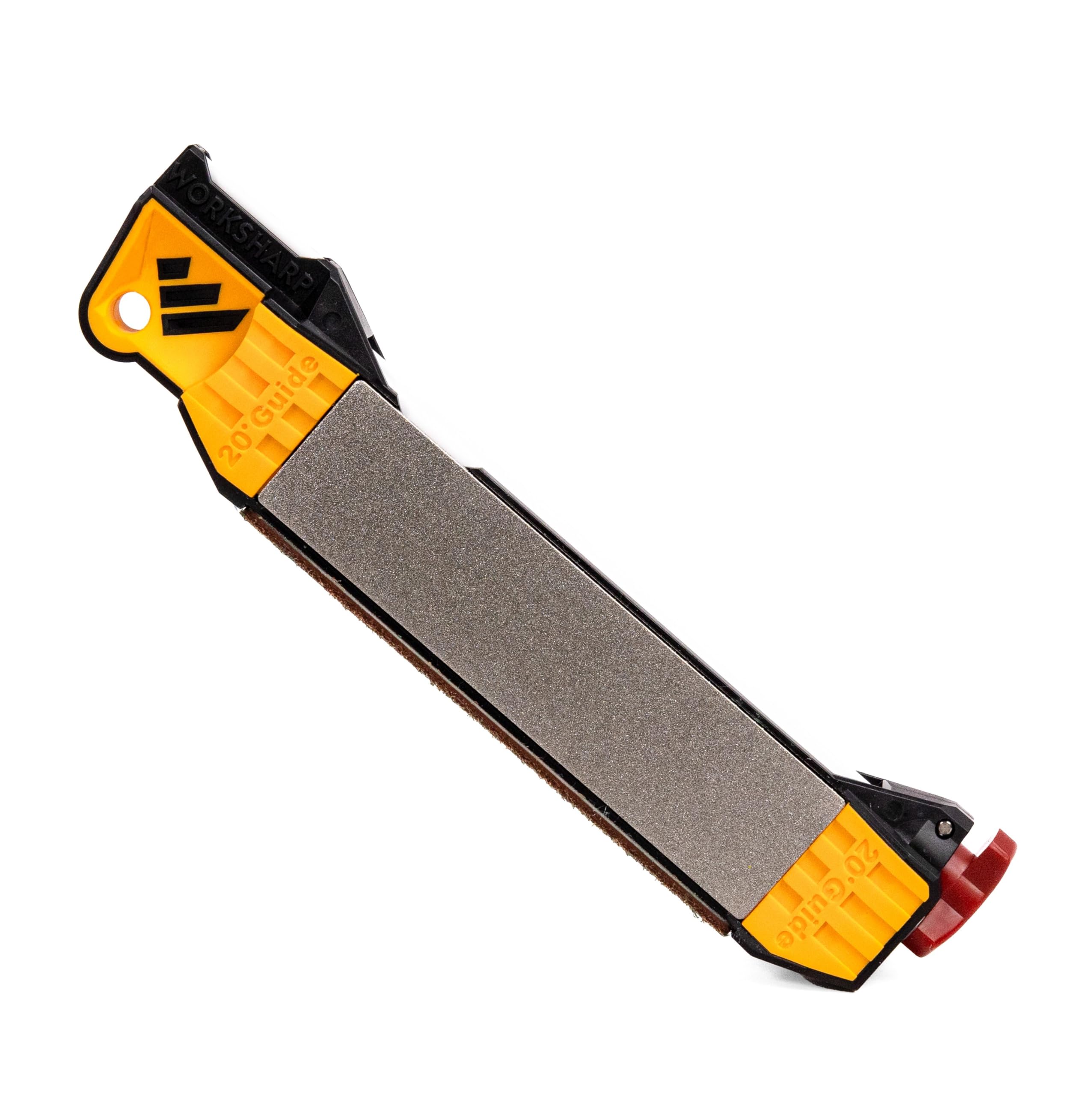
The Work Sharp Guided Field Sharpener is the most complete belt knife sharpening solution in a portable form factor. It packs five abrasives — coarse and fine diamond plates, fine and coarse ceramic rods, and a leather strop — all housed in a self-contained 9.5-inch case that requires no setup. The 20-degree and 25-degree sharpening guides give you two angle options, which is rare among compact sharpeners and allows you to match the edge profile to blade type and steel hardness.
The diamond plates are removable and conceal a broadhead wrench underneath, a practical detail for hunters. The ceramic rod rotates to expose coarse and fine surfaces plus a grooved section for fish hooks. A storage compartment holds the included leather strop. Build quality is excellent — the plastic body feels dense and the plates lock securely without wobble. At just under 5 ounces, the portability is strong, though the case length means it won’t slip into a small pocket; it’s better suited for a pack or glove box.
Customer feedback consistently highlights the guided system’s ability to produce razor edges on heavily used blades, with many users noting it outperforms pull-through sharpeners and smaller rod-only kits. The only drawback is the fixed 20-degree guide — users wanting a shallower angle for specific steels will need to adapt freehand. Overall, this is the sharpener to beat for anyone needing a do-it-all field solution.
Why it’s great
- Five abrasives in one compact unit for repair, honing, and finishing
- 20° and 25° guided angles deliver consistent edge geometry
- Includes broadhead wrench and fish hook groove for hunters
Good to know
- Case length makes it less pocket-friendly than smaller rod sharpeners
- Only two fixed angle options; no adjustment for sub-20° preferences
2. Wicked Edge Venture WE20
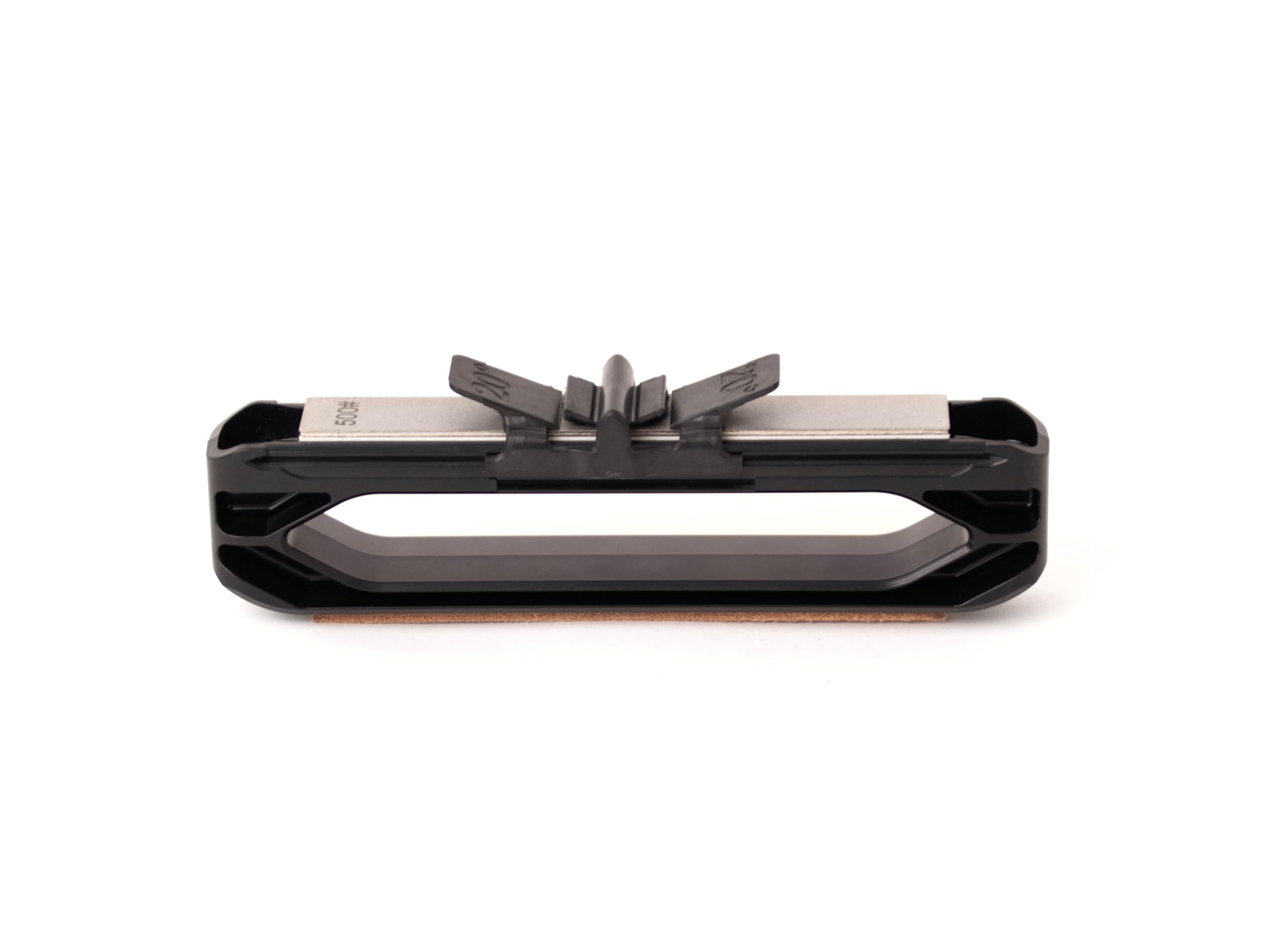
The Wicked Edge Venture WE20 brings precision-guided sharpening from a brand known for high-end bench systems into a truly pocketable package. Weighing only 4 ounces and measuring 7 inches long, it includes a patent-pending 20-degree angle guide, a dual-sided 500-grit diamond stone for shaping, a ceramic hone for refining, and a leather strop for final polishing. The angle guide features Velcro backing that ensures consistent blade placement stroke after stroke, which is especially useful when restoring a dull belt knife with a damaged edge profile.
Made in the USA, the Venture uses recycled ABS plastic for a robust housing with an ergonomic handle that keeps fingers clear of the sharpening path. The diamond side cuts quickly — users report hair-popping edges after a few passes on knives that were previously dull. The ceramic side requires a lighter touch but refines the edge cleanly. The strop, though small, adds that final polish that separates a sharp edge from a truly razor edge. Expandable grit stones (100/200, 800/1000, 1500/2200) are sold separately, so you can tailor the system to finer steels over time.
The main limitation is the fixed 20-degree guide — if you need a 15-degree or 17-degree angle, you’ll need to purchase separate guide inserts. Additionally, the small footprint means sharpening larger blades requires multiple passes. But for EDC belt knives and hunting blades, this is one of the best portable guided systems available. The 5-year warranty reinforces the quality.
Why it’s great
- Patent-pending angle guide ensures foolproof consistency
- Ultra-portable at 4 oz with a dual-sided stone and strop
- Made in the USA with a 5-year warranty
Good to know
- Angle guide may detach with heavy use; securing it with silicone is a common fix
- Larger knives feel awkward; optimized for blades under 6 inches
3. Smith’s 50933 Electric Belt Sharpener

For users who want speed over portability, the Smith’s 50933 electric belt sharpener changes the game. Instead of manual strokes, this 1-pound unit uses three replaceable abrasive belts — coarse, medium, and fine — to reshape and polish edges rapidly. Preset angle guides at 20 degrees for straight-edge knives and a separate guide for scissors remove the angle guesswork entirely. The floating backing plates keep the belt straight and prevent the blade tip from overheating or burning during extended sharpening sessions.
In practice, this sharpener can restore a heavily dulled belt knife to shaving sharpness in under two minutes. Users report that five dull kitchen knives achieved tomato-slicing sharpness in less than ten minutes. The coarse belt (80 grit) aggressively removes nicks and damaged steel, while the medium and fine belts refine the edge. The machine is compact at 9.6 x 5.7 x 6.8 inches and sits solidly on a benchtop. Left-handed users may find the orientation slightly awkward, but the process remains straightforward.
The trade-offs are belt wear and duty cycle. The fine belt’s splice can degrade faster than expected with heavy use, and the manufacturer recommends not running the unit for more than two minutes continuously to avoid plastic wheel heat damage. Replacement belts are readily available and easy to swap via a lock/release button. Smith’s customer support receives high marks for warranty replacements. This is a bench sharpener, not a field tool, but for anyone sharpening multiple knives regularly, it eliminates the fatigue of manual sharpening.
Why it’s great
- Fast edge repair: dull to sharp in under 2 minutes
- Three interchangeable belts for coarse aggressive cutting to fine polishing
- Preset 20° guides provide consistent results with minimal learning curve
Good to know
- Not portable; designed for home or workshop use only
- Plastic wheels can become brittle if run for more than 2 minutes continuously
4. Orange Ninja Pocket Field Knife Sharpener
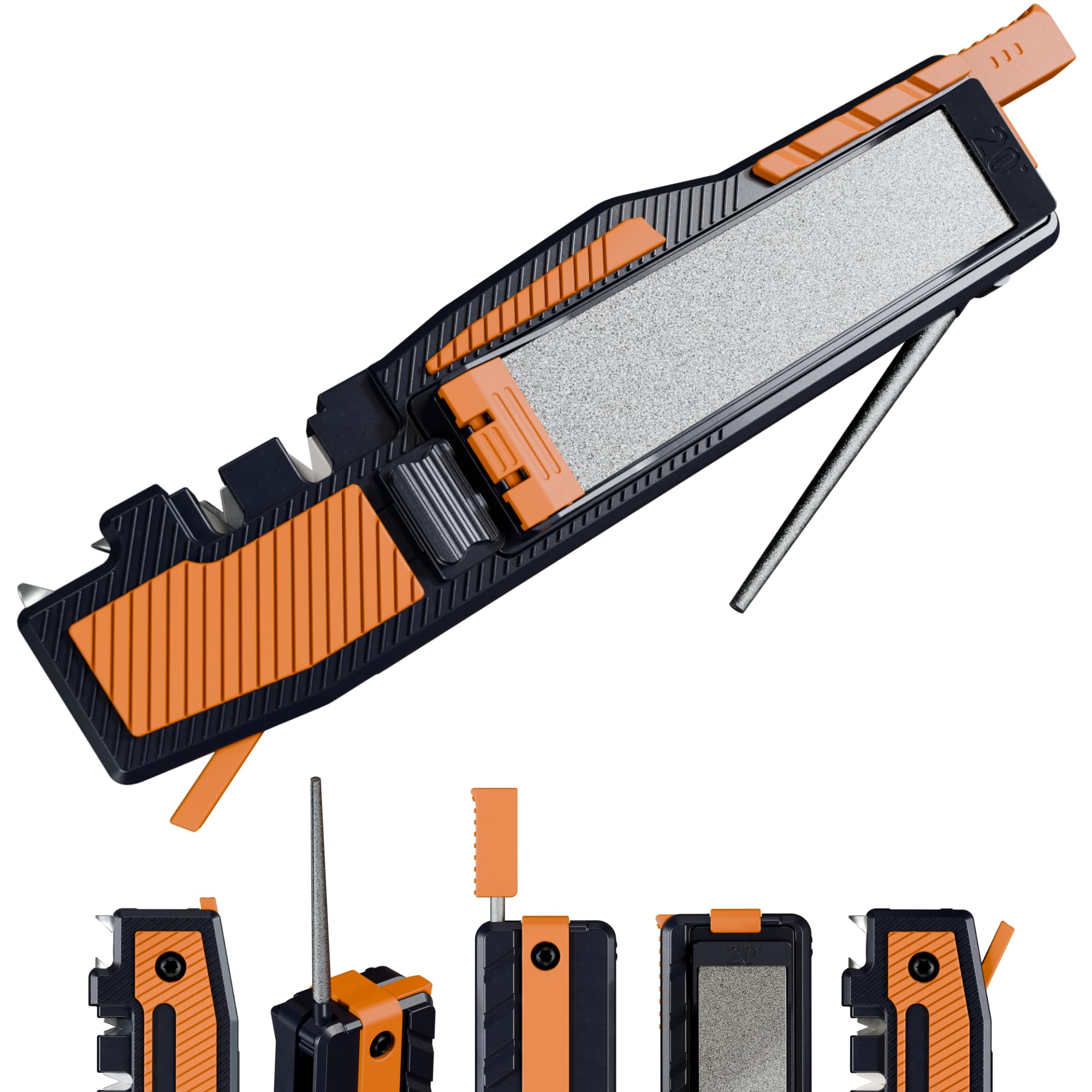
The Orange Ninja is an 8-in-1 EDC sharpener that packs guided diamond whetstones, a leather strop, a carbide pull-through slot, a ceramic hone, a diamond sharpening rod for serrations, a ferro fire starter, and an emergency whistle into a 5-inch frame. The dual-grit diamond plates (220 for repair, 600 for sharpening) are the core of the system, and they lock into place via a click mechanism that keeps the stones secure during use. The guided-angle system makes this beginner-friendly while still effective for experienced users.
The inclusion of a leather strop is a standout feature at this price point — it allows users to remove the burr after sharpening and polish the edge to a finer finish. The fire starter and whistle are useful additions for outdoor emergencies, but they don’t compromise the sharpening function. The diamond rod works well on serrated blades and gut hooks, filling a gap that many compact sharpeners ignore. At 0.4 pounds, it’s heavier than a standalone rod sharpener but carries the advantage of multiple tools in one package.
Build quality is acceptable for the price, though some users note the plastic housing feels a bit light compared to premium options. The guided whetstone system works best for blade maintenance rather than heavy reprofiling — the 220-grit side can repair moderate dullness, but heavily damaged edges may require the carbide slot with care to avoid removing too much steel. For camping, hiking, and general EDC use, the Orange Ninja offers impressive versatility in a compact form.
Why it’s great
- 8-in-1 design includes fire starter, whistle, and serrated rod
- Guided diamond whetstones with a leather strop for a polished edge
- Click-lock mechanism keeps plates secure during use
Good to know
- Plastic housing feels less robust than premium all-metal sharpeners
- Guided system best for maintenance; not ideal for heavy blade reprofiling
5. USELUCK Knife Sharpener
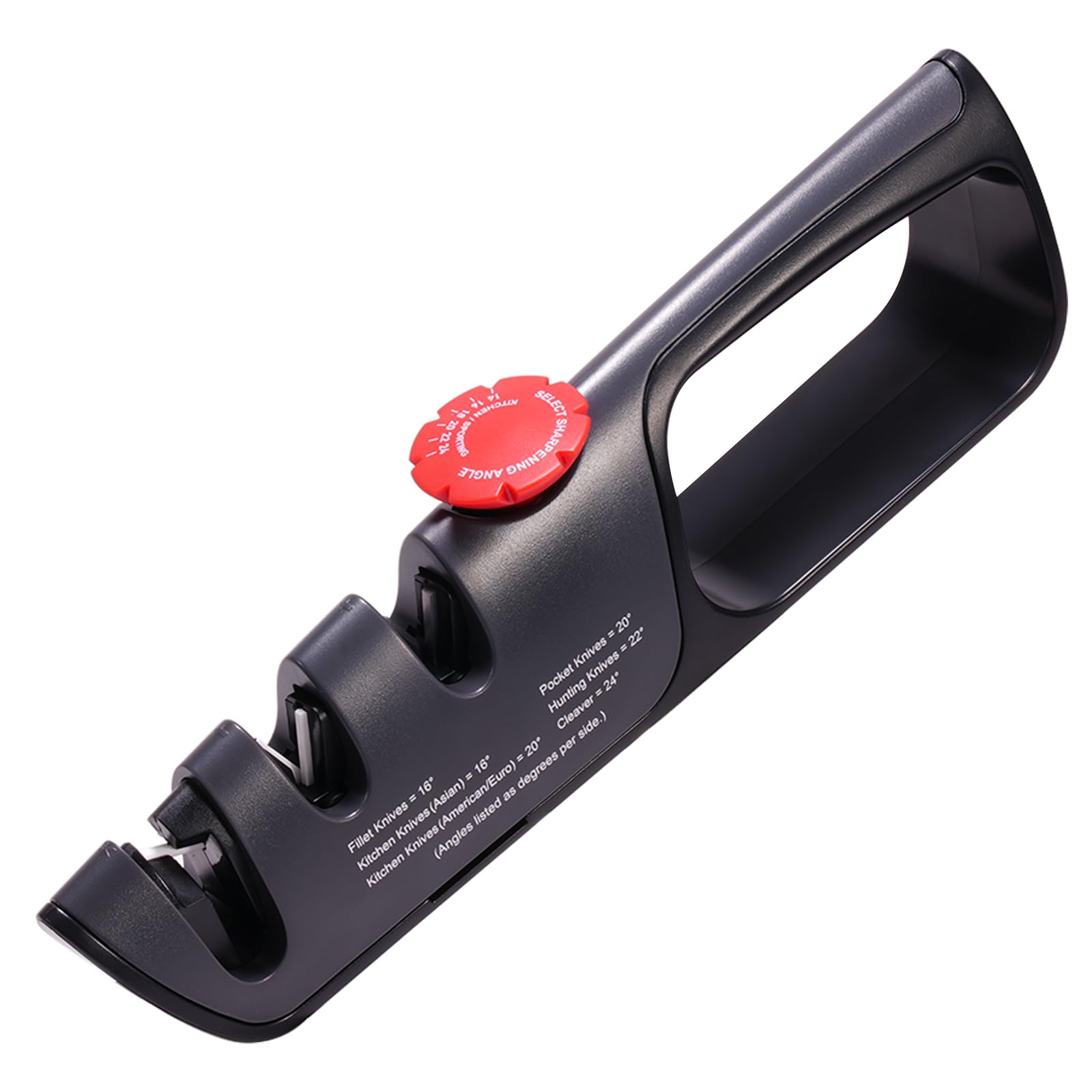
The USELUCK knife sharpener stands out for its six adjustable sharpening angles — 14, 16, 18, 20, 22, and 24 degrees — controlled by a simple depth adjustment dial. This flexibility makes it suitable for a wide range of blades, from thin Japanese kitchen knives to thicker pocket and belt knives. The sharpener uses diamond-coated and ceramic stones in two stages: a coarse stage for dull blade restoration and a fine stage for polishing. The ergonomic handle and non-slip rubber base keep the unit stable during use, requiring only a straight pull-through motion.
The 3-stage grit system (600/1200/2000 grit equivalent) minimizes steel loss while producing clean cutting edges. Users report excellent results on kitchen knives, pocket knives, and scissors. The removable stone holders make cleaning simple, and the compact 10.4-inch footprint fits easily on a countertop without being obtrusive. The depth adjustment dial allows you to match the angle to the blade’s factory edge, which is particularly useful if you’re sharpening multiple knife types with different bevels.
Build quality is good for the price, though some users note wear on the plastic housing after repeated use and caution against applying excessive pressure. The diamond-coated ceramic stones hold up well but will eventually require replacement with continued heavy use. For anyone who sharpens a variety of blades at home and wants precise angle control without investing in a bench system, the USELUCK offers the most adjustable angle range in a pull-through package.
Why it’s great
- Six adjustable angles from 14° to 24° accommodate nearly any blade type
- Diamond-coated ceramic stones remove less steel than carbide slots
- Non-slip base and ergonomic handle provide stable, controlled sharpening
Good to know
- Plastic housing may show wear over time with heavy use
- Depth adjustment dial is functional but feels somewhat basic
6. Work Sharp Folding Field Sharpener
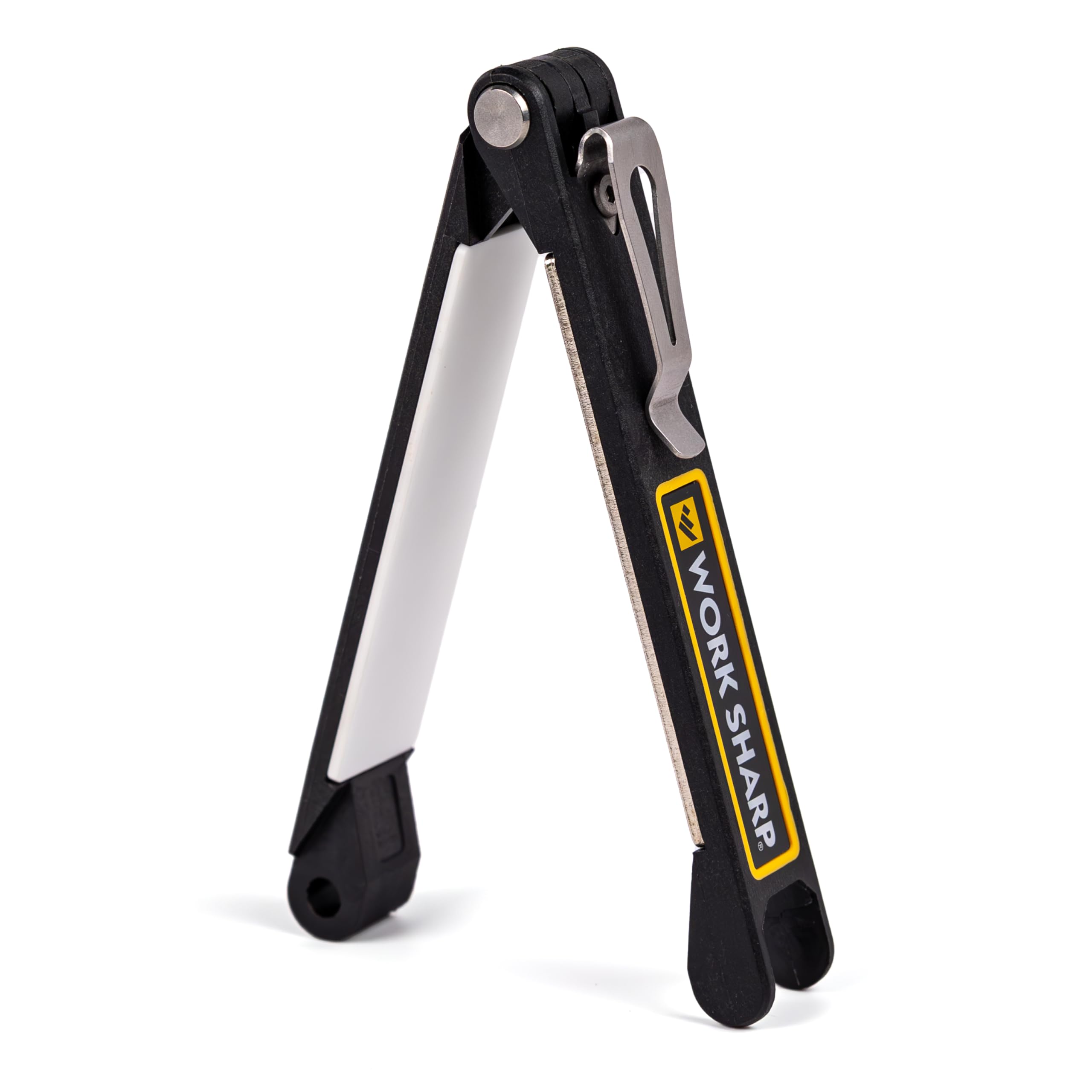
The Work Sharp Folding Field Sharpener is built for minimalist carry. At 5.25 inches folded and only 0.13 pounds, it’s designed to clip into a pocket like a folding knife. It features a 400-grit diamond plate with a 20-degree sharpening guide on one side and a fine-grit ceramic plate with a 25-degree honing guide on the reverse. This dual-angle approach allows you to set a primary bevel and then refine the edge at a slightly steeper angle for durability — a progression that works well on belt knives used for cutting abrasive materials.
The non-slip handle provides a secure grip during sharpening, and the folding design protects the sharpening surfaces when stored. The diamond side cuts quickly; users report restoring a working edge on a dull pocket knife in just a few passes. The ceramic side refines the edge and removes the burr left by the diamond plate. The pocket clip is secure and allows for quick access when you need to touch up a blade in the field. Designed and engineered in Oregon, the build quality is excellent for its size.
The main limitation is the grit range — 400 is on the coarser side for a primary sharpening stone, which means very dull blades may require more passes or a separate coarse stone before using this sharpener. The 25-degree ceramic side is primarily for honing rather than aggressive edge repair. This is best suited for maintenance sharpening — keeping an already-sharp edge in top condition — rather than restoring a heavily damaged blade. For EDC users who prioritize ultra-light carry, this is a top contender.
Why it’s great
- Folding design with pocket clip for ultra-compact everyday carry
- 400-grit diamond plate for fast edge restoration
- Non-slip handle provides a safe, controlled grip
Good to know
- Grit range limited to 400/1000; not ideal for heavy edge repair
- Ceramic side functions primarily as a hone, not a sharpener
7. SHARPAL 178N 3-in-1 Pocket Knife Sharpener

The SHARPAL 178N is a 3-in-1 diamond rod sharpener that packs serious abrasive aggression into a compact aluminum body. It includes a 4-inch round diamond-coated rod for straight edges, a 3.5-inch tapered diamond rod for serrations and gut hooks, and a sharpening groove for fish hooks and pointed tools. Both rods store inside the aluminum handle when not in use, making the unit self-contained and highly portable at just 0.14 kilograms. A lanyard hole and storage pouch add to its travel-friendliness.
The 600-grit monocrystalline diamond coating is aggressive enough to repair nicks and restore a dull edge quickly. Users report restoring serrated knives with missing teeth and cracked edges to functional sharpness — something many compact sharpeners cannot accomplish. The tapered rod’s shape allows access to serration valleys and gut hook curves that flat stones can’t reach. The aluminum handle feels solid and provides good grip, though some users note the diamond rod’s aggression requires a careful touch to avoid over-removing steel.
The 178N excels as a specialist tool for serrated and hook-style blades, which are common on belt knives used for hunting or utility work. Its limitations are the single grit (600) and the lack of a honing or polishing stage — the edge will be sharp but not as refined as what a strop or ceramic rod would deliver. The rods are long enough for most pocket and belt knives but short for larger blades. For the price, the SHARPAL 178N offers exceptional diamond-on-steel performance for field repair.
Why it’s great
- Monocrystalline diamond rods cut aggressively for fast edge repair
- Tapered rod handles serrations, gut hooks, and fish hooks effectively
- Self-contained design with lanyard hole for easy carry
Good to know
- Single 600-grit means no finer honing stage for a polished edge
- Diamond rod’s aggression can remove steel quickly if too much pressure is applied
FAQ
What grit should I use for a dull belt knife?
Can a belt knife sharpener handle serrated blades?
How do I prevent removing too much steel with a diamond sharpener?
What’s the difference between a guided field sharpener and a pull-through sharpener?
Final Thoughts: The Verdict
For most users, the best belt knife sharpener winner is the Work Sharp Guided Field Sharpener because it combines five abrasives, dual-angle guides, and a self-contained case that handles everything from heavy edge repair to final polishing. If you want ultra-portable precision for EDC, grab the Wicked Edge Venture WE20. And for budget-conscious buyers who need fast repair at home, nothing beats the Smith’s 50933 Electric Belt Sharpener.