
Our readers keep the lights on and the weekend projects moving. As an Amazon Associate, I earn from qualifying purchases.
Texas heat and clay soil create a unique challenge for lawn care: most cool-season grasses wither by July, while common Bermuda varieties struggle to establish a deep root system in the state’s erratic rainfall patterns. The right seed choice determines whether you get a patchy, weed-prone yard or a dense, carpet-like turf that stays green through the summer.
I’m Rikta — the co-founder and writer behind FitlyFast. This guide is built on hundreds of hours analyzing USDA hardiness zone maps, customer germination data across Texas climates, and side-by-side comparisons of seed coatings, purity percentages, and soil temperature requirements specific to Bermudagrass establishment in the South.
After comparing seven top options across mid-range and premium tiers, I identified the most reliable bermuda grass seed for texas lawns based on germination rates, drought tolerance, and proven performance in local soil conditions.
How To Choose The Best Bermuda Grass Seed For Texas
Texas spans three distinct climate zones — humid subtropical in the east, semi-arid in the west, and a transition zone across the middle. Bermuda grass is a warm-season grass that thrives in full sun and high heat, making it ideal for most of the state, but not all Bermuda varieties handle Texas conditions equally. Seed purity, coating technology, and cold tolerance determine whether your lawn survives its first winter.
Seed Coating and Germination Success
Some Bermuda seeds come pre-coated with fungicides and moisture-retaining materials (Penkoted is the most common). This coating protects the tiny seed against soil diseases and retains water during the critical first germination week. In Texas, where spring rains can be inconsistent, coated seeds generally provide more reliable establishment than raw seed. However, coating adds weight — a 5-pound bag of coated seed contains less actual seed than 5 pounds of uncoated seed, so compare coverage rates (sq. ft. per bag) rather than bag weight.
Cold Tolerance for Texas Winters
Standard common Bermuda grass goes dormant and turns brown when soil temperatures drop below 50°F. In the Texas Panhandle and northern regions near Dallas-Fort Worth, hard freezes can kill off common Bermuda entirely. Improved cold-tolerant varieties, like those in the Pennington blend, can survive occasional freezes and green up faster in spring. If you live south of I-10, cold tolerance matters less; if you’re north of Waco, prioritize seed labeled with cold-tolerant genetics.
Wear and Traffic Resistance
Bermuda grass naturally handles foot traffic better than fescue or bluegrass, but hybrids bred specificially for sports fields offer even greater recovery ability. If your lawn sees kids, pets, or frequent gatherings, look for blends that explicitly mention wear tolerance or “high traffic” performance. Deep root systems — often 6+ feet in well-established Bermuda — also improve drought resistance, so check whether the seed description mentions rooting depth.
Quick Comparison
On smaller screens, swipe sideways to see the full table.
| Model | Category | Best For | Key Spec | Amazon |
|---|---|---|---|---|
| Outsidepride Oasis Bermuda | Hybrid Blend | Texas heat & traffic | 2-3 lbs per 1,000 sq ft | Amazon |
| Outsidepride Maya Blackjack | Fine-Texture | Luxury carpet-like lawn | Coated seed for retention | Amazon |
| Pennington Bermuda | Cold-Tolerant | North Texas winters | Penkoted technology | Amazon |
| Jacklin Heisman Mix | Cool-Season Mix | NTX transitional lawns | 85% KBG + 15% PRG | Amazon |
| Scotts Turf Builder Sunny | Fertilizer + Seed | Quick fill-in patches | Root-Building Nutrition | Amazon |
| Scotts Kentucky 31 | Tall Fescue Blend | Shade tolerance | 7 lb bag covers 1,750 sq ft | Amazon |
| Jonathan Green Black Beauty | Cool-Season Mix | Heat tolerance up to 100°F | Roots up to 4 feet deep | Amazon |
In‑Depth Reviews
1. Outsidepride Oasis Bermuda Grass Seed

This hybrid blend combines three top-performing Bermuda varieties specifically selected for dense, aggressive growth that crowds out weeds — a critical advantage in Texas lawns where crabgrass and nutsedge are persistent problems. The Oasis mix is designed for full sun and high heat, with drought-tolerant genetics that maintain color even during Houston’s August dry spells or Austin’s watering restrictions. The seed is GMO-free and coated for moisture retention, which improves germination rates when soil temperatures hover around 65°F to 70°F.
Customer reports from Texas users confirm fast establishment — visible sprouts around day 7 to 10 with proper daily watering — and the grass fills in to a thick, carpet-like texture within weeks. The coverage rate of 2 to 3 pounds per 1,000 square feet means a 5-pound bag handles up to 2,500 square feet for new lawns, making it cost-efficient for larger properties. The 1/4-inch maximum planting depth is forgiving for homeowners using a broadcast spreader.
Some users in Austin reported slower germination during unseasonably cool spring weather, and a small percentage experienced near-zero germination, likely due to improper soil prep or inconsistent watering during the critical first 14 days. Mowing at 0.5 to 2 inches keeps the turf dense and prevents thatch buildup. For most Texas homeowners seeking a true Bermuda lawn that survives both heat and foot traffic, this is the most reliable choice.
Why it’s great
- Hybrid blend crowds out weeds naturally
- Heat and drought resistant for Texas summers
- Coated seed improves germination consistency
Good to know
- Requires daily watering for first 2 weeks
- Some users report slow germination below 70°F soil temp
2. Outsidepride Maya Blackjack II Bermuda Grass Seed

The Blackjack II variety is known for its exceptionally fine leaf texture and dark green color — closer to the look of a golf course fairway than standard common Bermuda. This seed is coated for moisture retention, which helps counteract the rapid evaporation Texas soil experiences in full sun. It also offers superior cold tolerance compared to older Bermuda cultivars, meaning it greens up earlier in spring in northern Texas zones and recovers faster from light frosts.
Customer feedback consistently notes the seed’s vigorous seedling vigor when soil temperatures exceed 70°F. One coastal Texas user reported excellent establishment even in sandy soil, while a reviewer in the DFW area saw sprouts by day 7 with proper prepping — tilling to 6 inches, adding compost, and watering 3 to 4 times daily at shallow depths. The fine texture requires mowing at 0.5 to 2 inches for best appearance, which is lower than most standard mowers’ typical range.
A subset of customers experienced poor germination, with some citing customer service challenges. The seed’s tiny size — almost powder-like — makes it easy to overseed unevenly if not mixed with a carrier like sand. Annual overseeding is recommended to maintain density. This is a premium choice for homeowners who prioritize a manicured, high-end lawn appearance over ease of planting.
Why it’s great
- Golf-course-grade fine texture and color
- Coated seed retains moisture in dry Texas spring
- Cold-tolerant genetics extend growing season
Good to know
- Requires precise soil prep and consistent watering
- Some batches showed low germination rates
3. Pennington Bermudagrass Grass Seed

Pennington’s Bermuda blend is one of the few mass-market options that includes improved cold-tolerant varieties, making it a solid choice for homeowners in Dallas, Fort Worth, and the Texas Panhandle who want a warm-season grass that survives winter dormancy without dying off. The seed uses Penkoted technology — a fungicide and nutrient coating that protects the tiny seed from soil-borne diseases and retains moisture during germination. This is especially valuable in Texas’s inconsistent spring rainfall patterns.
The blend is naturally more drought-tolerant than cool-season grasses, with a deep root system that can reach several feet once established. It produces fewer grass clippings than standard Bermuda, meaning less frequent mowing during peak growth months. Users report germination taking longer than expected — sometimes 14 to 21 days — even with twice-daily watering, but the germination percentage is generally high (around 95% in some user trials). One reviewer achieved thick coverage after using 3 pounds for 500 square feet instead of the bag’s recommended rate.
Some users reported zero germination, even with indoor tray tests, suggesting batch variability. The seed goes dormant and turns brown in winter, which surprises first-time Bermuda buyers expecting year-round green. It’s also not suitable for shady areas — Bermuda requires full sun to thrive. For northern Texas lawns that need cold-tolerant Bermuda genetics, this is the most accessible option.
Why it’s great
- Cold-tolerant varieties survive Panhandle winters
- Penkoted coating improves disease resistance
- Low-growing so fewer clippings
Good to know
- Slow germination — up to 3 weeks
- Batch quality can be inconsistent
4. Jacklin Seed Heisman Mix

This is not a Bermuda product — it’s an elite mix of 85% Kentucky Bluegrass (KBG) and 15% Perennial Ryegrass (PRG), included here for Texas homeowners in the northern transition zone (Amarillo, Lubbock, parts of the Panhandle) where cool-season grasses outperform warm-season options. The PRG germinates in 5 to 7 days and provides quick cover while the KBG takes 14 to 21 days to establish. Over time, the KBG crowds out the ryegrass, leaving a pure Kentucky Bluegrass lawn with excellent wear tolerance and disease resistance.
Customer reports confirm good germination in the right climate — one Indiana user saw sprouts in 5 days and a lush lawn in 4 weeks. The 0.00% weed seed content is a standout feature, preventing the introduction of unwanted species. The resealable bag packaging for orders under 50 pounds is practical for storing leftover seed between seasons. It’s suited for residential lawns, athletic fields, and high-traffic areas where durability matters.
KBG has naturally slow establishment — several users noted it took a full growing season to thicken properly, and some reported poor germination in single batches. This mix requires soil temperatures consistently above 50°F, ideally 60°F to 80°F, which limits the planting window in colder Texas regions. It’s not suitable for full Texas sun south of I-20, where Bermuda would be the better choice.
Why it’s great
- 100% weed-free seed content
- Excellent wear tolerance for high-traffic areas
- Quick-establishing PRG provides initial coverage
Good to know
- Not for full Texas sun — better for Panhandle
- Takes full season to thicken properly
5. Scotts Turf Builder Grass Seed Sunny Mix
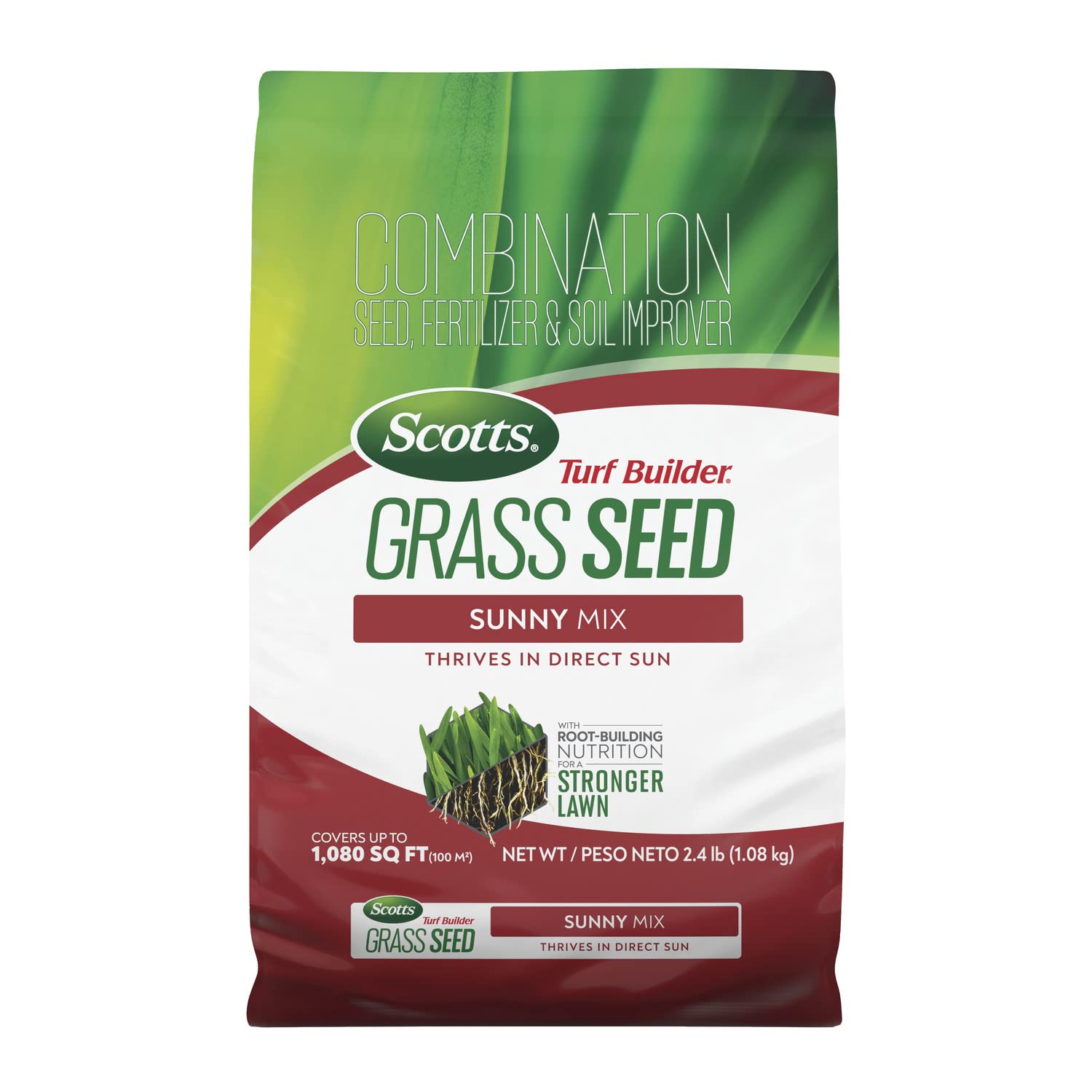
This Scotts product combines seed, fertilizer, and soil improver in one bag — a convenience that simplifies the planting process for homeowners filling bare spots or overseeding existing lawns. The Root-Building Nutrition formula encourages deep root development, which is especially beneficial in Texas’s compacted clay soils where drainage is poor. It’s designed for full sun to light shade areas, with medium to high drought resistance once established.
Customer feedback is generally positive, with many users reporting fast germination and strong growth even during drought conditions. One reviewer noted it took 3 months but successfully established grass on pavement-scraped ground covered with 2 inches of dirt, covering a 60×25 foot area with a single bag. The 2.4-pound bag covers 360 square feet for new lawns or 1,080 square feet for overseeding, making it suitable for small to medium patches rather than whole-lawn installation.
This is not a pure Bermuda seed — it’s a mix of grass types, so it won’t produce the same uniform Bermuda look. It also requires regular watering during establishment, which may conflict with local water restrictions in Texas during summer. For quick patch repairs where convenience matters more than species purity, this is a solid mid-range option.
Why it’s great
- All-in-one seed, fertilizer, and soil improver
- Fast germination in full sun conditions
- Root-Building Nutrition for clay soil
Good to know
- Not pure Bermuda — mixed grass types
- Small bag size limits whole-lawn use
6. Scotts Kentucky 31 Grass Seed Mix
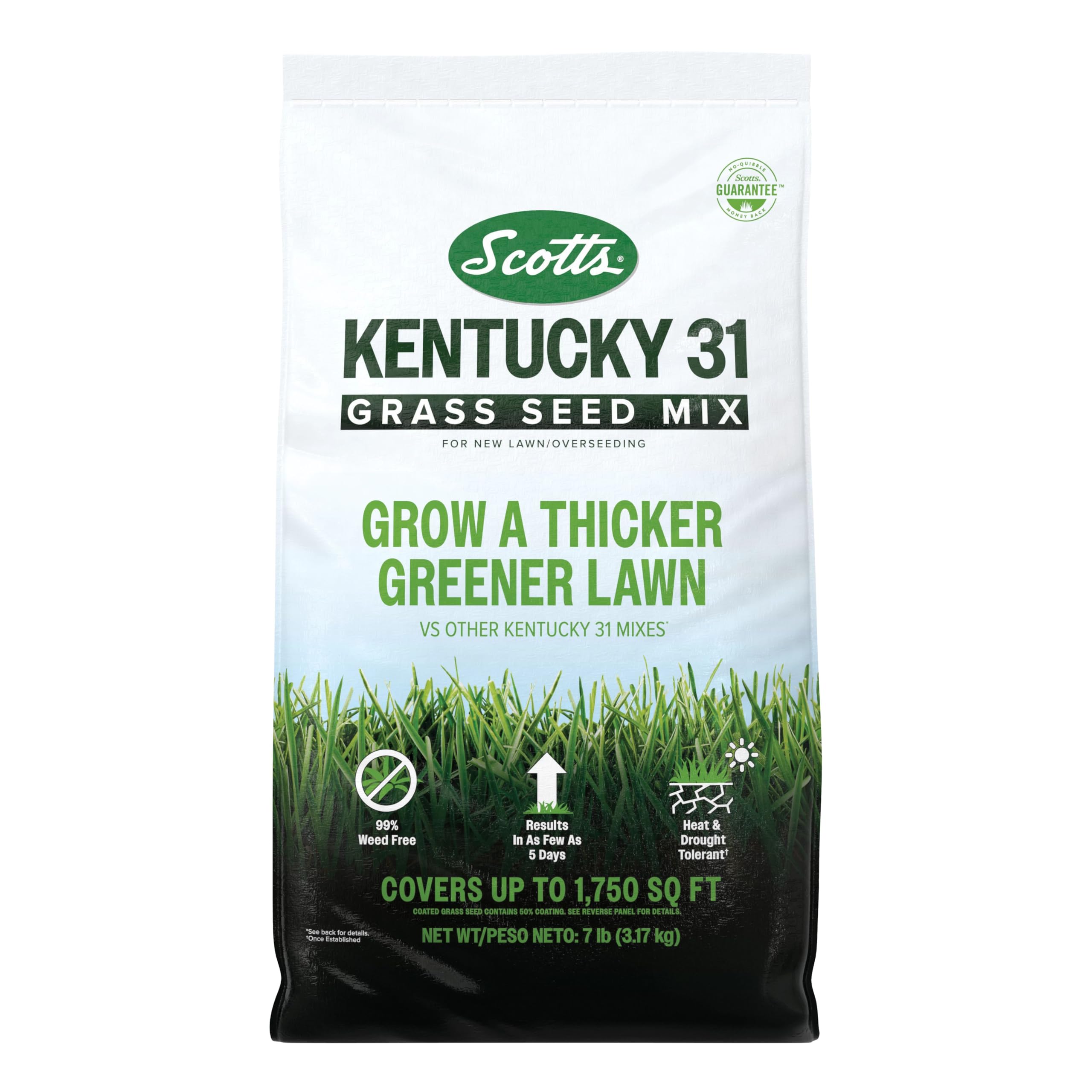
This is a tall fescue blend, not Bermuda, but it earns a place here for Texas homeowners with shaded yards where Bermuda cannot survive. The blend includes premium tall fescue (dense, dark green, heat-tolerant), annual ryegrass (quick germination), and Kentucky 31 tall fescue (durable, low-maintenance). It tolerates full sun to moderate shade and is 99% weed-free. The coverage is generous — a 7-pound bag covers up to 1,750 square feet for overseeding.
Customer reviews from the South are overwhelmingly positive. One user in Northern Virginia transformed a 40-foot bare pathway into a lush green carpet within weeks after four years of failures with other seeds. A North Florida user reported a full lawn from bare earth to thick coverage in 5 weeks. The seed germinates quickly — some users saw results in 5 days — and it holds up well to heat and moderate foot traffic.
Some users noted the bag includes a special coating that reduces actual seed weight, and a few experienced zero germination. Tall fescue requires more water than established Bermuda and may thin out during prolonged Texas droughts. It also goes dormant in extreme heat, unlike Bermuda which thrives in it. For shaded lawns or those in the cooler northern Texas regions, this is a cost-effective alternative.
Why it’s great
- 99% weed-free with fast germination
- Tolerates moderate shade where Bermuda fails
- Large coverage per bag — great value
Good to know
- Not Bermuda — requires more water
- Coating reduces actual seed weight
7. Jonathan Green Black Beauty Heat & Drought

Jonathan Green’s Black Beauty mix combines tall fescue and Texas bluegrass — a unique combination designed to tolerate heat up to 100°F while maintaining the dark green color typical of cool-season lawns. The grass develops a waxy leaf coating that reduces moisture evaporation, and roots can reach 4 feet deep, giving it drought resistance far beyond typical fescue. This makes it a viable option for Texas homeowners who want a green lawn year-round without the brown winter dormancy of Bermuda.
Users in the Carolinas reported beautiful results, with seed sprouting in 7 days and filling in by day 14 when combined with proper soil prep. The 3-pound bag covers up to 750 square feet for new lawns or 1,500 square feet for overseeding. It’s designed for full sun to lightly shaded conditions, and the recommended planting windows (mid-August to mid-October, or mid-March through mid-May) align with Texas’s milder seasons.
Several customers reported zero germination despite following instructions, and one noted the bag was insufficient for the claimed coverage area. Cool-season grasses require consistent fall and spring watering in Texas, and may struggle during extended 100°F+ heat waves. For homeowners who dislike Bermuda’s winter brown-out and want a deep-rooted green lawn that handles moderate heat, this is the best cool-season alternative.
Why it’s great
- Waxy leaf coating reduces water needs
- Roots reach 4 feet deep for drought tolerance
- Stays green year-round unlike Bermuda
Good to know
- Some batches show zero germination
- Not for full Texas sun in extreme heat
FAQ
Can I plant Bermuda grass seed in Texas during summer?
Why does my Bermuda grass turn brown in winter in Texas?
How often should I water new Bermuda seed in Texas heat?
Final Thoughts: The Verdict
For most Texas homeowners, the bermuda grass seed for texas winner is the Outsidepride Oasis Bermuda because its hybrid blend offers the best combination of heat tolerance, weed suppression, and reliable germination across Texas climate zones. If you want a fine-textured, golf-course look with superior cold tolerance for northern Texas, grab the Outsidepride Maya Blackjack II. And for Panhandle homeowners who need cold-tolerant genetics that survive hard freezes, nothing beats the Pennington Bermuda with its Penkoted technology and improved winter hardiness.