
Our readers keep the lights on and the weekend projects moving. As an Amazon Associate, I earn from qualifying purchases.
The difference between a thin, patchy lawn and a carpet of deep green starts with the seed you put down. Warm-season grasses demand the right genetics to handle relentless sun, foot traffic, and dry spells without turning into a weed haven.
I’m Rikta — the founder and writer behind FitlyFast. I’ve analyzed hundreds of seed formulations, germination rates, and real-world customer results to find the varieties that actually deliver a thick, self-repairing lawn.
After weeks of comparing germination times, cold tolerance, and coverage specs, I’ve narrowed the market to seven top contenders to help you find the best bermuda grass seed for your specific lawn conditions and climate zone.
How To Choose The Best Bermuda Grass Seed
Bermuda grass thrives on heat and sun, but not every bag of seed is built the same. The key factors that separate a lush lawn from a weedy disappointment are seed type, purity, and how the seed is processed before it reaches your spreader.
Hulled vs. Unhulled Seed
Unhulled seed retains its outer husk, which protects the embryo and extends the planting window into cooler soil temps. Hulled seed germinates faster because the protective layer is stripped off, but it requires warmer soil (above 70°F) and more careful moisture management. For spring seeding, unhulled gives you a wider safety margin.
Cold Tolerance and Dormancy
Standard Bermuda grass goes dormant and turns brown the moment nighttime temps dip below 50°F. Improved varieties like Blackjack II and Pennington’s cold-tolerant blend extend green color into early fall and recover faster after a mild frost. If your area sees occasional fall chills, cold tolerance is worth the premium.
Coated vs. Raw Seed
Coated seeds have a clay or polymer layer that holds moisture around the kernel during the critical first days of germination. This is a genuine advantage in sandy soil or when you can’t water twice daily. Raw seed is cheaper per pound but demands more precise moisture management and higher seeding rates to achieve the same coverage.
Quick Comparison
On smaller screens, swipe sideways to see the full table.
| Model | Category | Best For | Key Spec | Amazon |
|---|---|---|---|---|
| Outsidepride Maya (Blackjack II) | Hybrid | Dense, fine-textured turf | Cold-tolerant hybrid | Amazon |
| Outsidepride Oasis | Hybrid Blend | High traffic & sports turf | 3-variety hybrid blend | Amazon |
| Pennington Bermuda | Common | Cold-tolerant self-spreading | Penkoted technology | Amazon |
| Scotts Turf Builder Sun & Shade | Blend | Versatile sun/shade lawns | Root-Building Nutrition | Amazon |
| X-Seed Unhulled Bermuda | Unhulled | Wide planting window | Unhulled, GMO Free | Amazon |
| Scotts Turf Builder Sunny Mix | Mix | Full sun coverage | Fertilizer + soil improver | Amazon |
| Pennington Annual Ryegrass | Annual | Winter overseeding | Germinates in 3-7 days | Amazon |
In‑Depth Reviews
1. Outsidepride Maya (Blackjack II) Bermuda Grass Seed

The Maya Blackjack II is a hybrid Bermuda that delivers the fine-bladed, carpet-like texture you’d expect from a golf course fairway. Its cold tolerance is a genuine differentiator — this seed holds its color longer into the autumn than standard common Bermuda, giving you weeks of extra green when other lawns have already browned out.
Coated seeds improve moisture retention around the kernel, which explains why germination reports cluster around day 7 with proper watering. The coating also makes it easier to spread evenly through a rotary spreader without clumping. It demands the same strict soil prep — till six inches, test pH, keep topsoil constantly moist — but the payoff is a dense turf that crowds out annual weeds by mid-summer.
Customer experiences split sharply: those who follow the deep soil prep and daily misting see excellent results, while those who scatter and hope often report failure. This is not a toss-and-go seed. For the homeowner willing to invest the first three weeks of careful watering, the Blackjack II produces a lawn that rivals professional sod installation.
Why it’s great
- Cold-tolerant hybrid extends green season into fall
- Coated seed improves moisture retention during germination
- Fine texture creates dense, weed-suppressing turf
Good to know
- Requires strict soil prep and consistent moisture for success
- Customer service response is inconsistent on failed batches
2. Outsidepride Oasis Bermuda Grass Seed

The Oasis blend combines three top-performing Bermuda varieties into one bag, creating genetic diversity that helps the lawn resist disease and recover from wear. This is the seed to choose for high-traffic zones — backyards with kids, dog runs, or the path from the driveway to the front door. The blend’s aggressive growth habit fills in bare spots faster than a single-variety seed.
Drought tolerance is a standout feature of this mix. The Oasis blend maintains color with less frequent irrigation once established, which matters for homeowners in water-restricted areas or those who travel during summer. Seeding rate is 2-3 pounds per 1,000 square feet, and the hybrid vigor means you can drop to the lower end of that range without sacrificing coverage density.
Germination reports are mixed — some users see sprouting within 7 days, others report slow or zero germination after two weeks. The variability often traces back to soil temperature at planting; if the ground hasn’t reached a consistent 65°F, even good seed stays dormant. Use a soil thermometer before you spread, and the results become far more predictable.
Why it’s great
- Three-variety blend improves disease resistance and recovery
- Excellent drought tolerance once established
- Aggressive growth fills bare spots quickly
Good to know
- Requires consistent soil temps above 65°F for reliable germination
- Some batches show lower germination rates in cool conditions
3. Pennington Bermudagrass Grass Seed

Pennington brings its exclusive Penkoted technology to this Bermuda seed, a fungicide coating that protects the seed from soil-borne diseases during the vulnerable germination window. This is especially valuable when planting into less-than-ideal soil or when you can’t time the seeding perfectly before a rain event. The cold-tolerant varieties bred into this blend push the survival zone a bit further north than typical common Bermuda.
The self-spreading nature of this seed is its real selling point. Runners (stolons and rhizomes) extend aggressively, filling in gaps without needing a second overseeding pass. The low-growing growth habit also means fewer clippings, which reduces the need for bagging during the peak growing season. Expect a 5-pound bag to cover roughly 1,000 square feet at the standard seeding rate.
Germination requires patience — most successful reports describe emergence starting around day 10 to 14 with twice-daily watering, not the 5-7 day window some premium hybrids advertise. The trade-off is a deeper root system that makes the lawn genuinely drought-hardy once established. Florida and Gulf Coast users report excellent results converting weed beds into uniform turf.
Why it’s great
- Penkoted coating protects against damping-off diseases
- Aggressive self-spreading reduces overseeding needs
- Low-growing habit produces fewer clippings
Good to know
- Germination is slower than hybrid varieties
- Some batches have reported zero germination with identical care
4. Scotts Turf Builder Grass Seed Sun and Shade Mix

Scotts wraps seed, fertilizer, and soil improver into a single bag — a convenience play for homeowners who want to skip the separate starter fertilizer step. The Sun and Shade blend is formulated to handle moderate shade, which is rare for warm-season grasses. If your lawn has a tree line or northern exposure that filters afternoon light, this mix gives you better odds than straight Bermuda.
The Root-Building Nutrition formula uses a slow-release nitrogen source that feeds the seedling for several weeks without burning. Coverage is generous: one 5.6-pound bag overseeds up to 2,240 square feet. Customers note the grass feels soft underfoot, more like a carpet than the stiff blades of common Bermuda, which makes it a good candidate for barefoot-friendly yards.
Recent batches have drawn complaints about weed content, specifically crabgrass coming up with the seed. This appears to be a quality-control variance — earlier bags from the same product line had cleaner germination. If you choose this seed, consider a pre-emergent application a few weeks before planting to keep contaminants from establishing alongside the turf.
Why it’s great
- All-in-one seed, fertilizer, and soil improver saves a step
- Tolerates moderate shade better than standard Bermuda
- Soft texture ideal for family lawns
Good to know
- Germination is slower than straight Bermuda seed
- Recent bags show inconsistent weed content
5. X-Seed Unhulled Bermuda Grass Seed

The unhulled seed from X-Seed keeps its natural husk, which acts as a protective buffer against temperature swings and uneven moisture. This makes it a safer choice for early-spring planting when soil temps hover around 65°F and a late cold snap could kill a hulled seed. The expected germination window is 15-21 days — slower than coated or hulled options, but with a higher survival rate when conditions aren’t perfect.
GMO-free labeling matters for gardeners who prioritize non-modified genetics. The seed produces standard common Bermuda, not a hybrid, which means it won’t have the extreme cold tolerance or ultra-fine blade of a Blackjack II variety, but it will spread reliably and handle the deep south’s summer humidity without complaint. The 1-pound bag size is best for small patch repair rather than full-lawn renovation.
Reviews reveal a polarizing pattern: users who follow the strict 1/4-inch planting depth and daily watering routine see strong results, while those who scatter on the surface report poor germination. There are also isolated complaints about weeds emerging with the seed, suggesting batch variability in purity. For small-area repairs where you can control conditions carefully, this seed performs.
Why it’s great
- Unhulled seed offers a wider safe planting window
- GMO free for natural gardening preferences
- Dependable growth in deep south humidity
Good to know
- Germination takes 15-21 days even under ideal conditions
- Small 1-pound bag is limited to patch repair
6. Scotts Turf Builder Grass Seed Sunny Mix
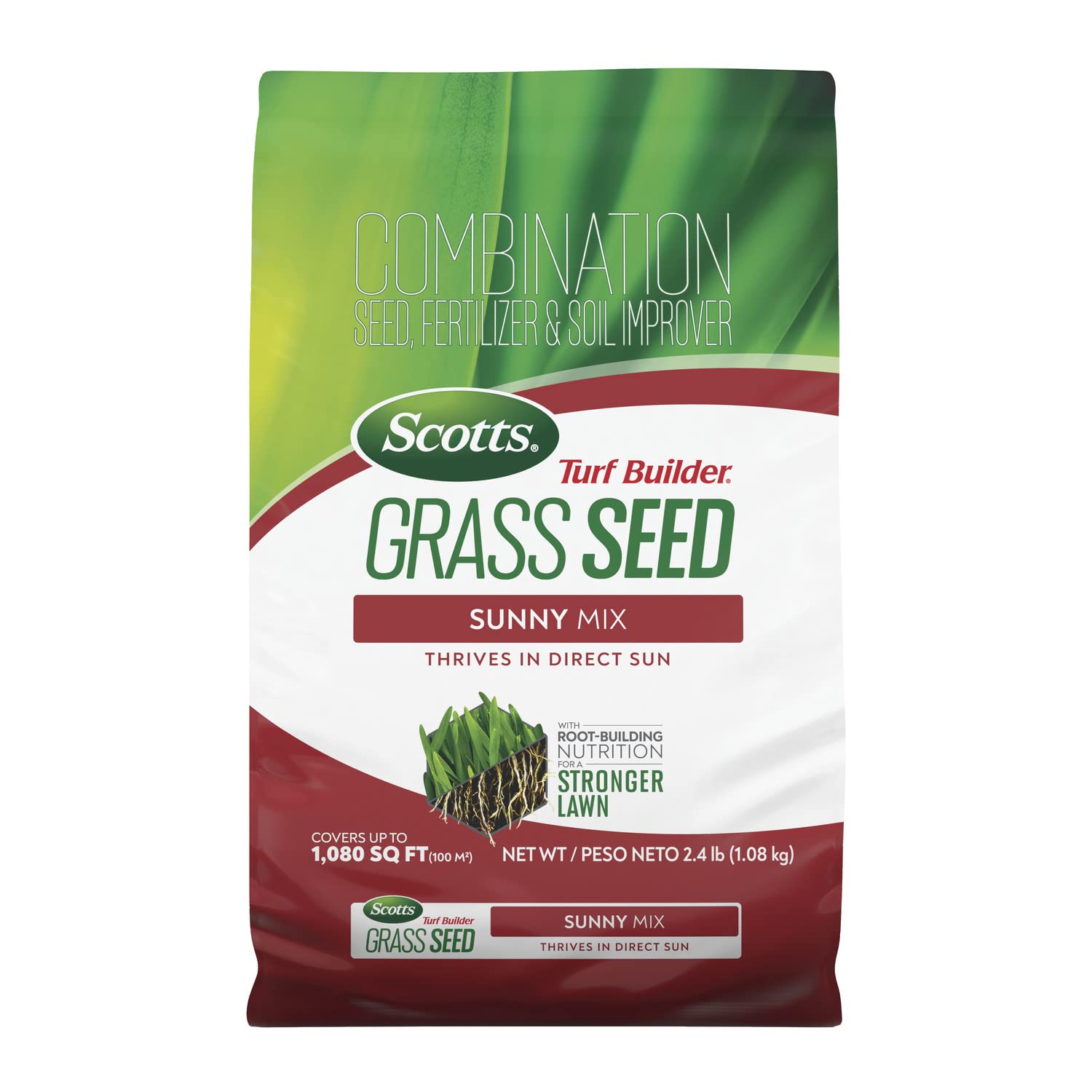
The Sunny Mix is Scotts’ entry-level warm-season blend designed for full-sun lawns that receive at least 6-8 hours of direct light daily. It integrates a turf-building fertilizer directly into the seed mix, which gives emerging seedlings a steady supply of phosphorus for root development without a separate application. A single 2.4-pound bag overseeds up to 1,080 square feet, making it economical for large-area coverage.
This mix includes multiple grass species, not pure Bermuda, which limits its ability to form that dense, uniform carpet pure Bermuda fans expect. The trade-off is better resilience in varying soil types and a faster green-up in early spring. Customers consistently report seeing growth within 10-14 days with consistent watering, and the drought resistance holds up well once the lawn reaches its second mowing.
User feedback is overwhelmingly positive for straightforward use cases — scattering on bare dirt, watering, and watching it fill in. One customer noted it took three months to fully cover a scraped-pavement area with only two inches of topsoil, which speaks to the seed’s persistence in tough conditions. It won’t win a beauty contest against a hybrid Bermuda, but for budget-conscious homeowners, it gets the job done.
Why it’s great
- Fertilizer integrated into the seed saves effort
- Large coverage area per bag for the cost
- Proven persistence in poor soil conditions
Good to know
- Mixed species won’t create a pure Bermuda lawn
- Slower to establish than hybrid Bermuda varieties
7. Pennington Annual Ryegrass Grass Seed

Annual ryegrass is not Bermuda, but it serves the essential role of winter overseeding for warm-season lawns that go dormant and turn brown from November through March. Pennington’s annual rye germinates in 3-7 days and provides green coverage throughout the cool months, then dies off naturally in late spring as the soil warms and the Bermuda re-emerges. One 10-pound bag covers up to 2,000 square feet.
The texture is visibly coarser than fine-bladed Bermuda, so it won’t match the manicured look of your summer turf. However, it holds up well under foot traffic and suppresses winter weeds that would otherwise take over bare soil. Users in zone 8 report successful germination even with December planting, though earlier sowing yields thicker coverage before the first hard freeze.
Some customers expect a permanent lawn and are disappointed when the rye fades in May. This product is explicitly a temporary solution — a winter blanket for an otherwise brown lawn. Paired with a spring transition plan, it gives you 12 months of green without committing to a cool-season grass that would struggle in southern summers.
Why it’s great
- Germinates in 3-7 days for quick winter green
- Large 10-pound bag covers 2,000 square feet
- Suppresses winter weeds in dormant Bermuda lawns
Good to know
- Coarser texture than Bermuda — not a match aesthetic
- Dies off in late spring; requires re-seeding annually
FAQ
How long does Bermuda grass seed take to germinate?
Can I plant Bermuda grass seed in the shade?
What is the difference between common Bermuda and hybrid Bermuda seed?
Why did my Bermuda seed not germinate?
Final Thoughts: The Verdict
For most users, the best bermuda grass seed winner is the Outsidepride Maya (Blackjack II) because its cold-tolerant hybrid genetics and coated seed deliver a fine-textured, dense turf that holds green longer into fall. If you want a high-traffic blend that recovers fast from wear, grab the Outsidepride Oasis. And for winter overseeding to keep your lawn green year-round, nothing beats the Pennington Annual Ryegrass for speed and coverage value.