
Our readers keep the lights on and the weekend projects moving. As an Amazon Associate, I earn from qualifying purchases.
You water your blueberry bushes, prune the raspberry canes, and watch for pests, yet the payoff is a handful of sour, undersized fruit instead of the overflowing harvest you imagined. The difference between a meager yield and a bountiful berry patch often comes down to one factor: the nutrition you feed the soil. Unlike general-purpose plant food, a proper berry fertilizer must match the specific acid-loving, fruit-producing chemistry of these plants, which means getting the nitrogen, phosphorus, and potassium balance exactly right.
I’m Rikta — the co-founder and writer behind FitlyFast. I’ve spent countless hours analyzing soil amendment data, comparing NPK ratios, and reading through hundreds of grower experiences on how different formulations affect brix levels, root mass, and fruit set in berry canes and bushes.
To help you cut through the shelf of bags and bottles, I assembled this guide to the best berry fertilizer options on the market, from fast-acting liquids to long-release organics. Whether you are planting a new patch or reviving an old one, knowing what to pour on the ground is the most direct path to a bigger berry harvest. this guide ranks the best berry fertilizer for bigger, sweeter crops.
How To Choose The Best Berry Fertilizer
Berry bushes are heavy feeders, but they are also sensitive to over-fertilization, especially with nitrogen. The wrong fertilizer can push all growth into leaves and canes while leaving the fruit small and tasteless. Understanding two things — the NPK ratio and the soil pH — will determine whether your plants produce or just survive.
The Right NPK Ratio for Berries
Most berry plants, including blueberries, raspberries, and blackberries, benefit from a balanced or slightly lower-nitrogen formula such as 4-3-4 or 10-10-10. Excess nitrogen triggers lush foliage at the expense of flowers and fruit formation. Phosphorus supports root development and fruit set, while potassium improves berry size, sugar content, and disease resistance. For blueberries specifically, formulations with added sulfur help maintain the acidic soil pH (4.5 to 5.5) these plants require to access iron and other micronutrients.
Granular vs. Liquid vs. Water-Soluble
Granular fertilizers, like the Espoma Berry-tone, release nutrients slowly and are ideal for pre-planting and top-dressing established beds. They feed the soil microbiology and reduce the risk of burning roots. Liquid fertilizers, such as the TPS Nutrients Blueberry Fertilizer, act faster and are excellent for giving a struggling plant a quick boost or for container-grown berries where nutrients leach out faster. Water-soluble powders, like Miracle-Gro for acid-loving plants, offer middle-ground convenience but require frequent re-application every one to two weeks.
Quick Comparison
On smaller screens, swipe sideways to see the full table.
| Model | Category | Best For | Key Spec | Amazon |
|---|---|---|---|---|
| Espoma Berry-tone | Organic Granules | All-around berry feeding | 4-3-4 with Bio-tone | Amazon |
| Espoma Holly-tone | Organic Granules | Acid-loving berries & shrubs | 4-3-4 with 5% Sulfur | Amazon |
| TPS Nutrients Blueberry Fertilizer | Liquid Concentrate | Quick blueberry recovery | 32 fl oz concentrate | Amazon |
| Miracle-Gro Water Soluble | Water-Soluble Powder | Fast green-up and blooms | 5 lb powder | Amazon |
| Dr. Earth Acid Lovers | Organic Granules | Non-GMO & pet-safe feeding | 0.3-0.4-3 formula | Amazon |
| Down To Earth Fruit Tree | Organic Powder | Berry shrubs & brambles | 6-2-4 + Calcium | Amazon |
| Down To Earth Feather Meal | Slow-Release Nitrogen | Nitrogen boost for heavy feeders | 12-0-0, 20 lb | Amazon |
In‑Depth Reviews
1. Espoma Berry-tone 4-3-4
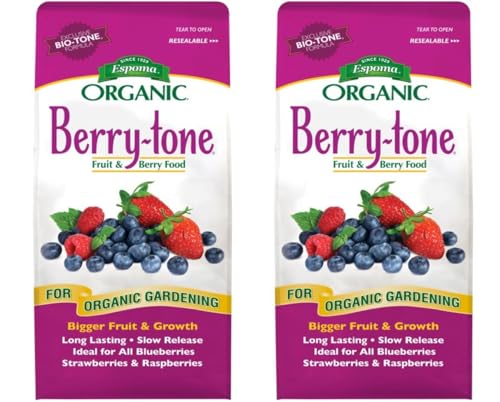
The Espoma Berry-tone is a purpose-built organic granular fertilizer designed specifically for fruiting plants like blueberries, strawberries, raspberries, and blackberries. Its 4-3-4 N-P-K analysis is low in nitrogen to prevent excessive leafy growth, which directly supports flower formation and fruit development. The inclusion of Espoma’s proprietary Bio-tone formula introduces beneficial microbes that help break down organic matter in the soil, making nutrients more available to the root zone over time.
This product requires no mixing — you simply sprinkle the granules around the drip line of the plant and water them in. The manufacturer recommends feeding twice per year, once in early spring and again in late spring, making it a low-maintenance option for gardeners who want set-and-forget feeding. Each bag covers a substantial area, and the 4-pound size is sufficient for multiple bushes or a modest strawberry patch.
Real-world reports confirm its effectiveness: one user saw a dramatic blackberry yield increase after switching to Berry-tone, while another noted that forgetting to apply it resulted in very few flowers. The slow-release granular form is especially well-suited for soil-based gardening where microbial activity is key.
Why it’s great
- Tailored 4-3-4 ratio for berry fruiting
- Added Bio-tone microbes improve soil health
- No mixing, simple twice-yearly application
Good to know
- Two 4 lb bags may be excessive for small patches
- Requires good soil moisture for granule activation
2. Espoma Organic Holly-tone 4-3-4

While Berry-tone is the targeted choice, Holly-tone is the larger, more versatile cousin that covers all acid-loving plants including blueberries, strawberries, and evergreens. With the same 4-3-4 N-P-K analysis but a 36-pound bag, this is the best option for those with extensive berry patches, multiple acid-loving shrubs, or a need to feed both blueberries and azaleas from the same bucket. The 5% sulfur content is critical: it helps maintain the low soil pH between 4.5 and 5.5 that blueberry bushes require for optimal nutrient absorption.
Like Berry-tone, this is a granular, ready-to-use formula that you sprinkle and water in. The slow-release organic ingredients break down over several months, providing a steady supply of nutrients through the growing season. The bags are large and economical for the coverage they provide — one reviewer noted they buy it every year for consistent results with their magnolias and flowering shrubs.
Customer feedback highlights near-miraculous bloom results on azaleas and hydrangeas, and users report that the product is particularly effective on blueberry bushes that have struggled in neutral or alkaline soils. If you are managing a diverse berry plot with blueberries as the cornerstone, this is the most cost-effective bulk choice.
Why it’s great
- Bulk 36 lb bag for large gardens
- High sulfur content for soil acidification
- Feed both berries and ornamentals
Good to know
- Overkill for a single blueberry bush
- Heavy bag, requires strength to move
3. TPS Nutrients Blueberry Fertilizer
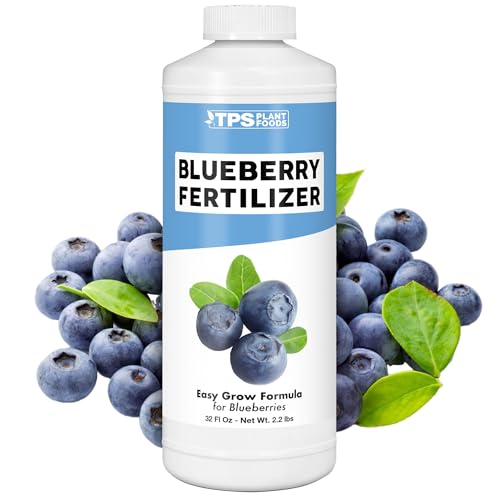
For berry growers who want immediate results, especially for container-grown blueberries or plants showing signs of stress, the TPS Nutrients liquid fertilizer delivers nutrients directly to the roots within days. Mix a few tablespoons per gallon of water and apply as a soil drench. The liquid form bypasses the slow microbial breakdown required by granules, making it ideal for rescuing a struggling bush or giving a young plant a strong start.
This product is specifically formulated for blueberry plants, supporting fruit production and root strength. One user reported that a dying blueberry bush perked up in just a couple of days after application, while another successfully propagated stem cuttings into small plants using this fertilizer. The 32-ounce bottle concentrates significantly — a single bottle can make many gallons of feed, covering multiple plants through the season.
One important caveat: the liquid does not appear to lower soil pH significantly on its own. If your soil is alkaline, you will need to supplement with an acidifying agent like pine wood chip mulch or elemental sulfur. This fertilizer works best as a supplemental feed in already acidic conditions or for hydroponic and container setups where pH is manually controlled.
Why it’s great
- Fast-acting liquid for quick plant recovery
- Excellent for container and raised bed berries
- High concentration value per bottle
Good to know
- Does not significantly lower soil pH
- Requires mixing and more frequent application
4. Miracle-Gro Water Soluble Azalea, Camellia, Rhododendron Plant Food

The Miracle-Gro Water Soluble formula is designed specifically for acid-loving plants, making it a suitable match for blueberries, raspberries, and other berry crops that prefer lower pH conditions. The powder dissolves instantly in water and can be applied with a watering can or a hose-end feeder. Its target species list includes gardenias, hydrangeas, and orchids, confirming its acid-biased formulation.
Users report visible greening within a week and impressive bloom results on camellias and rhododendrons. Many berry growers use it on their blueberry bushes with good results, noting that it is a convenient and affordable option that does not burn foliage when used according to the label. The three-pound bag is manageable and stores well in a dry place.
A common gripe is the poor bag closure system — the adhesive strip does not reseal effectively, forcing many users to transfer the powder to a separate container or use a clip. Compared to the organics on this list, this is a synthetic fertilizer, so it feeds the plant directly rather than building long-term soil biology. It is best used as a supplement for immediate nutrition needs in established berry patches.
Why it’s great
- Fast-acting, dissolves instantly in water
- Suitable for all acid-loving berry plants
- Easy to apply via watering can or hose
Good to know
- Bag closure is unreliable
- Synthetic formula, less soil-building than organics
5. Dr. Earth Acid Lovers 0.3-0.4-3

Dr. Earth Acid Lovers is the only Non-GMO Project Verified fertilizer in the United States, and it is handcrafted from human and feed-grade ingredients. Its unique 0.3-0.4-3 analysis is extremely low in nitrogen and phosphorus but rich in potassium, which supports fruit quality and disease resistance. The formula is designed for acid-loving plants like azaleas, camellias, rhododendrons, and maples, though it can be used around berry bushes in combination with a nitrogen source.
This product is OMRI-listed and CCOF-certified for organic production, and the manufacturer explicitly states it is people and pet safe, with no synthetic chemicals or GMO-infested chicken manure. Customers report dramatic results: one user’s gardenia bloomed better than ever, while a rhododendron that had not flowered in two years produced huge pink blossoms shortly after application.
Because of its low nitrogen content, this fertilizer is best used as a potassium and micronutrient booster rather than a standalone berry feed. For established berry patches that need a potassium push for fruit sweetness, it is an excellent supplement. The 4-pound bag covers a modest area.
Why it’s great
- Non-GMO verified and OMRI-listed
- Safe around children and pets
- Great for reviving blooming shrubs
Good to know
- Very low nitrogen, not a complete berry feed alone
- Small bag for the price point
6. Down To Earth Organic Fruit Tree 6-2-4

Though its name targets fruit trees, the Down To Earth 6-2-4 formula is effective for berry shrubs and brambles as well. The higher nitrogen count supports vigorous cane growth in raspberries and blackberries, while the phosphorus and potassium work together for fruit set and development. Added calcium is a key feature — it aids cell wall structure in developing fruit, reducing issues like blossom end rot in berries that are prone to it.
The ingredients list includes feather meal, fish bone meal, kelp meal, and alfalfa meal, all organic sources that release nutrients gradually. One user revived a struggling crabapple tree that had no leaves or fruit for two years, with it now producing healthy foliage and many berries. The five-pound box is compact but covers multiple bushes or a small orchard.
Since this is not specifically formulated for acid lovers, it works best on berries that tolerate a wider pH range, such as raspberries and blackberries. For blueberries, you will need to supplement with an acidifier. It is an excellent choice for mixed berry patches that include both cane berries and fruit trees.
Why it’s great
- Higher nitrogen for cane and bush growth
- Added calcium for fruit quality
- Versatile for berries and fruit trees
Good to know
- Not acid-specific, not ideal for blueberries alone
- Powder form can be dusty during application
7. Down To Earth Feather Meal 12-0-0
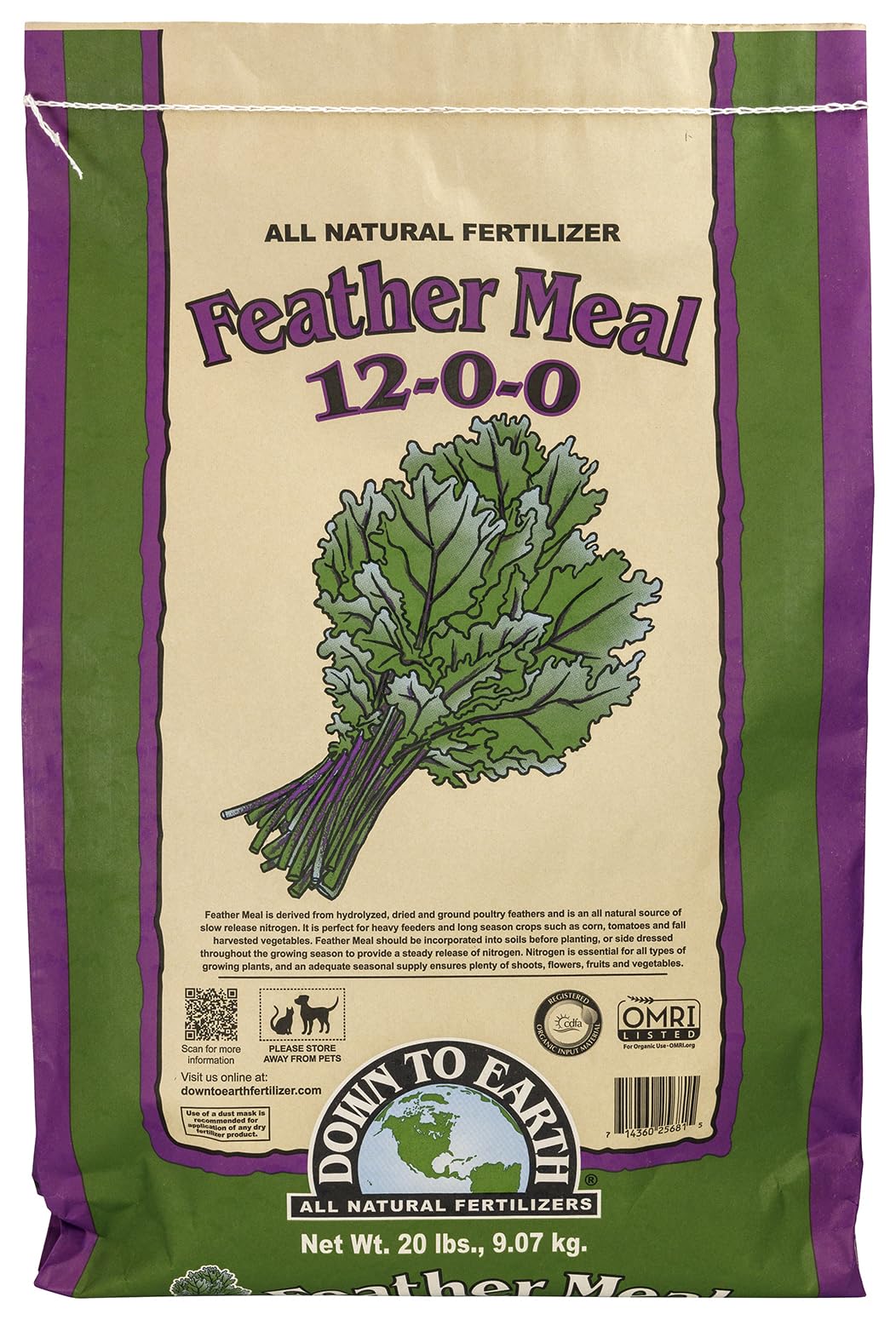
The Down To Earth Feather Meal is a straight 12-0-0 nitrogen source derived from hydrolyzed poultry feathers. This is not a complete berry fertilizer — it is a targeted nitrogen supplement for heavy-feeding crops that need a green growth push. For berry patches, it is useful when applied in early spring to fuel cane and leaf development, before switching to a balanced formula during fruiting.
As a slow-release organic nitrogen, it breaks down gradually over several weeks to months, depending on soil temperature and moisture. The 20-pound bag is substantial and very economical for large gardens. Users note that it works exceptionally well on corn, tomatoes, and other nitrogen-hungry vegetables, and that it has the added benefit of acting as a deer repellent due to its strong odor.
The smell is the most frequently mentioned drawback — several users describe it as extremely foul, which is normal for feather meal. This makes it unsuitable for application near patios or heavily trafficked areas. If you are managing a large berry patch and need a cost-effective nitrogen source, this is a solid option, but it requires careful timing to avoid pushing leafy growth at the expense of fruit.
Why it’s great
- Very cost-effective per pound of nitrogen
- Slow-release, feeds for weeks
- Natural deer repellent property
Good to know
- Extremely strong, unpleasant odor
- Not a complete fertilizer, must be balanced with PK
FAQ
Can I use a general all-purpose fertilizer on my blueberry bushes?
How often should I apply granular berry fertilizer during the growing season?
What is the difference between water-soluble and granular fertilizer for berries?
Final Thoughts: The Verdict
For most users, the best berry fertilizer winner is the Espoma Berry-tone because its 4-3-4 ratio, Bio-tone formula, and easy granular application make it a perfect fit for blueberries, strawberries, raspberries, and blackberries. If you have a large patch of acid-loving plants and want the best value per pound, grab the Espoma Holly-tone. And for a fast-acting rescue of a struggling blueberry bush in a container, nothing beats the TPS Nutrients Blueberry Fertilizer.