
Our readers keep the lights on and the weekend projects moving. As an Amazon Associate, I earn from qualifying purchases.
Specs are compiled from manufacturer listings and verified buyer reviews and can change over time — please confirm the key details on the product page before buying.
A betta’s mouth is roughly the size of a pencil tip, yet most pellets on the shelf are closer to a pea. That mismatch is the single reason finicky fish refuse to eat and water quality takes a hit from uneaten food sinking to the bottom. This guide cuts through the packaging claims to show you exactly which pellets fit a betta’s small mouth, float long enough for a surface-feeder to strike, and deliver the high-protein diet these fish were built for.
I’m Rikta — the founder and writer behind FitlyFast. This guide is built by comparing the manufacturers’ published specifications and the patterns across verified customer reviews, so you get each pick’s real strengths and trade-offs instead of marketing spin.
The key is finding a pellet that balances size, buoyancy, and protein content without clouding the water. That is exactly what this roundup of the best betta fish pellets delivers — a shortlist you can trust at feeding time.
Our Picks at a Glance

How To Choose The Best Betta Fish Pellets
Bettas are obligate carnivores and surface feeders by nature. In the wild, they eat insects and larvae that land on the water. Your goal is to mimic that diet with a pellet that stays at the top, fits in a tiny mouth, and packs enough protein to maintain that brilliant color.
Pellet Size and Mouth Fit
An adult betta’s mouth opens to about 2–3 millimeters. A pellet any larger than that forces the fish to tear at it, often giving up and leaving the food to rot. The right pellet is small enough to be sucked in whole, which is why “baby” or “micro” sizing matters more than the brand name.
Floatability vs Sinking Speed
A betta’s upturned mouth is designed to grab food from the surface. Pellets that sink before the fish notices them land on the substrate where the betta may ignore them or accidentally ingest gravel while scavenging. Floating pellets that hold on the surface for at least 30 seconds give the fish its natural feeding window.
Protein Content and Ingredients
Look for whole fish or shrimp meal as the first ingredient, not wheat or soy fillers. A protein level around 40–56% supports fin growth and scale color without overtaxing the betta’s short digestive tract.
Quick Comparison
| Model | Best For | Pellet Size | Protein Content | Floatability | Amazon |
|---|---|---|---|---|---|
| Hikari Betta Bio-Gold Baby★ Best Overall | Small mouths & color enhancement | Baby (micro) | High (formulated) | Floats well | Amazon |
| Aqueon Color Enhancing BettaBest Value Pack | Budget 3-pack | Standard | Balanced | Mixed feedback | Amazon |
| Omega One Betta Variety Pack | Variety & whole ingredients | Standard | Whole salmon | Sinks fast | Amazon |
| A.D.P. Biomass High Protein | Fry & tiny nano fish | 400 microns | 56.4% | Slow sink | Amazon |
| Aquatic Foods Floating Pellets | Consistent buoyancy | 1mm | Whole plankton/krill | Floats long | Amazon |
In‑Depth Reviews
1. Hikari Betta Bio-Gold Baby Floating Fish Food Pellets
Our pick — over 4.5★ from 550+ verified ratings; the strongest balance of quality and price.
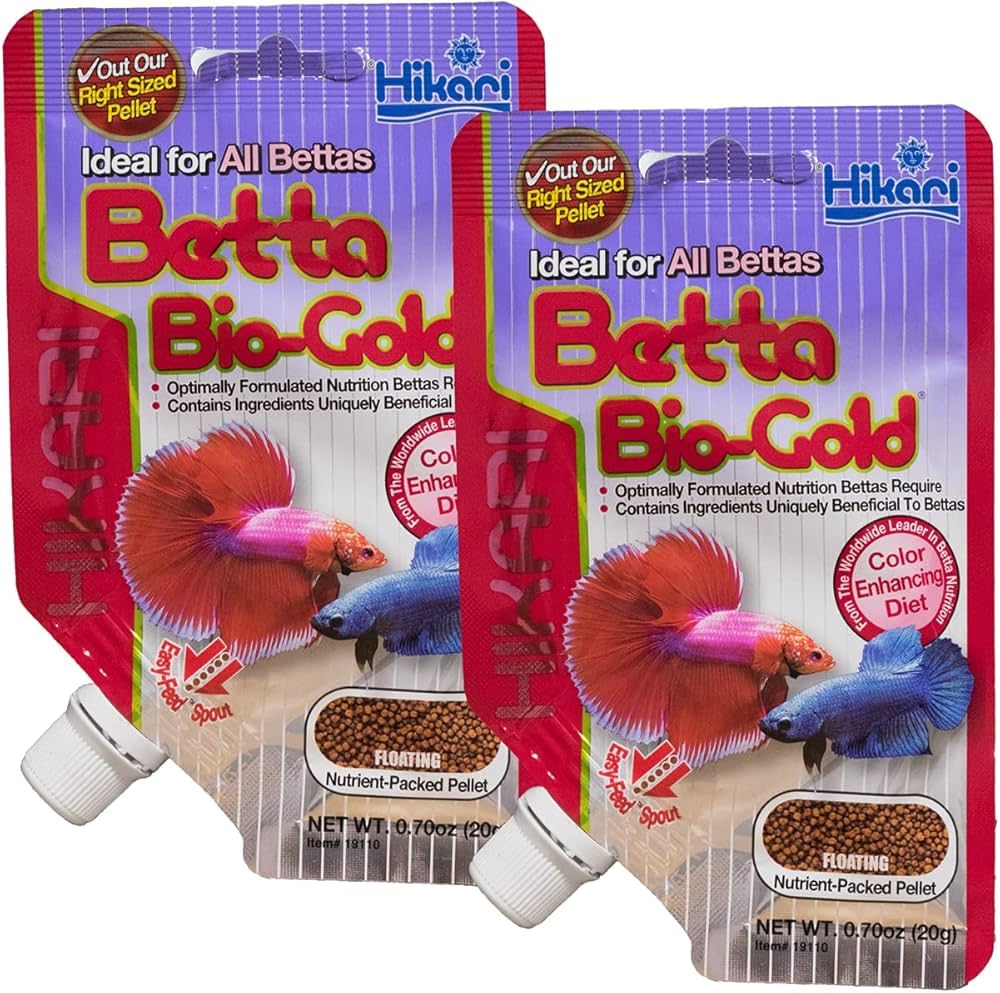
The micro-pellet that keeps fish colorful and water clear, sized for a betta’s tiny bite.
This is the crowd favorite for a reason — owners with picky eaters report that their bettas “go crazy for them,” jumping at feeding time rather than ignoring the food. The baby-size pellets are dramatically smaller than mass-produced alternatives, so a betta can inhale them whole without struggling. Buyers report that the color-enhancing diet, built around a superior protein source, leaves scales looking noticeably richer within a couple of weeks.
Because these are floating pellets that won’t cloud the water, you avoid the common frustration of food dissolving into a mess before the fish finds it. The two-pack gives you 0.7 oz per bag, and the control spout on the container prevents over-feeding — a small but real detail that helps beginners portion correctly.
At 19.87 g per bag these are a premium-tier weight (the variety pack below is three containers, but this one wins on size precision). The number one praise, mentioned by 33 owners, is the quality of the ingredients and how consistently the fish eat.
What owners love
- Pellet size is perfect for smaller betta mouths — the top detailed praise
- Floats for a while before sinking, giving the fish time to strike
- Value pack format at 2 x 0.7 oz is the only such bundle available
What to watch
- The dispensing spout gets mixed feedback for being slightly stiff
- Premium pricing per ounce vs bulk bags
Who it works for: Any betta owner whose fish is a picky surface-feeder — this is the pellet that gets eaten, not ignored.
Who might look further: Keepers with very large tanks or multiple bettas who need a bigger bag at a lower cost-per-gram.
2. Aqueon 3 Pack of Color Enhancing Betta Food Pellets
Three bottles of balanced nutrition for daily feeding while staying affordable.
This 3-pack gives you 0.95 oz per container — a total of 2.85 oz of pellet food formulated with shrimp and other ingredients bettas naturally crave. The balanced nutrition is designed for daily feeding, and the no-artificial-colors claim appeals to owners who want a clean ingredient list.
However, buyer experience splits here. The quality gets consistent thumbs-up (11 positive mentions), and the price-per-bottle is tough to top. But several owners point out that the pellets can be too large for a betta’s mouth — one buyer says “I can tell you that these pellets are too big for my Betta” and has to grind them by hand before feeding. Floatability also divides opinion: some report the pellets sink immediately while others say they drift down slowly.
The discrepancy likely comes from batch variation. If your betta has a larger mouth or you are willing to crush pellets between your fingers, this is a solid budget-friendly option. For a small or picky betta, the Hikari baby pellet is a safer bet.
Why it sells
- Three bottles for a low price, giving many weeks of food
- Does not cloud the water — owners praise it as “not messy”
- Shrimp protein is a natural betta attractant
Common caveat
- Pellet size is inconsistent — some batches run large for bettas
- Mixed floatability; a portion of the food sinks before the fish can grab it
Grab it if: You want a three-pack of everyday food and are comfortable checking pellet size at feeding time.
Pass if: Your betta is a fussy eater with a small mouth — the micro-pellets above are a better match.
3. Omega One Betta Combo, Variety Pack of 3

Three different flavors in one pack, built around whole salmon as the first ingredient.
This is a 50% bigger count than the Hikari two-pack, giving you three separate bags to rotate across feeding days. The all-life-stages formula means it works for adult bettas as well as fry, and the raw-diet style recipe uses whole salmon rather than meal, which provides essential fatty acids for fin health.
The honest trade-off is floatability. Owners consistently note that “the pellets do sink pretty fast,” which is a problem for a surface-feeding betta. Several owners mention their fish won’t eat the pellets once they hit the bottom. One owner rotates these daily and reports his betta loves all three flavors, but he has to work to make sure the fish grabs them before they sink.
If you feed in small pinches and your betta is an aggressive surface striker, the variety mix keeps meals interesting. For a slow or shy feeder, the sinking speed is a real hurdle you will have to manage by dropping one pellet at a time.
What stands out
- Three distinct flavors to rotate for dietary variety
- Whole salmon as the protein base is excellent for color and growth
- Suitable for community tanks with tetras and platies
The main friction
- Pellets sink fast — surface-feeding bettas may miss their meal
- Uneaten shrimp pieces can break down if not removed after 2-3 minutes
Reach for this if: You have a community tank with a betta plus tetras or catfish that will eat sinking food.
Think twice if: Your betta is the only fish and you want a pellet that stays floating long enough for a slow eater.
4. A.D.P. Biomass High Protein 56.4% Slow Sinking Pellets 400 Microns

A 56.4% protein micro-granule so tiny it looks like dust — purpose-built for newborn fry.
At 400 microns and a 100 g bag, this is the highest-protein option here and a 5.0x larger weight than the Hikari bag. The formula is designed in Thailand with a slow-sinking action, meaning it drifts downward gently rather than plummeting. That makes it suitable for mid-water feeders like tetras and gouramis as well as bettas.
However, the particle size is genuinely dust-like. Owners describe it as “like kosher salt,” which means it can get sucked into a filter if you are not careful. Several customers note the size changes between batches — one notes that an XS size in 2023 is now an S size in recent orders. This inconsistency is the biggest frustration for repeat purchasers. For adult bettas that are used to standard pellets, the dust may be too fine to trigger a feeding response.
Where this food shines is in a breeding setup with fry or very small nano fish. The high protein accelerates growth, and the clean-water formula does not cloud the tank. For a standard single-betta household, the microparticles are more hassle than help.
Where it wins
- 56.4% protein content is the highest in this roundup
- 100 g bag offers the best weight-to-price value
- Slow-sinking design works for a community of small fish
Where it trips up
- Batch-to-batch particle size inconsistency is frustrating
- Dust-like texture can be sucked into filters; requires pausing the pump
Best for: Breeders with fry, nano fish, or a community tank where tiny particles get eaten quickly.
Skip for: A single adult betta that needs a visible floating pellet to trigger its natural feeding instinct.
5. Aquatic Foods 1mm Floating Pellets 8oz

A sifted floating pellet that stays on the surface long enough for even the slowest betta to eat.
At 1mm with a “floating pellet” design, this is the most reliable buoyancy option in the lineup. The company sifts each batch to remove dust and broken pieces before shipping, so what lands in your tank is a clean, uniform pellet that stays afloat for a noticeably long time. One owner calls it “finally a fish food that floats for a long time,” which is the exact praise betta keepers need to hear.
The ingredient list includes freeze-dried plankton, krill, spirulina, and kelp — a diverse whole-food base that mirrors a betta’s natural insect-heavy diet. The 8 oz jar gives you a generous supply, and the brand is a third-generation family business with a large Amazon storefront of 400+ tropical fish foods. A few owners mention the pellets lack the strong fishy aroma of other brands, which may matter if your betta is a smell-driven eater, but the majority report fish eating them readily after a brief adjustment period.
At a price point that lands in the premium tier, you are paying for the sifting process and consistent buoyancy rather than raw volume. For owners tired of pellets that sink before the betta notices, this is the closest thing to a guarantee of surface time.
Why it earns its spot
- Floats for an extended period — the best buoyancy of any pick here
- Sifted to remove dust and fragments, so no filter-clogging fines
- Whole-foods ingredient list with plankton, krill, and kelp
What to consider
- Mild aroma may not entice smell-driven eaters immediately
- Some fish used to flakes need a short transition period
Who it is for: Keepers who have tried other pellets and found that food sinks before the fish can eat it — this is the buoyancy solution.
Who might look elsewhere: Anyone on a tight budget; the 8 oz jar costs more upfront than value packs.
Understanding the Specs
Pellet Size (Microns / Millimeters)
A betta’s mouth opens to about 2–3 mm wide. Pellets labeled “baby” or “micro” (around 400–1000 microns) are small enough for the fish to suck in whole. Standard pellets often measure 2–3 mm, which is borderline for smaller females and juveniles. If your betta spits out or ignores pellets, the size is the first thing to check.
Protein Percentage
Bettas are carnivores that need 40–56% protein in their diet for fin growth, muscle maintenance, and scale color. Anything below 35% is likely filled with wheat or soy — cheap fillers a betta’s short digestive tract cannot process efficiently. High-protein foods also tend to produce less waste because more of the food is actually absorbed.
FAQ
How many pellets should I feed my betta per day?
Why does my betta spit out its pellets?
Do bettas need floating or sinking pellets?
Can betta pellets cause bloating?
What is the difference between betta pellets and flakes?
Are color-enhancing pellets safe for bettas?
How long can I store an opened bag of betta pellets?
Will 1mm pellets work for betta fry?
Final Thoughts: The Verdict
Across the board, the best betta fish pellets winner is the Hikari Betta Bio-Gold Baby because its micro-pellet size matches a betta’s mouth perfectly and the floating formula keeps water clean while delivering visible color enhancement. If you want a three-bottle value pack for everyday feeding, grab the Aqueon 3-Pack. And for consistent buoyancy that stays afloat long enough for any feeding style, the Aquatic Foods 1mm Floating Pellets are the one to reach for.
How We Picked
We do not accept paid placement. Every pick is matched to a real buyer and a real use-case; we do not hands-on test units.
Sources & Methodology
Specifications: manufacturer listings and product documentation. Review insights: verified customer reviews, as of July 2026. Pricing: not shown on this page (it changes often); check the current price via the retailer link.
As an Amazon Associate, FitlyFast earns from qualifying purchases. This does not affect which products we feature.