
Our readers keep the lights on and the weekend projects moving. As an Amazon Associate, I earn from qualifying purchases.
Cycling with a toddler is one of the most rewarding ways to share the outdoors , but the wrong bike seat turns that vision into a battle of wobbly steering, pinched fingers, and a child who refuses to sit still. A properly mounted seat with adequate padding and secure foot placement is the difference between a smooth family ride and a stressful one.
I’m Rikta — the co-founder and writer behind FitlyFast. I’ve spent countless hours researching the specific safety standards, frame compatibility, and real-world usability of dozens of child bike seats to give you a clear picture of what actually matters at the checkout.
Whether you ride paved paths or singletrack, need a front-mounted view or a rear rack setup, this guide focuses exclusively on the bike seat for toddler to help you find the safest and most comfortable option for your child and your bike.
How To Choose The Best Bike Seat For Toddler
The right bike seat for your toddler starts with your bike’s frame, your child’s size, and your riding style. A rear-mounted seat shifts weight behind you, which can make balancing at low speeds more challenging, while a front-mounted seat keeps the child centered but may limit handlebar space. Beginners often overlook the importance of a 5-point harness or the minimum age requirement — a seat designed for a 2-year-old is not safe for a 9-month-old. Prioritize models with adjustable footrests, a padded headrest, and a harness that grows with your child.
Mount Type: Front vs. Rear vs. Center
Front-mounted seats (like the WeeRide Kangaroo or Peg Perego Orion) attach between the rider and the handlebars, allowing you to see your child and talk to them during the ride. They typically have weight limits around 33 lbs and can interfere with pedaling for shorter riders. Rear-mounted seats (like the XIEEIX or Thule Yepp 2) mount to a bike rack or the seatpost, offering higher weight limits and no impact on steering, but you lose the ability to see your child and your bike becomes longer and harder to maneuver.
Safety Harness and Padding
A 5-point harness is the gold standard — it secures both shoulders and the waist, preventing your child from leaning or sliding out. A 3-point harness is acceptable but provides less upper body restraint. The padding material matters too: foam-filled seats absorb road vibration, while gel pads (found on the Peg Perego Orion) offer superior comfort for longer rides. Avoid seats with thin plastic or rough edges that could pinch or chafe.
Frame Compatibility and Installation
Not every seat fits every bike. Rear rack-mounted seats require a rack that is at least 9.87 inches long and 7.87 inches wide. Front-mounted seats need a vertical head tube and enough clearance between the handlebars and the rider. Some models, like the Kids Ride Shotgun, use a dedicated mounting bracket that requires frame-specific measurements. Always check your bike’s downtube diameter and brake cable routing before purchasing — a seat that doesn’t fit securely is not safe.
Quick Comparison
On smaller screens, swipe sideways to see the full table.
| Model | Category | Best For | Key Spec | Amazon |
|---|---|---|---|---|
| Thule Yepp 2 | Rear Rack | High-mileage daily use | Weight limit 40 lbs / 5-point harness | Amazon |
| Kids Ride Shotgun | Front/Frame | Mountain bike trails | Weight limit 48 lbs / integrated handlebars | Amazon |
| WeeRide Kangaroo | Front Center | Front-view sightseeing | Weight limit 33 lbs / steel support bar | Amazon |
| Peg Perego Orion | Front Mount | Quick attach/detach | Weight limit 33 lbs / 3-point harness | Amazon |
| OUSEXI Rear Seat | Rear Mount | Budget-conscious families | Adjustable armrests / sponge padding | Amazon |
| XIEEIX Child Seat | Rear Mount | Folding storage | Foldable design / aluminum frame | Amazon |
| Topeak BabySeat II Rack | Rack Only | Topeak seat compatibility | QuickTrack 2.0 / disc brake compatible | Amazon |
In‑Depth Reviews
1. Thule Yepp 2 Child Bike Seat

The Thule Yepp 2 is the benchmark for rear-mounted toddler seats. It supports children from 9 months to 5 years up to 40 lbs, which is the highest weight capacity in this roundup. The universal rack mount system makes installation tool-free on most standard bike racks, and the 5-point padded harness adjusts snugly as your child grows. The shock-absorbing foam seat dampens road vibrations, making longer rides much more comfortable for your passenger.
The water-repellent material and childproof safety buckle add practical daily-use convenience. Owners report that the seat remains secure on rides lasting over 10 miles, and the built-in reflector with a safety light attachment point enhances visibility in low-light conditions. The anti-theft key lock secures the seat to the rack when parked.
One small downside is that some toddlers tend to slump forward when sleeping, though the harness keeps them contained. The premium price reflects the high build quality and the limited lifetime warranty. For families who ride frequently and want a seat that will last through multiple children, this is the clear choice.
Why it’s great
- Highest weight limit at 40 lbs — grows with your child
- Shock-absorbing foam seat for long rides
- Tool-free rack mount and anti-theft lock
Good to know
- Child may fall forward when sleeping
- Premium price point
2. Kids Ride Shotgun Child Bike Seat
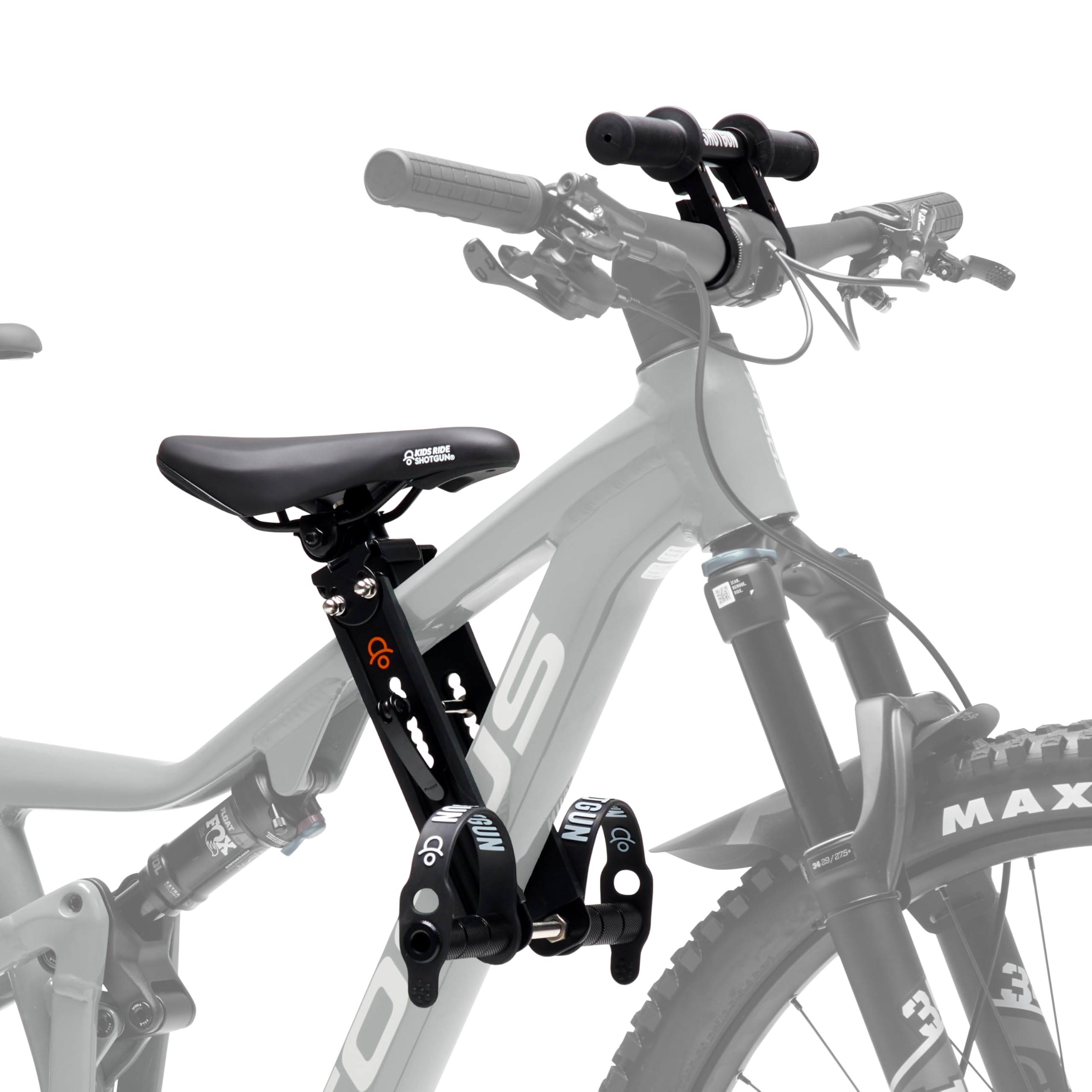
The Kids Ride Shotgun was designed by mountain biking enthusiasts for off-road use, and it shows. This front-mounted seat attaches to the frame top tube with a fully rubber-protected clamp that prevents scratching, making it safe for carbon and e-bike frames. It includes a custom handlebar combo that keeps small hands in the proper position, plus footrests with rubber straps that secure the child’s feet away from the front wheel.
Weighing just 300 grams for the seat itself (excluding the mounting kit), it minimizes the impact on your bike’s handling. The harness is a 5-point system, and the memory foam and PU rubber construction provide excellent shock absorption on rough terrain. Parents consistently praise how easily their toddlers adapt to the seat and how much they enjoy being able to talk to the rider.
The main trade-off is that the mounting bracket is specific to the downtube — switching the seat between different bikes takes time. Some taller riders (over 6 feet) find the seat reduces knee clearance. For dedicated trail riders with a single mountain bike, this is the safest and most engaging option for a toddler.
Why it’s great
- Rubber-protected clamp — safe for carbon frames
- Integrated handlebars for proper hand placement
- Memory foam padding for rough trails
Good to know
- Time-consuming to switch between bikes
- Not ideal for riders over 6 feet
3. WeeRide Kangaroo Child Bike Seat

The WeeRide Kangaroo puts your toddler right in the center of the action with a front-row view. It mounts to the top tube and down tube using a steel support bar that doesn’t interfere with brake cables or gear shifters. The seat is built from a sturdy steel frame with a plastic shell and includes a 5-point safety harness, a padded front bumper, and height-adjustable foot cups with openings for comfort on hot days.
Parents appreciate that the child’s weight actually enhances bike stability rather than impairing it — the center-mounted position lowers the center of gravity compared to rear seats. The padded headrest supports a sleeping child’s head, which is a common issue with many front seats. Owners routinely take the Kangaroo on rides of 35 miles with toddlers who fall asleep comfortably against the headrest.
The weight limit caps at 33 lbs, which means most children outgrow it around age 3 or 4. The plastic shell feels durable but is not as refined as the Thule or Peg Perego. For families who want the interactive front-face riding experience without paying premium prices, this is the best balance of cost and capability.
Why it’s great
- Center-mounted design improves bike stability
- Padded headrest supports sleeping toddlers
- No interference with brake cables or gears
Good to know
- Weight limit only 33 lbs
- Plastic shell shows wear over time
4. Peg Perego Orion Front Mount Child Seat

The Peg Perego Orion stands out for its installation system. The compact clamp stays on your bike’s frame, and the seat snaps in and out with the push of a button — a five-second operation. It fits frames between 32mm and 52mm and is made from thick, sturdy plastic that feels significantly more rigid than cheaper alternatives.
The 3-point harness adjusts in length, and the footrests have three positions so the seat grows with your child from 12 months up to 33 lbs. The gel pad provides noticeable comfort improvement over standard foam, especially on longer paved rides. Owners who have used both the Orion and the Bell carrier report that the Orion feels much sturdier with no wobble from the fixing point.
Installation instructions are picture-only, which some find confusing, and riders shorter than 5’3” may find their daughter’s knees tap the handlebars on sharp turns. The 3-point harness is a minor safety step down from a 5-point, but the quick-release convenience makes it a favorite for urban commuters who need to detach the seat when parking.
Why it’s great
- Attach/detach in under 10 seconds
- Thick, rigid plastic with minimal wobble
- Gel pad for extra comfort
Good to know
- 3-point harness provides less upper body restraint
- May interfere with pedaling for short riders
5. OUSEXI Rear Child Bike Seat

If you are looking for a rear-mounted seat that will last through multiple growth stages, the OUSEXI offers adjustable armrests that slide inward or outward to accommodate children aged 2 to 8. The seat surface features smooth leather-like material over thickened sponge padding, which is both waterproof and easy to wipe clean after muddy rides. The steel rear frame and sturdy plastic guardrail provide a stable platform, while the non-slip textured handle gives the child something secure to hold.
Installation is straightforward on any standard flat bike rack, though the rack must be longer than 9.87 inches. The footrests and handlebar can be removed as the child grows, extending the usable life well into elementary school. One parent reported their 4-year-old was comfortable on a 12-mile ride without complaints.
Quality control is a concern — some units arrive with stripped machine screw holes in critical load-bearing areas, and the seat bottom is plastic rather than plywood. The lack of an integrated seat belt (side bars and handlebar provide security instead) may make parents of very wiggly toddlers nervous. For budget-conscious families who plan to upgrade after a year, this works well.
Why it’s great
- Adjustable armrests fit toddlers through school age
- Waterproof and easy-to-clean surface
- Removable foot supports extend usable life
Good to know
- Quality control issues with screw holes
- No integrated seat belt
6. XIEEIX Child Bike Seat
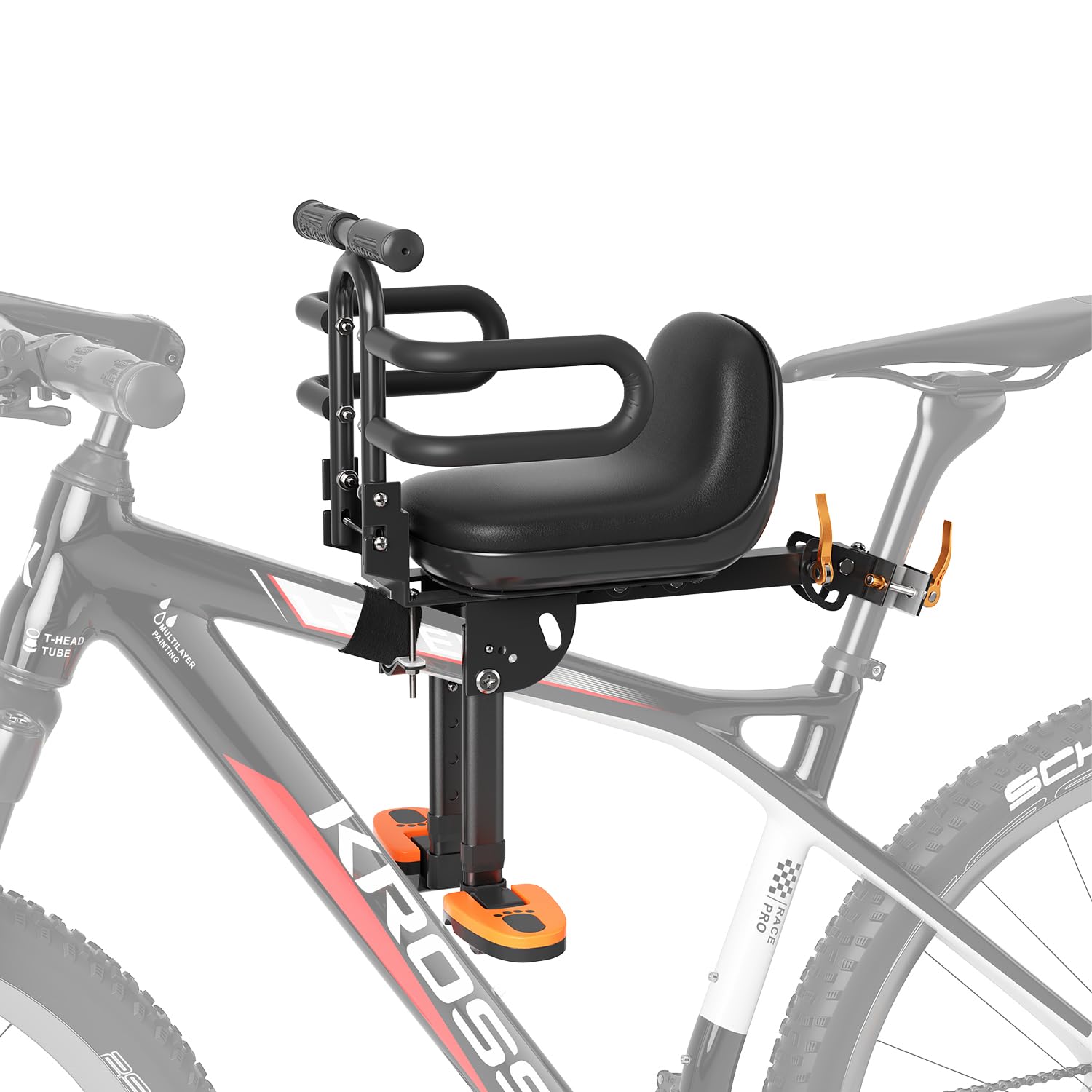
The XIEEIX child bike seat is built around portability. Its handlebar and pedals fold flat when not in use, reducing the seat’s footprint for storage or travel. The aluminum frame keeps the weight to about 2.55 kg, and the guardrail and backrest provide good support for children aged 1 to 3. Several parents report that their 3-year-old loves riding in it, and it fits easily on both standard mountain bikes and electric bikes.
Installation takes roughly 20 minutes, though the included instructions are confusing — the process is intuitive enough that most users figure it out without trouble. The seat feels lightweight and well-constructed for the price, with no sharp edges or rough plastic. The foldable feature genuinely helps when saving space in a trunk or storage closet.
The lack of a child buckle rated as “sturdy” is a recurring theme in reviews. At 36 lbs, one 3-year-old just barely fits, and the seat shows signs of strain. The plastic on the support bar connection points feels less robust than metal competitors. For short neighborhood rides with a light toddler, this is a perfectly capable and affordable choice.
Why it’s great
- Foldable design saves storage space
- Lightweight aluminum frame at 2.55 kg
- Quick 20-minute installation
Good to know
- Instructions are hard to follow
- Plastic on support bar feels less durable
7. Topeak BabySeat II Bike Rack

The Topeak BabySeat II rack is not a seat itself — it is the dedicated rear rack designed exclusively for Topeak’s BabySeat II child seat. If you already own or plan to buy a Topeak child seat, this rack is a critical component. The QuickTrack 2.0 system provides a secure slide-in mount, and the rack is compatible with disc or non-disc brake bikes for wheel sizes 26”, 27.5”, and 29”.
Owners praise the rack’s stability when paired with the Babyseal, noting that it sits close to the bike’s seat and doesn’t wobble even over rough terrain. The rack also accepts MTX 2.0 bags and clips, making it a dual-purpose piece of gear for carrying cargo when the seat is removed. Installation is relatively straightforward if your bike has standard mounting points, though the included instructions lack clarity.
The rack may not fit every frame out of the box — some users had to attach the arms to the seatpost clamp or drill additional holes. If your bike lacks the proper rack eyelets, you may need the longer bracket sold separately. For a clean OEM-level fit with a Topeak seat, this rack is the gold standard.
Why it’s great
- QuickTrack 2.0 for secure slide-in mount
- Dual-purpose — works with MTX 2.0 bags
- Compatible with disc and non-disc brakes
Good to know
- May not fit all frames without modification
- Instructions are not user-friendly
FAQ
Can I install a front-mounted seat on a bike with suspension?
What is the minimum age for using a bike seat with a toddler?
Will a bike seat fit my e-bike?
Final Thoughts: The Verdict
For most users, the bike seat for toddler winner is the WeeRide Kangaroo because it combines a front-facing, interactive experience with excellent stability and a reasonable weight limit. If you want maximum durability and a seat that lasts through multiple kids, grab the Thule Yepp 2. And for off-road trails where the child stays engaged and secure, nothing beats the Kids Ride Shotgun.