
Our readers keep the lights on and the weekend projects moving. As an Amazon Associate, I earn from qualifying purchases.
The moment your toddler lifts a leg over their first set of wheels, their world expands. But that first bike often misses the mark — too heavy to steer, too tall to stand over, or missing the sensory hooks that turn a hesitant push into a confident glide. The right training handle is less about the metal frame and more about how it dials in balance, limits tipping, and builds the muscle memory your child needs to transition from scooting to pedaling without tears or frustration.
I’m Rikta — the co-founder and writer behind FitlyFast. I’ve spent hundreds of hours analyzing the real-world specs, customer durability reports, and developmental fit of toddler balance bikes to separate the toys from true training tools.
Whether you are looking for a first birthday gift or a multi-stage ride that grows through the preschool years, this guide breaks down the very best bike training handle options across safety, materials, and long-term value.
How To Choose The Best Bike Training Handle
Not every colorful ride-on delivers the right training. The difference between a bike that teaches real balance and one that just rolls in circles comes down to a few non-negotiable specs. Here is what to check before clicking buy.
Steering Limiter & Enclosed Wheels
The single most overlooked safety feature on toddler training bikes is the steering limiter. A 135° turning radius cap prevents the front wheel from turning too sharply, which eliminates the sudden sideways tip that sends toddlers tumbling. Paired with fully enclosed wheels — no spokes, no gaps — you remove the pinch hazard that turns a gentle scoot into a painful toe-catch. Models that skip the steering limiter may be cheaper, but they require constant adult correction.
Weight & Frame Material
A training bike that weighs more than your child can lift on their own works against the whole purpose: building independent balance. Carbon steel frames offer the best durability-to-weight ratio for this category, while heavy iron frames add stability at the cost of maneuverability for little arms. Look for a bike under 9 pounds for two-year-olds and under 5 pounds for one-year-olds. An overweight frame forces the child to compensate with poor posture, delaying the balance reflex you are trying to develop.
Multi-Mode Versatility vs Dedicated Balance Bike
The market splits into two camps: single-purpose balance bikes (scoot-only, no pedals) and convertible multi-mode trikes that transition from baby walker to tricycle to balance bike. If you have a single child and want one purchase to cover ages one through four, a 5-in-1 with a removable pedal system and adjustable push handle gives you the longest runway. If you already own a pedal bike for later years, a dedicated lightweight balance bike with LED wheels may offer a simpler, lighter, and more focused training experience for the critical 12- to 36-month window.
Quick Comparison
On smaller screens, swipe sideways to see the full table.
| Model | Category | Best For | Key Spec | Amazon |
|---|---|---|---|---|
| XIAPIA 5-in-1 | Convertible Trike | Long-term growth (1-4 yrs) | 120° steering limit, 4 kg carbon steel | Amazon |
| LOL-FUN 5-in-1 | Convertible Trike | Parent-steer walking mode | 50° angle limit, 8.6 lb build | Amazon |
| KRIDDO 2-in-1 | Push Trike | Taller parents and long walks | 40.3″ extended push handle | Amazon |
| Doselie Glow Wheel | Music Balance Bike | Sensory engagement (12-24 mo) | 4 glow wheels, soft music + animal sounds | Amazon |
| Fealarfaith Baby Balance | 4-Wheel Balance Bike | First bike for 10-24 month olds | 3.6 lb frame, 135° limiter | Amazon |
| Gotrax KS12 | Balance Bike | Older toddlers (2-5 yrs) | 12″ EVA flat-free tires, 8.6 lb | Amazon |
| Bobike Balance Bike | Budget Balance Bike | Affordable lightweight trainer | Aluminum frame, 110 lb max weight | Amazon |
In‑Depth Reviews
1. XIAPIA 5-in-1 Toddler Tricycle

The XIAPIA 5-in-1 earns the top spot because it solves the single biggest pain in this category: your child outgrowing the bike before they have truly learned to ride. This machine moves through five distinct modes — baby walker, scooter, balance bike, tricycle with pedals, and standard balance bike again — without requiring any tools. The push-button and snap-on design lets you swap between modes in under a minute, which means the bike stays relevant from the first unsteady steps at 12 months all the way to confident pedaling at four years old. The 120° steering limiter and fully enclosed wheels provide the pinch protection and tip resistance that parents of one-year-olds demand.
The frame is built from high-hardness carbon steel and weighs a manageable 4 kilograms, which is light enough for a toddler to lift and steer but dense enough to absorb the bumps of indoor tile and outdoor pavement. EVA solid shock-absorbing wheels roll smoothly without the flat-tire hassle, and the rubber handles add a non-slip grip that small hands can hold without fatigue. A small but thoughtful detail — the footrests tuck under the frame when not in use, so they do not scrape against the ground during balance-mode scooting.
Where this bike really separates itself is the adjustable push rod. Parents up to 70 inches tall can walk behind without hunching, and the rod clicks into a comfortable angle for steering assistance during the early walker and balance stages. The only real trade-off is the absence of LED light-up wheels, which means this bike relies on function over flash. But for a family that wants one purchase to cover the full toddler-to-preschool window, the XIAPIA delivers the longest usable life of any model in this lineup.
Why it’s great
- No-tool mode changes in under 60 seconds
- Adjustable push rod for tall parents (no back strain)
- 120° steering limiter prevents tip-overs
- Carbon steel frame is both light and durable
Good to know
- No built-in lights or sounds for sensory engagement
- Pedals may be out of reach for children under 15 months
- Parent push rod does not steer the front wheel
2. LOL-FUN 5-in-1 Toddler Tricycle

What sets the LOL-FUN apart from other multi-mode trikes is the parent steering mechanism. The telescoping handle connects directly to the front wheel, so when you twist the handle, the wheel turns. That might sound minor, but most competing push-handle bikes require you to physically lift and pivot the entire rear of the bike to change direction — which is exhausting on walks longer than ten minutes. With the LOL-FUN, both wheels stay planted while you steer, making walks around the block genuinely pleasant rather than a workout in frustration.
The build quality punches above its mid-range position. The carbon steel body feels solid under a toddler’s weight, and the sawtooth thickening handle design absorbs shock better than the slim rubber grips found on budget models. The wheels are oversized, which helps the bike roll over minor cracks in pavement and indoor threshold strips without jarring the rider. Assembly is truly tool-free — each part clicks into place with button locks — so you can go from box to riding in about one minute. The 50° angle limit on the steering keeps the front wheel from over-rotating and dumping the child sideways.
The main limitation is size. The bike fits best from 10 months through about three and a half years, which is a solid window but shorter than the XIAPIA. Taller or larger toddlers may find the wheelbase too compact by age four. Also, the paint finish, while beautifully bright, is prone to scuffing on rough asphalt. For families who prioritize parent-controlled steering and ease of assembly over the very longest growth window, this is the most comfortable daily driver in the category.
Why it’s great
- Parent handle steers the front wheel (no lifting required)
- Tool-free click-in assembly in about one minute
- Oversized wheels handle indoor and outdoor surfaces well
- Shock-absorbing sawtooth grips improve comfort for small hands
Good to know
- Best fit up to 3.5 years; may be cramped for age 4+
- Paint can scuff on rough surfaces
- No LED lights or music for sensory play
3. KRIDDO 2-in-1 Toddler Tricycle
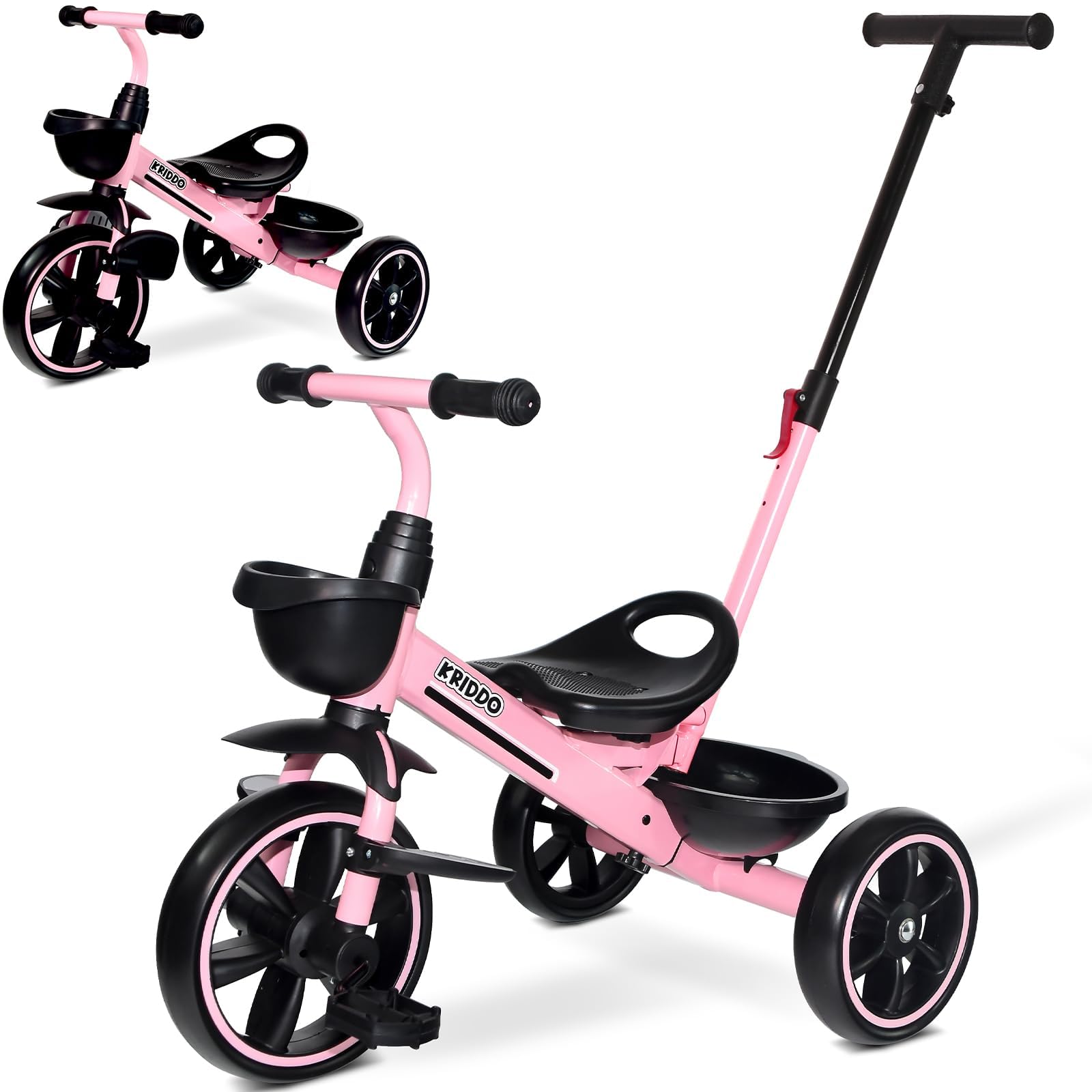
The KRIDDO 2-in-1 solves a very specific ergonomic problem: if you are over 5’10”, most toddler push handles force you to walk hunched over like a question mark. The KRIDDO extends to 40.3 inches — the longest in this comparison — which lets even taller parents walk upright while pushing. That single spec makes a real difference on daily strolls around the neighborhood, because a comfortable parent pushes longer and more often, which means more practice time for the child.
The design is a straightforward two-mode system: parent-push mode (with the extended handle and a foldable front footrest for the child to rest their feet) and traditional cycling mode with pedals. The foldable footrest is a clever touch — when the child is too short for pedals, they rest their feet on the footrest while you push, and when they grow into pedaling, the footrest flips up and out of the way without requiring removal or storage. The seat is ergonomically shaped with smooth edges and a non-slip handle grip, and the wheels include silent shock absorption that rolls quietly across hardwood floors without waking a napping sibling.
The main drawback is that the KRIDDO maxes out younger than you might expect. Children who are tall for their age — hitting the 95th percentile height by three and a half — may find their knees bumping the handlebars, which limits pedaling efficiency. The bike also lacks the multi-mode flexibility of the 5-in-1 competitors; it is a tricycle first and does not convert to a pure balance bike. For parents who want a push trike for the 18-month to 4-year window and do not need a separate balance bike mode, the KRIDDO is the most comfortable option for tall caregivers.
Why it’s great
- 40.3-inch adjustable handle fits tall parents comfortably
- Foldable footrest eliminates loose parts when switching modes
- Silent shock-absorbing wheels are floor-friendly indoors
- Ergonomic non-slip grips support early hand placement
Good to know
- Tall or average-size 4-year-olds may bump knees on handlebars
- Only two modes; no balance-bike-only capability
- Assembly requires more time than click-in competitors
4. Doselie Glow Wheel Balance Bike
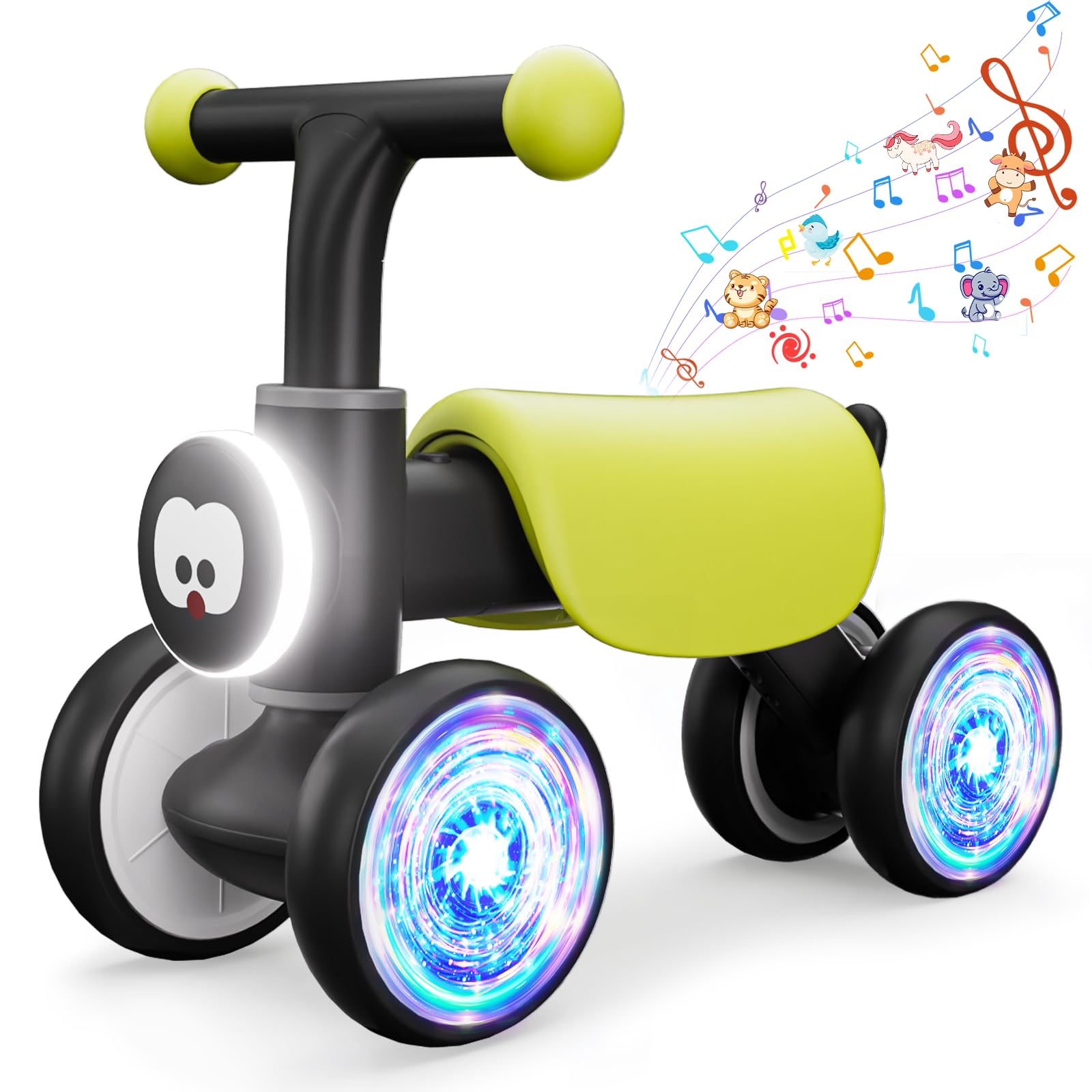
The Doselie Glow Wheel bike targets the 12-to-24-month window with an approach that prioritizes motivation over growth. Where most training bikes rely on the child’s intrinsic desire to move, this one adds external rewards: four wheels that spin into a colorful LED glow without any batteries, plus a tail button that plays five built-in songs and animal sounds. For a one-year-old who is still unsure about lifting both feet and gliding, the flash and sound create a positive feedback loop that turns a wobbly first ride into a repeat request. Multiple customer reports confirm that the light-up wheels, in particular, encourage children to keep scooting when they would otherwise lose interest.
Safety is well-covered for the age group. The 135° steering limiter prevents the sharp turn that dumps a novice rider, and the fully enclosed closed wheels eliminate pinch points for toes. The low center of gravity means the bike stops naturally when the child plants their feet, which reduces the panic factor during those first independent glides. The plastic frame keeps the total weight to just 5 pounds — easy for a toddler to pick up and turn around on their own. Assembly is minimal because the bike comes mostly pre-built; the longest step is installing three AAA batteries for the sound module.
The trade-offs are real. The 30-pound maximum weight capacity means this bike has a shorter usable life than any other model on this list — most children will outgrow it well before their second birthday. The music has no volume control and the animal sounds (including a lion roar that some toddlers find startling) cannot be turned off independently from the music. This is a specialized tool for the sensory-seeking 12-to-24-month stage, not a multi-year investment. If your goal is simply to get a hesitant one-year-old excited about gliding, it works brilliantly; if you want a bike that lasts through age four, look at the convertible trikes instead.
Why it’s great
- 4 no-battery LED wheels strongly motivate toddlers to scoot
- 135° limiter and enclosed wheels are safe for first riders
- Lightweight 5-pound frame is easy for toddlers to handle
- Minimal assembly required out of the box
Good to know
- 30-pound max capacity limits use to ~24 months
- Music and animal sounds have no volume control
- Lion roar sound may startle sensitive children
5. Fealarfaith Baby Balance Bike
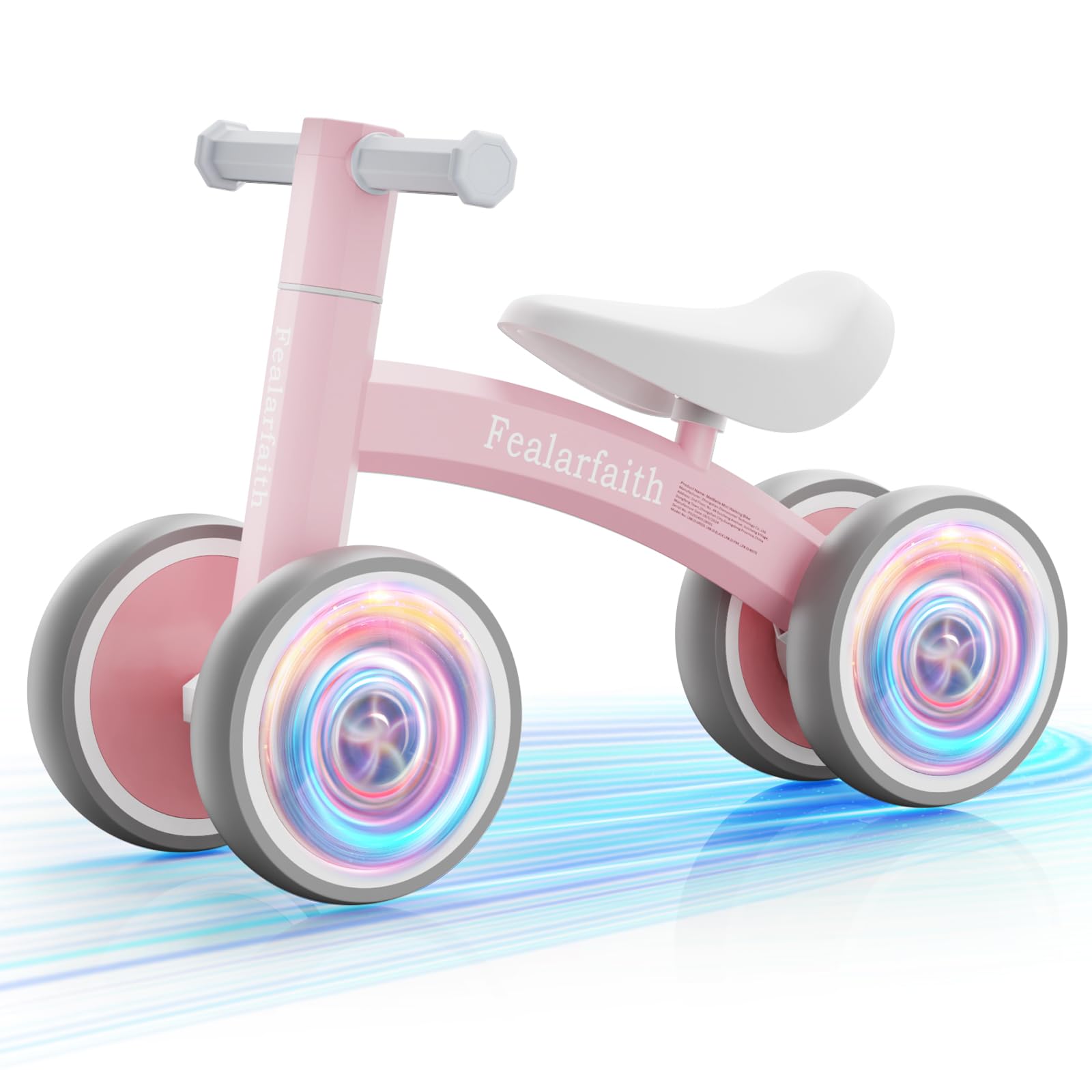
At 3.6 pounds, the Fealarfaith is the lightest bike in this guide — a critical advantage for the youngest riders who are still building the arm and core strength to steer and lift their own ride. The 4-wheel LED setup uses the same no-battery spin-to-light technology found on premium models, but the Fealarfaith delivers it in a frame designed specifically for the 10-to-24-month age bracket. The shorter wheelbase and low seat height mean a one-year-old with a 10-inch inseam can sit flat-footed with both soles on the ground, which is the single most important prerequisite for balance confidence.
The safety engineering is thorough. The fully enclosed wheel design wraps each wheel completely — no exposed spokes or gaps where small toes can slip in. The 135° steering limit matches the industry standard for tip prevention, and the non-toxic materials all pass the 100% baby-safe check that parents of teething toddlers (who sometimes explore with their mouths) need to hear. Assembly requires zero tools thanks to an intuitive buckle system that clicks together in about one minute, which is impressive for a model in this price tier. The PU+EVA seat is soft enough for extended rides without chafing, and the non-slip EVA handlebars give small sweaty hands reliable grip.
The main compromise is the frame material. While the carbon steel construction is sturdy, the overall feel is noticeably less premium than the aluminum-framed competitors — the joints are functional rather than smooth, and the paint finish is basic. The bike also lacks the adjustable seat or handlebar height of the Gotrax or Bobike models, which means once your child outgrows the fixed geometry, the bike is done. But for the price, targeting the narrow 10-to-24-month window with a focus on extreme lightness and instant assembly, the Fealarfaith is a purpose-built tool that does one job exceptionally well.
Why it’s great
- Ultra-light 3.6-pound frame is ideal for the youngest riders
- 4 no-battery LED wheels provide strong visual motivation
- Tool-free assembly takes about one minute
- Non-toxic materials and enclosed wheels for safety
Good to know
- Seat and handlebars are not height-adjustable
- Basic paint finish looks less premium than costlier models
- Fixed geometry means a short usable window (10–24 months)
6. Gotrax KS12 Balance Bike
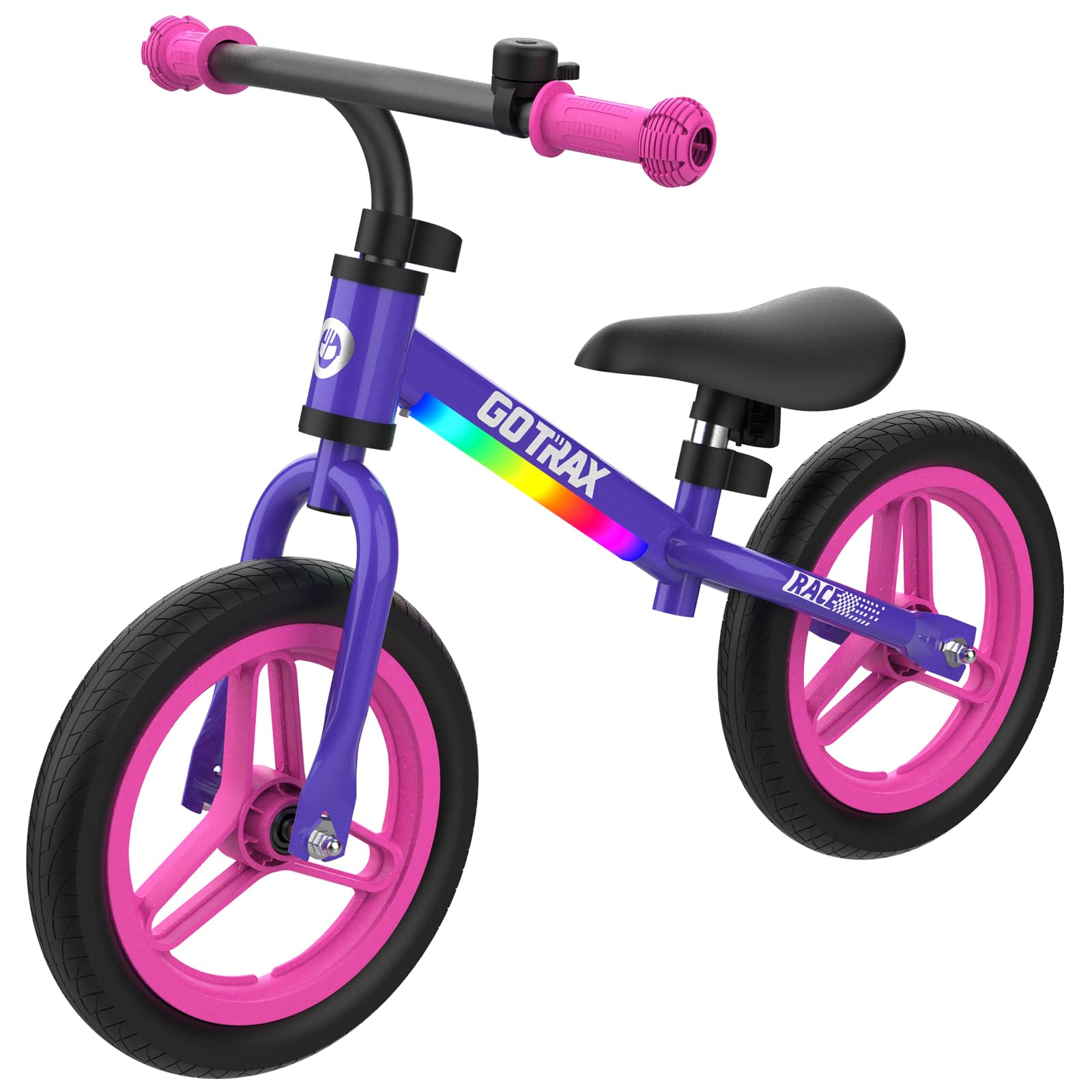
The Gotrax KS12 targets the 2-to-5-year-old range with a dedicated balance bike that skips the multi-mode complexity in favor of a lighter, more focused riding experience. The 12-inch EVA foam wheels are a standout feature in this tier — they are completely flat-free, require no inflation, and provide enough compliance to smooth out sidewalk bumps without the sluggish feel of solid rubber. The LED light built into the frame (not the wheels) adds a visual reward that activates during motion, which keeps older toddlers engaged during practice sessions. The included bell is a small touch that disproportionately boosts a child’s sense of ownership and pride.
Adjustability is generous for the price bracket. The seat slides from a 16.5-inch minimum to 18.3 inches, and the handlebar adjusts from 22.8 to 26 inches, which accommodates children from about two years old up to a 110-pound maximum. The range means this bike can realistically serve as the only balance bike a child needs before transitioning to a pedal bike. The silicone handlebars are noticeably more comfortable than the hard plastic grips found on cheaper competitors, and the thicker seat cushion reduces the butt-soreness that sometimes shortens practice sessions. The 8.6-pound weight is reasonable for a bike with 12-inch wheels — light enough for a three-year-old to lift onto a curb, but planted enough to feel stable at a gliding pace.
Where the KS12 falls short is the absence of a steering limiter. While the bike is stable at low speeds, the unrestricted front wheel can turn too far during a fast dismount, potentially causing a sideways tip. The customer reviews are overwhelmingly positive, but a small number note that younger two-year-olds sometimes struggle with the fully free-spinning front end. If your child is already confident on a smaller balance bike and you want a dedicated trainer for the older toddler years, the Gotrax delivers great adjustability and premium-feel tires. For a first-ever bike for a cautious two-year-old, consider a model with a steering limiter instead.
Why it’s great
- 12-inch EVA foam tires are flat-free and smooth-rolling
- Wide seat and handlebar adjustment range (fits 2–5 years)
- Silicone grips and thick seat cushion improve comfort
- Built-in LED light and bell add kid-appeal
Good to know
- No steering limiter; front wheel can over-turn
- Lacks multi-mode conversion capability
- 8.6-pound weight is on the heavier side for smaller two-year-olds
7. Bobike Toddler Balance Bike

If you are looking for a no-frills entry point that still includes the critical safety features, the Bobike checks the essential boxes without pushing the price into premium territory. The aluminum frame keeps the overall weight low — light enough for a two-year-old to carry up a porch step — while the 135° steering limiter and fully enclosed wheels provide the same tip prevention and pinch protection found on models costing twice as much. The adjustable seat and handlebar give this bike a growth window that spans roughly from 18 months to four years, which is impressive for the price tier.
The build quality is respectable for a budget-focused model. The carbon steel frame (described as aluminum in some listings, but functionally light in either case) holds up well to daily use on driveways and indoor floors. The foam wheels are firm — they do not absorb bumps as well as the EVA wheels on the Gotrax, but they also do not deflate or require maintenance. Assembly is straightforward with the included tool kit, and most customers report getting the bike ride-ready in under 10 minutes. The green color option is genuinely gender-neutral, which appeals to families who want a bike that can pass from one sibling to another regardless of preference.
The compromises show up in the details. The foam wheels transmit more vibration on rough pavement, which makes the ride less comfortable on long outdoor sessions compared to the softer EVA alternatives. The handlebar height adjuster cover can work loose over time and requires periodic tightening. The 110-pound maximum weight rating is generous, but the bike’s compact frame geometry means most children will feel cramped before they hit that weight limit — typically around age four. For a first balance bike that covers the basics at a price that leaves room for a future pedal bike upgrade, the Bobike is a smart, no-regret starting point.
Why it’s great
- Aluminum frame keeps weight manageable for toddlers
- 135° steering limiter prevents sharp-tip accidents
- Adjustable seat and handlebar extend usable growth window
- ASTM and EN71 certified for safety compliance
Good to know
- Firm foam wheels transmit road vibration
- Handlebar adjuster cover may loosen over time
- Compact geometry feels small for children over four years
FAQ
What does the steering limiter angle number actually mean?
Can a balance bike with foam wheels be used outdoors on asphalt?
When should I switch from a balance bike to a pedal bike?
Final Thoughts: The Verdict
For most users, the bike training handle winner is the XIAPIA 5-in-1 Toddler Tricycle because it combines a 120° steering limiter, a carbon steel frame, and tool-free mode changes that let it serve as a walker, balance bike, and tricycle across a full four-year growth window — the best single-purchase value in the category. If you want parent-controlled front steering that makes daily walks genuinely comfortable, grab the LOL-FUN 5-in-1. And for a dedicated balance bike with 12-inch flat-free EVA tires and wide adjustability for the 2-to-5-year set, nothing beats the Gotrax KS12.