
Our readers keep the lights on and the weekend projects moving. As an Amazon Associate, I earn from qualifying purchases.
Whether you’re a weekend gravel grinder or a daily commuter weaving through city traffic, the right bike watch transforms raw data into real performance gains. You need a rugged head unit that locks onto satellites fast, survives rain, and surfaces every metric that matters — from average speed to climbing efficiency — without draining your phone’s battery.
I’m Rikta — the co-founder and writer behind FitlyFast. I’ve spent thousands of hours analyzing GPS chipset specs, ANT+ interoperability, battery cycle tests, and real-world riding logs to separate true performance tools from overpriced novelties.
After evaluating multi-band positioning, display contrast under direct sunlight, and real-world sync reliability, the results are clear: the best bike watch must deliver accurate GPS, intuitive navigation, and long-lasting battery life without breaking your budget.
How To Choose The Best Bike Watch
Choosing the right bike watch goes far beyond picking a screen size. You need to match the device’s GPS architecture, sensor ecosystem, and battery endurance to your specific riding style — whether that’s competitive road racing, all-day mountain bike epics, or city commuting.
GPS Accuracy & Satellite Support
A device that only hunts for GPS satellites will struggle in dense forests, between tall buildings, or under heavy cloud cover. Look for support for at least four satellite constellations (GPS + GLONASS + Galileo + BeiDou). Premium models add multi-band GNSS, which triangulates on two frequencies simultaneously for sub-meter accuracy in challenging environments.
ANT+ & Bluetooth Sensor Ecosystem
Your bike computer is only as useful as the sensors it talks to. ANT+ is the industry-standard protocol for power meters, cadence sensors, speed sensors, heart rate monitors, and radar tail lights. Bluetooth alone limits you to basic accessories. Confirm the unit supports dual-protocol connectivity (ANT+ and Bluetooth) and check how many simultaneous sensor connections it allows — eight or more is ideal for a fully instrumented bike.
Battery Life & Charging Standard
A 20-hour battery may cover a week of commuting but fall short on a multi-day tour. Budget-friendly units often promise 40 hours by stripping out navigation and color screens. Evaluate your typical ride length honestly. Also check the charging interface: USB-C is faster and more durable than micro-USB, and many modern units now ship with USB-C as standard.
Navigation & Mapping Features
If you explore unfamiliar routes, you need more than just a breadcrumb trail. Offline map downloads, turn-by-turn prompts, and automatic re-routing when you miss a turn are essential. Premium units now offer ClimbPro-style ascent planners that show remaining grade and elevation gain, allowing you to pace climbs intelligently without pre-loading a course.
Quick Comparison
On smaller screens, swipe sideways to see the full table.
| Model | Category | Best For | Key Spec | Amazon |
|---|---|---|---|---|
| Garmin Edge 540 | Premium GPS | Serious training & racing | 26h battery / Multi-band GNSS | Amazon |
| Magene C606 V2 | Feature-Packed | Climb analysis & camera control | 2.8″ color touch / ClimbPro | Amazon |
| iGPSPORT BSC300T | Mid-Range Touch | Offline navigation & e-bike | 2.4″ touch / Off-course warning | Amazon |
| Magene C506 | Touchscreen Value | Smart navigation on a budget | 2.4″ touch / 24h battery | Amazon |
| GEOID CC600 | Color Navigation | Route rerouting & indoor training | 2.4″ color / Auto reroute | Amazon |
| COOSPO BC107 | Budget Entry | New riders & short commutes | 2.4″ LCD / GPS+BeiDou | Amazon |
| iGPSPORT BSC100S | Budget Long Haul | Ultra-long battery & basic data | 40h battery / 5 satellites | Amazon |
In‑Depth Reviews
1. Garmin Edge 540

The Garmin Edge 540 is the benchmark for serious cyclists who demand race-grade accuracy and data depth. Its multi-band GNSS locks onto satellites across multiple frequencies, delivering sub-meter positioning even when you’re threading through tree tunnels or narrow urban canyons. Physical buttons provide reliable control with sweaty or gloved hands — a design choice veterans appreciate over touchscreens that can become sluggish in wet conditions.
The 540 truly shines in training intelligence. Targeted Adaptive Coaching analyzes your power meter and heart rate data to suggest daily workouts that match your recovery and load. The ClimbPro ascent planner works on every ride — no pre-loaded course needed — showing real-time grade and remaining elevation gain so you can pace climbs efficiently. Stamina insights display your remaining energy reserves, helping you avoid blow-ups on long efforts.
Battery life is class-leading: up to 26 hours in demanding use and 42 hours in battery saver mode, enough for multi-day stage races. The Garmin Connect ecosystem syncs seamlessly with Strava, TrainingPeaks, and Komoot. The only real trade-off is the lack of a touchscreen for map panning, and the price reflects its premium status. For riders who train with purpose, this is the definitive tool.
Why it’s great
- Multi-band GNSS for unmatched accuracy in challenging terrain
- Adaptive coaching and stamina insights for data-driven training
- Exceptional 42-hour battery saver mode
Good to know
- No touchscreen — physical buttons only
- Premium investment compared to many competitors
2. Magene C606 V2
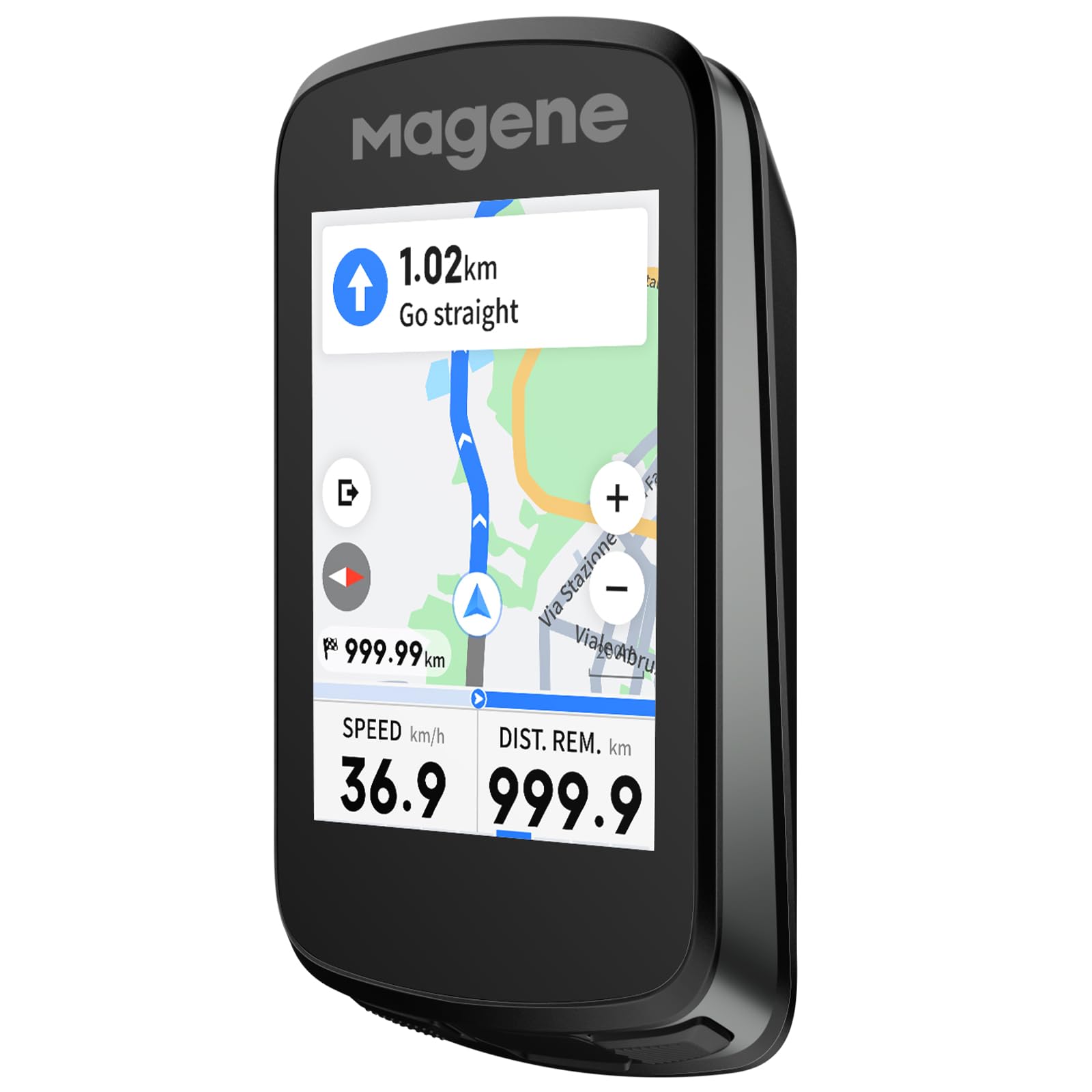
The Magene C606 V2 is the first sub- bike computer to offer a true ClimbPro-style feature. Its Multi-Scenario ClimbPro detects climbs mid-ride and displays real-time gradient, remaining elevation, distance to summit, and a profile graph — all without uploading a course. The large 2.8-inch vibrant TFT touchscreen makes those charts easy to read at a glance, even in bright sunlight.
Magene packs a surprising amount of premium tech into this unit. Strava Live Segments sync automatically over Wi-Fi and display real-time competition data on a dedicated dashboard. Cycling Dynamics unlock power phase distribution and seated-versus-standing time when paired with compatible power meters like the Magene P715 or Favero Assioma. The C606 V2 also supports wireless camera control for DJI Action and Insta360 cameras — a unique feature for content creators.
Battery life reaches 25 hours, and the IPX7 rating means it survives torrential downpours. The bottom line is that the C606 V2 delivers 90 percent of the Garmin Edge 540’s training features at roughly 60 percent of the cost. The only downside is that the touch screen can feel slightly dim at maximum brightness, but for recreational and club-level riders, it’s a phenomenal value.
Why it’s great
- Standalone ClimbPro functionality without pre-loaded routes
- Cycling dynamics and Strava Live Segments at a mid-range price
- Wireless camera control for action cams
Good to know
- Screen brightness could be higher under direct summer sun
- Touch response occasionally lags in heavy rain
3. iGPSPORT BSC300T

The iGPSPORT BSC300T bridges the gap between basic GPS logging and full-fledged navigation without pushing into premium pricing. Its 2.4-inch touchscreen responds reasonably well, though it can be slow with gloves, but the six-button backup means you never lose control. The offline global map download lets you store entire regions before you leave home — critical when cellular service drops on remote gravel routes.
The off-course warning is a standout safety feature: the moment you veer from your pre-loaded route, the BSC300T vibrates and alerts you until you return to the correct path. Real-time tracking also allows your group to see each other’s positions, preventing wrong turns during team rides. E-bike riders will appreciate the dedicated e-bike mode that displays battery level and assist mode, a rare find in this price tier.
Battery life is rated at 20 hours, which is solid for all-day adventures. ANT+ and Bluetooth 5.0 dual protocol support lets you pair up to 130+ data fields across sensors. The main compromise is the smaller font size on data pages, which can be tough to read during high-speed glances. For explorers who prioritize navigation and e-bike compatibility, the BSC300T is a smart mid-range choice.
Why it’s great
- Offline global map downloads with turn-by-turn prompts
- Dedicated e-bike mode with power level display
- Real-time group tracking to keep the peloton together
Good to know
- Touchscreen responsiveness drops with sweaty or gloved fingers
- Data field fonts are smaller than some competitors
4. Magene C506
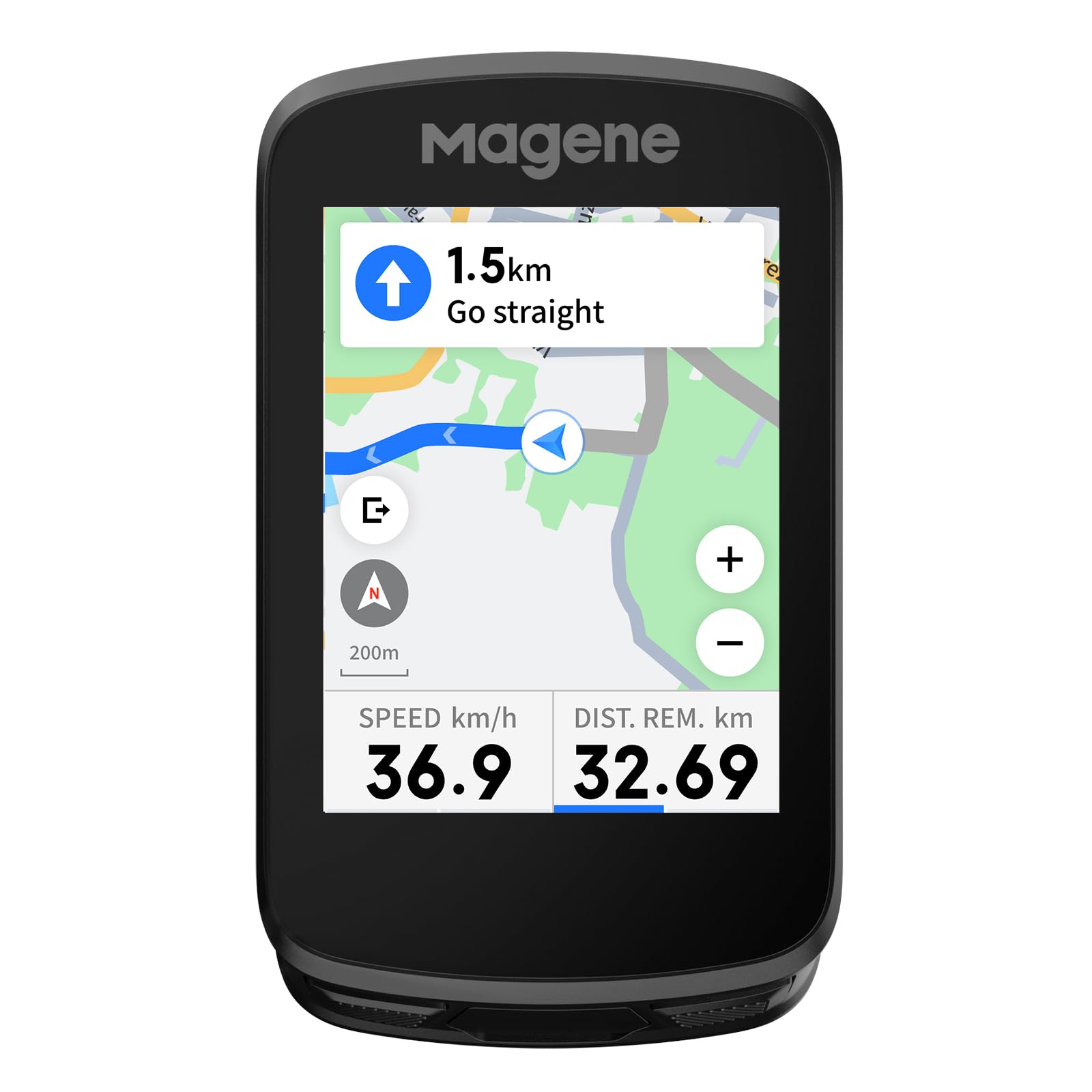
The Magene C506 delivers a full-color touchscreen GPS computer at a price that undercuts most competitors by a wide margin. The 2.4-inch display supports tap-and-swipe interactions, and an ambient light sensor automatically adjusts brightness as you move from shaded forest to open sunlit road. The Airoha chipset captures GPS lock in roughly five seconds — competitive with units costing twice as much.
Navigation is driven by free global maps downloaded directly to the device. The C506 supports turn-by-turn directions and the OnelapFit app allows custom route creation or GPX file import. The Smart Riding Assistant feature pairs with Magene L508 and L308 tail lights to auto-activate the front light when speed exceeds 10 km/h — a smart safety touch for commuters. Indoor training is also handled well, with support for smart trainer resistance control and TrainingPeaks course syncing.
The touchscreen is occasionally unresponsive when wet, and the map download process through the app is less intuitive than Garmin’s. Battery life reaches 24 hours, which covers long weekend rides. For riders who want a modern touch interface and navigation capabilities without paying premium dollars, the C506 represents the best bang-for-buck in today’s market.
Why it’s great
- Full-color touchscreen with ambient light sensor at a breakthrough price
- Free global offline maps with turn-by-turn navigation
- Smart Riding Assistant for auto-light activation
Good to know
- Touchscreen can be finicky when wet or sweaty
- App interface for map downloading needs improvement
5. GEOID CC600

The GEOID CC600 stands out for its combination of colorful route navigation and free indoor training at a mid-range price. The 2.4-inch color screen, protected by durable Asahi glass, displays turn reminders and elevation profiles clearly. When you deviate from your planned route, the CC600 automatically recalculates a new path — a behavior usually reserved for premium units — so you never need to pull out your phone to find the way back.
Data customization is exceptional for this price point: up to 10 data pages, each with 10 data fields, drawn from 108 supported metrics. Display options include numerical charts, circular dials, line graphs, and bar charts. The unit supports both Bluetooth and ANT+ protocols, pairing seamlessly with up to nine sensors including power meters, HR straps, and electronic shifting systems like SRAM eTap and Shimano Di2.
Battery life is rated at 24 hours, and the IPX7 rating provides confidence in wet weather. The main drawback is the learning curve: the app and on-device menus are less polished than Garmin’s, and the rerouting logic can produce odd detours. For riders who want navigation with actual rerouting plus indoor training capabilities at a fair price, the CC600 is a compelling option.
Why it’s great
- Automatic rerouting when you leave the planned course
- Free indoor smart trainer mode with power and gradient control
- Highly customizable data pages with 108 metrics
Good to know
- App and UI have a noticeable learning curve
- Rerouting can sometimes suggest impractical detours
6. COOSPO BC107

The COOSPO BC107 is the perfect gateway device for new cyclists who want GPS tracking and ANT+ sensor support without financial overcommitment. The compact 2.4-inch LCD wraps in glass-filled ABS and TPU, keeping weight below 140 grams. Dual-mode GPS and BeiDou positioning delivers accurate speed, distance, and elevation data with a cold-start lock time of under 30 seconds.
ANT+ connectivity is the BC107’s killer feature at this price point. It pairs with ANT+ heart rate monitors, speed and cadence sensors, and even power meters — a capability usually missing from budget units. The CoospoRide app handles device setup, activity recording, and Strava syncing straightforwardly. The included standard mount works fine, though the rubber ring mounting system can feel less secure than quarter-turn alternatives.
Battery life is excellent, with reports of well over 20 hours of real-world riding. The main limitation is the lack of navigation features — this is a pure data logger, not a route-finder. For riders who just want to record their rides, monitor their heart rate, and track fitness progress without spending heavily, the BC107 is the smartest entry-level buy available.
Why it’s great
- ANT+ support for power meters, HR, speed, and cadence sensors
- Excellent battery life for multiday weekend trips
- Lightweight and rugged glass-filled ABS/TPU construction
Good to know
- No navigation or turn-by-turn routing
- Rubber ring mount feels less secure than quarter-turn mounts
7. iGPSPORT BSC100S
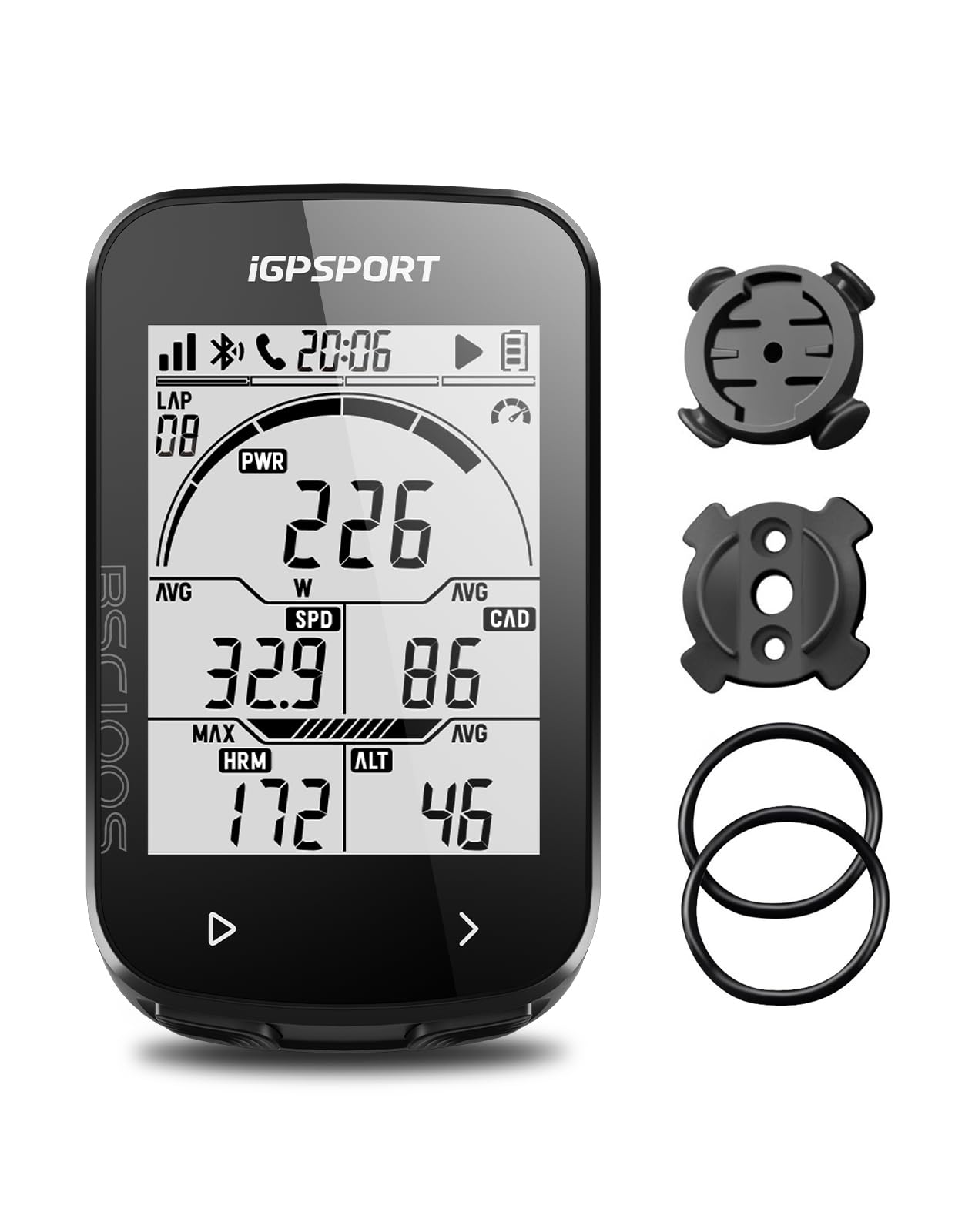
The iGPSPORT BSC100S is an endurance-focused GPS computer that prioritizes battery life above all else. The 600mAh lithium polymer cell delivers a claimed 40 hours of runtime, and real-world reports confirm you’ll get through a full week of commuting or a multi-day tour without a charge. The USB-C port (cable not included) charges faster than older micro-USB units, a welcome upgrade at this price level.
Five-satellite support (GPS + BeiDou + GLONASS + Galileo + QZSS) locks on quickly and maintains accuracy even under tree cover. The 2.6-inch anti-glare LCD is one of the largest in its class, making speed, distance, and grade figures readable in direct sunlight. The device pairs with ANT+ and Bluetooth 5.0 sensors, including speed, cadence, and heart rate monitors. Syncing to Strava via the iGPSPORT app works reliably after an initial setup.
The BSC100S lacks navigation, color graphics, and touch functionality — it’s a pure data recorder with a focus on long runtime. The two-button interface is simple to operate with gloves, and the rubber band mounting system is functional but not as secure as quarter-turn designs. For riders who want maximum battery endurance at a minimal cost, the BSC100S is the most honest bike computer on this list.
Why it’s great
- Industry-leading 40-hour battery for ultra-distance rides
- Large 2.6-inch anti-glare LCD readable in all light
- Five-satellite GPS for reliable lock in varied conditions
Good to know
- No navigation or route planning features
- Rubber band mount is less stable than quarter-turn options
FAQ
Is a touchscreen bike computer better than physical buttons for riding?
How many satellites do I really need for accurate bike GPS?
Final Thoughts: The Verdict
For most users, the best bike watch winner is the Garmin Edge 540 because its multi-band GNSS, adaptive training coaching, and 42-hour battery saver mode cover every need from daily training to multi-day events. If you want ClimbPro analytics, a vibrant color touchscreen, and cycling dynamics at a significantly lower price, grab the Magene C606 V2. And for a budget entry point with ANT+ support and exceptional battery life, nothing beats the COOSPO BC107.