
Our readers keep the lights on and the weekend projects moving. As an Amazon Associate, I earn from qualifying purchases.
A jammed machine that miscounts your stack of worn twenties right before a bank deposit is a slow-motion disaster for any cash-handling business. A reliable bill counter machine eliminates this anxiety by delivering fast, auditable counts with embedded counterfeit detection, turning a nightly chore into a 30-second operation.
I’m Rikta — the co-founder and writer behind FitlyFast. I have spent years analyzing hardware specifications for business equipment, focusing on the friction-roller materials, sensor arrays, and firmware stability that separate a workhorse counter from a frustrating paperweight.
This guide breaks down the detection technologies, count speeds, and build quality that matter most so you can confidently choose the best bill counter machine for your store, church, or office without wasting time on units that jam on the first feed.
How To Choose The Best Bill Counter Machine
Not every counter works the same. A machine that breezes through crisp new banknotes can choke on a stack of wrinkled singles. You need to match the sensor technology, detection modes, and build quality to your actual cash mix. Here are the three factors that separate a reliable purchase from a costly mistake.
Sensor Array — The Core of Accuracy and Security
The sensor package determines whether the machine can read mixed denominations and spot fakes. Entry-level units use UV and MG sensors, which catch basic counterfeits. Mid-range models add IR and dimensional detection for better reliability. Premium counters deploy 2CIS — dual contact image sensors that scan both sides of a note like a human eye, allowing them to handle wrinkled, torn, or polymer bills without constant jams. If you handle a high volume of worn currency, skip any machine without 2CIS or at least dedicated IR tubes.
Count Speed and Throughput — Real-World Limits
Advertised speeds of 1200 to 1500 notes per minute matter only when the hopper and stacker capacities keep up. A machine that claims 1500 n/min but only holds 200 bills in the hopper will force you to reload constantly. Also consider the friction-roller material: polyurethane rollers sourced from Japanese banking standards, for instance, grip old notes better than basic rubber, reducing jams and double feeds at high speed. For most small businesses, 1000–1200 n/min with a 200-bill hopper is a practical sweet spot.
Denomination Modes — Mixed vs. Single Sorting
Mixed denomination counting (MDC) lets you dump a stack of assorted bills into the hopper and get a total value instantly. This requires CIS or advanced IR sensors. If your machine lacks MDC, you must pre-sort bills by denomination before counting, which adds manual labor. Some models also offer SORT mode, which separates denominations into different stacker pockets — a huge time-saver for end-of-day reconciliation. Determine whether your workflow demands mixed-value totals or physical sorting before you commit to a specific unit.
Quick Comparison
On smaller screens, swipe sideways to see the full table.
| Model | Category | Best For | Key Spec | Amazon |
|---|---|---|---|---|
| Aneken AL-931 | Premium | High-volume mixed counting & SN tracking | 2CIS / 4.5″ touch / 1200 n/min | Amazon |
| RIBAO MC-40 | Premium | Super counterfeit detection on worn bills | 2CIS + blink CIS / 1500 n/min | Amazon |
| MUNBYN IMC01 | Premium | Multi-currency businesses needing 2-year warranty | 2CIS / 11 detection methods | Amazon |
| DETECK DT500 | Premium | Mixed counting with US-based support | 2CIS/UV/IR/MG / 1200 n/min | Amazon |
| Aneken N60 | Mid-Range | Mixed counting with external display | MDC / UV/MG/IR/DD / 1200 n/min | Amazon |
| MUNBYN IMC09 | Mid-Range | Mixed counting with 2-year quality protection | MDC / UV/IR/MG/MT / 1000 n/min | Amazon |
| PONNOR N70 | Mid-Range | Mixed counting with triple display setup | MDC / 2 IR tubes / 1200 n/min | Amazon |
| VEVOR WR960 | Mid-Range | Multi-currency with CIS mixed recognition | CIS sensors / 5 detection methods / 1200 n/min | Amazon |
| DETECK DT200 | Budget | Single-denomination counting on a budget | UV/MG/IR / 1300 n/min | Amazon |
In‑Depth Reviews
1. Aneken AL-931
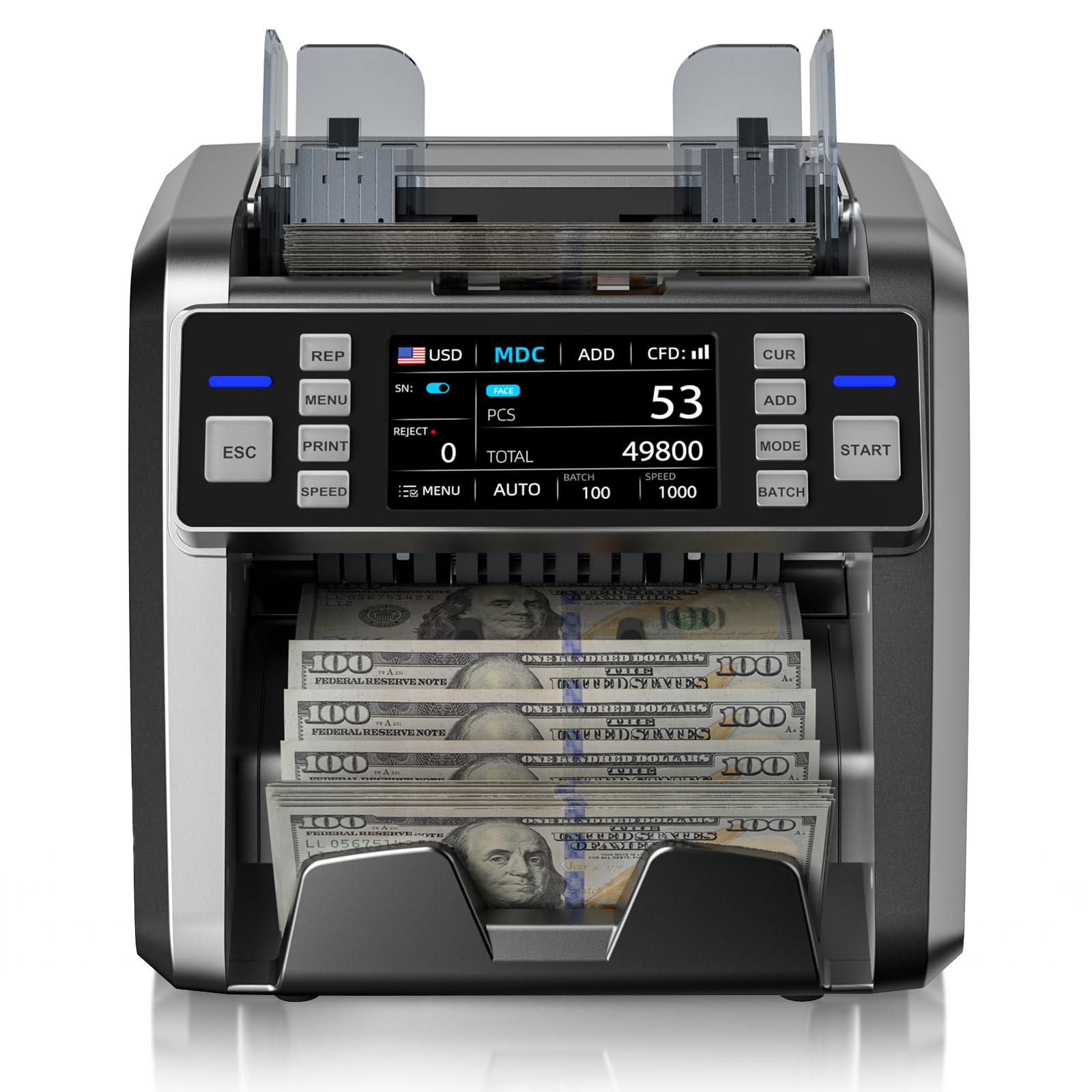
The Aneken AL-931 is the rare counter that checks every box for serious cash handlers. Its dual contact image sensors read both sides of each note, enabling reliable mixed-denomination value counting even on worn, wrinkled, or slightly torn bills. The 4.5-inch touch screen gives you granular control over three speed settings (800, 1000, 1200 n/min) and delivers instant reports with quantity and value per denomination.
Counterfeit detection is comprehensive — UV, MG, IR, MT, and dimensional sensors — and the machine can record serial numbers during counting, a feature that transforms cash auditing for high-volume businesses. The 16-detection alert system stops on any suspicious note and displays a red warning. Users report minimal errors and a sturdy build that survives daily use without rattling loose.
The 200-bill hopper and 200-bill stacker keep throughput steady during end-of-day rushes. Compatibility with the optional Aneken P30 printer means you can print count summaries and serial number lists. The gray metal chassis weighs over 17 pounds, giving it a planted feel on any desk. Lifetime firmware upgrades and discreet packaging round out a package that earns its premium position.
Why it’s great
- 2CIS sensors handle worn bills better than any single-sensor unit
- Touch interface is intuitive and shows denomination breakdowns
- Serial number recognition adds an audit trail for cash tracking
Good to know
- One report of a DOA unit suggests batch variability
- Heavier than most mid-range models at 17.6 pounds
2. RIBAO MC-40
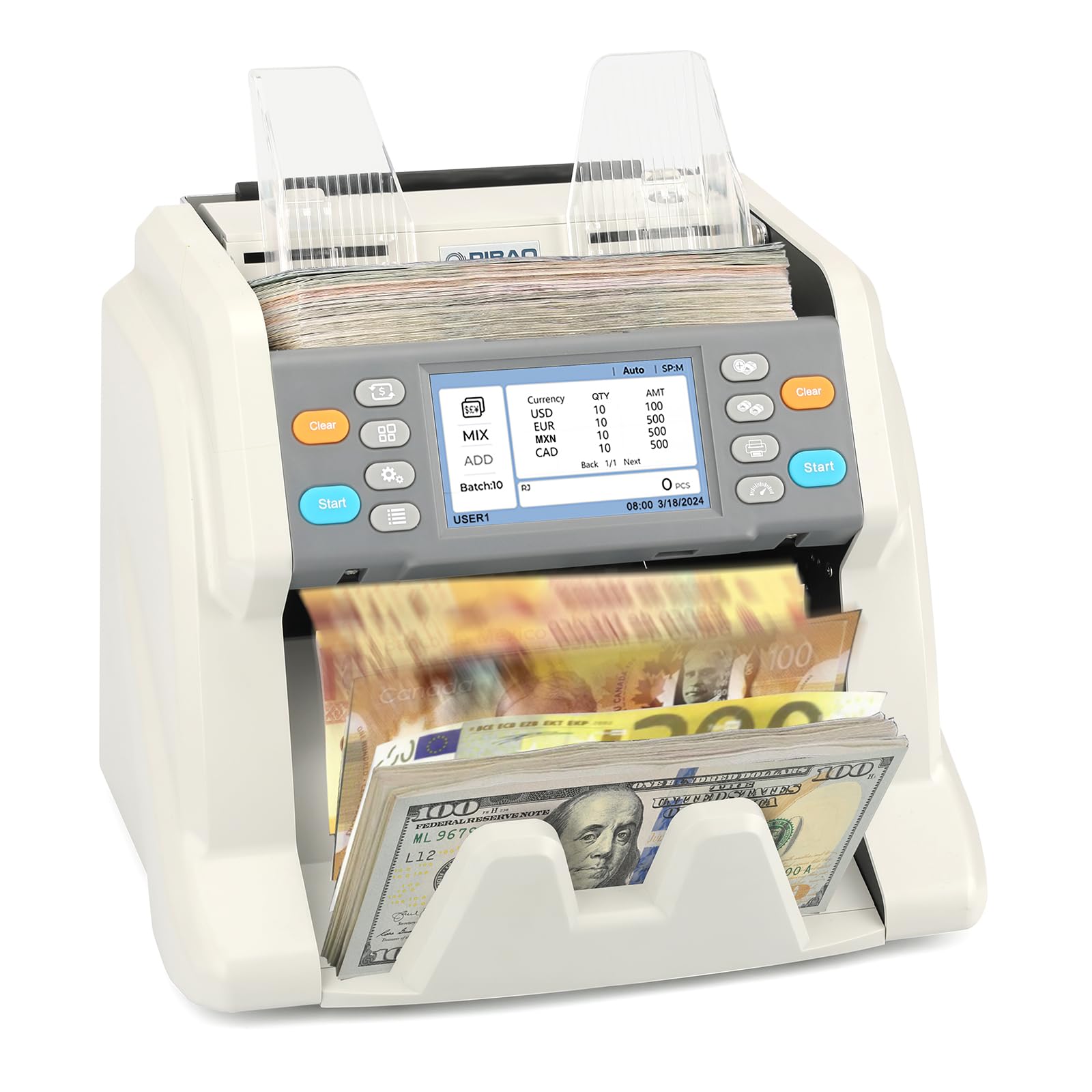
The RIBAO MC-40 shoves the speed needle to 1500 notes per minute without sacrificing accuracy, thanks to its bank-grade polyurethane friction rollers designed to Japanese banking standards. The front-loading system pulls notes smoothly regardless of condition — crisp, worn, or slightly damaged — and the 4.3-inch touch screen makes switching between mixed-denomination, batch, and sort modes effortless.
Counterfeit detection goes beyond standard UV and MG. The MC-40 employs a blink CIS system that uses 850nm and 940nm IR rays to catch super-counterfeit notes that fool basic sensors. Users consistently praise its jam-free operation even with large stacks, and the stacker handles up to 500 bills without overflow, a significant advantage over competing 200-bill stackers.
Two-year US-based after-sales support with 12-hour email response time backs the unit. The machine supports USD, EUR, CAD, and MXN direct, with multi-language interface including full Spanish. One user reported a failure after two years and received a replacement part plus installation help the same day — a level of service that justifies the investment.
Why it’s great
- 1500 n/min is the fastest speed in this roundup
- Blink CIS catches super-counterfeit notes effectively
- Premium polyurethane rollers grip damaged bills
Good to know
- No serial number recording at this price tier
- Occasional jams require resetting if bills are excessively folded
3. MUNBYN IMC01

The MUNBYN IMC01 brings bank-grade hardware to small businesses. Dual contact image sensors scan each note front and back, making the value counting three times more accurate than single-CIS machines — critical when handling a mix of crisp and street-worn banknotes. Serial number recording adds a forensic layer perfect for police departments, casinos, or anyone who needs cash traceability.
Eleven counterfeit detection methods — 2CIS, UV, MG, IR, MT, and dedicated sensors for super-dollar bills — create a layered defense that stops before a fake hits the stacker. The machine supports mixed denominations across USD, MXN, CAD, EUR, and over 120 more currencies via firmware updates, and it handles polymer notes without skipping a beat. The package includes a dust cover, calibration paper, cleaning brush, and fuse.
A two-year quality protection plan and lifetime software upgrades remove the long-term risk that plagues cheaper counters. Support is responsive — one user needed a custom currency update for Surinamese dollars, and the team delivered customized firmware within days. The white chassis is compact enough for a crowded counter yet robust enough for daily commercial throughput.
Why it’s great
- 2CIS sensors provide industry-leading mixed-count accuracy
- Two-year warranty and lifetime firmware updates
- Serial number recognition for cash audit trails
Good to know
- Premium price point may be overkill for low-volume users
- One report of failure after limited use, though support resolved it
4. DETECK DT500
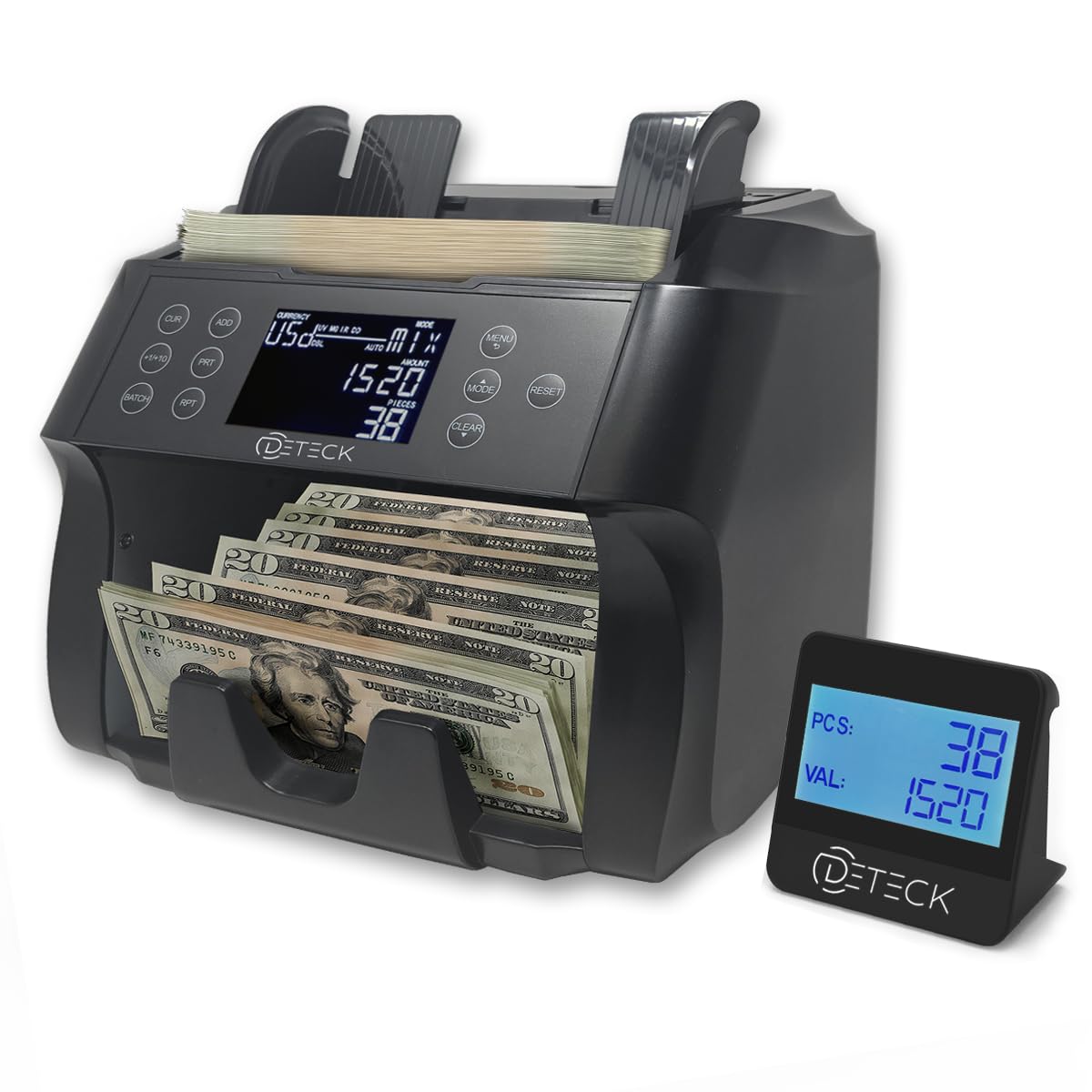
DETECK designs its counting machines for North American businesses, and the DT500 reflects that focus in its sensor package and support structure. The 2CIS scanner array combined with UV, MG, and IR detection delivers mixed-denomination value counting that users describe as bank-grade. An optional serial number recognition module tracks every bill that passes through, creating a digital log for high-stakes environments.
The on-screen report shows grand total, bill quantity, and value per denomination — no mental math required. The machine counts up to 1200 notes per minute and can run continuously all day without overheating. Business owners report that the reject tray catches double feeds and suspicious notes accurately, though worn bills sometimes cause miscounts due to their flimsy feel.
Top points go to the US-based support team. One user’s unit lost power after two years; DETECK repaired, cleaned, and tuned the machine for a minimal fee and shipped it back within five days. The one-year manufacturer warranty is standard, but the quality of after-sales service makes this a safer bet for owners who rely on their counter daily.
Why it’s great
- US-based support with fast turnaround on repairs
- 2CIS sensors handle mixed denominations reliably
- Optional serial number recognition for auditing
Good to know
- Can struggle with heavily worn bills (double feeds)
- Occasional bills fly out of the stacker if wrinkled
5. Aneken N60

The Aneken N60 delivers mixed-denomination value counting with a 3.5-inch TFT screen and a separate external display for customer-facing visibility. In MDC mode, the machine automatically reads the value of each bill across USD, CAD, MXN, EUR, and GBP, providing both quantity and total amount. The dual-screen setup makes it easy for both the cashier and the customer to verify the count at a glance.
Detection covers UV, MG, IR, and dimensional sensors, and the N60 stops with a red screen and alarm if it flags a suspicious note. The 200-bill hopper feeds at 1200 notes per minute, and the machine includes batch and accumulation modes for drawer reconciliation. A metal chassis keeps vibration low during prolonged counting sessions.
Users note that jams are rare when bills are inserted straight, and the denomination breakdown feature — showing count per denomination after a mixed run — is a genuine time-saver. The package includes a dust cover, calibration paper, brush, cleaning cloth, and 8 currency straps. Lifetime software upgrades and discreet shipping add peace of mind for a machine at this price point.
Why it’s great
- MDC mode reads mixed denominations automatically
- External display lets customers see the count
- Lifetime firmware updates included
Good to know
- Spits out an occasional bill, requiring a full recount
- Bills must be straight to avoid jams
6. MUNBYN IMC09

MUNBYN’s IMC09 is a white, compact mixed-denomination counter built around an upgraded roller system designed to handle creased and old bills with fewer jams than earlier models. The 3.5-inch TFT display shows value and quantity clearly, and the machine supports multi-currency value counting for USD, MXN, CAD, and EUR. A separate external screen gives customers or coworkers an independent view.
Detection uses UV, IR, MG, and MT methods alongside nine separate techniques including dimensional, thickness, security line, and spectrum analysis. The system flags counterfeits, doubles, and half-bills and stops automatically. Calibration is straightforward, and the included IR calibration paper ensures the sensors stay aligned over time.
Two years of quality protection and a lifetime upgrade program make this a low-risk choice for businesses that want support without paying premium tier prices. User feedback highlights responsive customer service — one owner needed custom firmware for Peruvian sol detection, and MUNBYN delivered video guides and custom settings within hours. Just be aware that bills must be well-aligned to minimize the jamming that a few reviewers experienced.
Why it’s great
- Two-year warranty at a mid-range price
- Custom firmware support for non-standard currencies
- Upgraded rollers reduce jams on creased bills
Good to know
- Mixed mode only works with top 4 priority currencies
- Alignment-critical — diagonal bills cause jams
7. PONNOR N70
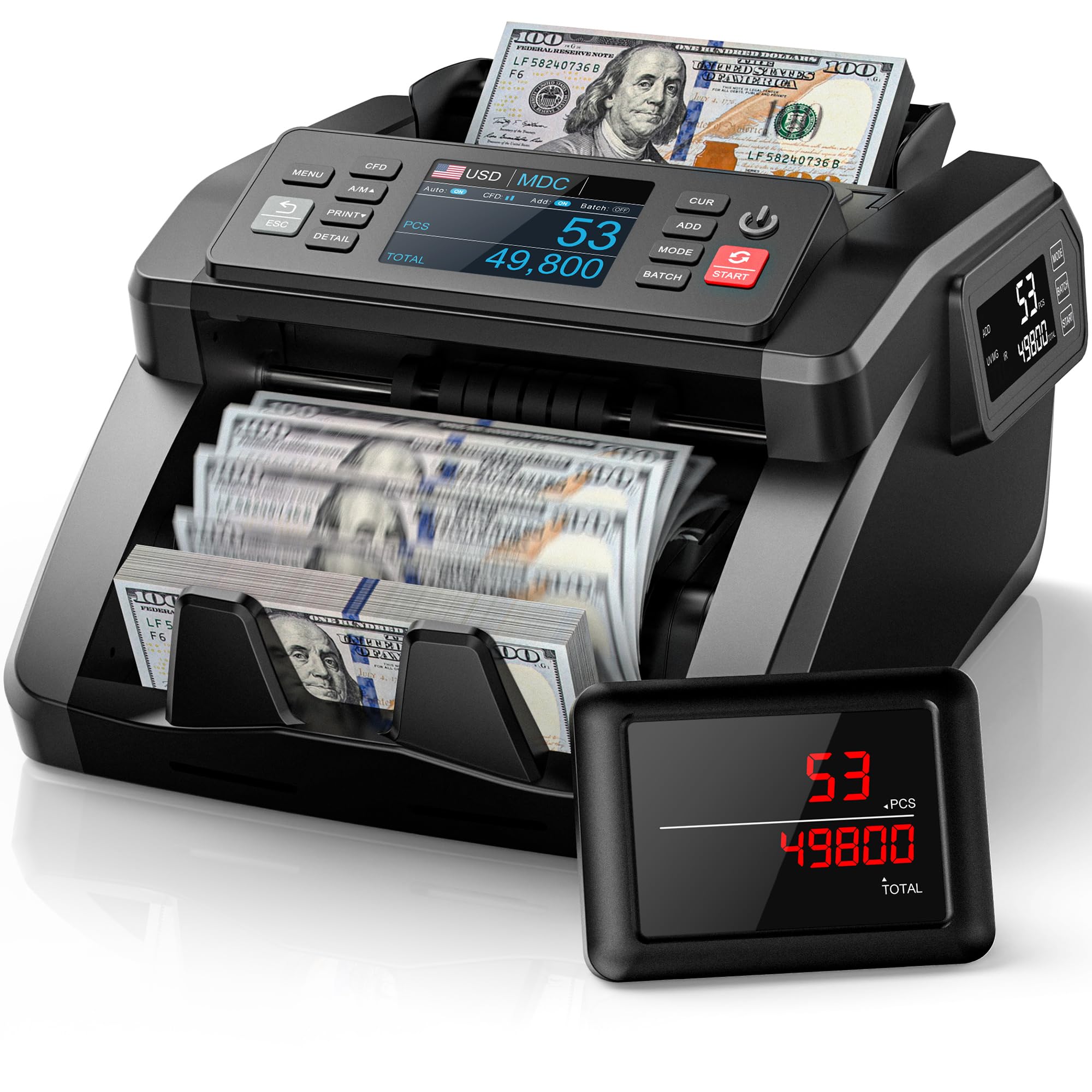
The PONNOR N70 stands out with a triple-screen design — a 3.5-inch TFT LCD on the main unit, a side screen for numerical data, and an external display for shared viewing. This setup makes it easy for multiple staff members to verify counts from any angle, reducing miscommunication during busy shifts. A voice announcement feature in MDC and SDC modes reads out the count audibly, useful for noisy retail floors.
Mixed denomination counting is handled by two specialized infrared detection tubes in addition to UV, magnetic, and dimensional sensors. Bank-grade detection stops the machine and sounds an alarm if it senses counterfeit, half, chain, or double bills. The 200-bill hopper and 200-bill stacker keep the workflow moving at 1200 notes per minute.
Users consistently call the N70 easy to set up out of the box — plug in, select US currency, and start counting. The included dust cover, calibration paper, nylon brush, and cleaning cloth show attention to maintenance. Keep in mind that the plug is 110V and designed for US electrical systems only, and the machine is not designed for mixed-bill counting of different currencies simultaneously.
Why it’s great
- Triple display gives everyone on shift visibility
- Voice announcement helps verify counts in noisy environments
- IR detection tubes provide strong counterfeit coverage
Good to know
- Mixed counting only works per currency, not inter-currency mixing
- 110V only — not compatible with international voltage
8. VEVOR WR960
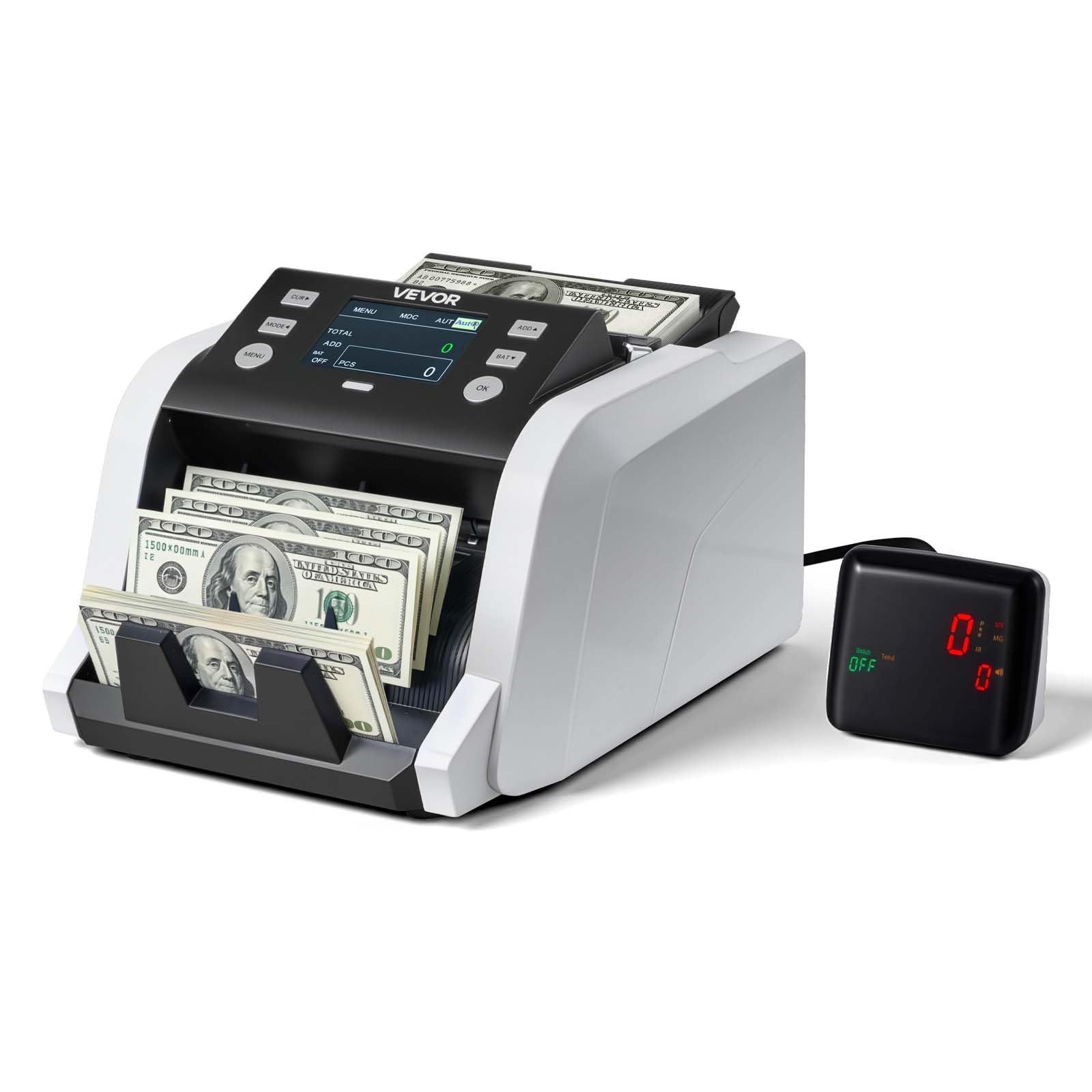
The VEVOR WR960 uses CIS sensors to scan both sides of each banknote, enabling automatic mixed-denomination recognition without needing to pre-sort. It supports USD, CAD, MXN, EUR, and GBP in a single load, making it a strong fit for businesses that handle multiple currencies. The 200-bill hopper feeds at 1200 notes per minute, and a 200-bill stacker keeps the pace consistent during heavy periods.
Detection covers UV, MG, IR, DD, DBL, HLF, and CHN sensors — seven methods that flag counterfeits, half-bills, and chained notes. When a suspicious bill is detected, the machine stops immediately and alerts the operator. Users who have run the unit for two years report no mechanical issues, and the metal chassis maintains alignment through thousands of cycles.
One smart workflow tip from experienced users: lower the max reject count from 70 to 40 in the settings to reduce jams from crumpled bills. The external 3.5-inch TFT display and separate customer-facing screen keep everyone informed. This machine offers a rare mix of CIS-based mixed counting and multi-currency support at a mid-range tier that undercuts similar-feature competitors by a wide margin.
Why it’s great
- CIS sensors enable true mixed-denomination value counting
- Multi-currency support without pre-sorting
- Proven reliability over two years per user reports
Good to know
- Future support may be limited as brand expands
- Reject bin needs tuning to avoid jams on crumpled bills
9. DETECK DT200
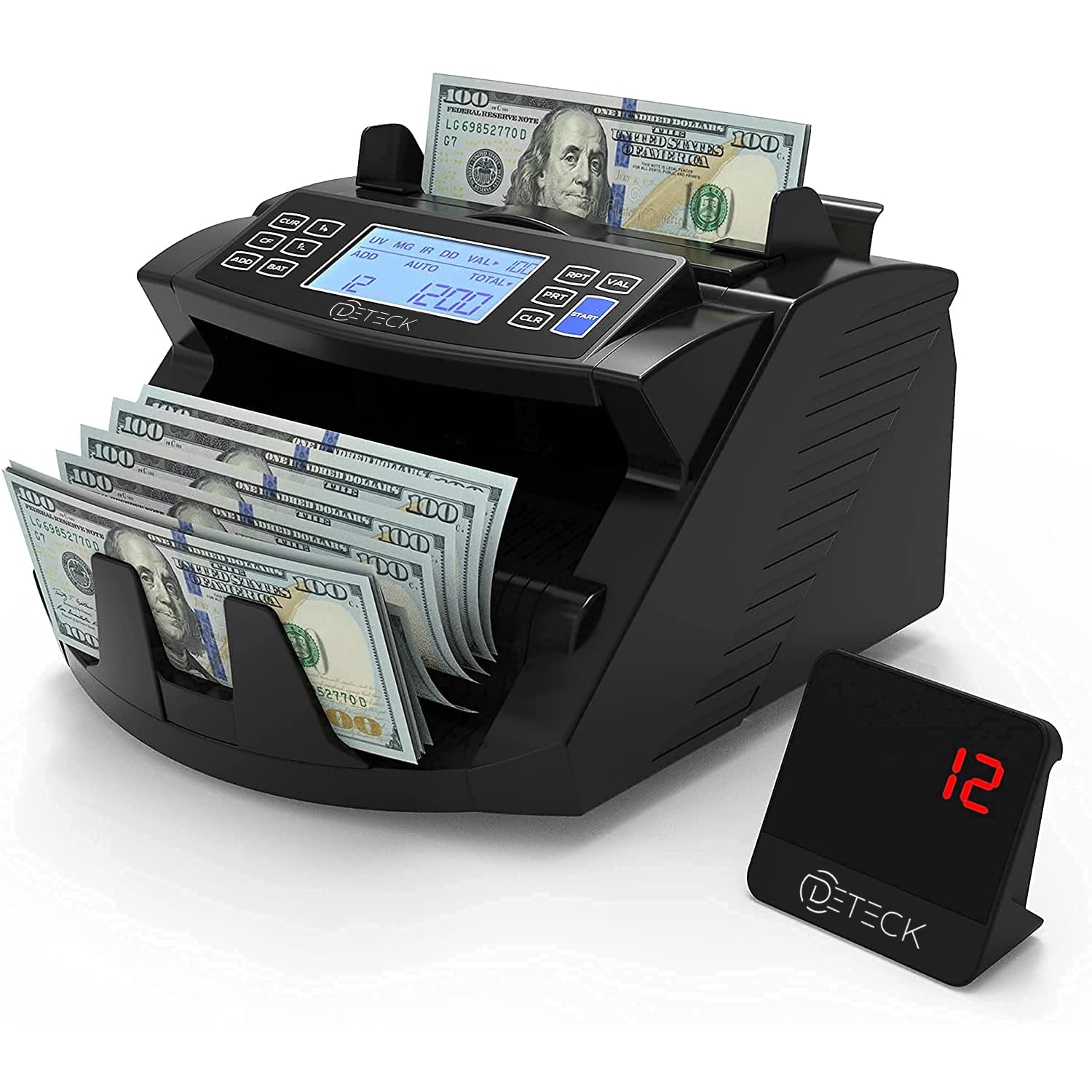
The DETECK DT200 is a solid entry-level counter that focuses on single-denomination counting with value totals. It handles up to 1300 notes per minute using a US-made friction roller system and a widened impeller that keeps bills from flying. The 4-inch LCD display is easy to read, and the ADD mode lets you sum multiple stacks of the same denomination like a calculator.
Counterfeit detection relies on UV and MG sensors, which catch basic fakes but lack the IR or CIS layers needed for mixed-denomination value counting. You must sort bills by denomination before each run. For organizations like small churches or side businesses that handle mostly one type of bill at a time, this limitation rarely matters — the DT200 cuts counting time in half compared to hand counting.
The US-based support team backs the machine with a one-year warranty, and reviewers who had issues reported responsive help. However, jamming is a known frustration if bills are not neat — one reviewer reported constant jams with 95% of attempts. This unit works best when fed crisp, sorted, and aligned notes. If your cash stack includes many wrinkled or crumpled bills, consider a mid-range model with more robust feeding mechanics.
Why it’s great
- Fast 1300 n/min for sorted, neat bills
- ADD mode simplifies single-denomination batch totals
- US-based support with one-year warranty
Good to know
- Jams frequently with worn or crumpled notes
- No mixed-denomination or IR detection for advanced security
FAQ
Can a mixed-denomination counter handle extremely wrinkled or torn bills?
Do I need serial number recognition for a small retail store?
Final Thoughts: The Verdict
For most users, the best bill counter machine winner is the Aneken AL-931 because it combines 2CIS accuracy, intuitive touch controls, and serial number tracking into a single reliable chassis. If you want blazing speed and best-in-class counterfeit detection on worn bills, grab the RIBAO MC-40. And for multi-currency flexibility with a two-year warranty and outstanding support, nothing beats the MUNBYN IMC01.