
Our readers keep the lights on and the weekend projects moving. As an Amazon Associate, I earn from qualifying purchases.
A cruise ship’s rolling deck and the constant motion of the ocean turn a casual glance into a blur. The wrong binoculars amplify every sway into a shaky, nauseating mess — the right ones lock onto a whale breach or a distant coastline with steady clarity, making the entire voyage feel like a private viewing platform. The key is pairing the right magnification with a forgiving exit pupil and waterproof build that laughs off salt spray.
I’m Rikta — the founder and writer behind FitlyFast. I’ve spent years analyzing optical hardware, comparing lens coatings, field-of-view specs, and build tolerances across marine and travel bins to separate deck-ready performers from cabin clutter.
After poring over durability reports, prism materials, and real-world user feedback from salty ocean trips, here is a tightly curated selection of the binoculars for a cruise that balance portability with the stability needed to enjoy the view from the railing.
How To Choose The Best Binoculars For A Cruise
Picking the right glass for a cruise isn’t about raw magnification — it’s about matching the optical system to the unique instability of a deck at sea. A pair that works brilliantly on a static mountaintop can feel unusable when the ship rolls. Focus on these three factors to avoid buyer’s remorse.
Magnification and Objective Lens Balance
An 8x or 10x magnification paired with a 25mm to 42mm objective lens is the functional sweet spot for a cruise. 7x (like the classic marine 7×50) trades a bit of reach for an ultra-stable, bright image because the exit pupil is huge — 7.1mm — which is forgiving for hand-held viewing on a swaying deck. Higher than 10x, and every ship vibration and hand tremor becomes a magnified blur, making distant subjects harder to track rather than easier.
Water and Fog Protection are Non-Negotiable
Salt spray, humid ocean air, and sudden rain showers are constants on a cruise. Look for O-ring sealed and nitrogen-purged builds. An IPX7 rating means the binoculars can survive a drop into standing water or a drenching from a rogue wave without fogging internally. Budget models that lack nitrogen purging will cloud up the moment you step from air-conditioned cabin to humid deck.
Weight, Grip, and Deck-Ready Ergonomics
A bulky pair quickly becomes a neck-ache on a day-long excursion. Sub-1.5-pound models with rubber armoring provide the non-slip grip you need when the ship lists. Twist-up eyecups are critical for eyeglass wearers who need to hold the eyepiece at the right distance. Open-bridge designs also improve grip and reduce weight without sacrificing optical alignment.
Quick Comparison
On smaller screens, swipe sideways to see the full table.
| Model | Category | Best For | Key Spec | Amazon |
|---|---|---|---|---|
| Bushnell Marine 7×50 | Porro Prism | Steady marine viewing | 7.1mm Exit Pupil | Amazon |
| Nikon PROSTAFF P3 10×42 | Roof Prism | All-weather long range | 367 ft FOV | Amazon |
| Vortex Crossfire HD 10×42 | Roof Prism | Lifetime warranty value | HD Optical System | Amazon |
| Nikon TRAVELITE EX 8×25 | Roof Prism | Ultra compact carry | 11.1mm Eye Relief | Amazon |
| Bushnell H2O 10×42 | Roof Prism | Rugged waterproof value | IPX7 Rated | Amazon |
| Carson RD-826 8×26 | Open Bridge | Featherweight deck use | 0.6 lbs Weight | Amazon |
| Nocs Standard Issue 10×25 | Roof Prism | Pocketable style | 315 ft FOV | Amazon |
In‑Depth Reviews
1. Bushnell Marine 7×50

The Bushnell Marine 7×50 is the gold standard for cruise optics because it was purpose-built for the sea. The 7x magnification is deliberately lower than typical terrestrial bins — this prevents the ship’s natural roll from shaking the view into a blur, while the massive 50mm objective lenses with a 7.1mm exit pupil deliver an exceptionally bright image even in overcast marine light or dusk hours when whales surface.
Its Porro prism design, paired with fully multi-coated BaK-4 prisms, provides a wide apparent field of view that makes scanning the horizon feel natural. The hermetically sealed, nitrogen-purged body and corrosion-resistant rubber armor mean salt spray and accidental splashes from the rail are non-issues — this is a Coast Guard-recommended configuration for a reason. Individual eyepiece focus eliminates the need for a central focus knob, which simplifies use in wet conditions.
The trade-off is size and weight — at over two pounds, it’s not a pocket pair. Travelers relying on a neck strap for long deck sessions should consider upgrading to a padded neoprene strap. But for anyone who prioritizes a rock-steady, brilliant image from a moving ship, this is the most capable choice in the list.
Why it’s great
- Massive 7.1mm exit pupil for unmatched stability and brightness on a rolling deck
- Hermetically sealed and corrosion-proof for direct salt spray exposure
- Porro prism delivers a wide, immersive field of view for horizon scanning
Good to know
- Hefty build is tiring on long excursions without a good strap
- Individual focus takes a moment to set for each user
2. Nikon PROSTAFF P3 10×42
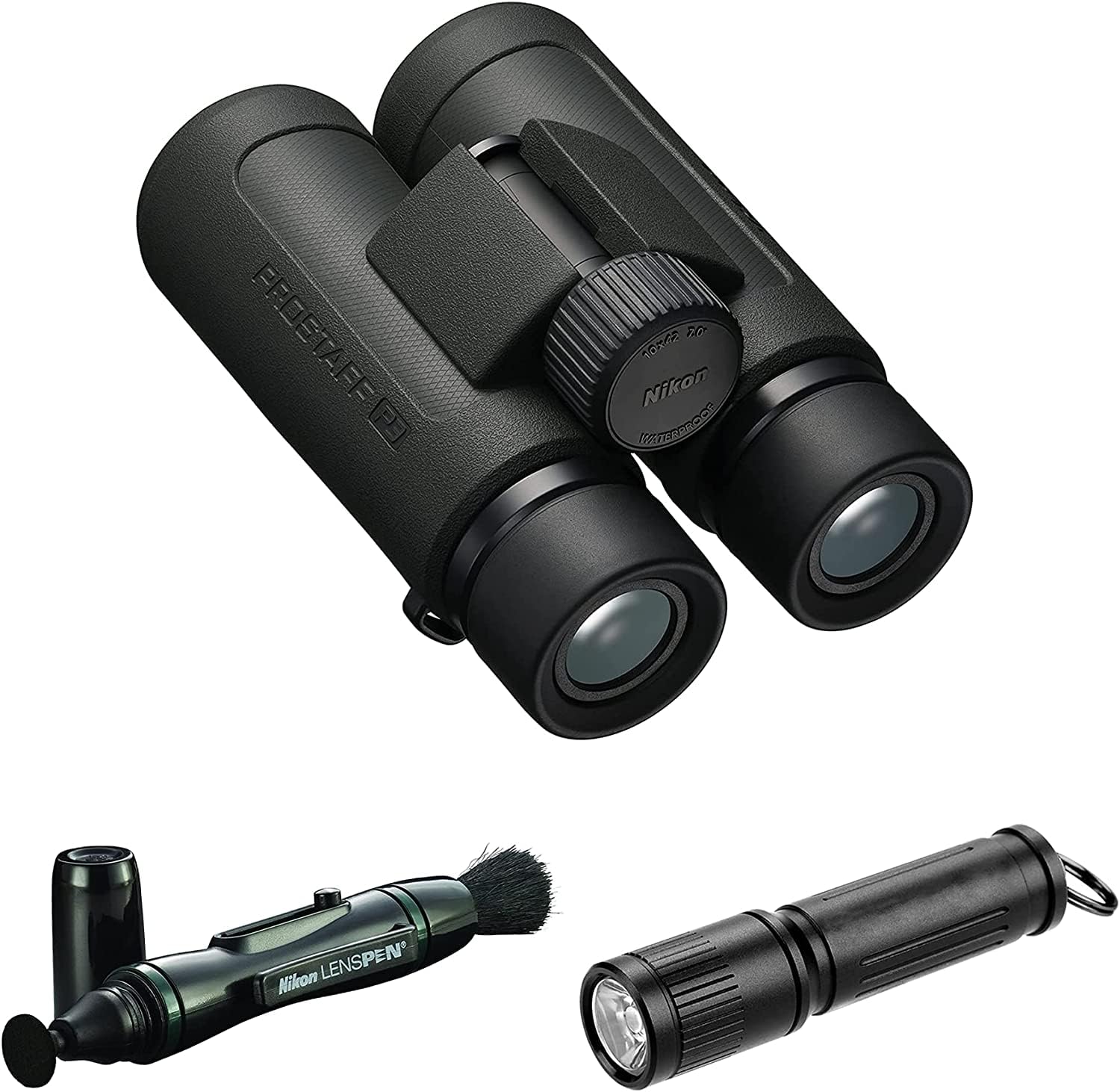
When your cruise itinerary includes glacier viewing in Alaska or spotting distant coastal wildlife, the Nikon PROSTAFF P3 10×42 delivers the reach without the bulk of traditional marine glass. The 10x magnification pulls in detail that 8x glasses miss, while the 42mm objective and multilayer anti-reflective coatings maintain surprising brightness even under overcast skies — a common condition on northern routes.
The nitrogen-filled, O-ring sealed body makes this fully waterproof and fog-proof, which is essential for those early-morning deck sessions when humidity is at its peak. The polycarbonate and rubber armoring keeps weight manageable at just over a pound while adding shock resistance for accidental drops. Twist-up eyecups with multi-stop positions work well for eyeglass wearers who need precise eye relief.
The included lens pen cleaning system and keychain flashlight add genuine value for a cruise setting where salt residue builds up fast. One consideration: 10x on a moving ship requires a steady hand — or bracing your elbows on the rail — to avoid image shake. If you tend toward seasickness or find yourself on a smaller, choppier vessel, a lower magnification may be more comfortable.
Why it’s great
- 10x magnification gives excellent reach for distant coastline and wildlife spotting
- Nitrogen-purged and O-ring sealed for full fog-proof performance in marine humidity
- Lightweight rubber-armored body reduces fatigue on long excursions
Good to know
- 10x magnification amplifies hand and ship motion — requires a stable brace
- Eyecups can feel stiff during rapid adjustment
3. Vortex Crossfire HD 10×42

The Vortex Crossfire HD 10×42 earns its place here because of an HD optical system that cuts chromatic aberration — that purple-green fringing you see on high-contrast edges — better than anything else at this tier. On a cruise, where bright white hulls cut against blue water and gray skies, that clarity makes every scene look crisp and true. The nitrogen purging and O-ring sealing guarantee fog-free performance when you step from the air-conditioned cabin to the humid deck.
The rubber armor provides a positive grip even when your hands are damp from the sea breeze, and the included GlassPak case and rainguard eyepiece cover are thoughtful additions for wet storage. The center focus wheel is smooth and precise, while the diopter adjustment locks firmly to avoid accidental changes — a common complaint on cheaper bins. At roughly 24 ounces, it’s a solid mid-weight that balances durability with carry comfort.
The VIP warranty is the clincher: it’s unlimited, unconditional, and fully transferable. If these get knocked overboard, damaged in a bag, or develop a mechanical fault, Vortex repairs or replaces them for life. That kind of guarantee makes the Crossfire HD a low-risk investment for a vacation where gear takes a beating. The one downside is that for pure low-light performance on a dark ocean evening, the slightly larger 50mm objective of a marine-specific model will edge ahead.
Why it’s great
- HD glass elements virtually eliminate color fringing on high-contrast marine views
- Unconditional lifetime VIP warranty protects against cruise damage or loss
- Fully multi-coated lenses and BaK-4 prisms deliver bright, vivid images
Good to know
- Not quite as bright in extremely low light as larger 50mm objective models
- Weight, while reasonable, is slightly heavier than dedicated travel compacts
4. Nikon TRAVELITE EX 8×25

The Nikon TRAVELITE EX 8×25 is the answer for cruisers who refuse to check a bulky bag. At this size, it slips into a day-pack pocket or a cabin safe with zero fuss, yet the 8x magnification and 25mm objective produce a field of view that feels anything but cramped — 47.5 degrees apparent angle means you can track a moving dolphin pod without constantly re-centering. The multilayer-coated optics and aspherical eyepiece lenses deliver sharp, color-true images that rival larger bins in good light.
Die-cast aluminum body wrapped in rubber armoring gives it surprising shock resistance for such a small unit. The nitrogen-purged, O-ring sealed build makes it waterproof up to two meters for five minutes — plenty for a rain squall on deck or a splash from the pool. The turn-and-slide eyecups provide 11.1mm of eye relief, accommodating eyeglass wearers better than most compacts at this price point. The click-type diopter stays put after adjustment, which is a thoughtful detail for repeated use across different viewers.
The main trade-off is light gathering — the 25mm objective has a 3.13mm exit pupil, which means the image dims noticeably in twilight or heavily overcast conditions. For daytime excursions, snorkeling spot checks, and harbor views, it’s brilliant. For sunset whale watching or navigating a dimly lit rainforest canopy, you’ll want the larger 42mm objective of a model like the Bushnell H2O or Vortex Crossfire.
Why it’s great
- Ultra-compact and lightweight — fits in a day-pack or large pocket
- Waterproof and fog-proof with 11.1mm eye relief for eyeglass wearers
- Nikon’s aspherical lenses keep distortion low edge-to-edge
Good to know
- Small 25mm objective struggles in low light compared to 42mm models
- Best as a secondary or day-use binocular rather than a primary all-weather tool
5. Bushnell H2O 10×42

The Bushnell H2O 10×42 is a no-nonsense waterproof performer built to survive the wet, salty environment of a cruise. Its IPX7 rating means it can be submerged in three feet of water for 30 minutes without internal damage — far beyond what a splash-resistant model offers. The fully multi-coated optics and BaK-4 prisms produce a bright, high-contrast image that handles the glare off the water effectively.
The soft-touch rubber housing features textured grip runners on the sides and bridge, which is a lifesaver when your hands are damp from sea spray or sunscreen. The 12-foot close focus is surprisingly useful for inspecting on-deck details or nearby marina wildlife. At under 1.5 pounds with a lightweight aluminum chassis, it strikes a smart balance between ruggedness and portability — much easier to carry all day than a traditional marine 7×50.
The diopter adjustment on this model is notably stiff, which is actually a positive for cruise use — it won’t drift out of alignment when jostled in a bag or passed between family members. The included case is serviceable but not padded for hard impacts. If you want a binocular that shrugs off weather and delivers consistent optical quality without costing a premium, the H2O is a reliable mid-range pick that outperforms its price tier.
Why it’s great
- IPX7 waterproof rating handles full submersion — ideal for wet marine environments
- Non-slip rubber grip with textured runners stays secure when hands are damp
- Lightweight aluminum chassis keeps carry fatigue low for all-day use
Good to know
- Diopter ring is very stiff — difficult to adjust without a firm grip
- Carrying case is basic and offers limited impact protection
6. Carson RD Series 8x26mm Open-Bridge
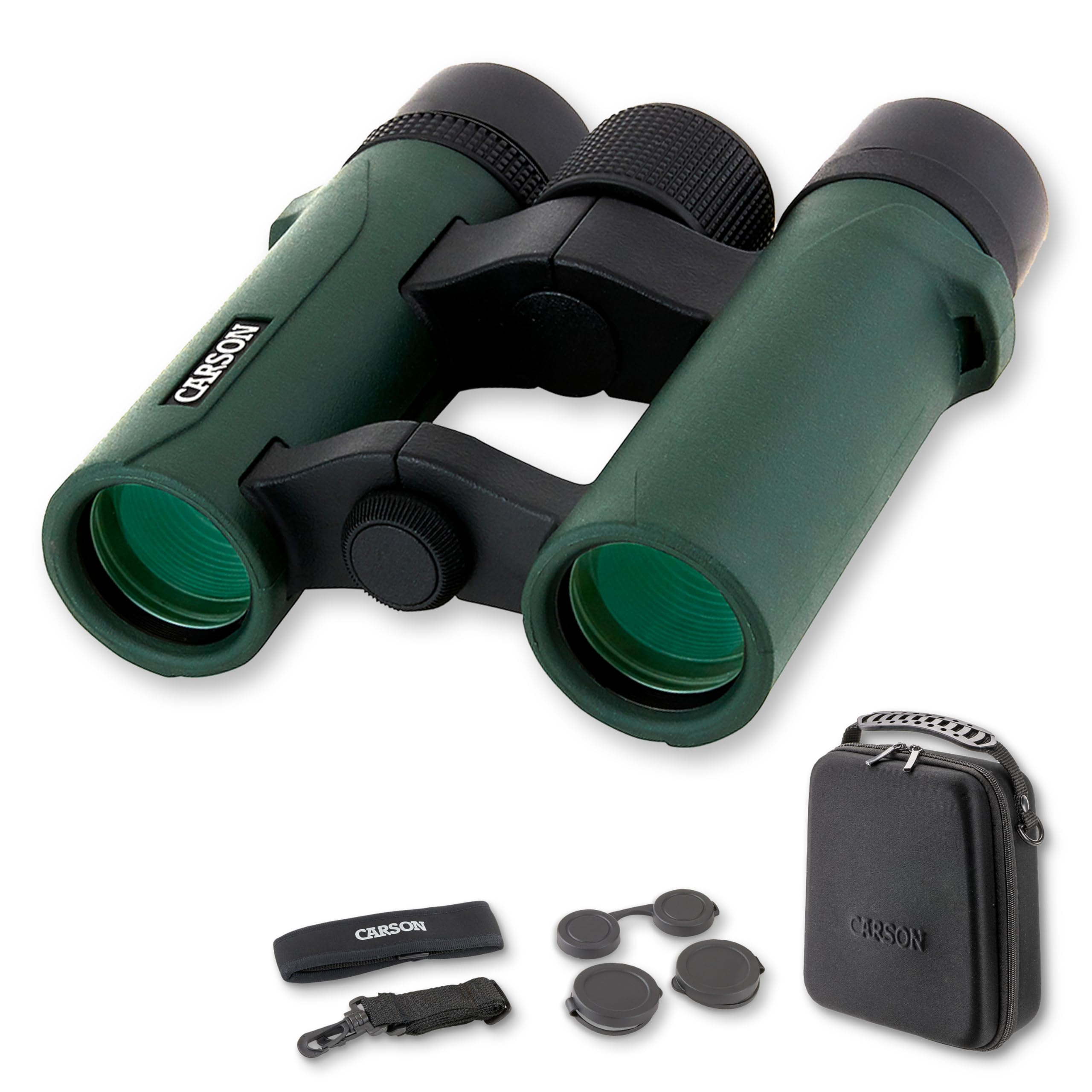
The open-bridge design (a split bridge connecting the two barrels) reduces weight while improving heat dissipation and providing a more natural grip. At 8x26mm, it’s a classic compact configuration that balances magnification with a forgiving exit pupil of 3.25mm for daytime use.
The BaK-4 prisms and multi-coated optics produce a sharp, bright image that belies the small size, and the 16mm eye relief is generous for this class — comfortable enough for a full day of sightseeing without eye strain. The nitrogen-filled, O-ring sealed body makes it both waterproof and fog-proof, which is essential for the humidity and spray of an open deck. The extra-long twist-down eyecups work well for those who prefer a deep eye socket seal against ambient light.
Where the Carson saves weight, it cuts corners on the accessories. The included zippered case is widely noted as flimsy — the zipper pull tends to detach with regular use, so plan to store it in a padded pouch of your own. The neck strap is also serviceable but not premium. For the price, the optical core is excellent; just budget for a better carrying solution if you’re taking it on multiple excursions.
Why it’s great
- Remarkably light at 0.6 lbs — ideal for minimalist packers
- Open-bridge design improves grip and reduces weight without optical compromise
- 16mm eye relief is generous for compact binoculars — great for eyeglass wearers
Good to know
- Included carrying case has a fragile zipper that may fail during a trip
- Limited low-light performance due to 26mm objective lens
7. Nocs Provisions Standard Issue 10×25

The Nocs Provisions Standard Issue 10×25 makes the list because it proves a small binocular can be both functional and genuinely pleasant to carry. Its 10x magnification and 25mm objective fit the compact travel formula, and the fully multi-coated optics with a Swiss-designed BaK-4 prism deliver a 315-foot field of view that feels wide for the size — enough to track birds along a coastline without losing the subject.
The IPX7 waterproof rating and nitrogen purging mean this little pair can handle a rainstorm on deck or an accidental drop in a puddle without fogging. The rubber “Rugged Wave Grip” casing provides a comfortable, slip-resistant hold, and the multi-stop twist-up eyecups offer three distinct positions to dial in the perfect eye relief for both glasses wearers and bare eyes. The Pacific Blue II colorway is a refreshing departure from the usual black or green.
The strap attachment system is frustratingly tight — the narrow slots make threading the included strap difficult, and once attached, the strap itself may be too short for taller users to wear cross-body. The compact form factor also means the 10x magnification can feel shaky without a solid brace; pairing it with a wrist strap rather than a neck strap helps stabilize the view. For a stylish, packable backup pair that looks good in photos and performs in good light, the Nocs delivers — just pack your own strap.
Why it’s great
- IPX7 waterproof and fog-proof in a pocketable package
- Patented wave-grip rubber casing offers secure hold in wet conditions
- Lifetime “No-Matter-What” warranty provides peace of mind for travelers
Good to know
- Strap attachment slots are very narrow — installation is a struggle
- 10x on a compact body amplifies shake; bracing is needed for clear views
FAQ
Is 10x magnification too shaky for a cruise ship deck?
What is the difference between waterproof and water resistant for marine binoculars?
Should I choose a Porro or roof prism binocular for a cruise?
Final Thoughts: The Verdict
For most users, the binoculars for a cruise winner is the Bushnell Marine 7×50 because its massive exit pupil and purpose-built marine sealing deliver a steady, bright image even on a moving deck. If you want ultra-compact carry that disappears into a day bag, grab the Nikon TRAVELITE EX 8×25. And for all-weather versatility backed by a lifetime warranty, nothing beats the Vortex Crossfire HD 10×42.