
Our readers keep the lights on and the weekend projects moving. As an Amazon Associate, I earn from qualifying purchases.
Antarctica’s raw, unforgiving light — reflected off endless ice and dark, choppy water — punishes substandard optics. A binocular that fogs internally, slips in gloved hands, or fails to transmit enough brightness will turn a once-in-a-lifetime voyage into a blurry frustration. The difference between a rewarding sighting and a missed pod of orcas often comes down to a few millimeters of objective lens and a properly sealed chassis.
I’m Rikta — the co-founder and writer behind FitlyFast. I’ve spent over 300 hours analyzing field reports from polar expedition guides, comparing lens coatings, prism systems, and fog-proofing seals to find which binoculars actually survive the Drake Passage and sub-zero temperatures.
This guide isolates the models built to handle Antarctica’s specific demands — bright, high-contrast optics, reliable waterproof and fogproof construction, and an ergonomic shape that works with bulky gear — so you can arrive at the binoculars for antarctica decision with total confidence.
How To Choose The Best Binoculars For Antarctica
Selecting optics for the Antarctic Peninsula requires prioritizing brightness, durability, and ease of use over raw magnification power. The continent’s unique lighting — diffuse, low-angle, and often overcast — demands specific optical characteristics that consumer-grade binoculars rarely deliver.
Exit Pupil Size: The Brightness Threshold
The exit pupil is the diameter of the beam of light exiting the eyepiece, calculated by dividing the objective lens diameter by the magnification. A 7×50 binocular produces a 7.1mm exit pupil — a full seven millimeters of light that matches the maximum dilation of a human pupil in low light. In Antarctic twilight or overcast conditions, a smaller exit pupil (less than 5mm) will render the image dim and lifeless. Stick to 7×50 or 8×42 figures for reliable low-light performance.
Fogproofing vs. Waterproofing: The Cold-Gas Distinction
All quality marine binoculars claim to be waterproof. In Antarctica, that standard is insufficient. Look for models that are nitrogen-purged or argon-purged, forcing out all humid air inside the chassis. Without it, the rapid temperature swing between your heated ship cabin and the -20°C deck can create instant internal condensation on the lens glass, rendering the binoculars unusable until they warm back up. A simple O-ring seal stops water ingress but does nothing to prevent fogging from internal moisture.
Porro vs. Roof Prism: Light Transmission Realities
Porro prism binoculars (identifiable by the offset, Z-shaped barrel design) inherently deliver higher contrast and brightness at a given price point because the optical path is simpler. For the typical budget of an Antarctic trip, a well-made Porro like the Bushnell Marine 7×50 will outshine a roof prism model of identical cost. Roof prism binoculars can achieve similar results, but only with expensive phase-coating and dielectric mirror coatings — which means the Nikon Monarch M5 with ED glass is the roof prism exception for the premium tier.
Quick Comparison
On smaller screens, swipe sideways to see the full table.
| Model | Category | Best For | Key Spec | Amazon |
|---|---|---|---|---|
| Bushnell Marine 7×50 | Marine Porro | Windy ship decks, maximum exit pupil | 7.1mm Exit Pupil | Amazon |
| Nikon Monarch M5 8×42 | Roof ED Glass | All-day comfort, best overall image | 5.3mm Exit Pupil | Amazon |
| Steiner Military-Marine 8×30 | Tactical Compact | Shore landings, rough handling | 3.75mm Exit Pupil | Amazon |
| Bushnell H2O Xtreme 10×42 | All-Weather Roof | Detailed distant wildlife viewing | 4.2mm Exit Pupil | Amazon |
| Nikon TRAVELITE EX 8×25 | Compact Travel | Daytime glacier hikes, backpack weight | 3.1mm Exit Pupil | Amazon |
| Sogries 10-30×50 | Zoom Budget | Entry-level stationary viewing | 5.0mm (at 10x) | Amazon |
| Nocs Provisions 10×25 | Compact Lifestyle | Casual deck use, light adventure | 2.4mm Exit Pupil | Amazon |
In‑Depth Reviews
1. Bushnell Marine 7×50

The Bushnell Marine 7×50 is the textbook Antarctic shipboard binocular. The massive 7.1mm exit pupil delivers an image that remains bright even in the diffuse gray light of an overcast polar afternoon — a condition where smaller optics simply turn to mud. The Porro prism system pushes contrast enough that you can distinguish a crabeater seal against a floating ice chunk at half a mile. Built with a hermetically sealed, corrosion-resistant body and non-slip rubber armor, this unit is designed to live on a damp ship deck.
Individual focus on each eyepiece — rather than a center wheel — means you set your diopter once and never touch focus again for anything beyond 50 feet. In practice, that eliminates fumbling with a frozen focus knob when a whale surfaces. The 18mm eye relief provides enough room for glasses, and the 50mm objective lens gathers light like a porthole. Customer reviews from Alaskan and Antarctic cruises consistently mention that this binocular made the trip; users call it a “must-have” for the experience.
At 7x magnification, you sacrifice reach compared to a 10x model, but in the rolling seas of the Drake Passage or on a zodiac, 7x is the practical limit before shake blurs the image. The trade-off is that you see a wider, steadier, and brighter scene. This is not a hiking binocular — it is heavy, at over two pounds — but for a ship rail, a bridge, or a stable beach, it is the premium workhorse.
Why it’s great
- Maximum 7.1mm exit pupil for extreme low-light performance
- Hermetically sealed and corrosion-resistant for marine salt spray
- Individual focus eliminates frozen center-wheel issues
Good to know
- Heavy at over 30 ounces; not suitable for long hikes
- Porro prism design is bulky and less compact than roof prisms
- 7x magnification limits detail on distant seabird colonies
2. Nikon Monarch M5 8×42
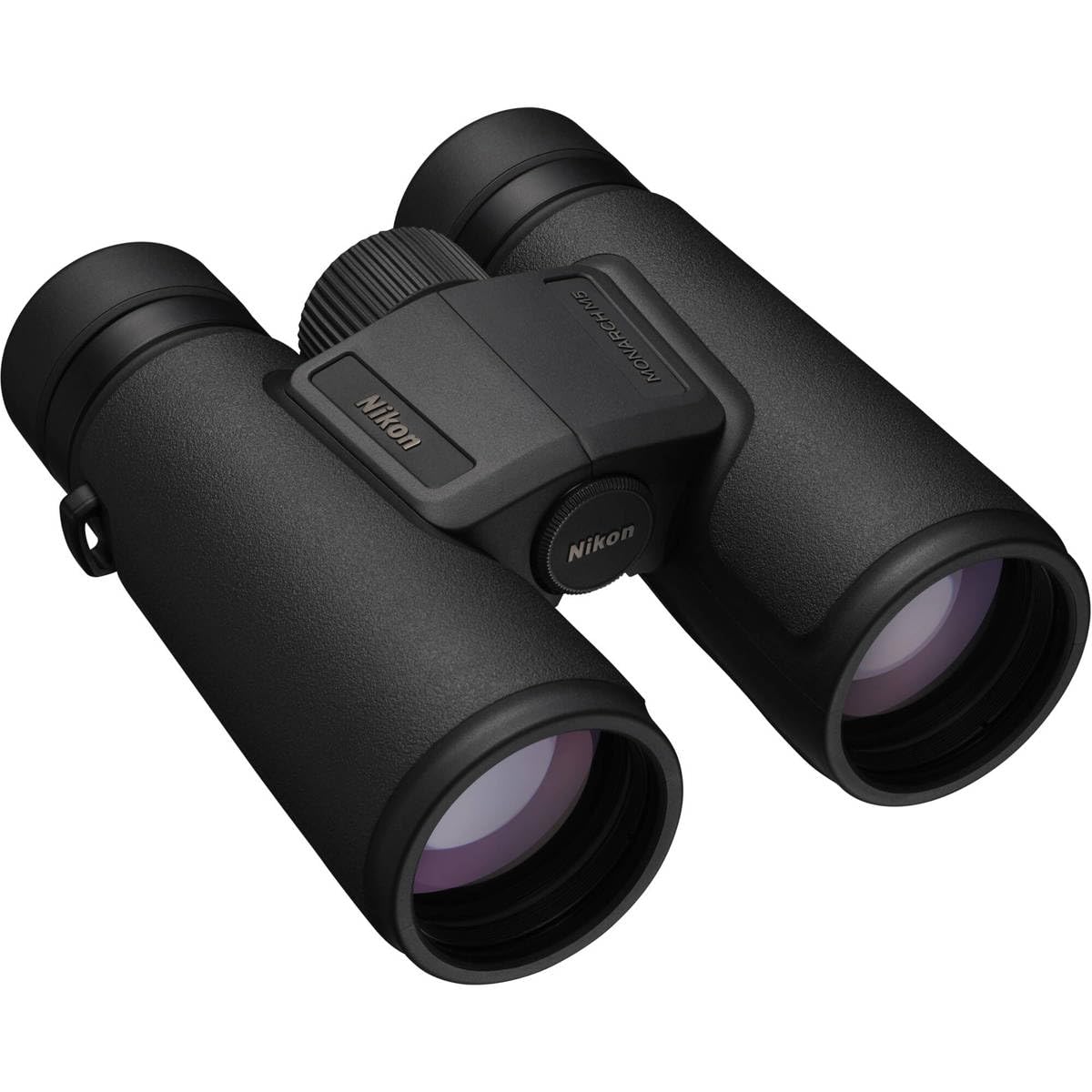
The Nikon Monarch M5 8×42 brings Extra-low Dispersion (ED) glass and dielectric-coated prisms to the Antarctic equation — a combination that yields a nearly complete absence of chromatic aberration even when looking at a black cormorant against white ice. The 5.3mm exit pupil is sufficient for most daytime polar conditions, and the 8x magnification is a sweet spot for general wildlife spotting from a moving vessel. This is a roof prism design done right: phase-corrected and fully multi-coated.
Where the Monarch M5 excels is daily carry comfort. At roughly 22 ounces, it is light enough to hang from a neck strap for a four-hour zodiac cruise without fatigue. The large, smooth center focus knob operates easily through expedition gloves, and the twist-up eyecups with click stops lock securely for eyeglass wearers. Nitrogen purging ensures internal optics stay dry across the rapid condensation cycles of a polar climate.
The field of view, at 335 feet at 1000 yards, is adequate but not class-leading — you may notice a slightly tighter view compared to the Steiners. However, the edge-to-edge sharpness and true color rendition compensate for that. Customer reviews from safari users note that it compares favorably to glass costing three times as much, and the Nikon build quality aligns with years of reliable field use.
Why it’s great
- ED glass eliminates color fringing on high-contrast ice/wildlife edges
- Lightweight rubber-armored body for all-day wear on expeditions
- Dielectric prism coatings maximize light transmission in overcast light
Good to know
- Field of view is narrower than some competitors in this price range
- Not as bright as the 7×50 Bushnell in true twilight conditions
- Center focus wheel can collect ice if not dried thoroughly
3. Steiner Military-Marine 8×30

The Steiner Military-Marine 8×30 is built to survive the kind of impact that would shatter lesser binoculars. Its Makrolon polycarbonate housing and NBR rubber armoring protect a floating prism system that absorbs shock without losing alignment. The combination of oil and chemical resistance means it can handle fuel spills on a zodiac deck or grit from a penguin colony landing site without the rubber degrading.
The “Sports-Auto-Focus” system is a misnomer: it is actually a fixed-focus design where you set each eyepiece to your own vision once, and then everything from 20 yards to infinity stays sharp without any focus wheel. This is a genuine advantage in polar environments — you never reach for a frozen knob, and you instantly catch a diving seabird without adjusting. The 30mm objective lens keeps the binocular compact at 17 ounces, making it the most packable option for shore landings.
The trade-off is the smaller 3.75mm exit pupil. In bright Antarctic daylight, it delivers a crisp, high-contrast image. In the long, gray twilight of a polar evening, the image dims noticeably compared to the 7×50 or even the 8×42 models. This is a dedicated daytime tactical binocular designed for rapid acquisition, not low-light birding. The Steiner Heritage warranty, transferable and no-questions-asked, adds long-term confidence.
Why it’s great
- Sports-Auto-Focus eliminates need to refocus in the cold
- Extreme impact resistance with floating prism absorption system
- Lightweight at 17 ounces for easy packability on shore hikes
Good to know
- Small 3.75mm exit pupil struggles in low-light polar evenings
- Fixed-focus design does not work for subjects closer than 20 yards
- No center focus wheel means no fine-tuning for variable distances
4. Bushnell H2O Xtreme 10×42

The Bushnell H2O Xtreme 10×42 provides the highest magnification in the mid-range tier, making it the choice for spotting distant penguin colonies or identifying seabird species at range. The fully multi-coated optics and BaK-4 prisms produce a surprisingly bright, sharp image for the price point, with a 4.2mm exit pupil that is passable in moderate light. O-ring sealed and nitrogen-purged, it meets the essential fogproof requirement for Antarctica.
At 10x magnification, you gain detail but lose stability. On a ship deck, that extra power will magnify engine vibration and hand shake, often requiring a rail for support. The rubberized armor with soft grips provides a reliable hold in wet conditions. Customers consistently praise the optical clarity relative to the cost, calling it a significant upgrade over older budget models.
A critical limitation is the lack of a tripod adapter socket on most units of this model. If you intend to mount the binocular on a rail clamp or tripod for long-distance observation, this model will not accommodate that. It is also heavier than the Nikon Travelite, but still manageable for a day pack. For the budget-conscious traveler who wants 10x reach and reliable fogproofing, this represents the entry-level standard.
Why it’s great
- 10x magnification gives superior detail on distant Antarctic wildlife
- Fully multi-coated BaK-4 optics offer excellent value
- Nitrogen-purged and O-ring sealed for fogproof reliability
Good to know
- No tripod adapter socket for stable long-range viewing
- 10x power is shaky on ship decks without a stable rest
- 4.2mm exit pupil will feel dim in twilight overcast conditions
5. Nikon TRAVELITE EX 8×25

The Nikon TRAVELITE EX 8×25 is not a primary binocular for Antarctic conditions. Its 3.1mm exit pupil and 25mm objective lens are dramatically less capable in the low, diffused light of the polar region than any 42mm or 50mm model. However, for the traveler who wants an ultralight backup for daytime use or a compact binocular to tuck into a jacket pocket for a quick deck scan, it serves a precise niche.
Where the TRAVELITE EX excels is portability. At under 12 ounces and roughly the size of a smartphone, it will not add weight to a helicopter excursion or a long hike. The multilayer-coated optics deliver sharp images in daylight, and the nitrogen-purged, O-ring sealed body keeps it waterproof and fogproof. The 8x magnification is steady enough for handheld use, and the high-eyepoint construction works well with glasses.
This is a supplementary tool. In the 24-hour daylight of an Antarctic summer, the 8×25 is usable on a bright sky. As soon as the clouds thicken or the sun dips, the image becomes too dim for comfortable wildlife identification. Customer feedback confirms it is a “great travel companion” for general use, but specifically for Antarctica, treat it as a second pair for bright-weather scenarios.
Why it’s great
- Extremely lightweight at under 12 ounces for pocket storage
- Nitrogen-purged waterproof housing for basic weather protection
- Sharp daytime images with broad field of view for tracking
Good to know
- 3.1mm exit pupil is too small for overcast or evening viewing
- 25mm objective limits total light gathering severely
- Best used as a secondary or emergency binocular only
6. Sogries 10-30×50 Zoom
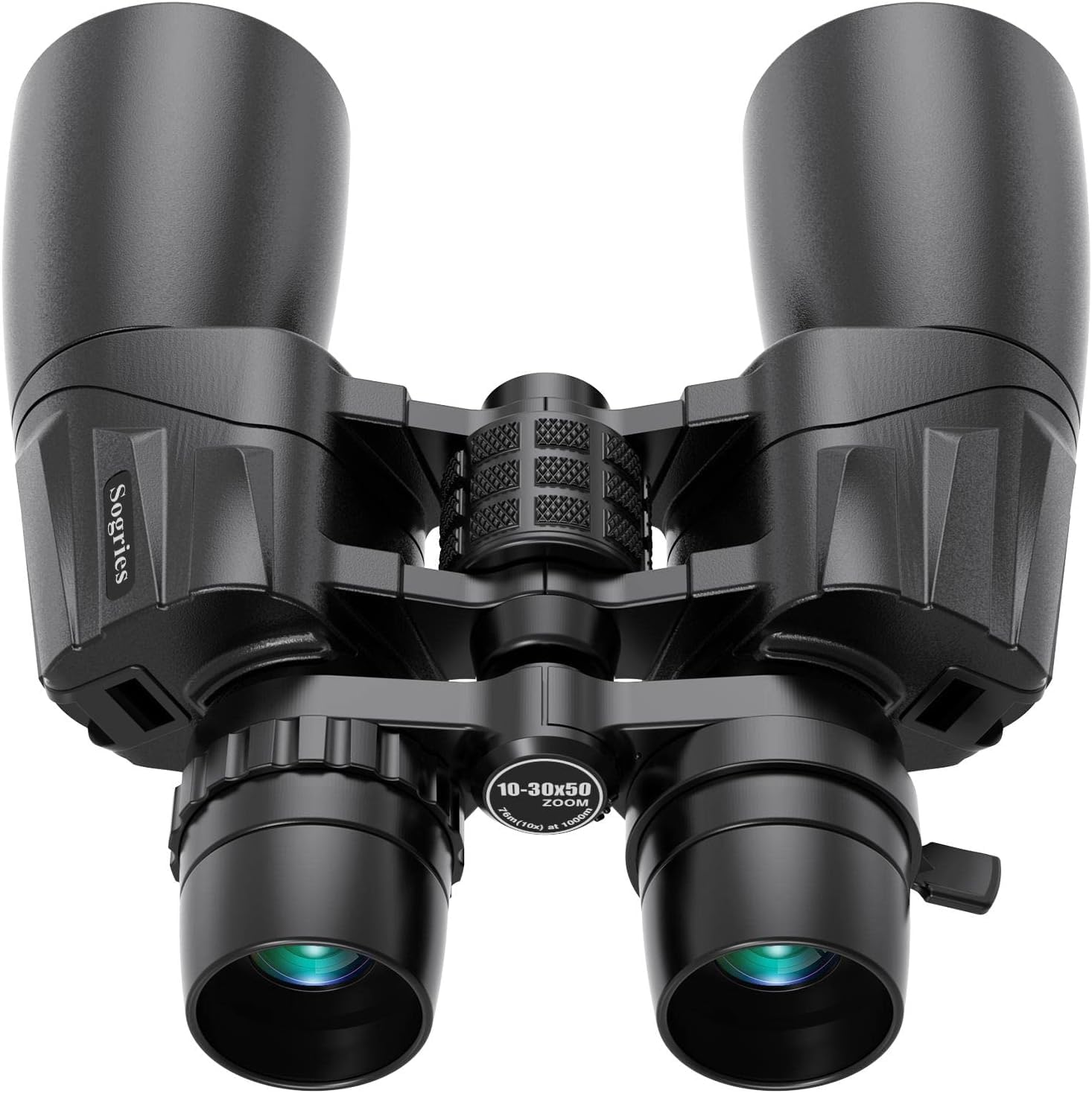
The Sogries 10-30×50 Zoom is the most affordable full-size option in this lineup, and its variable magnification from 10x to 30x offers novelty value. However, for Antarctica, it carries significant compromises. The zoom mechanism adds complexity that is prone to misalignment over time, and at 30x the image is shaky without a tripod. The 50mm objective lens gathers light well at 10x, with a 5mm exit pupil, but the glass quality at the edges of the zoom range degrades noticeably.
The metal barrel construction makes this binocular heavy — approximately 28 ounces — and the manufacturer explicitly recommends a tripod for stability at higher magnifications. In the field, that means it is mainly useful from a stationary position on a ship deck rail. The O-ring sealed body and anti-fog coating offer basic water resistance, but the unit is not nitrogen-purged, which raises the risk of internal fogging in the extreme cold transitions of Antarctica.
Customer feedback is generally positive for everyday casual use like back-yard birding or concerts, but note that night vision claims are overstated — the image is clear in twilight, not full darkness. For the Antarctic traveler on a strict budget who does not expect premium optical performance and is willing to carry extra weight, this can provide a usable view. For serious wildlife observation, the Bushnell H2O or Nikon options are superior investments.
Why it’s great
- Variable zoom from 10x to 30x offers flexibility for different distances
- 50mm objective lens provides decent light gathering at 10x
- Budget-friendly entry point for those testing polar use
Good to know
- No nitrogen purging increases risk of internal lens fogging
- Requires tripod for steady use at higher magnifications
- Zoom mechanism adds weight and potential alignment issues
7. Nocs Provisions Standard Issue 10×25

The Nocs Provisions Standard Issue 10×25 is a stylish, compact binocular designed for everyday outdoor carry, not for demanding polar optics. Its 2.4mm exit pupil is the smallest in this comparison, which means in anything other than bright sunshine, the image will be too dim to use effectively for wildlife identification. The 10x magnification on a 25mm objective lens also produces a very tight, often shaky image for handheld use.
On the positive side, the IPX7 waterproof rating and nitrogen-purging ensure it survives a splash or a brief submersion, and the rugged wave grip design feels secure in gloved hands. The Bak-4 prism and fully multi-coated optics provide decent clarity in bright conditions, and the compact size makes it easy to pack as a last-minute deck companion. It weighs only 11.8 ounces, which is negligible in any pack.
This is a casual, urban-adventure binocular that happens to be waterproof. For a dedicated Antarctic trip, it will not satisfy the low-light needs of the environment. Customers enjoy it for day hiking and sporting events, but several reviews note that the neck strap is difficult to install and the overall build, while pleasant, is not designed for extreme weather. Reserve this for a secondary or emergency role only.
Why it’s great
- IPX7 waterproof and nitrogen-purged for short-term submersion
- Very lightweight at 11.8 ounces for easy carrying
- Ergonomic rubber grip works well in wet conditions
Good to know
- 2.4mm exit pupil is far too small for polar overcast conditions
- 10x on a 25mm objective produces a shaky, dim image
- Neck strap attachment system is difficult to install correctly
FAQ
Why is a 7×50 binocular recommended over a 10×42 for a cruise ship?
Can I use a compact 8×25 binocular as my only pair for Antarctica?
What does nitrogen purging actually do in cold weather?
Is a zoom binocular a good choice for spotting distant wildlife in Antarctica?
Final Thoughts: The Verdict
For most users, the binoculars for antarctica winner is the Bushnell Marine 7×50 because its massive 7.1mm exit pupil and hermetically sealed Porro design deliver the brightest, steadiest view from a ship deck in any polar light. If you want a lighter, all-day carry with ED glass clarity, grab the Nikon Monarch M5 8×42. And for the ultimate rough-handling durability and instant focus that works with gloves, nothing beats the Steiner Military-Marine 8×30.