
Our readers keep the lights on and the weekend projects moving. As an Amazon Associate, I earn from qualifying purchases.
Scanning the Milky Way’s faint dust lanes or resolving the twin shadows of a Jovian moon transit requires glass that gathers light, not just magnifies it. The wrong choice delivers a dim, shaky smear; the right pair transforms your backyard into a deep-sky observatory. The decision comes down to aperture size, prism quality, and a realistic appraisal of your own tolerance for a tripod.
I’m Rikta — the co-founder and writer behind FitlyFast. I’ve spent countless hours dissecting optical specifications, poring over customer field reports, and comparing light-gathering formulas to identify the binoculars that genuinely serve the stargazer, not just the marketing department.
After evaluating nine diverse models spanning compact image-stabilized units to giant 100mm aperture giants, this guide to the best binoculars for astronomy separates deep-sky contenders from daytime-only toys.
How To Choose The Best Binoculars For Astronomy
Astronomy binoculars live and die by their ability to collect and transmit light. A 10×42 model that works for daytime birding will feel dead at night, while a 25×100 giant reveals star clusters you never knew existed. Focus on three core pillars: aperture, prism architecture, and your willingness to mount the unit on a tripod.
Aperture: The Light-Bucket Rule
Objective lens diameter (the second number in the specification) is the single most critical spec for astronomy. A 50mm lens collects about 40% more light than a 42mm, while a 70mm gathers nearly three times the light of a 42mm. For serious deep-sky work, aim for 50mm as a minimum; 70mm and above unlock nebulas and globular clusters.
Prism Quality & Coatings
BaK-4 glass prisms transmit more light and produce sharper edges than the cheaper BK-7 alternative. Pair this with fully multi-coated (FMC) optics—every air-to-glass surface treated—to maximize transmission. Dielectric coatings on the prism reflect more light than standard aluminum, delivering a brighter, more natural image.
Magnification vs. Stability
10x is the handheld ceiling for most people; 12x and above introduces noticeable shake. For 15x and higher, plan on using a tripod. Image-stabilized models, like the Canon 12×36 IS III, break this rule by electronically canceling hand tremors, allowing you to hold 12x steady without a mount.
Quick Comparison
On smaller screens, swipe sideways to see the full table.
| Model | Category | Best For | Key Spec | Amazon |
|---|---|---|---|---|
| Canon 12×36 IS III | Premium | Handheld deep-sky scanning | Image Stabilization | Amazon |
| Celestron SkyMaster 25×100 | Premium | Deep-sky clusters | 100mm Aperture | Amazon |
| Sogries 25×100 | Premium | All-weather deep-sky | Waterproof, 8.8 lbs | Amazon |
| Pentax SP 10×50 WP | Mid-Range | Rugged low-light observation | JIS Class 6 Waterproof | Amazon |
| Nikon Monarch M5 8×42 | Mid-Range | Wide-field scanning | ED Glass | Amazon |
| Celestron SkyMaster 12×60 | Mid-Range | Entry-level astronomy | 60mm Objective Lens | Amazon |
| Tenjin 30X80 Astro | Mid-Range | High-magnification lunar | 80mm Aperture | Amazon |
| Sogries 18×70 Astronomy | Entry | Budget deep-sky starter | IPX7 Waterproof | Amazon |
| Sogries 10-30×50 Zoom | Entry | Versatile terrestrial + moon | 30x Zoom Range | Amazon |
In‑Depth Reviews
1. Canon 12×36 Image Stabilization III Binoculars

The Canon 12×36 IS III redefines what handheld astronomy binoculars can do. Its Vari-Angle prism image stabilization cancels out hand tremors, effectively turning 12x magnification into a steady, tripod-free view. This is a game-changer for scanning the Milky Way or tracking the Orion Nebula without hauling a mount into the field.
Optically, the doublet field-flattener lenses deliver sharp, distortion-free images edge-to-edge, a rarity for this price tier. The Super Spectra multi-coating and Porro II prisms ensure high light transmission, producing bright, contrast-rich views of open clusters and brighter deep-sky objects. At only about 1.5 pounds, it’s lightweight enough for travel.
The primary trade-off is aperture: 36mm objective lenses limit light-gathering compared to 50mm or 70mm models. This means it won’t reveal faint galaxies or dim nebulas as well as a larger-aperture tripod-mounted unit. Battery life is excellent, but the IS button must be held continuously—a minor ergonomic quirk for rock-steady views.
Why it’s great
- Image stabilization delivers tripod-steady handheld viewing at 12x.
- Field-flattener lenses eliminate edge distortion for crisp panoramas.
- Lightweight design suits extended sessions and travel.
Good to know
- 36mm aperture limits faint deep-sky performance.
- IS button must be pressed continuously; no latch.
- Lens caps are not tethered and can be lost easily.
2. Celestron SkyMaster 25×100 Binoculars
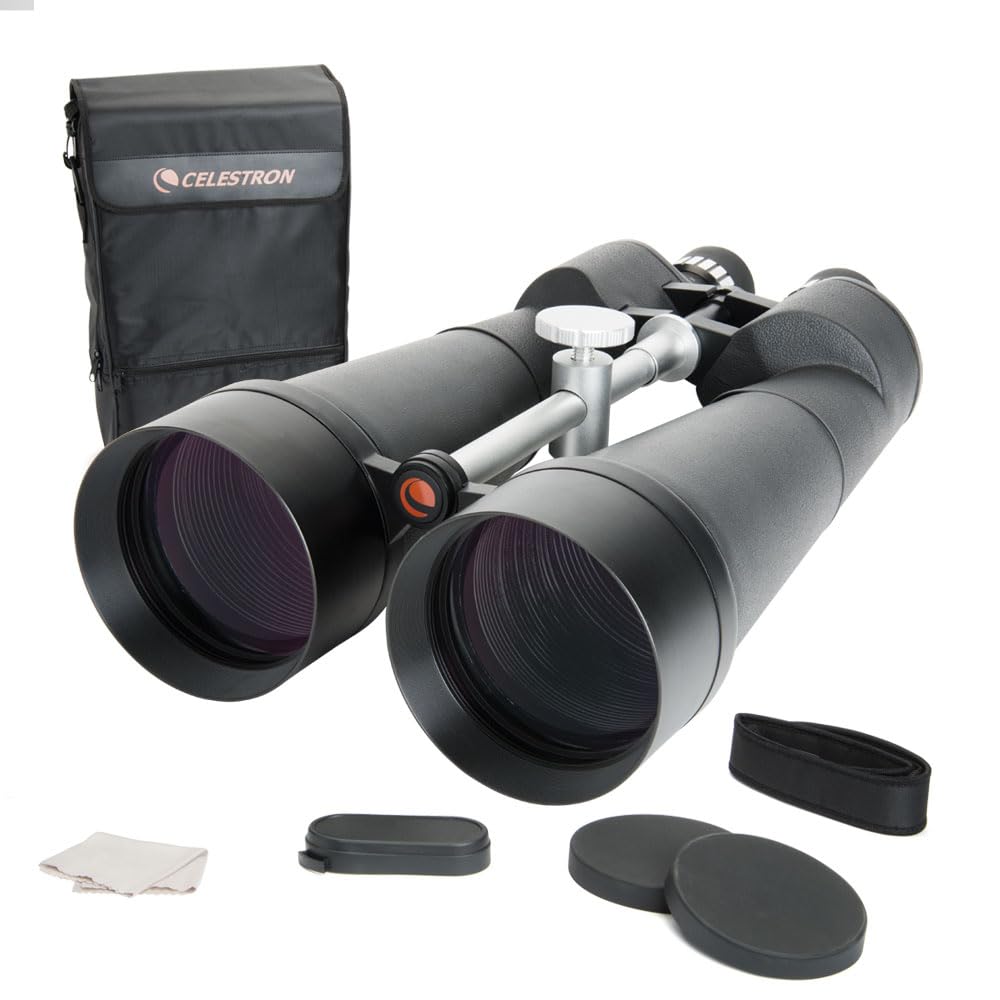
The Celestron SkyMaster 25×100 is the gold standard for dedicated deep-sky enthusiasts who accept that a tripod is mandatory. Its 100mm objectives gather enough light to resolve globular clusters like M13 into individual stars and reveal the structure of the Andromeda Galaxy in a way that smaller binoculars simply cannot.
BaK-4 prisms and multi-coated optics produce bright, high-contrast images even in twilight. The individual-eye focus system ensures precise collimation, though it requires patience to set up initially. The included tripod adapter and sturdy carrying case are practical additions for regular field use.
Weighing over 9 pounds, this unit is useless handheld; a heavy-duty tripod and fluid pan head are non-negotiable investments. Reports of variable quality control (loose components, minor collimation issues) suggest inspecting the unit promptly. The water-resistant housing, not fully waterproof, demands care in wet conditions.
Why it’s great
- 100mm aperture excels at deep-sky detail and faint star clusters.
- BaK-4 prisms deliver bright, high-contrast nighttime views.
- Individual-eye focus maintains precise alignment.
Good to know
- Heavy—requires a sturdy tripod and fluid head.
- QC can vary; inspect collimation upon arrival.
- Water-resistant, not fully waterproof.
3. Sogries 25×100 Binoculars for Adults
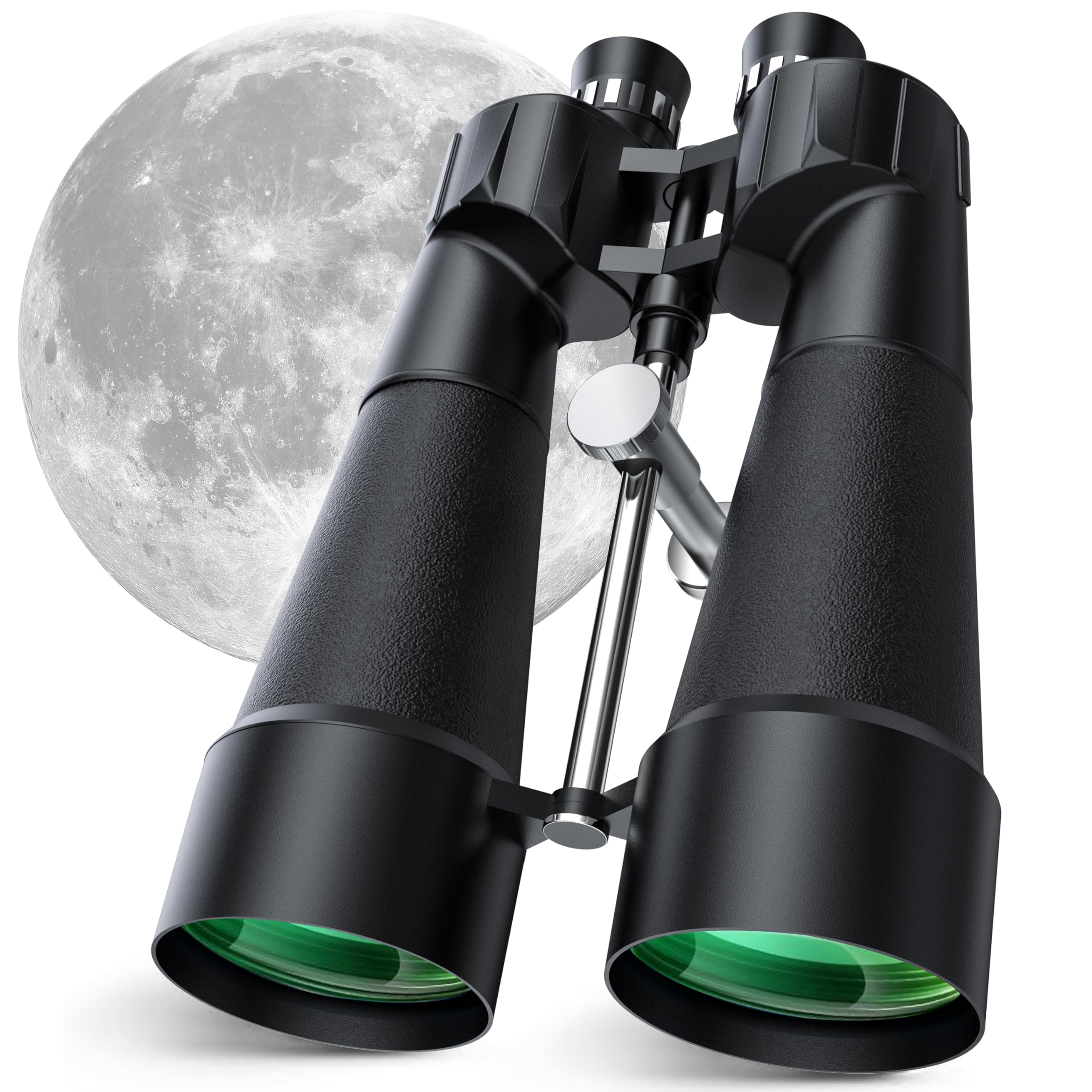
The Sogries 25×100 competes directly with the Celestron SkyMaster 25×100, offering a comparable 100mm aperture and 25x magnification with fully multi-coated BaK-4 prisms for edge-to-edge brightness. Users consistently praise its sharpness on lunar craters and the lack of chromatic aberration in the central field.
A key differentiator is the nitrogen-filled waterproof construction (IPX7 rating), which makes it more resistant to fogging and moisture intrusion than the water-resistant Celestron. The included premium leather backpack and smartphone adapter add genuine practical value for digiscoping astrophotography.
At 8.8 pounds, this is still a dedicated tripod instrument. Some owners report that the focus knobs can be stiff out of the box, though they loosen with use. The field of view is narrow at 2.8 degrees, making it better suited for targeted deep-sky objects than scanning wide star fields.
Why it’s great
- True waterproof construction handles wet conditions reliably.
- Sharp optics with minimal chromatic aberration in the center.
- Leather backpack and smartphone adapter included.
Good to know
- Heavy—tripod is essential, not optional.
- Focus knobs may be stiff initially.
- Very narrow FOV limits wide-field scanning.
4. Pentax SP 10×50 WP Binoculars

The Pentax SP 10×50 WP offers the ruggedness of a JIS Class 6 waterproof rating (submersible to 1 meter) combined with 10x magnification and a generous 5mm exit pupil that delivers bright views even in twilight. Its large objective lenses gather enough light to resolve the Pleiades and show Jupiter’s moons with ease.
Premium multi-layer coatings maximize light transmission, producing crisp, true-to-life color with minimal flare. The rigid magnesium body maintains precise optical alignment over years of use, a durability that justifies the premium over cheaper alternatives. The long 20mm eye relief accommodates eyeglass wearers comfortably.
The field of view is slightly narrower than some competitors at 331 feet per 1000 yards, which can feel restrictive for scanning. The included lens caps are not tethered, and the carrying case is functional but not premium. For a rugged, fully waterproof 10×50 that will last, this is a strong contender.
Why it’s great
- JIS Class 6 waterproof—submersible and fully sealed.
- Rigid magnesium body maintains alignment for decades.
- Excellent light transmission for its class.
Good to know
- Narrower field of view than some 10×50 options.
- Lens caps not tethered; easy to lose.
- Carrying case is basic.
5. Nikon Monarch M5 8×42 Binoculars
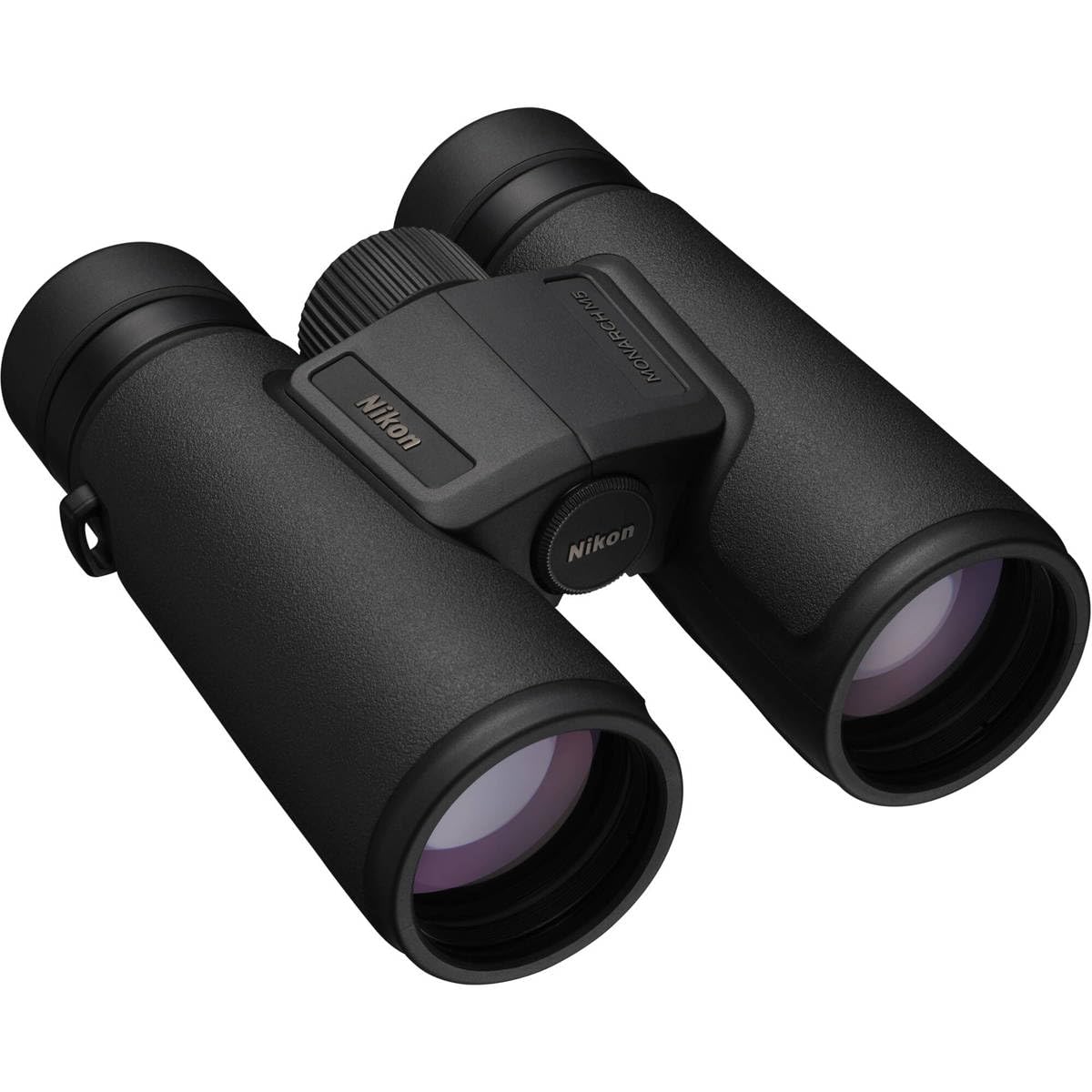
The Nikon Monarch M5 8×42 is the ultimate wide-field astronomy companion when you want to take in the full sweep of the Milky Way without moving your head. Extra-low Dispersion (ED) glass eliminates the purple fringing that plagues lesser optics, and the dielectric-coated prisms deliver exceptional color fidelity and contrast.
With an 8x magnification and a 335-foot field of view, it excels at scanning large constellations and tracking satellite passes. The waterproof, nitrogen-purged housing ensures it performs reliably in dewy conditions. The lightweight 21-ounce design makes it the ideal grab-and-go pair for quick sessions.
The 42mm objective lenses gather less light than 50mm or 70mm models, making it unsuitable for resolving faint deep-sky objects like globular clusters. The field of view, while wide, is not as expansive as some dedicated low-power astronomy binoculars. This is a superb generalist that also performs admirably under the stars.
Why it’s great
- ED glass virtually eliminates chromatic aberration.
- Dielectric-coated prisms deliver bright, natural colors.
- Lightweight build excellent for travel and quick sessions.
Good to know
- 42mm aperture limits deep-sky capability.
- 8x magnification insufficient for planetary detail.
- Not as wide as dedicated wide-field astro binoculars.
6. Celestron SkyMaster 12×60 Binoculars

The Celestron SkyMaster 12×60 is the most popular entry point for astronomy binoculars on the market. Its 60mm objectives gather enough light to show Jupiter’s disc and Galilean moons, Saturn’s oval shape, and the Andromeda Galaxy as a distinct smudge of light. The BaK-4 prisms ensure bright images even at dusk.
At 2.4 pounds, it can be handheld for short bursts, though the 12x magnification amplifies shake. Many users mount it on a lightweight tripod for extended sessions. The water-resistant rubber armor provides a secure grip and basic weather protection.
The included neck strap is thin and not clip-on, which many replace immediately. A tripod adapter is not included, though the binoculars have a 1/4″-20 socket. Some chromatic aberration is noticeable on bright objects. For the price, it delivers an unbeatable balance of aperture and portability.
Why it’s great
- Excellent entry-level aperture for lunar and brighter deep-sky.
- BaK-4 prisms deliver bright, high-contrast images.
- Manageable weight for occasional handheld use.
Good to know
- Some chromatic aberration on bright subjects.
- Poor neck strap; tripod adapter not included.
- Water-resistant, not waterproof.
7. Tenjin 30X80 Astro Binoculars

The Tenjin 30X80 is a high-magnification specialist designed for lunar and planetary observation. Its 30x power and 80mm objectives produce a mesmerizing 3D-like view of the Moon’s crater walls and rilles, and resolve Jupiter’s cloud bands more clearly than standard 20x binoculars.
The BaK-4 prism system and 60-degree apparent field of view provide a bright, immersive experience. The nitrogen-filled, water-resistant construction with an aluminum alloy body adds durability. A tripod adapter is included, which is essential given the 2.9kg weight.
Significant chromatic aberration (purple halos) is visible around bright objects, and the edge sharpness degrades noticeably outside the central 50% of the field of view. The individual-eye focus requires careful calibration every session. For casual lunar enthusiasts, the view is spectacular; for critical observers, the optical flaws are distracting.
Why it’s great
- 30x magnification reveals exceptional lunar detail.
- Large 80mm aperture for bright, immersive views.
- Included tripod adapter adds value.
Good to know
- Noticeable chromatic aberration on bright targets.
- Edge sharpness is poor; only center is crisp.
- Heavy—tripod is mandatory.
8. Sogries 18×70 Astronomy Binoculars

The Sogries 18×70 delivers serious deep-sky aperture at a budget-friendly price point. Its 70mm objectives gather significantly more light than 50mm binoculars, revealing fainter nebulas and resolving star clusters that smaller optics miss. The BaK-4 prisms and fully multi-coated lenses produce commendable brightness and contrast.
The IPX7 waterproof rating and nitrogen-purged construction mean you can use this in fog, rain, or high-humidity conditions without worrying about internal fogging. The included smartphone adapter and tripod adapter make it easy to capture and share your observations.
Weighing nearly 3 pounds, it is too heavy for comfortable handheld use, and the 18x magnification amplifies every movement. The neck strap is functional but thin. Some users report that the eyecups are not as comfortable as premium models. For the price, the optical performance is outstanding.
Why it’s great
- 70mm aperture provides excellent deep-sky light-gathering.
- IPX7 waterproof and fog-proof for all-weather use.
- Smartphone adapter included for digiscoping.
Good to know
- Heavy—requires a tripod for steady viewing.
- Eyecups could be more comfortable.
- Neck strap is basic and should be upgraded.
9. Sogries 10-30×50 Zoom Binoculars
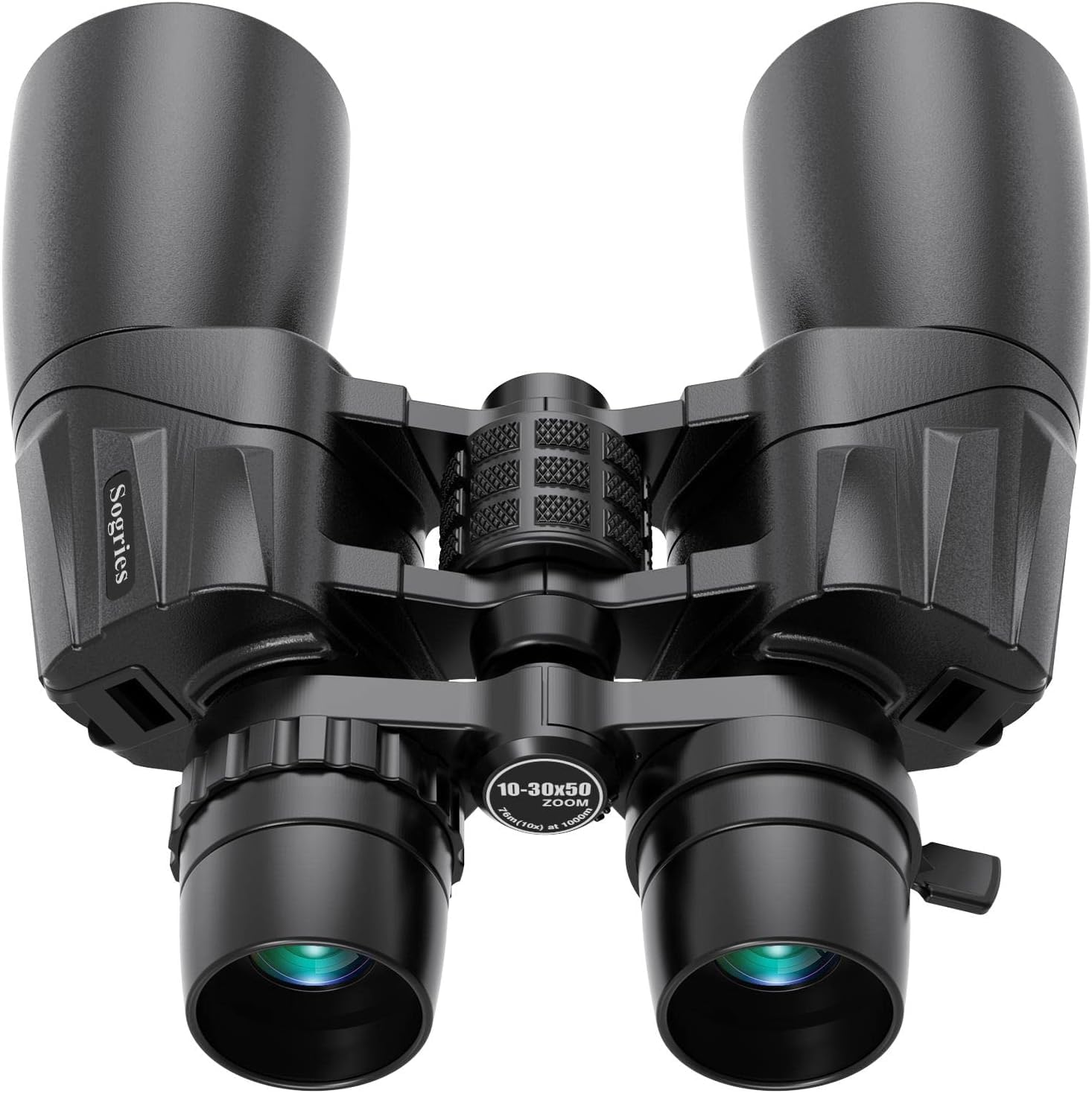
The Sogries 10-30×50 Zoom is a versatile multi-purpose binocular that covers a wide range of magnifications, from wide-field terrestrial scanning at 10x to detailed lunar observation at 30x. The zoom mechanism is operated by a smooth joystick, allowing quick changes without taking your eye off the target.
The BaK-4 prisms and FMC broadband green film coatings claim 99.5% light transmission, delivering bright images even in low-light conditions. The rubber-armored, O-ring sealed body is waterproof and shock-resistant. The 22mm long eye relief provides comfortable viewing for eyeglass wearers.
At 30x zoom, image quality degrades noticeably compared to a dedicated 30x binocular, and the narrow field of view at high magnification makes it challenging to locate objects. The built-in tripod socket is essential at 30x. It is a better terrestrial tool than a dedicated astronomy unit, but serviceable for casual lunar views.
Why it’s great
- Variable zoom range (10-30x) for versatile use.
- Smooth zoom joystick for quick adjustments.
- Long 22mm eye relief accommodates all users.
Good to know
- Image quality degrades at 30x magnification.
- Narrow FOV at high zoom makes object location difficult.
- Tripod required for steady viewing at 30x.
FAQ
Why is a 10×50 considered the minimum for serious astronomy?
Can I use a 25×100 binocular without a tripod?
How important are fully multi-coated (FMC) optics?
What is the difference between BaK-4 and BK-7 prisms?
Does a zoom binocular like 10-30x work well for astronomy?
Final Thoughts: The Verdict
For most users, the best binoculars for astronomy winner is the Canon 12×36 IS III because its image stabilization uniquely delivers steady, tripod-free views at 12x. If you want maximum deep-sky aperture on a mount, grab the Celestron SkyMaster 25×100. And for the best all-around budget astronomy starter, nothing beats the Celestron SkyMaster 12×60.