
Our readers keep the lights on and the weekend projects moving. As an Amazon Associate, I earn from qualifying purchases.
You finally spot that warbler flitting through the underbrush, lift your binoculars, and all you get is a shaky, dim, color-washed blur. That frustrating moment separates a cheap toy from a real birding tool. Specs like exit pupil, prism type, and lens coatings directly control whether you see a sharp, bright tuft of feathers or a frustrating blob of gray.
I’m Rikta — the co-founder and writer behind FitlyFast. My process for this guide involved cross-referencing hundreds of customer reviews against technical specifications like BaK-4 prism material, lens coating layers, and field-of-view measurements to find the true standouts for someone just starting out in birding.
I surfaced the seven most reliable options that deliver genuine optical performance without overwhelming a new birder. This is the definitive guide to finding the best binoculars for beginner bird watching.
How To Choose The Best Binoculars For Beginner Bird Watching
A new birder faces a wall of numbers and jargon. Magnification, objective lens diameter, exit pupil, prism type, lens coatings — each spec directly impacts a real moment in the field. The goal is to match the tool to the exact conditions where you will use it.
Magnification and Objective Lens: The 8×42 Sweet Spot
The first number (magnification) and the second number (objective lens diameter in mm) are the most important pair. 8×42 delivers the best balance for a beginner: enough magnification to see feather details without the image shake common at 10x or 12x, and a 42mm lens that gathers ample light for dawn and dusk bird activity. 8×25 models are lighter but dimmer in low light — fine for a midday walk but not for early mornings.
Prism Quality: BaK-4 vs. BK-7
Prisms inside the binoculars flip the image right side up. BaK-4 glass prisms reflect more light to your eye than cheaper BK-7 prisms, yielding a brighter, sharper image. Any binocular worth buying for birding will specify BaK-4. A roll of the eye test: hold the binoculars at arm’s length, look at the eyepieces, and see if the circle of light is fully round. BaK-4 prisms produce a clean round exit pupil — BK-7 often shows a square cut-off.
Lens Coatings: The Brightness Multiplier
Coatings reduce the light lost to reflection off glass surfaces. Fully multi-coated (FMC) means every air-to-glass surface has multiple anti-reflective layers. This is the minimum standard for decent birding binoculars — it prevents the washed-out, low-contrast view of uncoated or only single-coated lenses. A green or purple tint on the objective lens usually indicates quality multi-coating.
Quick Comparison
On smaller screens, swipe sideways to see the full table.
| Model | Category | Best For | Key Spec | Amazon |
|---|---|---|---|---|
| Celestron Nature DX ED 8×42 | Premium ED Glass | Crisp, color-true views | ED Objective Lens / 5.25mm Exit Pupil | Amazon |
| Nikon TRAVELITE EX 8×25 | Compact Travel | Ultra-light carry | 8×25 / 3.13mm Exit Pupil | Amazon |
| Athlon Optics Neos G2 8×42 | All-Weather Workhorse | Durable, long eye relief | 17mm Eye Relief / BaK-4 Prism | Amazon |
| Bushnell H2O Xtreme 10×42 | Waterproof Marine | Wet conditions, boating | Fully Multi-Coated / 4.2mm Exit Pupil | Amazon |
| Timorn HD 8×42 | Starter Kit | All-in-one accessory bundle | Fully Multi-Coated / 5.2mm Exit Pupil | Amazon |
| Gosky 8×42 Roof Prism | Value 8×42 | Budget 8×42 with phone mount | IPX7 Waterproof / 5.25mm Exit Pupil | Amazon |
| Celestron Outland X 8×25 | Pocket Compact | Kids, backpacking | 8.2° FOV / 3.1mm Exit Pupil | Amazon |
In‑Depth Reviews
1. Celestron Nature DX ED 8×42 Premium Binoculars

The premium tier of this list earns its place with Extra-Low Dispersion (ED) glass — a material that virtually eliminates chromatic aberration, the purple/green fringing that plagues cheaper optics. In practice, that means a warbler’s yellow breast appears as pure yellow, not a fuzzy rainbow at the edges. The 42mm objective lens paired with phase-coated BaK-4 prisms delivers generous light transmission, making early-morning canopy viewing noticeably brighter than the standard 8×42 competition.
Eye relief measures a comfortable 17.8mm, coupled with twist-up eyecups that offer intermediate click stops. Glasses wearers can position the eyecups precisely to get the full 7.5° apparent field of view without vignetting. The central focus knob moves smoothly across the full range, and at roughly 1.5 pounds, you can hold it steady for the five-minute stretches typical when tracking a single bird through branches.
The dust-protected bag, rainguard, and objective caps are practical for field storage, and the Celestron Limited Lifetime US Warranty removes the anxiety about a beginner’s first scratch or drop. This is the set where optical quality and long-term value converge — the most capable tool for progressing from casual backyard watching to serious species identification.
Why it’s great
- ED glass eliminates color fringing for sharp, true-to-life feather detail.
- Exceptional low-light brightness from 5.25mm exit pupil.
- Lifetime warranty from a trusted California optics brand.
Good to know
- Premium pricing compared to entry-level models.
- Focus action requires a deliberate turn — not the quickest for fast-moving targets.
2. Nikon TRAVELITE EX 8×25 Binoculars

Nikon’s TRAVELITE EX 8×25 represents the peak of the compact category for the birder who prioritizes portability over the light-gathering advantage of 42mm objectives. The 25mm lenses produce a 3.13mm exit pupil — workable in full daylight but noticeably dim in shaded understory or at dawn. The die-cast aluminum body wrapped in rubber armor feels more solid than the all-plastic shells of many compact competitors, and the multilayer-coated optics produce surprisingly good contrast for the form factor.
The 8x magnification pairs naturally with the compact build; there is less mass to shake, so hand-holding at 8x is very steady. Aspherical eyepiece lenses reduce distortion at the field edge, which matters when scanning laterally for movement. The turn-and-slide eyecups provide a secure fit under sunglasses or prescription eyewear, though the 11.1mm eye relief is tighter than the 17mm+ found on full-size models — glasses wearers may need to press in slightly.
Nitrogen-purged and O-ring sealed to 2 meters, this binocular can survive an unexpected rain shower or a splash from a creek crossing. The click-stop diopter holds its position reliably, a detail budget compacts often neglect. For a birder who keeps a binocular in a daypack or jacket pocket for spontaneous walks, this is the most refined pocket-sized option available in the mid-range zone.
Why it’s great
- Exceptional build quality with die-cast aluminum and rubber armor.
- Very compact and lightweight for carry-everywhere convenience.
- Multilayer-coated optics deliver crisp, color-accurate images for a 25mm design.
Good to know
- 3.13mm exit pupil limits performance in low-light conditions.
- Eye relief is tight for eyeglass wearers.
3. Athlon Optics 8×42 Neos G2 HD Binoculars

The Neos G2 HD stakes its claim on eye relief: 17mm of it, with twist-up eyecups that have intermediate click stops. For birders who wear glasses, that spec translates to full field-of-view visibility without having to jam the eyecups against the lenses. The BaK-4 prisms and multi-coated optics (not fully multi-coated) produce a respectable image, though sharpness falls off more noticeably at the edge of the 7° apparent field compared to the Celestron Nature DX ED.
At roughly 1.4 pounds, the composite body keeps weight manageable for extended sessions. The focusing knob has a smooth rotation with no slop, though reviewers note the plastic knob feels slick in cold or wet conditions — a minor ergonomic nitpick for an otherwise well-sorted unit. Waterproof and fog-proof construction adds confidence for use in rain or humidity without needing to stash the binoculars at the first cloud.
The field of view — 7° (about 350 feet at 1000 yards) — leans slightly narrow for an 8×42. Beginners scanning for movement across an open marsh may find the more generous 8.2° FOV of the Timorn or Celestron Outland more helpful. Still, for the eyeglass-dependent birder, the Neos G2 provides comfortable optical access at a price point that undercuts the premium competition while maintaining solid build standards.
Why it’s great
- Excellent 17mm eye relief with adjustable twist-up eyecups — a win for glasses wearers.
- Lightweight composite body reduces arm fatigue on long walks.
- Waterproof and fog-proof sealing for all-weather field use.
Good to know
- Multi-coated (not fully multi-coated) optics slightly reduce brightness vs. premium models.
- Field of view is narrower than the 8.2° standard in this class.
4. Bushnell H2O Xtreme 10×42 Compact Waterproof Binoculars

Bushnell’s H2O Xtreme delivers a 10×42 configuration in a compact roof-prism body that is O-ring sealed and nitrogen-purged — built to shrug off spray from kayaking, fishing, or hiking in rain. The fully multi-coated lenses and BaK-4 prisms produce a notably bright, contrast-rich image. The 4.2mm exit pupil is smaller than an 8×42’s 5.25mm, so image brightness drops in deep twilight, but in medium-light conditions the 10x magnification gives you that extra zoom reach to study a hawk’s wing pattern without switching optics.
Eye relief measures a generous 17mm, and the twist-up eyecups work well for users who wear prescription glasses. At 10x, the extra magnification amplifies hand-shake — a tripod adapter socket would have been helpful, but this model notably lacks one. Field of view sits at about 6.8°, which is tight; tracking a fast-flying bird is more challenging than with an 8x wide-angle alternative.
Despite a heavy feel compared to the other composite-bodied options, the rubber armor offers a confidence-inspiring grip when wet. The included attached front lens covers are a practical touch for coastal birding. For the birder who needs a rugged, waterproof, higher-magnification tool and is comfortable with a narrower viewing corridor, this is the most reliable entry in the sub-ultra-premium price bracket.
Why it’s great
- Fully multi-coated optics with BaK-4 prisms provide outstanding brightness for the price.
- O-ring sealed and nitrogen-purged for total weather resistance.
- 17mm eye relief suits eyeglass wearers.
Good to know
- 10x magnification amplifies hand-shake; no tripod adapter socket.
- Narrower field of view makes tracking fast birds more difficult.
5. Timorn HD 8×42 Birding Binoculars

The Timorn HD 8×42 positions itself as a complete starter kit. The binoculars themselves deliver a bright, color-true image supported by fully multi-coated optics and BaK-4 roof prisms. The 8.2° apparent field translates to 430 feet at 1000 yards — genuinely wide, which helps beginners locate subjects without losing them in peripheral blur. The 5.2mm exit pupil provides solid low-light performance for early morning outings.
The inclusion of a smartphone adapter, a tabletop tripod, and a carrying case makes this an immediate grab-and-go rig for beginners who also want to digiscope — share a photo of that blue jay instead of just describing it to a friend. The twist-up eyecups with intermediate stops work well, though some users find the diopter adjustment ring, located in the center bridge, gets accidentally bumped during use.
The rubber-armored, nitrogen-purged body is waterproof to 1 meter for 30 minutes, adequate for rain and the occasional drop in a stream. For roughly the same price as a bare 8×42 from other brands, the Timorn bundle eliminates the need to buy a tripod and phone mount separately. This is the sensible choice for a first-time birder who wants to document finds from day one without making a separate equipment run.
Why it’s great
- Full accessory kit — phone adapter, tripod, and case included.
- Wide 8.2° field of view makes locating birds effortless.
- Bright 5.2mm exit pupil for dawn and dusk viewing.
Good to know
- Center-bridge diopter can shift accidentally during use.
- Included tripod is basic; a full-size tripod recommended for serious digiscoping.
6. Gosky 8×42 Roof Prism Binoculars

Gosky packs an IPX7 waterproof rating — submersible to 1 meter — into a binocular that costs less than many non-waterproof 8x42s. The argon-purged body genuinely prevents internal fogging, a common failure point in budget optics. Fully multi-coated lenses combined with BaK-4 prisms produce a view that rivals some mid-tier options in daylight: good contrast, minimal chromatic aberration, and a 5.25mm exit pupil that keeps the image bright in moderately low light.
The 15mm eye relief is adequate for quick looks without glasses, but eyeglass wearers may find it insufficient to see the full field. Twist-up eyecups with intermediate positions help, but the limited relief means glasses users will have to press the eyecups against their lenses, which can cause smudging. The field of view is an average 6.8° — functional for general scanning but not as generous as the Timorn or Celestron Outland options.
The included phone adapter and tripod are functional but best considered bonus items — the tripod mount screw is noted for being poorly drilled, requiring a bit of force to attach. The binoculars weigh just over 1.25 pounds, which is comfortable for a standard 8×42 form. For an absolute beginner on a tight budget who still wants full-size performance and genuine weather sealing, this is the lowest-cost entry point that doesn’t compromise the basics.
Why it’s great
- IPX7 waterproof rating at a budget-friendly price point.
- Fully multi-coated BaK-4 optics deliver surprisingly bright, clear views.
- Argon purging ensures fog-free performance in wet or cold conditions.
Good to know
- 15mm eye relief is limited for eyeglass wearers.
- Phone adapter and tripod build quality is inconsistent.
7. Celestron Outland X 8×25 Binoculars
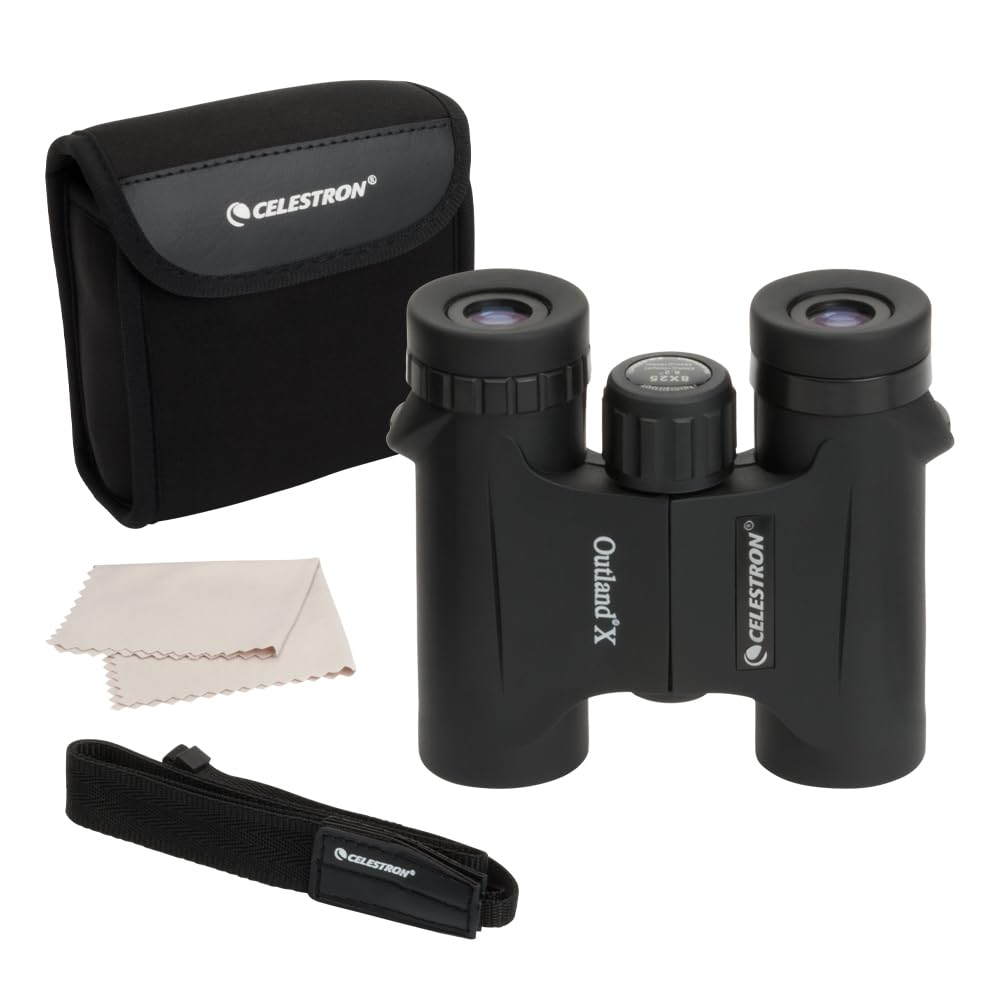
This compact 8×25 packs an 8.2° apparent field into a body that fits in a jacket pocket. The field of view is wider than some full-size 8x42s, making it excellent for scanning open fields or tracking birds in flight without moving the binocular head-to-head. The multi-coated optics and BaK-4 prisms produce a sharp center image — surprising brightness for a 25mm objective, though the 3.1mm exit pupil limits performance in low light or deep shade.
At 9.3mm eye relief, this is not a binocular for prolonged use with eyeglasses. The twist-up eyecups help, but the short relief means glasses wearers will see a cropped view. The rubber-armored polycarbonate housing is rugged enough for a child’s daily carry or a backpack’s bottom compartment. The central focus wheel turns smoothly across the diopter range, and the 2.5-meter close focus distance allows detailed inspection of a flower or insect.
The Celestron Limited Lifetime US Warranty provides reassurance that an accidental drop or misalignment won’t end the binocular’s life early. This is the ideal entry point for a young birder, a casual observer who wants pocket optics for daytime walks, or a backup binocular to keep in the car. It will not replace an 8×42 for serious birding, but for its specific role — compact, tough, and wide-viewing — it is the best option available at its tier.
Why it’s great
- Compact and lightweight — true pocket-size portability.
- Wide 8.2° field of view tracks birds in motion easily.
- Lifetime warranty and waterproof/fogproof sealing from a trusted brand.
Good to know
- 3.1mm exit pupil is dim in low-light conditions.
- Short eye relief makes it less comfortable for eyeglass wearers.
FAQ
Is 8×42 always better than 8×25 for a beginner birder?
What does fully multi-coated mean?
Why do binocular specs list BaK-4 vs BK-7 prisms?
Can I use a smartphone adapter with any binocular?
What should I look for in binoculars for birding at dawn or dusk?
Final Thoughts: The Verdict
For most users, the best binoculars for beginner bird watching winner is the Celestron Nature DX ED 8×42 because its ED glass provides the sharpest, most color-accurate view available without stepping into ultralight specialty territory. If you want a compact, pocketable companion for daytime walks, grab the Nikon TRAVELITE EX 8×25. And for the absolute best value in a full-size 8×42 bundle that includes a phone adapter and tripod, nothing beats the Timorn HD 8×42.