
Our readers keep the lights on and the weekend projects moving. As an Amazon Associate, I earn from qualifying purchases.
Finding binoculars that actually work with glasses means hunting for a model with enough eye relief to avoid a black ring eating your view. Most “birding” binoculars assume you peek through them without lenses, leaving spectacle-wearers with a frustrating vignette that turns a hobby into a headache.
I’m Rikta — the co-founder and writer behind FitlyFast. I’ve spent countless hours cross-referencing optical specs, customer testaments, and real-world field notes to determine exactly which models deliver a full, unobstructed field of view for glasses users.
Whether you are upgrading from a bulky pair or buying your first serious set, this guide breaks down the essential eye relief numbers, lens coatings, and ergonomic features that separate usable optics from frustrating ones, offering a curated selection of binoculars for bird watching with glasses that let you see the whole picture without removing your frames.
How To Choose The Best Binoculars For Bird Watching With Glasses
Glasses introduce an extra 10–15mm between your eye and the binocular’s eyepiece, which means a compact design with short eye relief will clip your peripheral view. The right choice balances generous relief with optical quality and a secure grip for long sessions in the field.
Eye Relief: The Make-or-Break Spec
Eye relief is the distance from the eyepiece to your eye where the full image circle is visible. For glasses wearers, a minimum of 17mm is the baseline; 18–20mm is ideal. Models with less than 15mm should be avoided unless you are willing to press your glasses against the eyepiece and risk scratches.
Twist-Up Eyecups vs. Fixed
Twist-up, click-stop eyecups allow you to dial in the exact height that matches your glasses’ depth. Fixed or simple fold-down eyecups are less precise and often leave you guessing. Binoculars with multi-stop eyecups let you find a consistent, comfortable position every time you lift them to your eyes.
Lens Coatings and Prism Glass
Fully multi-coated lenses and BaK-4 prisms ensure high light transmission, which matters at dawn and dusk when bird activity peaks. Extra-low dispersion (ED) glass reduces chromatic aberration (color fringing) so you see clean feather detail against bright backgrounds. Dielectric prism coatings boost reflectivity above 99%, pushing brightness even higher.
Magnification and Objective Lens Size
8×42 is the favorite all-rounder combination for birding: enough magnification to see detail, a wide enough field to track movement, and a bright exit pupil for low light. 10×42 gives you more reach but narrows the field and amplifies hand shake. For glasses wearers, the 8×42’s larger, more forgiving exit pupil helps offset any misalignment caused by frames.
Quick Comparison
On smaller screens, swipe sideways to see the full table.
| Model | Category | Best For | Key Spec | Amazon |
|---|---|---|---|---|
| Nikon Monarch M5 8×42 | Premium | Glasses wearers seeking maximum field of view | 19.5mm Eye Relief | Amazon |
| Carson 3D ED 8×42 | Premium | Compact, lightweight daily carry with ED glass | 19.5mm Eye Relief | Amazon |
| ZEISS Terra ED 10×42 | Premium | High-end clarity and brand optics | 18mm Eye Relief | Amazon |
| Athlon Midas G2 UHD 10×50 | Premium | Low-light performance with UHD glass | 16.9mm Eye Relief | Amazon |
| Nikon Prostaff P7 10×42 | Mid-Range | Excellent brightness and clarity at a budget | 15.7mm Eye Relief | Amazon |
| Celestron Nature DX ED 8×42 | Mid-Range | ED glass value for sharp, color-accurate views | 17.8mm Eye Relief | Amazon |
| Wingspan Skyview Ultra HD 8×42 | Mid-Range | Wide field of view and close focus | 17.8mm Eye Relief | Amazon |
| Vortex Copperhead HD 10×42 | Value | Durable build with unconditional warranty | 17mm Eye Relief | Amazon |
| Bushnell H2O Xtreme 10×42 | Value | Wet-weather birding with IPX7 rating | 17mm Eye Relief | Amazon |
In‑Depth Reviews
1. Nikon Monarch M5 8×42 Binoculars
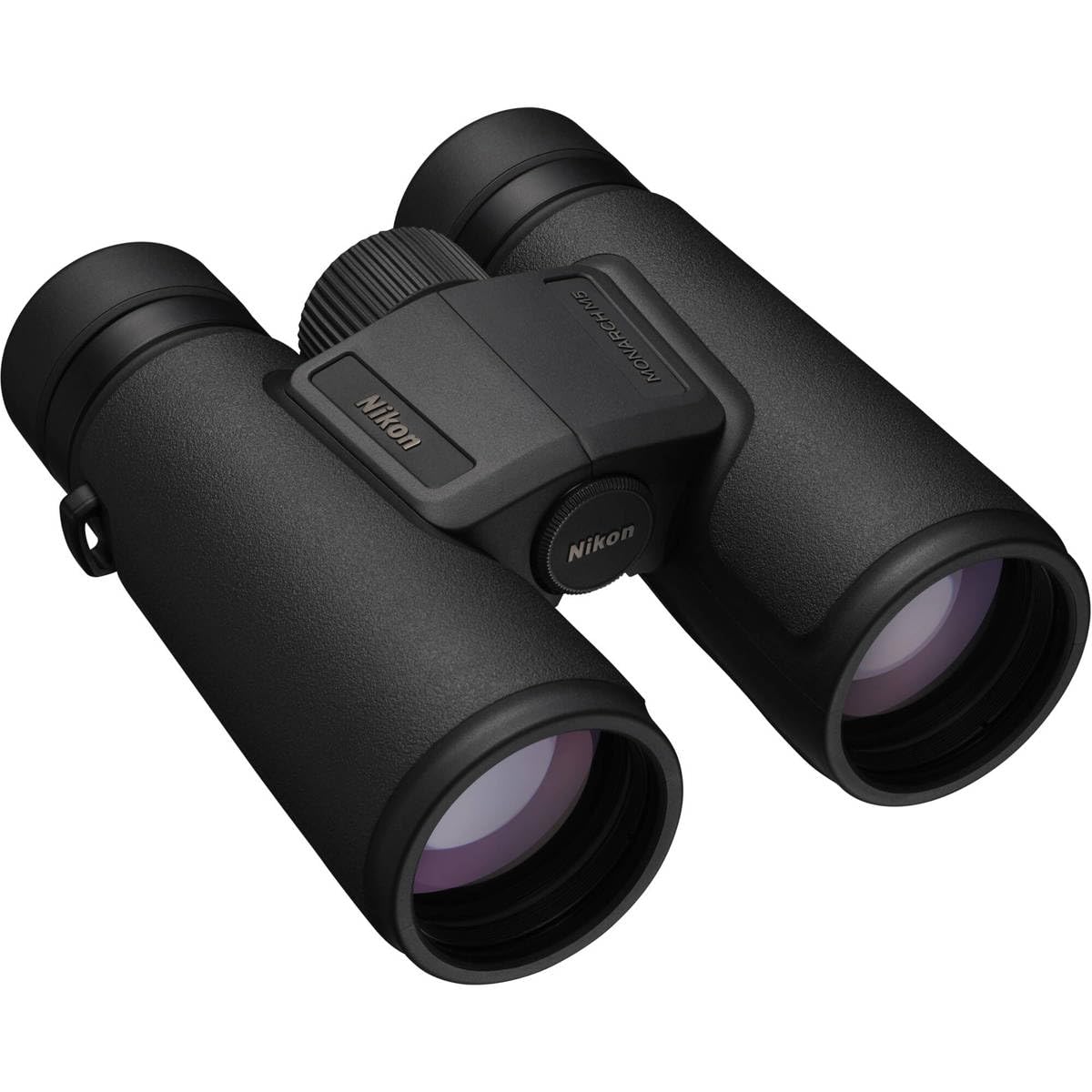
The Monarch M5 stands out immediately for glasses wearers because of its class-leading 19.5mm of eye relief. When you twist up the click-stop eyecups, your frames sit safely behind the eyepiece while still letting you see the entire 335-foot-wide field of view. Dielectric high-reflective prism coatings and ED glass work together to suppress color fringing and boost transmission, making dusk birding sessions far easier than with standard mid-range glass.
In real-world use, the closed-bridge design and large center focus knob allow precise adjustments even with gloves on. The open hinge and lightweight rubber-armored body make it comfortable for long walks, though seasoned users who prefer Swarovski-level weight savings may find it a bit stout at under a pound. The 8×42 format gives a steady, generous exit pupil that compensates for minor alignment issues common when wearing thicker frames.
Customer feedback from safari trips and backyard birding consistently praises the edge-to-edge sharpness and natural color rendition. While the Monarch M5 is a mid-premium model, its optical performance rivals models that cost significantly more. The nitrogen-purged, O-ring-sealed housing ensures it survives rain and humidity without fogging, exactly what a birder needs when the weather turns.
Why it’s great
- Excellent 19.5mm eye relief provides a full field for glasses wearers
- ED glass and dielectric coatings produce vibrant, color-accurate images
- Smooth, precise focus knob and durable rubber-armored build
Good to know
- Not the lightest pair in this category; better for longer carries than ultralight demands
- Field of view is slightly narrower than some 8×42 competitors
2. Carson 3D ED Series 8×42 Binoculars

The Carson 3D ED 8×42 packs premium ED glass into a body that feels remarkably compact for a full-size objective. With 19.5mm of eye relief, it matches the Monarch M5 for glasses compatibility, and the twist-up eyecups provide that critical adjustment so your spectacles never push against the housing. The fully multi-coated lenses and BaK-4 prisms deliver a bright, crisp image that reviewers consistently describe as “punching above its weight class.”
Build quality centers on a polycarbonate chassis with a rubberized armor coating, keeping weight low without sacrificing durability. An included shoulder harness helps distribute the load during long hikes. The 8×42 format yields a 5.25mm exit pupil, which is generous enough to give a bright view even in shaded woodland. Some long-term users note that the eyecups have only one locking position, which might not suit everyone’s fit, but for most glasses wearers the single stop works well.
Out in the field, the 393-foot field of view at 1,000 yards makes tracking fast-moving warblers or swallows easier than with narrower glass. The included carry case and harness add convenience, though the case is not the most compact. If you need a lightweight, ED-equipped 8×42 that plays nicely with frames, this is a strong, well-priced contender.
Why it’s great
- Excellent 19.5mm eye relief designed for spectacle wearers
- ED glass virtually eliminates chromatic aberration
- Lightweight construction and included shoulder harness
Good to know
- Eyecups use a single locking position rather than multi-stop
- Overall fit and finish feels more utilitarian than premium metal rivals
3. ZEISS Terra ED 10×42 Binoculars

When you want the optical pedigree of ZEISS without the flagship price, the Terra ED 10×42 delivers 88% light transmission thanks to its Schmidt-Pechan prisms and hydrophobic multi-coating. The 18mm eye relief is comfortable for most glasses wearers, though it is slightly less forgiving than the 19.5mm options on this list. The large, fast-focus wheel falls naturally under your index finger, letting you track birds that dart between branches without losing a beat.
The fiberglass-reinforced polycarbonate casing feels nearly indestructible yet remains light enough for all-day carry. In wet weather, the hydrophobic coating beads water off the lenses, so you keep a clear view when the drizzle starts. Reviewers consistently mention the Terra ED as a clear step up in contrast and color accuracy compared to sub- models, calling it a “mid-level upgrade” that brings genuine ZEISS glass to serious birders on a budget.
The 10×42 configuration gives you an extra reach advantage for spotting birds in tall canopy or across open fields, but the narrower field of view means you’ll need steady hands. The included neoprene strap and hard case protect your investment during transport. If you can stretch your budget for a premium brand known for optical precision, the Terra ED is a solid, durable companion.
Why it’s great
- Premium ZEISS glass with hydrophobic coating for wet weather
- Fast, intuitive focus wheel ideal for tracking moving birds
- Lightweight, rugged fiberglass-reinforced build
Good to know
- 18mm eye relief is adequate but not the longest for glasses
- 10x magnification amplifies hand shake compared to 8x models
4. Athlon Optics Midas G2 UHD 10×50 Binoculars
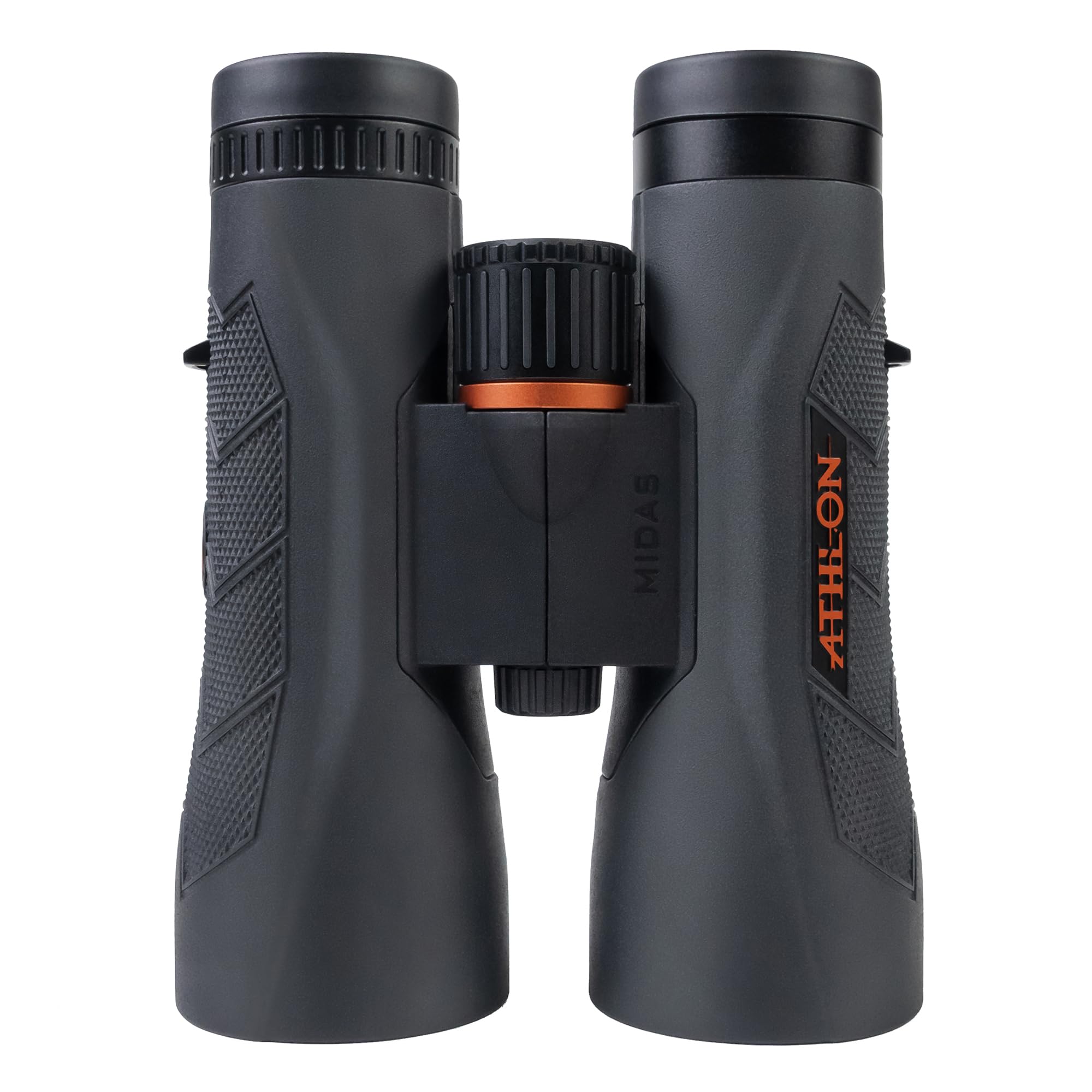
The Athlon Midas G2 UHD 10×50 is built for birders who value raw brightness and low-light performance. The 50mm objective lenses gather far more light than standard 42mm glass, making it an ideal choice for pre-dawn migration counts or late-evening owls. Eye relief is 16.9mm, which is slightly below the 17mm baseline; glasses wearers with thick frames may experience some vignette, but those with thinner spectacles typically report a usable view, especially with the twist-up eyecups fully down.
The UHD extra-low dispersion glass combined with ESP dielectric coatings reflects over 99% of light to your eyes, creating a sharp, color-accurate image with almost no chromatic aberration. The magnesium chassis reduces weight by up to 35% compared to a standard aluminum frame, so even with the larger 50mm objectives, the Midas stays manageable during long sessions. A 16.9mm exit pupil is generous for low light, giving you a bright view even when the sun is barely above the horizon.
Customer reviews highlight the near-flawless image quality and precise diopter adjustment. Some users with closer-set eyes found the objective covers needed slight adjustment to avoid bridging. The included padded strap, soft case, and lifetime warranty add peace of mind. If you need extra light and reach and can work within the shorter eye relief, this is a purpose-built tool for serious low-light birding.
Why it’s great
- Excellent low-light brightness from 50mm objectives and UHD glass
- Dielectric coatings provide over 99% light reflection
- Lightweight magnesium chassis for a 50mm binocular
Good to know
- 16.9mm eye relief is borderline for many glasses wearers
- Heavier than standard 42mm models, despite magnesium body
5. Nikon Prostaff P7 10×42 Binoculars

The Nikon Prostaff P7 10×42 brings Nikon’s advanced multilayer optical coating and dielectric prism coating to a more accessible price point. The 10x magnification and 42mm objectives give you excellent reach for field birding, and the locking diopter ring keeps your focus setting secure when passing the binoculars to a partner. With 15.7mm of eye relief, this model is best suited for glasses wearers who can press their frames gently against the eyecups or those who prefer to remove their spectacles when viewing.
Phase-correction coated roof prisms and dielectric high-reflective prism coatings ensure high light transmission, resulting in a bright, vivid image even in overcast conditions. The turn-and-slide eyecups adjust smoothly, though tall eyecup settings may reduce the usable field for glasses wearers. The fiberglass-reinforced polycarbonate body with rubber armor feels solid without being heavy, and the oil- and water-repellent lens coatings make cleaning smudges quick between sessions.
Customer reviews praise the optical clarity for the price, with several noting the sharpness rivals older Nikon models at twice the cost. The 367-foot field of view is respectable for a 10×42. If you are willing to trade some glasses-friendly eye relief for a lower cost and high optical performance, the Prostaff P7 is a capable, lightweight option for daytime birding.
Why it’s great
- Excellent optical clarity and brightness for the price
- Locking diopter ring keeps settings secure
- Lightweight polycarbonate body with durable rubber armor
Good to know
- 15.7mm eye relief is short for glasses; may require removing spectacles
- 10x magnification narrows field of view compared to 8x models
6. Celestron Nature DX ED 8×42 Binoculars

The Celestron Nature DX ED 8×42 is one of the most affordable ways to get true extra-low dispersion glass in a binocular, and its 17.8mm eye relief makes it genuinely usable for glasses wearers. The ED objectives virtually eliminate the color fringing that cheap binoculars exhibit around bright branches or white birds against a blue sky. Phase-coated BaK-4 prisms and fully multi-coated lenses deliver a bright, sharp image that reviewers frequently call “crisp” and “true to life.”
Ergonomically, the Nature DX ED feels compact and light at just over 25 ounces, with a rubber-armored polycarbonate housing that provides a secure grip. The center focus knob is smooth and responsive, though some users note a slower adjustment compared to more expensive models. The built-in tripod adapter thread is a useful addition for extended stationary viewing from a blind or a car window mount.
Customer reviews consistently highlight the value proposition: you get ED glass and waterproof nitrogen-purged construction at a price that undercuts many rivals. The limited lifetime warranty from Celestron adds confidence. If your priority is maximizing optical quality per dollar and you need a full field of view with glasses, the Nature DX ED is a top-tier budget release.
Why it’s great
- Impressive 17.8mm eye relief works well with spectacles
- ED glass significantly reduces chromatic aberration
- Great value for the optical performance and solid warranty
Good to know
- Focus knob is slower than on higher-end models
- Ergonomics are functional but not as refined as premium options
7. Wingspan Skyview Ultra HD 8×42 Binoculars

The Wingspan Skyview Ultra HD 8×42 is built around a 393-foot field of view at 1,000 yards, one of the widest in its class. That expansive view, combined with 17.8mm eye relief, makes it a strong candidate for birders who wear glasses and want to scan treelines or marsh edges without constantly panning. The extra-wide apparent angle of view (7.1 degrees) gives you an immersive, open feeling that helps you spot movement in your peripheral vision.
ED glass and phase-correction coated prisms work together to deliver sharp, bright images with minimal chromatic aberration. The 8×42 format provides a steady, forgiving 5.2mm exit pupil that remains bright even in late afternoon light. The DuraTech Technology body is both lightweight (25.6 ounces) and rugged, with waterproof and fogproof nitrogen purging. The close focus distance of just over 6 feet lets you examine nearby butterflies or flowers without losing sharpness.
Customer feedback is overwhelmingly positive, with many calling it the best value in wide-field birding. Some users found the included strap attachment points a bit fiddly to secure, but once set, the binoculars feel balanced and comfortable. If a broad, open field of view is your primary need, and you wear glasses, the Skyview Ultra HD delivers without breaking the bank.
Why it’s great
- Wide 393-foot field of view ideal for scanning open habitats
- Comfortable 17.8mm eye relief for glasses wearers
- ED glass and phase-correction prisms deliver sharp, bright views
Good to know
- Strap attachment system can be tricky to fasten securely
- 8x magnification may not provide enough reach for some open-field birders
8. Vortex Copperhead HD 10×42 Binoculars

The Vortex Copperhead HD 10×42 enters the list with a 17mm eye relief, meeting the baseline for glasses wearers, and an HD optical system that delivers strong color fidelity and edge-to-edge sharpness. The 10x magnification pulls distant birds into clear view, while the 42mm objectives provide enough light for all but the deepest twilight. Fully multi-coated lenses with anti-reflective coatings boost transmission, and the rubber armor gives a confident, slip-free grip even in wet conditions.
One of the strongest selling points is Vortex’s unlimited, unconditional lifetime VIP warranty — it is fully transferable and covers repair or replacement for any damage or defect (excluding loss, theft, or cosmetic damage). This makes the Copperhead HD a worry-free choice for rough environments. The binocular is waterproof, fogproof, and shockproof, and it is tripod-adaptable for those longer observation sessions from a static position.
Customer reviews note that the Copperhead HD performs well for an entire hunting or birding season in rain, snow, and sun. A few users who compared it to Vortex’s own Diamondback HD reported slightly less crispness at the edges and in very low light, but for the price, the consensus is that the view is excellent. The included GlassPak harness is a nice bonus for all-day carry. If you need a tough, well-warranted 10×42 that works with glasses, the Copperhead HD is a reliable, value-driven option.
Why it’s great
- 17mm eye relief meets the minimum for comfortable glasses use
- Rugged, waterproof construction with a lifetime VIP warranty
- HD optics provide clear, color-accurate views in various conditions
Good to know
- Edge sharpness and low-light performance are not as strong as higher-priced models
- Slightly heavier than some competing 10×42 models
9. Bushnell H2O Xtreme 10×42 Binoculars

The Bushnell H2O Xtreme 10×42 is purpose-built for birders who face rain, fog, and wet environments. The O-ring-sealed, nitrogen-purged construction earns an IPX7 waterproof rating, meaning it can be submerged in water up to 1 meter for 30 minutes without damage. The 17mm eye relief meets the standard for glasses use, and the fully multi-coated glass surfaces on BaK-4 prisms maximize clarity and light transmission so you can see detail even through overcast skies.
The compact roof-prism design makes it easy to pack, and the rubber armor with soft grip panels keeps the binocular steady when your hands are wet. It does not have a tripod adapter socket, which may be a downside for users who want to mount it for extended viewing sessions. At just over 25 ounces, it is manageable for all-day wear but not the lightest entry in this tier.
Customer reviews consistently praise the bright, clear image and reliable waterproof performance. Many users upgraded from older, bulkier binoculars and report a significant leap in clarity and compactness. The included strap is functional but not luxurious; some reviewers replaced it immediately. If you bird regularly in rainy climates or near water and need a well-sealed 10×42 that handles glasses reasonably well, the Bushnell H2O Xtreme is a solid, proven option.
Why it’s great
- IPX7 waterproof rating for reliable use in rain and wet conditions
- Fully multi-coated BaK-4 prisms deliver bright, clear views
- Compact roof-prism design for easy portability
Good to know
- No tripod adapter socket for stationary viewing
- Included neck strap lacks comfort for extended wear
FAQ
Can I use birding binoculars with my prescription sunglasses?
What is the difference between BaK-4 and BK-7 prisms?
Should I choose 8×42 or 10×42 binoculars for birding with glasses?
Final Thoughts: The Verdict
For most users, binoculars for bird watching with glasses winners are the Nikon Monarch M5 8×42 because it combines 19.5mm of eye relief with premium ED glass and a comfortable, durable build that works for long days in the field. If you want a compact, lightweight companion with the same stellar eye relief, grab the Carson 3D ED 8×42. And for budget-conscious birders who still demand ED glass and a full field view with spectacles, nothing beats the value of the Celestron Nature DX ED 8×42.