
Our readers keep the lights on and the weekend projects moving. As an Amazon Associate, I earn from qualifying purchases.
There are few things more frustrating than lifting your binoculars to follow a warbler through the understory only to be met with a dim, color-washed image that leaves you guessing at species. The best optics erase that guesswork. They resolve feather detail at dawn, keep a sharp edge across the full field, and let you follow flight patterns without eye strain.
I’m Rikta — the founder and writer behind FitlyFast. My evaluation process is built on years of cross-referencing optical bench tests, customer durability reports, and field usability patterns across every major binocular brand carried on Amazon.
After stacking specifications and real-world user feedback across nine models ranging from compact travel glasses to premium ED-equipped full-size binoculars, I assembled this guide to the binoculars for birding that actually perform where it matters — in the field, at range, and in low light.
How To Choose The Best Binoculars For Birding
A birding binocular is a long-term investment in how you see the natural world. The wrong choice leaves you fighting vibration, losing light at twilight, or guessing between a Downy and a Hairy Woodpecker because the color fringing washes out the field marks. Focusing on three specific areas removes nearly all the guesswork.
Magnification and Objective Lens Size: The 8×42 Sweet Spot
For birding, 8x magnification delivers the most stable handheld view. The wider field of view helps you locate and track birds in dense brush, and the larger 5.25mm exit pupil (42 ÷ 8) keeps your eye aligned even in shaky conditions. A 10×42 offers more reach for open-country species but narrows the field and amplifies hand shake — you may need to brace against a tree or use a tripod for extended viewing. Beginners almost always prefer 8x for all-day comfort.
Glass Quality and Coatings: ED Glass and Phase Correction
Extra-Low Dispersion (ED) glass eliminates chromatic aberration — that purple or green fringe you see along high-contrast edges like a bird against a bright sky. Fully multi-coated lenses maximize light transmission, while phase-correction coatings on roof-prism binoculars boost contrast and resolution. If you regularly identify birds by subtle color differences (like separating a Nashville from a Tennessee Warbler), ED glass is non-negotiable.
Weather Sealing and Build Durability
Birding happens in all conditions — humidity, drizzle, dust, and temperature swings. A nitrogen-purged, O-ring-sealed body prevents internal fogging and lets you keep glassing through a light rain. Rubber armor provides a non-slip grip even with wet hands and absorbs minor drops. For long days in the field, look for models weighing under 26 ounces that carry well on a harness or neck strap.
Quick Comparison
On smaller screens, swipe sideways to see the full table.
| Model | Category | Best For | Key Spec | Amazon |
|---|---|---|---|---|
| Nikon Monarch M5 8×42 | Mid-Range | All-around field performance | ED Glass, 19.5mm Eye Relief | Amazon |
| Vortex Diamondback HD 8×42 | Mid-Range | Durable all-weather birding | Dielectric Coating, Argon Purged | Amazon |
| Celestron Nature DX ED 8×42 | Value | ED glass at entry-level price | ED Glass, BaK-4 Prisms | Amazon |
| Wingspan Skyview Ultra HD 8×42 | Value | Close-focus birding | ED Glass, 2m Close Focus | Amazon |
| ZEISS Terra ED 10×42 | Premium | Open-country long-range | Schmidt-Pechan ED, Hydrophobic Coat | Amazon |
| Maven C1 10×42 | Premium | Optical performance per dollar | ED Glass, 5.9 ft Close Focus | Amazon |
| Celestron Nature DX ED 10×42 | Value | Reach with ED clarity | ED Glass, 10x Magnification | Amazon |
| Bushnell H2O Xtreme 10×42 | Budget | Wet-weather durability | IPX7 Waterproof, Fully Multi-Coated | Amazon |
| Nikon Travelite EX 8×25 | Budget | Ultralight travel companion | Multilayer-Coated, 10.9 oz | Amazon |
In‑Depth Reviews
1. Nikon Monarch M5 8×42
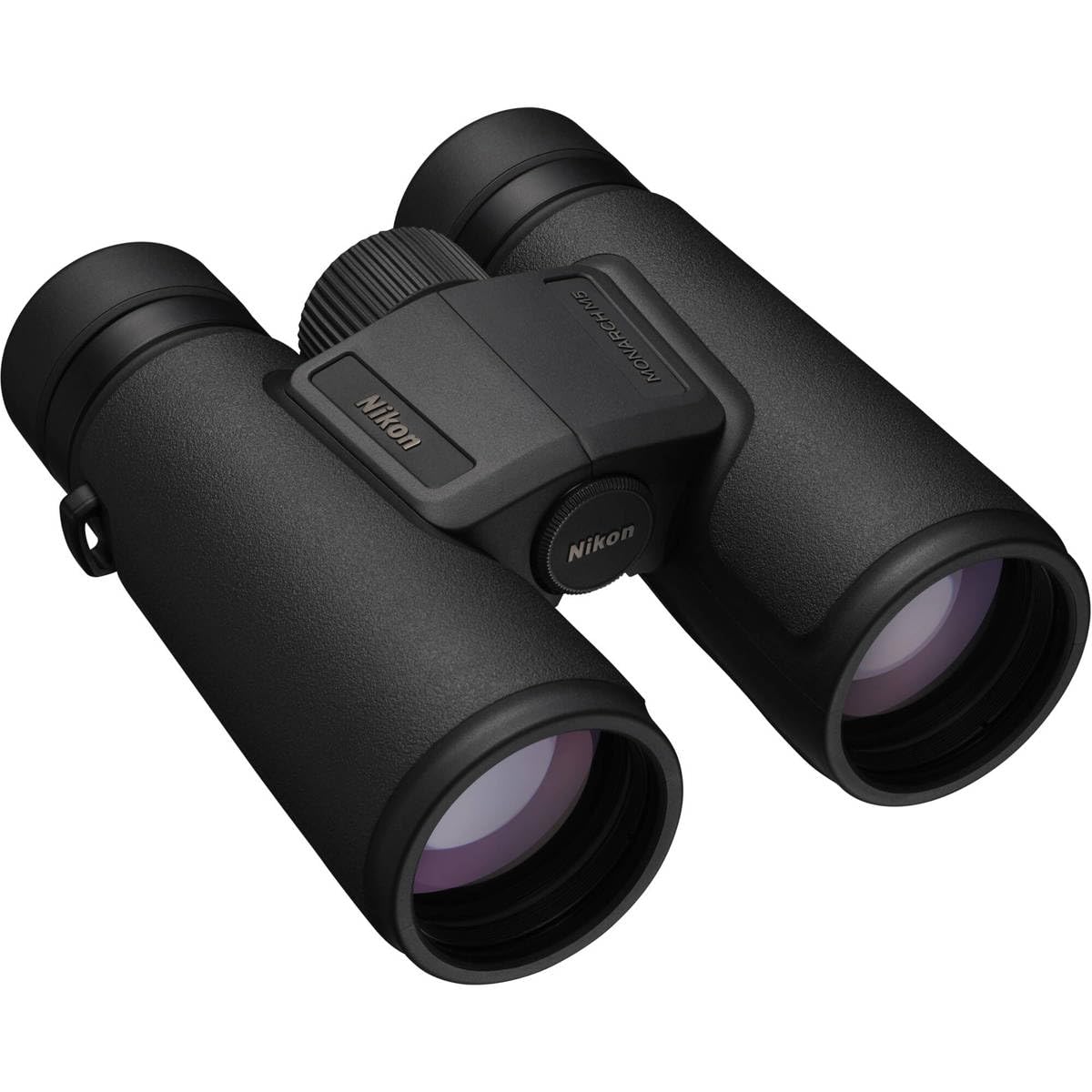
The Nikon Monarch M5 sits in a rare spot — it delivers ED glass and dielectric-coated prisms at a price that undercuts most premium competition. The 19.5mm of eye relief is generous enough for eyeglass wearers to hold a full field of view without pressing into the lenses. In the field, the 335-foot field of view at 1000 yards lets you track a moving bird through marsh grass without re-centering every few seconds.
Low-light performance separates this from mid-range options. The dielectric high-reflective multilayer coatings on the prisms boost light transmission significantly, so the difference between a Hermit Thrush and a Swainson’s Thrush remains clear even under a closed canopy at dusk. The close-focus ability down to 8.2 feet is useful for spotting warblers working bark an arm’s length away.
Build quality feels reassuring — the rubber-armored body is nitrogen-purged and O-ring sealed for waterproof and fogproof operation. The large center focus knob is smooth enough for one-finger adjustment, though some users note the wheel sits slightly closer to the body than ideal. For the all-around birder who needs one binocular for everything from backyard feeders to mountain trails, this is the strongest value in the segment.
Why it’s great
- ED glass virtually eliminates chromatic aberration
- 19.5mm eye relief works well with eyeglasses
- Dielectric-coated prisms for excellent low-light brightness
Good to know
- Field of view slightly narrower than some 8×42 competitors
- Slightly heavier than purely travel-focused models
2. Vortex Diamondback HD 8×42

The Vortex Diamondback HD uses select HD glass elements and dielectric coatings to deliver exceptional resolution and color fidelity. The 393-foot field of view at 1000 yards is among the widest in this class, making it ideal for scanning open marshes or following fast-moving swallows. The argon purging and O-ring seals provide waterproof and fogproof performance across extreme temperature swings — a real advantage for birders who glass in winter cold and summer humidity.
The VIP warranty is a genuine differentiator. It is unconditional, unlimited, lifetime, and fully transferable — if you break them, Vortex repairs or replaces them regardless of fault. For a piece of gear that lives around your neck on muddy trails and rocky coastlines, this removes the anxiety of a costly repair bill. The included GlassPak harness distributes weight across your shoulders rather than your neck, reducing fatigue during all-day outings.
The twist-up eyecups with adjustable positions accommodate both eyeglass and non-eyeglass users, and the center focus wheel is buttery smooth for precise adjustments. The Armortek coating on external lenses resists scratches and makes cleaning off dirt and fingerprints easier. For the birder who prioritizes durability and a no-fault safety net alongside sharp optics, the Diamondback HD is a compelling choice.
Why it’s great
- Wide 393-foot field of view for tracking birds
- VIP unconditional lifetime warranty
- Argon purging prevents fogging in extreme conditions
Good to know
- No ED glass — some chromatic aberration in high-contrast scenes
- Relies on dielectric coating rather than full phase-correction on prisms
3. Celestron Nature DX ED 8×42

The Celestron Nature DX ED brings Extra-Low Dispersion glass to the entry-level price bracket, which is rare. The ED objective lenses effectively kill the color fringing that plagues budget binoculars when you try to identify a bird silhouetted against a bright overcast sky. The BaK-4 prisms with phase coatings maximize light transmission and contrast, giving you sharp, true-to-life color even in the muted light of a forest floor.
At just under 22 ounces, this binocular is light enough to carry on a long hike without grumbling. The rubber-armored polycarbonate housing is tough enough to survive the occasional drop onto a rock, and the nitrogen-purged construction keeps the interior dry in rain or fog. The built-in tripod adapter threads are a welcome addition for digiscoping or extended watching sessions where arm fatigue becomes a factor.
The 17.8mm of eye relief is comfortable for most users, and the twist-up eyecups lock into place with positive clicks. Some users find the grip slightly less ergonomic than more expensive models — the barrel shape is rounder without pronounced thumb rests — but the optical performance is a clear step above similarly priced non-ED binoculars. For the birder on a budget who refuses to compromise on image clarity, this is the smart pick.
Why it’s great
- ED glass at a budget-friendly price point
- Phase-coated BaK-4 prisms for bright, sharp images
- Tripod adaptable for stable long sessions
Good to know
- Ergonomics are adequate but not class-leading
- Shallow depth of field requires more precise focusing
4. Wingspan Skyview Ultra HD 8×42

The Wingspan Skyview Ultra HD is designed specifically with birders in mind — the close-focus distance of 2 meters is one of the shortest in this roundup, letting you examine a perched bird just a few feet away without losing focus. The ED glass and phase-correction-coated high-index prisms deliver sharp, high-contrast images that make feather detail stand out even in shaded environments. The extra-wide 393-foot field of view at 1000 yards reduces the need to sweep constantly.
The DuraTech Technology body is lightweight at 25.6 ounces but feels solid in hand. The thumb grooves on the barrels provide a secure grip, and the rubberized surface handles well in damp conditions. Users consistently note how the binocular brightens shaded areas — a real advantage when birds are working the understory or feeding in deep woods where light is scarce.
Some chromatic aberration is noticeable at extreme high-contrast edges, but it is minimal for the price tier. The strap attachment system is a bit fussy compared to more refined designs. For the birder who regularly works close-range habitats like backyard feeders or dense riparian zones where close focus matters most, the Skyview is a specialized and effective tool.
Why it’s great
- 2-meter close focus for nearby bird observation
- ED glass reduces chromatic aberration effectively
- Wide field of view for tracking movement
Good to know
- Strap attachment mechanism could be more refined
- Some users may need a tripod for steady long-range viewing
5. ZEISS Terra ED 10×42

The ZEISS Terra ED delivers 88% light transmission through Schmidt-Pechan ED glass with a hydrophobic multi-coating, producing bright, high-contrast images that hold up in adverse light conditions. The 10x magnification gives you the reach needed for open-country species like raptors or shorebirds, and the 330-foot field of view is reasonable for a 10x glass. The hydrophobic coating on the external lenses is a practical touch — water beads up and rolls off rather than smearing across the glass.
Build quality is typical ZEISS — the fiberglass-reinforced polycarbonate casing is tough and lightweight. The large focus wheel is positioned so your index finger lands naturally on it, allowing quick reaction when a bird flushes unexpectedly. The 18mm of eye relief is generous for eyeglass wearers, and the twist-up eyecups with multiple click stops provide a secure fit. The included neoprene strap and hard case are higher quality than what typically ships with mid-range binoculars.
The 10x magnification amplifies hand shake, so you will want to brace your elbows against your chest or use a tripod for prolonged viewing. The slightly higher weight is noticeable compared to an 8×32. For the birder who primarily watches open habitats like grasslands, coastlines, or mountain ridges, the Zeiss Terra ED 10×42 brings genuine optical heritage and field performance.
Why it’s great
- ZEISS hydrophobic coating sheds rain and dew effectively
- Excellent 88% light transmission for low-light clarity
- Fast, ergonomic focus wheel for quick target acquisition
Good to know
- 10x magnification requires steady hands or tripod support
- Premium price positions it for serious enthusiasts
6. Maven C1 10×42

The Maven C1 10×42 punches far above its price tier by stripping away retail markup and focusing on core optical performance. The ED glass and fully multi-coated lenses produce edge-to-edge sharpness and neutral color that users frequently compare to binoculars costing several times more. The close-focus distance of 5.9 feet is excellent for a 10x model, letting you study nearby subjects without constantly re-focusing. At 24.5 ounces, the lightweight polymer frame reduces fatigue during long carrying sessions.
Customer reviews consistently describe the C1 as optically competitive with models in the – range. The low-light performance is particularly strong, with crisp detail visible well after the sun drops below the treeline. The Maven unconditional lifetime warranty — no-fault, fully transferable — matches the confidence of much more expensive brands. The diopter adjustment is stiff and precise, staying in place once set.
The included accessories are basic — a soft pouch and neck strap instead of a hard case — which reflects the direct-to-consumer value philosophy. Some users report minor quality control variation on the diopter ring. For the experienced birder who cares about optical benchmarks over packaging frills and wants alpha-class performance without the alpha-class price, the Maven C1 delivers on every level.
Why it’s great
- Optical quality rivals models at significantly higher price points
- Lightweight polymer frame reduces carrying fatigue
- Excellent close-focus for a 10x binocular
Good to know
- Accessories are basic — soft pouch instead of hard case
- Minor quality control variation reported on diopter ring
7. Celestron Nature DX ED 10×42
The 10×42 version of Celestron’s Nature DX ED offers the same ED glass and phase-coated BaK-4 prism system as the 8×42 but with additional reach for identifying distant birds. The 309-foot field of view at 1000 yards is understandably narrower than the 8x, but the extra magnification helps separate a Red-tailed Hawk from a Rough-legged Hawk at range. The 14.3mm of eye relief is adequate but less forgiving for eyeglass wearers than the 8x version.
Build quality mirrors the 8×42 — rubber-armored, waterproof, fogproof, and tripod-adaptable. The binocular is compact enough for a day pack and handles well in wet conditions. For the birder who already owns an 8x and wants a second pair for open-country scouting, this is a cost-effective way to add reach without sacrificing ED glass quality. The lower depth of field at 10x means you will adjust focus more frequently, but the fast center wheel makes it manageable.
The included accessories — carrying case, lens cloth, neck strap, objective lens caps, and rainguard — cover the basics adequately. Some users note that the eyecups could be more rigid. For the birder who needs magnification for shorebird identification or scanning distant treeline edges, the Nature DX ED 10×42 pairs ED clarity with practical reach at a reasonable investment.
Why it’s great
- ED glass minimizes chromatic aberration at higher magnification
- Affordable way to add 10x reach with quality optics
- Waterproof, fogproof, and tripod adaptable
Good to know
- 14.3mm eye relief is tight for eyeglass wearers
- Shallower depth of field requires more frequent refocusing
8. Bushnell H2O Xtreme 10×42

The Bushnell H2O Xtreme is purpose-built for wet environments. The IPX7 rating means it can survive submersion in up to one meter of water for 30 minutes — a serious spec for birders who work coastlines, marshes, or rainy climates. The fully multi-coated glass surfaces and BaK-4 prisms produce a bright image that outperforms its price tier, and the 17mm of eye relief works well for most users. The 10×42 configuration provides solid reach for scanning open water or mudflats.
The rugged rubber design with soft grip ridges provides a non-slip hold even with wet or cold hands. The nitrogen-purged O-ring seals prevent internal fogging during temperature shifts. Users report that the minimum focus distance is better than expected for a budget 10x, and the clarity at 200 yards surprises many who step up from older entry-level glasses. The included carrying case and straps are functional but basic, which is typical at this level.
The H2O Xtreme lacks a tripod adapter socket, which is a notable omission for anyone wanting to mount it for extended viewing. Some users note the 10x magnification amplifies hand shake, and the slightly heavier feel compared to 8x options can lead to fatigue over a full day. For the birder who needs a waterproof workhorse for kayak trips, coastal walks, or birding in persistent drizzle, this is a durable and capable choice.
Why it’s great
- IPX7 waterproof rating for submersion protection
- Non-slip rubber grip in wet conditions
- Bright image with fully multi-coated optics
Good to know
- No tripod adapter socket for stable long sessions
- 10x magnification increases hand shake at this weight
9. Nikon Travelite EX 8×25

The Nikon Travelite EX 8×25 prioritizes portability above all else. At just 10.9 ounces, it disappears into a jacket pocket or small day pack, making it the ideal companion for birders who want optics available at a moment’s notice without the weight of a full-size binocular. The multilayer-coated optics produce a surprisingly bright image for a 25mm objective, and the aspherical eyepiece lenses minimize distortion across the field. The 8x magnification is steady enough for comfortable handheld use.
The nitrogen-purged and O-ring-sealed body is waterproof to 2 meters for 5 minutes and completely fogproof — serious weather protection for such a compact frame. The turn-and-slide eyecups and click-type diopter adjustment make customization straightforward, and the high-eyepoint design works well for eyeglass wearers. Users report the image quality competes favorably with much larger binoculars in good light, though the small exit pupil (3.13mm) limits low-light performance at dawn and dusk.
The compact size means a narrower field of view and less light-gathering ability compared to 42mm models. This is a tool for well-lit conditions — forest canopy, open fields, midday birding — not for glassing at twilight. For the birder who already owns a full-size pair and wants a backup for travel, hiking, or casual walks, the Travelite EX offers the best portability-to-performance ratio in this lineup.
Why it’s great
- Extremely lightweight at 10.9 ounces for easy carry
- Waterproof and fogproof despite compact size
- Sharp, distortion-free image from aspherical lenses
Good to know
- 3.13mm exit pupil limits performance in low light
- 25mm objective gathers less light than full-size models
FAQ
Is 8x or 10x magnification better for birding?
What does phase coating do in roof prism binoculars?
How important is waterproofing for birding binoculars?
Final Thoughts: The Verdict
For most users, the binoculars for birding winner is the Nikon Monarch M5 8×42 because it pairs ED glass and dielectric-coated prisms with 19.5mm of eye relief and a smooth, precise focus wheel at a mid-range investment that outperforms many more expensive models. If you want the widest field of view and the most durable warranty in the category, grab the Vortex Diamondback HD 8×42. And for the budget-conscious birder who refuses to give up ED glass and phase-coated BaK-4 prisms, nothing beats the Celestron Nature DX ED 8×42.