
Our readers keep the lights on and the weekend projects moving. As an Amazon Associate, I earn from qualifying purchases.
Dawn on the trail. A flash of movement in the undergrowth, or a distant ridgeline speckled with shapes you want to identify. The right optics turn that blur into a crisp, memorable moment. The wrong pair stays in your pack—too heavy, too fogged, too fragile to trust on uneven ground.
I’m Rikta — the founder and writer behind FitlyFast. I’ve sifted through years of field reports and lab-grade spec sheets to find the binoculars that genuinely balance optical clarity with the real-world abuse of a backpack.
This guide focuses on the models that earn their space in a pack, covering magnification, weather sealing, and weight trade-offs. If you are serious about finding the best binoculars for hikers, these are the pairs built for miles, not just the view from the car.
How To Choose The Best Binoculars For Hikers
Hiking binoculars live in a different world from birding stationary or stadium-watching. You care about what goes in your pack and how much your neck will ache at mile six. Every spec choice—magnification, objective diameter, prism quality, coating, and sealing—shifts the trade-off between what you see and what you can carry.
Choose Your Magnification Wisely
8x and 10x are the hiking sweet spots. 8x gives you a wider field of view and a steadier image when your hands are tired, while 10x pulls in more detail at the cost of shakiness and a narrower view. Anything above 10x usually requires a tripod to be useful at distance, which defeats the purpose of a lightweight hike. Stick to these two options and let the trail conditions decide.
Objective Lens Size and Weight
The second number (e.g., the “42” in 10×42) is the objective lens diameter in millimeters. Larger objectives gather more light—great for dawn and dusk—but they add bulk. A 42mm lens pair will often weigh double a 25mm or 28mm pair. For day hikes where you start after sunrise, a 25mm or 28mm objective saves real pack weight without sacrificing daytime clarity.
Weather Sealing Is a Must
A waterproof and fogproof build isn’t optional for a hiker. Rain, river crossings, and temperature shifts from valley to peak will fog unsealed optics. Look for nitrogen-purged or argon-purged sealing and an IPX7 rating for submersion. Models without these features risk condensation on cold mornings, which ruins the view exactly when you need it most.
Prism Glass and Coatings
BaK-4 glass delivers brighter, sharper images than standard BK-7 glass by reducing light loss at the prism edge. Fully multi-coated lenses (multiple anti-reflective layers on every air-to-glass surface) maximize light transmission. These two specs together separate a crisp, high-contrast view from a muddy, dull one—especially when looking into shadowed forest or water.
Quick Comparison
On smaller screens, swipe sideways to see the full table.
| Model | Category | Best For | Key Spec | Amazon |
|---|---|---|---|---|
| Vortex Diamondback HD 10×28 | Premium Compact | All-day carry with elite clarity | Argon-purged & fogproof | Amazon |
| ZEISS Terra ED 10×42 | Premium Full-Size | Maximum low-light performance | ED glass hydrophobic coating | Amazon |
| Celestron Nature DX ED 8×42 | Mid-Range Full-Size | Extra-low dispersion color accuracy | ED objective lenses | Amazon |
| Nikon TRAVELITE EX 8×25 | Compact Mid-Range | Ultra-portable travel companion | Die-cast aluminum body | Amazon |
| Bushnell H2O 8×25 | Value Compact | Budget-friendly trail starter | IPX7 waterproof rating | Amazon |
| Barska Crush 10×42 | Value Full-Size | Colorful shockproof for casual hikes | Fully multi-coated optics | Amazon |
| Nocs Provisions Standard Issue 10×25 | Compact Lifestyle | Pocketable style with lifetime warranty | 10×25, 11.85oz weight | Amazon |
In‑Depth Reviews
1. Vortex Optics Diamondback HD 10×28

The Diamondback HD 10×28 is the benchmark for hikers who refuse to compromise between weight and optical fidelity. At 10x magnification with a 28mm objective, you get genuine reach without the bulk of a 42mm lens. The HD optical system uses select glass elements to cut chromatic aberration, and dielectric coatings on the prisms push light transmission high enough to keep views bright even in the gloom of a forest understory.
Argon purging and o-ring seals make this pair fully waterproof and fogproof across rapid temperature shifts—exactly what you face climbing from a shaded valley to an exposed ridge. The rubber armor provides a secure, non-slip grip even with wet hands, and the 16mm of eye relief means eyeglass wearers can keep their glasses on without losing the full field of view. The center focus wheel is buttery smooth, allowing one-handed adjustments while braced on a trekking pole.
Vortex backs the Diamondback HD with its unconditional, lifetime VIP warranty—transferable, no receipt needed, no questions asked. That guarantee alone makes this a long-term investment for hikers who want one pair to last through every trail condition. The included soft carry case and tethered lens covers round out a package designed for real trail days, not just the closet.
Why it’s great
- Excellent light transmission from dielectric-coated prisms
- Argon-purged fogproof performance in all conditions
- Lifetime unconditional warranty adds zero-risk ownership
- Non-slip rubber grip works in wet weather
Good to know
- 28mm objective limits low-light usability at dawn/dusk
- Build quality and optical performance come at a higher cost
2. ZEISS Terra ED 10×42

Stepping up to the ZEISS Terra ED means buying into a level of optical engineering that only a few manufacturers can deliver. The 10×42 configuration uses Extra-Low Dispersion (ED) glass in a Schmidt-Pechan prism system to yield 88% light transmission. Colors appear saturated and true, and chromatic aberration—the ugly purple fringing common on cheaper glass—is virtually nonexistent. This is a binocular that reveals details other pairs simply miss.
ZEISS applied a hydrophobic multi-layer anti-reflective coating to the exterior lenses, which makes water bead up and roll off instantly. Combined with a fiberglass-reinforced polycarbonate housing that is fully waterproof, the Terra ED is built for relentless rain, river mist, or condensation from a cold morning. The large, fast-focus wheel lands naturally under your index finger, letting you snap from a bird at 20 feet to a ridgeline at 300 yards in a fraction of a second.
The 42mm objective lenses gather substantial light, pushing usability well into twilight—a critical advantage if you hike early or late. The included neoprene strap and hard carry case feel worthy of the Zeiss name. Weight is slightly higher than a compact pair, but the optical payout in low-light scenarios justifies the extra ounces for hikers who value what they see at dawn and dusk.
Why it’s great
- 88% light transmission for exceptional low-light performance
- ED glass virtually eliminates color fringing
- Hydrophobic coating sheds water and grease effectively
- Fast-focus wheel with natural ergonomics
Good to know
- Full-size 42mm objective adds noticeable pack weight
- Price point is the highest in this list
3. Celestron Nature DX ED 8×42

The Celestron Nature DX ED offers a rare combination: Extra-low Dispersion objective glass at a price point that undercuts most competitors. ED glass eliminates chromatic aberration, and here it delivers crisp, true-to-life color that makes identifying subtle plumage or foliage variation far easier. The 8x magnification provides a steady image with a wider field of view—an advantage when scanning across a forest canopy or following a moving trail runner.
Phase-coated BaK-4 prisms and fully multi-coated lenses maximize brightness and contrast, producing an image that feels open and immersive. The 42mm objective ensures you have enough light gathering for dim conditions, and the exit pupil of 5.25mm is generous enough for older eyes or shaky hands. The rubber-armored polycarbonate housing is nitrogen-purged and o-ring sealed, keeping fog out during temperature swings.
Celestron includes a carrying case, neck strap, objective lens caps, and rainguard. The tripod-adaptable design is useful for extended observation sessions, though the center focus knob lacks the silky smoothness of the premium Vortex or Zeiss offerings. For hikers who prioritize color accuracy and brightness over absolute low-light extremes, the Nature DX ED is an optical upgrade that stays closer to a mid-range budget.
Why it’s great
- ED glass at an aggressive mid-range price point
- Phase-coated BaK-4 prisms for maximum brightness
- Wide 7.5° field of view aids tracking subjects
- Fully waterproof and nitrogen-purged
Good to know
- Focus knob ergonomics are less refined than top-tier options
- Largest design among the compact-focused reviews here
4. Nikon TRAVELITE EX 8×25

Nikon’s TRAVELITE EX 8×25 is a marvel of pack optimization. Weighing just over 10 ounces and folding down to a compact footprint, it disappears into a jacket pocket or hip belt pouch. The die-cast aluminum body with rubber armoring feels surprisingly robust for its size, and the multilayer-coated optics deliver bright, sharp images that punch well above their small objective class. For day hikers who refuse to carry extra ounces, this is the sweet spot.
The turn-and-slide eyecups provide good eye relief for glasses wearers, and the click-type diopter stays locked once set. Nitrogen-purged and O-ring sealed, the TRAVELITE EX is both waterproof and fogproof—impressive for such a small form factor. The 8x magnification yields a steady, wide view that minimizes the hand-shake issues common with higher-magnification compacts. Image brightness holds up well in open shade but does drop noticeably in deep twilight.
Nikon includes a soft case and strap, and the overall build quality is consistent with the brand’s reputation. Some users note that the rubber grip can separate after heavy use, though this is a relatively rare complaint. For travelers and minimalist hikers who value a binocular that feels like it is not there until you need it, the TRAVELITE EX is a category leader in size-to-performance ratio.
Why it’s great
- Extremely lightweight and pocketable for day hikes
- Nitrogen-purged for fogproof performance
- Sharp multi-coated optics with good color rendition
- Turn-and-slide eyecups suit eyeglass wearers
Good to know
- 25mm objective struggles in low-light conditions
- Rubber grip may detach with sustained rough use
5. Bushnell H2O 8×25

Bushnell’s H2O 8×25 proves that reliable outdoor optics don’t have to cost a week’s worth of trail food. The BaK-4 prisms and fully multi-coated lenses produce surprisingly crisp and bright images for the price, making it a legitimate entry-level option for new hikers. The 8x magnification is forgiving on shaky hands, and the 25mm objective keeps weight low enough for a neck strap or pack pocket.
The standout feature here is the IPX7 waterproof rating—these binoculars can be submerged in up to three feet of water for thirty minutes without damage. Combined with nitrogen-purged fogproofing, the H2O handles mist, rain, and stream crossings without internal condensation. The non-slip rubber armor provides a tactile grip, and the twist-up eyecups accommodate glasses. Field of view at 54.69 degrees is decent for the size, making scanning hillsides feel natural.
Bushnell includes a carrying case, neck strap, and lens covers. The diopter adjustment is stiff and may require some force initially, and the case is basic. The internal focusing design keeps out dust better than external-focus models. For budget-conscious hikers or those buying their first dedicated trail binocular, the H2O delivers essential performance without pretending to compete with premium glass.
Why it’s great
- BaK-4 prism and multi-coated lenses punch above cost
- IPX7 waterproof and nitrogen-purged fogproof
- Lightweight enough for all-day pack carry
- Non-slip rubber armor provides secure wet grip
Good to know
- Diopter adjustment is stiff and hard to fine-tune
- Included case offers minimal padding
6. Barska Crush 10×42
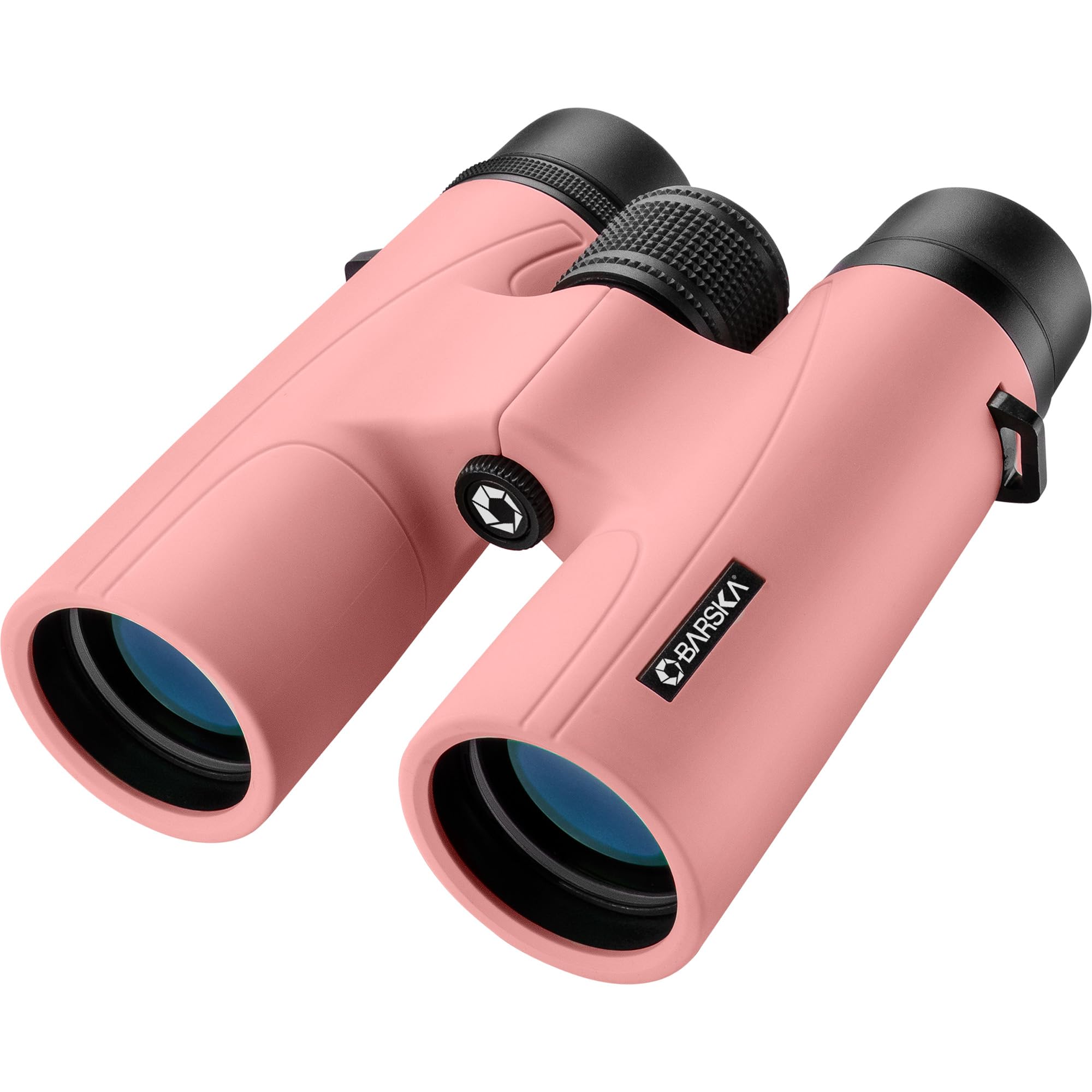
The Barska Crush 10×42 targets hikers who want full-size reach without a premium price tag, wrapped in a bright color scheme that’s hard to lose on the trail. Fully multi-coated optics and BaK-4 prisms produce a crisp, clear image that competes favorably with models costing significantly more. Users consistently compare the clarity to premium brands like Vortex Triumph, calling it the best sub- binocular available.
Shock-absorbing rubber armor protects the optics from drops on rocky terrain, and the 42mm objective delivers enough light gathering to remain useful in overcast conditions. The 10x magnification gives excellent detail on distant features, though the narrower field of view may require more scanning. Eye relief at 13.6mm is adequate for quick views but may not be comfortable for extended sessions with glasses.
The package includes a carrying case, neck strap, and lens cloth. The ergonomic grip is comfortable, but the center focus wheel lacks the damped smoothness of higher-end competitors. For hikers who want a durable, bright full-size binocular for casual weekend use—and don’t mind a few extra ounces—the Crush is a value proposition that delivers on the essentials.
Why it’s great
- Optical clarity competes with premium brands at lower cost
- Shock-absorbing rubber armor suits rough terrain
- 42mm objective provides good light for overcast days
- Bright color options prevent easy misplacement
Good to know
- 13.6mm eye relief may feel tight for glasses wearers
- Focus wheel lacks the smoothness of higher-priced options
7. Nocs Provisions Standard Issue 10×25

Nocs Provisions designed the Standard Issue 10×25 to be a compact companion that looks as good as it performs. Weighing just 11.85 ounces, these pocket-sized binoculars feature a patented Rugged Wave Grip that makes one-handed use secure even in wet conditions. Fully multi-coated optics and a Swiss-designed BaK-4 prism deliver a bright field of view that covers 315 feet at 1,000 yards.
Rated IPX7, the Standard Issue is submersible and fogproof thanks to a medical-grade O-ring assembly and inert nitrogen gas injection. The multi-stop twist-up eyecup mechanism works well for both eyeglass wearers and bare eyes. While the 10x magnification in a 25mm objective can be slightly prone to hand shake, the lightweight build encourages casual use that reduces fatigue.
Nocs backs this product with a “No-Matter-What” Lifetime Warranty, reflecting confidence in the build quality. The strap slots are narrow, which can make installation of some neck straps fiddly. For hikers who prioritize a sleek, eco-conscious design with a warranty that matches premium brands, this compact makes a strong secondary or dedicated pocket carry option.
Why it’s great
- Very lightweight and pocketable at 11.85 ounces
- IPX7 waterproof and nitrogen-purged fogproof
- Unique wave grip improves wet-weather handling
- Lifetime “No-Matter-What” warranty builds confidence
Good to know
- Narrow strap slots make attachment difficult with some straps
- 10x magnification can amplify hand shake in a compact frame
FAQ
What is the best magnification for hiking binoculars?
Do hikers need waterproof binoculars?
Is a 42mm objective lens too heavy for hiking?
Should I choose roof or Porro prism binoculars for hiking?
Final Thoughts: The Verdict
For most users, the binoculars for hikers winner is the Vortex Diamondback HD 10×28 because it delivers near-premium optical clarity—dielectric coatings and argon purging—in a lightweight 28mm format backed by a lifetime no-questions warranty. If you want maximum low-light performance for early starts or late finishes, grab the ZEISS Terra ED 10×42. And for the ultra-minimalist hiker who refuses to carry anything extra, nothing beats the Nikon TRAVELITE EX 8×25.