
Our readers keep the lights on and the weekend projects moving. As an Amazon Associate, I earn from qualifying purchases.
That shake in your hands on the trail isn’t just adrenaline — it’s the difference between seeing a distant hawk clearly and mistaking it for a rock. The wrong binocular specs turn a summit view into a blurry frustration.
I’m Rikta — the co-founder and writer behind FitlyFast. I’ve spent years analyzing optical coatings, prism types, and waterproofing standards to separate genuine hiking binocular performance from marketing noise.
After comparing dozens of models against real trail conditions — weight, grip in wet weather, field of view for tracking fast movement — I’ve narrowed it down to the best binoculars for hiking that deliver clarity without dragging you down.
How To Choose The Best Binoculars For Hiking
The hiking trail demands a specific set of compromises that living-room or stadium binoculars don’t need to make. You need optical performance that works in variable light, a chassis that survives a bump against a rock, and a weight that won’t punish you after eight miles.
Magnification and Objective Lens Size
The familiar 8×42 and 10×42 numbers aren’t arbitrary. The first number (8 or 10) is how many times closer an object appears. The second (42mm) is the diameter of the front lens. For hiking, 8x gives you a wider, steadier field of view — crucial for tracking birds or wildlife that won’t hold still. 10x pulls details closer but amplifies hand shake, making it harder to hold steady without a support. 42mm lenses gather enough light for dawn and dusk viewing without adding excessive bulk.
Weight and Portability
Every ounce compounds with every mile. A pair weighing 25 ounces might feel fine in the store, but after a five-hour climb with a full pack, that weight becomes a genuine burden. The best hiking binoculars fall between 11 and 25 ounces. Full-size models (like 8×42) often sit around 20-25 ounces, while compact 10×25 or 8×25 designs duck under 15 ounces. The trade-off is less light-gathering ability in low conditions with compact lenses.
Waterproofing and Fogproofing
Trail weather changes fast. A passing rain shower or crossing a stream shouldn’t ruin your optics. Look for an IPX7 rating — that means the unit can be submerged in three feet of water for 30 minutes without failure. Nitrogen or argon purging prevents internal fogging when you move from a cold valley to a warm ridge. O-ring seals are the standard construction method for keeping moisture out.
Optical Coatings and Prism Quality
Fully multi-coated lenses (multiple anti-reflective layers on every glass surface) maximize light transmission — the difference between a dim, washed-out view and a bright, crisp one. BaK-4 prisms are the gold standard; they transmit more light than cheaper BK-7 prisms and produce a sharper image edge to edge. ED (extra-low dispersion) glass eliminates the purple or green fringing around high-contrast objects, a defect that becomes obvious when scanning treetops against a bright sky.
Quick Comparison
On smaller screens, swipe sideways to see the full table.
| Model | Category | Best For | Key Spec | Amazon |
|---|---|---|---|---|
| Vortex Diamondback HD 10×28 | Mid-Range | All-weather durability with a lifetime warranty | Argon purged, 16mm eye relief | Amazon |
| Nikon Monarch M5 8×42 | Premium | True-color clarity in low light | ED glass, 335ft FOV | Amazon |
| Celestron Nature DX ED 8×42 | Premium | Budget-friendly ED glass entry | ED glass, 17.8mm eye relief | Amazon |
| ZEISS Terra ED 10×42 | Premium | Professional-grade optics | Hydrophobic coating, 88% transmission | Amazon |
| Bushnell H2O Xtreme 10×42 | Mid-Range | Rugged waterproofing on a budget | IPX7, 17mm eye relief | Amazon |
| Nikon TRAVELITE EX 8×25 | Mid-Range | Ultra-light packing | 11.1mm eye relief, 12.4 oz | Amazon |
| Nocs Provisions Standard Issue 10×25 | Entry-Level | Pocketable carry with lifetime warranty | IPX7, 11.85 oz | Amazon |
In‑Depth Reviews
1. Vortex Optics Diamondback HD 10×28

The Vortex Diamondback HD 10×28 hits the sweet spot for hikers who need a rugged, all-weather companion without the premium price tag. The HD optical system uses select glass elements to cut chromatic aberration — that distracting color fringing around branches against a bright sky — while delivering sharp resolution across the entire field of view.
Argon purging and O-ring seals make it fully waterproof and fogproof, a critical feature when you’re caught in an afternoon thunderstorm. The 16mm of eye relief comfortably accommodates eyeglass wearers, and the adjustable twist-up eyecups lock into position for a consistent view.
What seals the deal is the VIP warranty — unlimited lifetime, unconditional, fully transferable. If these binoculars break due to a defect or a drop on the trail, Vortex repairs or replaces them at no cost to you. That kind of guarantee matters for gear that lives in a pack and sees real abuse.
Why it’s great
- Dielectric coatings produce bright, color-accurate images
- Armortek coating protects exterior lenses from scratches
- Tripod-adaptable for stable viewing at rest stops
Good to know
- 10x magnification can feel shaky without a steady rest
- Does not include a harness in the package
2. Nikon Monarch M5 8×42
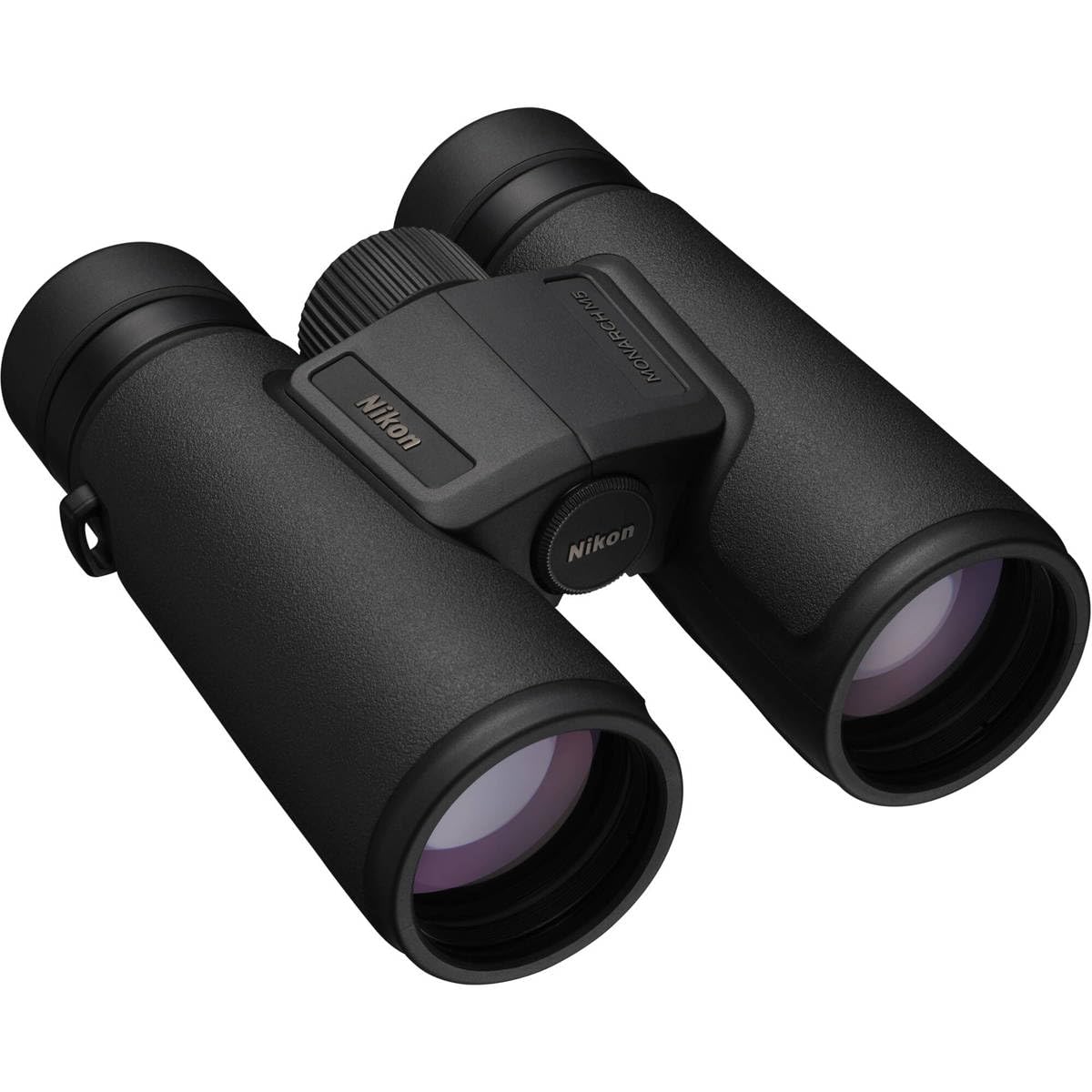
Nikon’s Monarch M5 8×42 is built for the hiker who starts before sunrise or stays out until dusk. Extra-low Dispersion (ED) glass eliminates chromatic aberration so thoroughly that the image edges remain crisp and color-true even in dim forest light. The dielectric high-reflective multilayer prism coatings push light transmission to the point where you can pick out feather textures in deep shadow.
The 19.5mm of eye relief is generous — one of the highest in this class — and the turn-and-slide eyecups let eyeglass wearers find a comfortable viewing position without losing the full field of view. At roughly 23 ounces, it’s heavier than compact models, but that weight is the price you pay for 42mm objectives and the light-gathering advantage they bring.
The closed-bridge configuration gives you a large, smooth center focus knob that works naturally with gloved fingers. The nitrogen-purped housing is both waterproof and fogproof, and the rubber armor provides a secure grip in wet conditions. For hikers who prioritize image quality over minimalist weight, this is the benchmark.
Why it’s great
- ED glass virtually eliminates color fringing
- 19.5mm eye relief accommodates glasses easily
- Bright, natural color rendition in low light
Good to know
- Heavier than compact alternatives at 23 ounces
- Some users note a narrower field of view compared to competitors
3. Celestron Nature DX ED 8×42

The Celestron Nature DX ED 8×42 proves you don’t have to spend premium money to get ED glass. Extra-low Dispersion objective lenses slice through chromatic aberration, giving you sharp, true-color views that rival optics costing twice as much. The BaK-4 prisms with dielectric and phase coatings maximize light transmission for bright images even in the fading light of a long hike.
The 42mm objectives gather enough light for dawn and dusk viewing, and the 17.8mm of eye relief is comfortable for extended use. At about 24 ounces, it’s in the same weight class as the Nikon Monarch M5, so this is a binocular for daypacks and dedicated optics duty — not a pocket pair.
The rubber-armored polycarbonate housing shrugs off bumps against rocks and trail furniture, and the nitrogen-purged construction keeps fog at bay when you move between temperature zones. A built-in tripod adapter thread means you can mount it for shake-free viewing at a scenic overlook. Celestron backs it with a limited lifetime warranty and US-based support.
Why it’s great
- ED glass at a mid-range price point
- Phase-coated BaK-4 prisms for bright, sharp images
- Tripod-adaptable for stable views
Good to know
- Ergonomics less refined than higher-priced competitors
- Shallower depth of field requires more refocusing
4. ZEISS Terra ED 10×42

When weight and size matter less than optical purity, the ZEISS Terra ED 10×42 delivers a level of clarity that justifies its position at the top of the price spectrum. The Schmidt-Pechan ED glass with ZEISS’s hydrophobic multi-coating achieves 88% light transmission, producing images that look brighter and more contrast-rich than most binoculars in this class.
The hydrophobic coating is not a gimmick — water beads up and rolls off the lenses instantly, keeping your view clear in rain or when you’re breathing hard in humid air. The large center focus wheel is positioned so your index finger lands on it naturally, enabling fast refocusing when a bird or animal moves unexpectedly. At 18mm of eye relief, it’s generous enough for glasses wearers to enjoy the full field.
The fiberglass-reinforced polycarbonate casing is waterproof and nearly indestructible. ZEISS includes a neoprene strap and a quality hard case. This is a serious investment, but for the hiker who wants reference-grade optics that reveal detail other binoculars miss — like the individual feathers on a hawk at 200 yards — nothing else on this list compares.
Why it’s great
- 88% light transmission for brilliant low-light views
- Hydrophobic coating sheds rain and fog
- Fast, intuitive focus wheel
Good to know
- Premium price places it out of budget for many hikers
- 10x magnification is less forgiving of hand shake
5. Bushnell H2O Xtreme 10×42

The Bushnell H2O Xtreme 10×42 is the trail-tested veteran of this list — a 10×42 roof-prism design that has proven itself for years in wet, muddy, and cold conditions. The O-ring sealed, nitrogen-purged construction meets IPX7 standards, meaning you can submerge it without worry. The fully multi-coated optics and BaK-4 prisms deliver bright, clear images that outperform the price point.
At roughly 25 ounces, it’s heavier than the compact options, but the weight is distributed well and the rubberized grip stays secure even when your hands are sweaty or wet. The center focus knob is smooth and the diopter adjustment (located on the right eyepiece) clicks positively into place. Some users report the neck strap is uncomfortable, but the included lens covers and case add real value.
A notable drawback: this model lacks a tripod adapter socket, so if you plan to mount your binoculars for extended viewing, you’ll need to look elsewhere. But for a straightforward, durable pair of 10x42s that can handle rain, river crossings, and the bottom of a pack without complaint, the H2O Xtreme is hard to beat.
Why it’s great
- IPX7 waterproof rating for total weather protection
- Fully multi-coated optics and BaK-4 prisms
- Rugged rubber grip stays secure when wet
Good to know
- No tripod adapter socket
- Neck strap design is mediocre
6. Nikon TRAVELITE EX 8×25

The Nikon TRAVELITE EX 8×25 is the answer for hikers who prioritize pack weight above all else. At 12.4 ounces, it disappears into a jacket pocket or the side pouch of a daypack without you noticing. The 8x magnification pairs naturally with the 25mm objectives to give you a wide, steady field of view that’s ideal for tracking birds in motion or scanning a valley.
The multilayer-coated optics and aspherical eyepiece lenses produce sharp, true-color images with minimal distortion at the edges. The nitrogen-purged, O-ring sealed body is waterproof to 2 meters and fully fogproof, so a sudden rain shower won’t take them out of commission. The die-cast aluminum body with protective rubber armoring absorbs the occasional knock against a tree or rock.
Turn-and-slide eyecups with click-type diopter adjustment make it comfortable for eyeglass wearers, and the high-eyepoint design reduces eye strain during long viewing sessions. The trade-off, as with any compact binocular, is reduced low-light performance — 25mm objectives simply can’t gather as much light as larger lenses. But for daytime hikes where every ounce counts, this is a top-tier choice.
Why it’s great
- Ultra-light at 12.4 ounces for easy packing
- Waterproof and fogproof in a compact package
- Wide, steady field of view for tracking
Good to know
- 25mm lenses limit low-light performance
- Not suitable for deep twilight or pre-dawn viewing
7. Nocs Provisions Standard Issue 10×25

The Nocs Provisions Standard Issue 10×25 is the modern, design-forward choice for hikers who want a capable binocular that doesn’t look or feel like bulky outdoor gear. The IPX7 rating means it survives submersion in three feet of water for 30 minutes, and the nitrogen-injected, O-ring sealed construction prevents fogging in humid conditions. At 11.85 ounces, it’s one of the lightest fully waterproof options available.
The fully multi-coated optics with Bak4 prisms deliver bright, crisp images with good color clarity. The patented Rugged Wave Grip design keeps the binocular secure in your hand, even when your palms are sweaty from the climb. The multi-stop twist-up eyecups provide three distinct positions, making it easy for eyeglass wearers to find a comfortable fit.
Nocs backs this with a “No-Matter-What” lifetime warranty and is a 1% For The Planet member, which matters if sustainability is part of your buying criteria. The strap installation is fiddly — you’ll need to cut and tape the strap ends to thread them through the narrow barrel grooves. But once set up, this is a fun, colorful, and genuinely capable hiking binocular that rewards you with a premium-feeling view for a very accessible price.
Why it’s great
- IPX7 waterproofing in a sub-12 ounce body
- Comfortable, non-slip grip design
- Lifetime warranty and eco-conscious brand
Good to know
- Strap installation is frustratingly difficult
- 10x at 25mm can feel dim in low light
FAQ
Should I choose 8x or 10x magnification for hiking?
What does ED glass do for hiking binoculars?
How much should a good pair of hiking binoculars weigh?
Can I use my smartphone with these binoculars for photos?
Final Thoughts: The Verdict
For most hikers, the binoculars for hiking winner is the Vortex Diamondback HD 10×28 because it combines a rugged, all-weather build with an unconditional lifetime warranty at a price that doesn’t require months of saving. If you want top-tier low-light performance and true-color clarity, grab the Nikon Monarch M5 8×42. And for ultralight packing where every ounce matters, nothing beats the Nikon TRAVELITE EX 8×25.