
Our readers keep the lights on and the weekend projects moving. As an Amazon Associate, I earn from qualifying purchases.
Spotting the rivets on a 787 at cruising altitude or reading the airline name on a taxiing A320 needs binoculars that balance reach, stability, and light-gathering power. Cheap optics give you shaky, fuzzy images that turn a day at the airport into an eye-straining guessing game. This guide cuts through the specs to find the pair that actually lets you follow traffic patterns and read registration markings in real-world conditions, from the observation deck to the fence line.
I’m Rikta — the co-founder and writer behind FitlyFast. This guide is built by comparing the manufacturers’ published specifications and the patterns across verified customer reviews, so you get each pick’s real strengths and trade-offs instead of marketing spin.
Whether you are a seasoned spotter or just starting out, finding the right binoculars for plane watching means matching magnification, objective lens size, and image stabilization to your specific viewing habits and environment.
How To Choose The Best Binoculars For Plane Watching
Choosing binoculars for watching planes is different from picking a pair for hiking or birding. Your targets are fast, often far away, and frequently against a bright sky. Here is what really matters.
Magnification and Stability
For plane watching, 8x is a good starting point for tracking aircraft during approach and departure, while 10x to 12x gives you the reach to read tail numbers and spot details on aircraft at higher altitudes or on the taxiway. Magnification above 12x starts to amplify your hand shake to the point where the image bounces around, making it harder to keep a plane in view. For zoom binoculars that go higher than 12x, like 10-30x, you will almost always need a tripod to get a steady view at the top end of their range.
Objective Lens Size and Light
The second number, like the 42 in 8×42, is the diameter of the objective lens in millimeters. This lens is the front glass that gathers light. A larger objective lens, such as 42mm or 50mm, lets in more light, which makes the image brighter in overcast conditions, at dusk and dawn, or when watching planes against a shadowed runway. The catch is that larger objective lenses also mean heavier, bulkier binoculars.
Field of View (FOV)
This is the width of the area you can see at a specific distance, often listed in feet at 1,000 yards. A wider field of view helps you find a plane in the sky and track it as it moves, which is especially helpful for fast jets or aircraft turning onto final approach. A narrower FOV can make it feel like you are looking through a straw, making it easy to lose track of a moving target.
Image Stabilization (IS)
This is the single biggest advantage for plane watching at 10x magnification and above. Image stabilization, also called IS, uses gyroscopic sensors and a movable prism inside the binoculars to counteract your hand movement. It effectively turns a shaky 12x view into a rock-solid image, letting you read text on the side of a plane without needing a tripod. This is a premium feature, but one that makes a massive difference for long spotting sessions.
Quick Comparison
On smaller screens, swipe sideways to see the full table.
| Model | Category | Best For | Key Spec | Amazon |
|---|---|---|---|---|
| Canon 12×36 IS III | Image Stabilization | Handheld high-mag plane watching | 12x / 12x36mm / IS | Amazon |
| Canon 10×30 IS II | Image Stabilization | Travel-friendly stabilized spotting | 10x / 10x30mm / IS | Amazon |
| Leupold BX-4 Pro Guide HD 12×50 | Premium Glass | Crystal-clear long-range spotting | 12x / 12x50mm / HD Glass | Amazon |
| Nikon Monarch M5 8×42 | Mid-Range All-Rounder | Versatile tracking with bright views | 8x / 8x42mm / ED Glass | Amazon |
| Vortex Razor HD 12×50 | Top-Tier Optics | Maximum low-light performance | 12x / 12x50mm / HD Glass | Amazon |
| Sogries 10-30×50 | Zoom | Reading distant text on the tarmac | 10-30x / 50mm / Zoom | Amazon |
| Pentax UP 8-16×21 | Compact Zoom | Pocketable spotting for casual use | 8-16x / 21mm / Zoom | Amazon |
In‑Depth Reviews
1. Canon 12×36 Image Stabilization III Binoculars

12x magnification makes it the top pick for the plane watcher who needs to read tail numbers and airline names without a tripod. Its image stabilization (an internal system that uses gyroscopes to cancel out hand shake) turns a 12x view into something that looks like it is locked down on a table, which is the only way to get useful handheld magnification at this level for plane watching. One reviewer noted that at 150 feet the stabilization revealed a bird standing on one leg and identified a British Airways jet.
The 12x magnification gives you 50% more reach than the 8x standard on most general-purpose binoculars, and the 36mm objective lens gathers enough light for bright, sharp images during the day and twilight hours. Reviewers describe the optics as sharp and distortion-free, and the stabilization as providing a tripod-like view without the tripod. It also has a long eye relief of 14.5mm, so you can wear glasses and still see the full image without black edges.
The biggest trade-off is that you have to hold down the IS button continuously to keep the stabilization active, a minor but consistent user complaint. For a plane spotter who wants to read tail numbers and track aircraft from a vantage point, this is the pair that delivers handheld high-power viewing that would be impossible with standard optics. The verdict is clear: this is the pick for serious handheld plane watching.
Why it’s great
- Image stabilization eliminates shake, making 12x usable handheld
- Compact and lightweight for easy carrying to observation decks
- Sharp, distortion-free edge-to-edge glass
Good to know
- IS button must be held down continuously for stabilization
- No built-in objective lens caps included
2. Canon 10×30 Image Stabilization II Binoculars
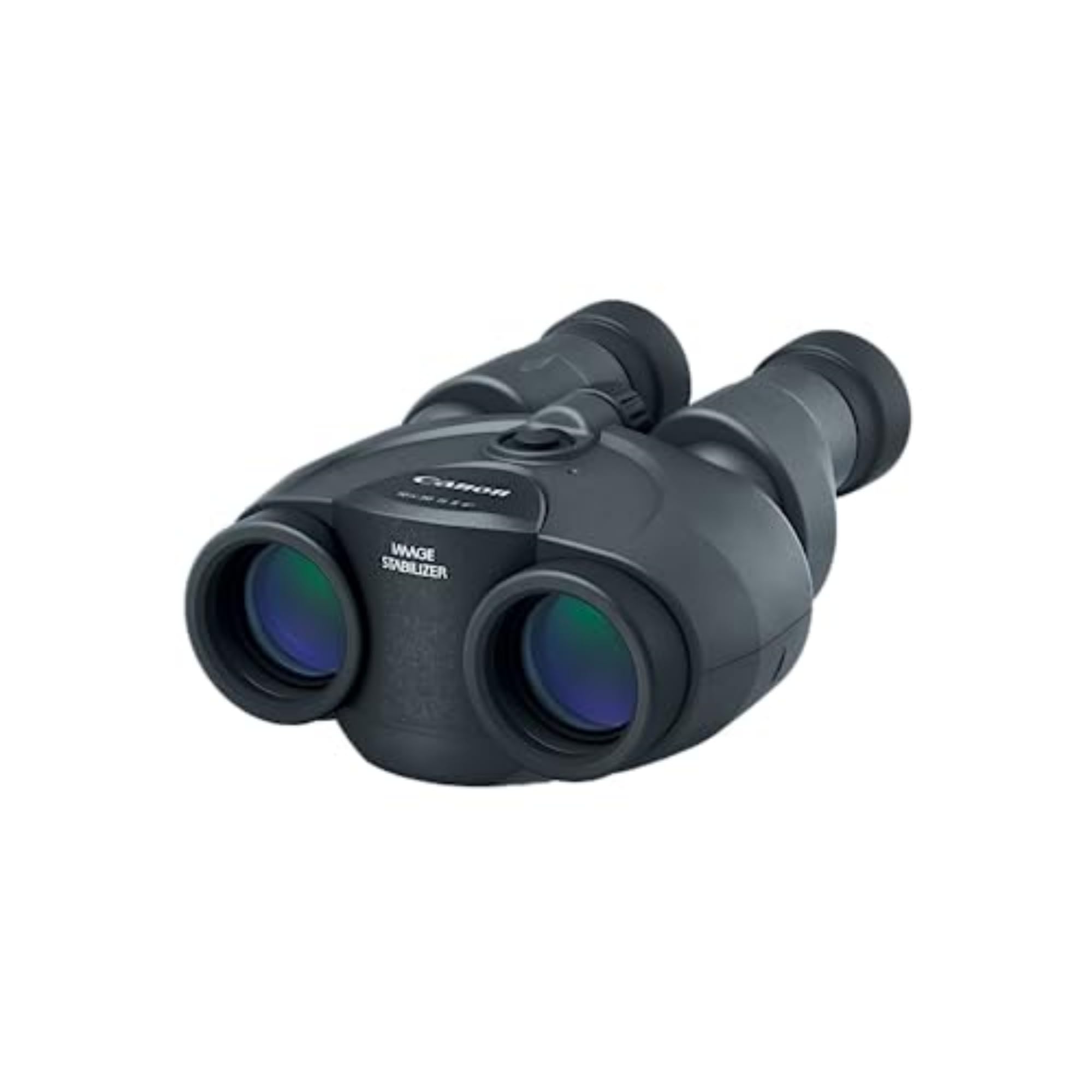
The Canon 10×30 IS II trades 2x magnification and a 6mm larger objective lens compared to the top pick’s 12×36 IS III, but it cuts weight by roughly 6 ounces and costs less while retaining the same image stabilization technology. This makes it a far more portable option for plane watching, though the 30mm objective gathers less light than the 50mm lenses on premium models.
Buyers report the image stabilization delivers a sharp, steady image that allows you to see details like rivets and registration text on planes that would be a blurry mess without it. The 10x magnification with a 10x30mm objective lens is spec’d for a bright, clear view in good to partly cloudy light, and the Super Spectra multicoated optics (a Canon coating that reduces glare and improves color) keep the image crisp. Reviewers also note it excels for astronomy, seeing stars 1 to 2 magnitudes dimmer than standard binoculars.
If you want the stabilization feature but need to keep the budget lower or the weight to a minimum for a long day of spotting, choose this over the 12×36 IS III.
Where it shines
- Excellent image stabilization in a lightweight, travel-friendly package
- Sharp, ghost-free optics with a wide 315-foot field of view
- Good for both day spotting and twilight stargazing
Worth noting
- No objective lens caps included, requiring aftermarket solutions
- At 10x it has less reach than the 12x models for reading distant text
3. Leupold BX-4 Pro Guide HD Binoculars, 12x50mm Gen 2

For the plane watcher who values raw optical clarity above all else, the Leupold BX-4 Pro Guide HD delivers a stunningly bright and sharp view thanks to its 12x50mm configuration. The 50mm objective lens lets in far more light than the 30mm or 36mm lenses on the Canon stabilized models, which translates to better visibility during overcast days, dusk spotting sessions, and keeping plane details crisp against a hazy sky. Owners mention using these to easily read text on aircraft 400-plus yards away.
You get a 65.2-degree apparent angle of view, which is 39% wider than the 47-degree view on a compact zoom like the Pentax UP, making it much easier to track a jet across the sky without constantly re-aiming. The HD glass and hydrophobic Guard-ion lens coating mean water and fingerprints slide right off, keeping your view clear even in damp weather on the observation deck. At 1.83 pounds, it is not a featherweight, but it is notably light for a 50mm glass.
The downside is that at 12x with no image stabilization, you will need solid bracing or a tripod for extended viewing — your own arm movements will shake the image at this magnification. While its open-bridge design and ergonomic grip make it comfortable to hold, a steady rest is essential to get the full benefit of its sharp optics. This is the choice for the spotter who sets up at a fixed location with a monopod or likes the pure clarity of premium glass over the convenience of electronics.
What stands out
- Exceptional 12x50mm HD glass delivers bright, sharp images in low light
- Hydrophobic Guard-ion coating resists water and fingerprints
- Wide 65.2-degree apparent angle of view for easy target acquisition
The trade-offs
- 12x magnification without stabilization requires a steady rest or tripod
- Premium pricing places it at the higher end of the field
4. Nikon Monarch M5 8×42 Binocular
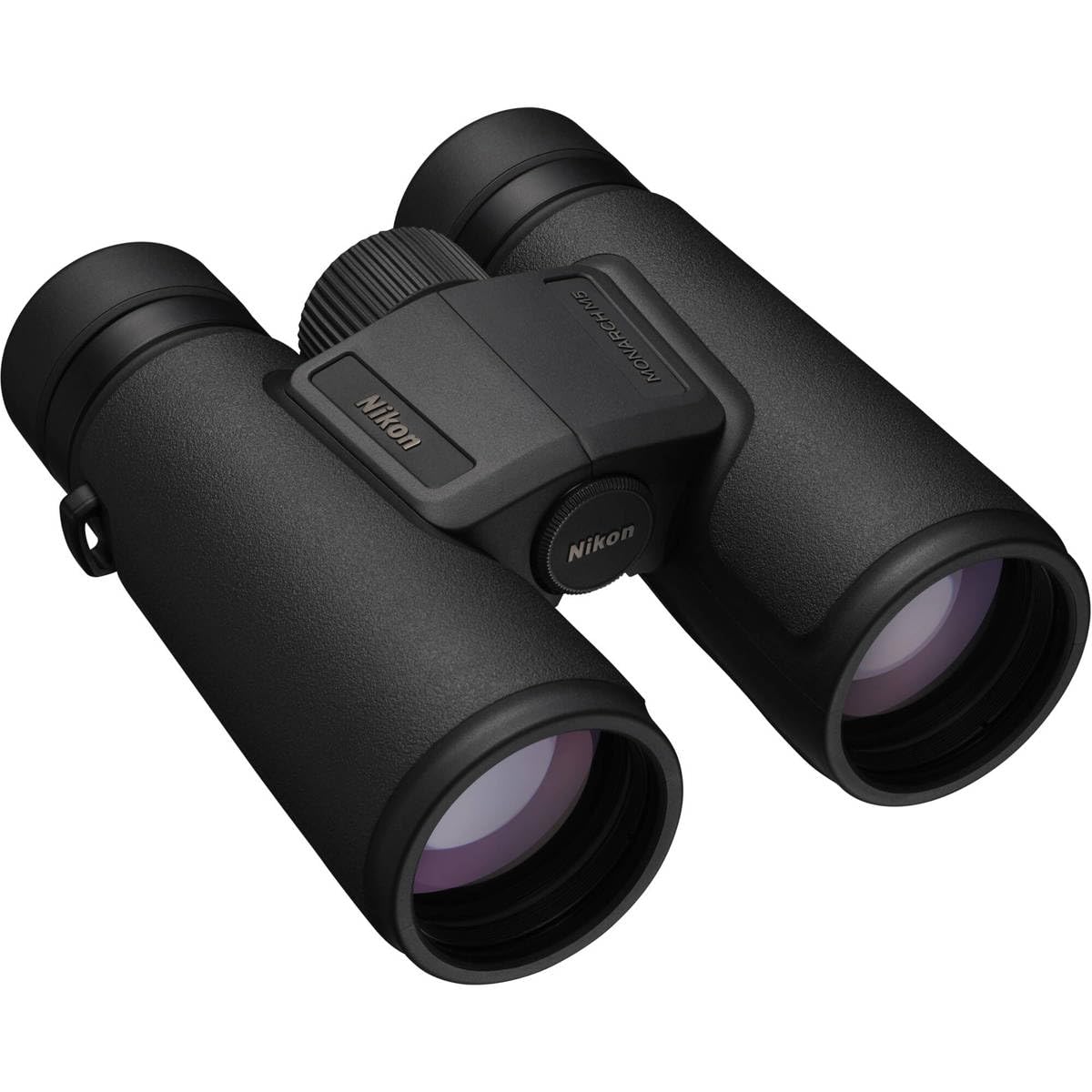
The single number that matters most in this category is the 8x magnification, which scores perfectly for a wide, steady view ideal for tracking planes on approach and landing, paired with a 42mm objective lens that handles low light better than budget zooms while keeping weight manageable.
The ED glass (Extra-low Dispersion glass that reduces color fringing) and dielectric high-reflective multilayer prism coatings (which reflect more light to the eye) keep the image bright and natural, even in the shade of a terminal building. It has a field of view of 335 feet at 1000 yards, which is broad enough to easily pick up a plane turning final without hunting for it. Buyers confirm it “worked great on a safari, from birdwatching to spotting rhinos from afar,” proving its versatility across different distances and lighting.
The trade-off is the 8x magnification, which gives you less detail on aircraft at altitude or at the far end of the airfield compared to a 10x or 12x model. If your primary goal is reading tail numbers at long range, you may want more magnification. For a one-pair-for-everything approach, the Monarch M5 delivers the best balance of clarity, brightness, and ease of use at its price point.
The upsides
- Excellent ED glass optics deliver sharp, true-to-color images
- Bright 5.3mm exit-pupil provides good performance in low light
- Waterproof and fogproof, ready for any weather
Keep in mind
- 8x magnification is lower than other picks for distant plane details
- Some users note a field of view that is narrower than ideal for moving targets
5. Vortex Razor HD Roof Prism Binoculars 12×50

What you actually get at this lower price is hand-selected prisms and premium high-density glass with state-of-the-art anti-reflective plasma coatings, all housed in a featherweight magnesium chassis. The 12x50mm configuration gives you an exit-pupil diameter of 4.17mm, matching the Leupold BX-4, but the Razor HD adds an Argon-purged waterproof and fogproof seal for lifetime reliability. One buyer called it a “dramatic upgrade” from the lower-tier Vortex Viper, noting it rarely needs a spotting scope for targets under half a mile. The field of view is 285 feet at 1000 yards.
The Vortex Razor HD 12×50 sits at the top of the premium glass pile, offering optical performance that many customers note rivals European brands like Swarovski at a significantly lower price point. With 12x magnification and a 50mm objective lens, it gathers maximum light for the brightest possible image during late evening spotting sessions when aircraft lights are just coming on, and the high-definition glass resolves exceptional detail.
Pricing is very premium, putting it at the highest end of this list. You are paying for the absolute best optical clarity possible without image stabilization, and for that, this is the field leader. If you are a dedicated spotter who sets up at a prime location and the budget allows, this is the binocular that shows you the most detail in the most challenging light conditions, making it perfect for the budget buyer who prioritizes top-tier optical performance over cost.
Why we’d pick it
- Exceptional HD glass and plasma coatings offer reference-level clarity
- Lightweight magnesium chassis for a 50mm binocular
- Unlimited, unconditional, lifetime transferable warranty
A few caveats
- Very high price point puts it in a premium tier
- 12x magnification without stabilization demands a steady rest
6. Sogries 10-30×50 Zoom Binoculars for Adults
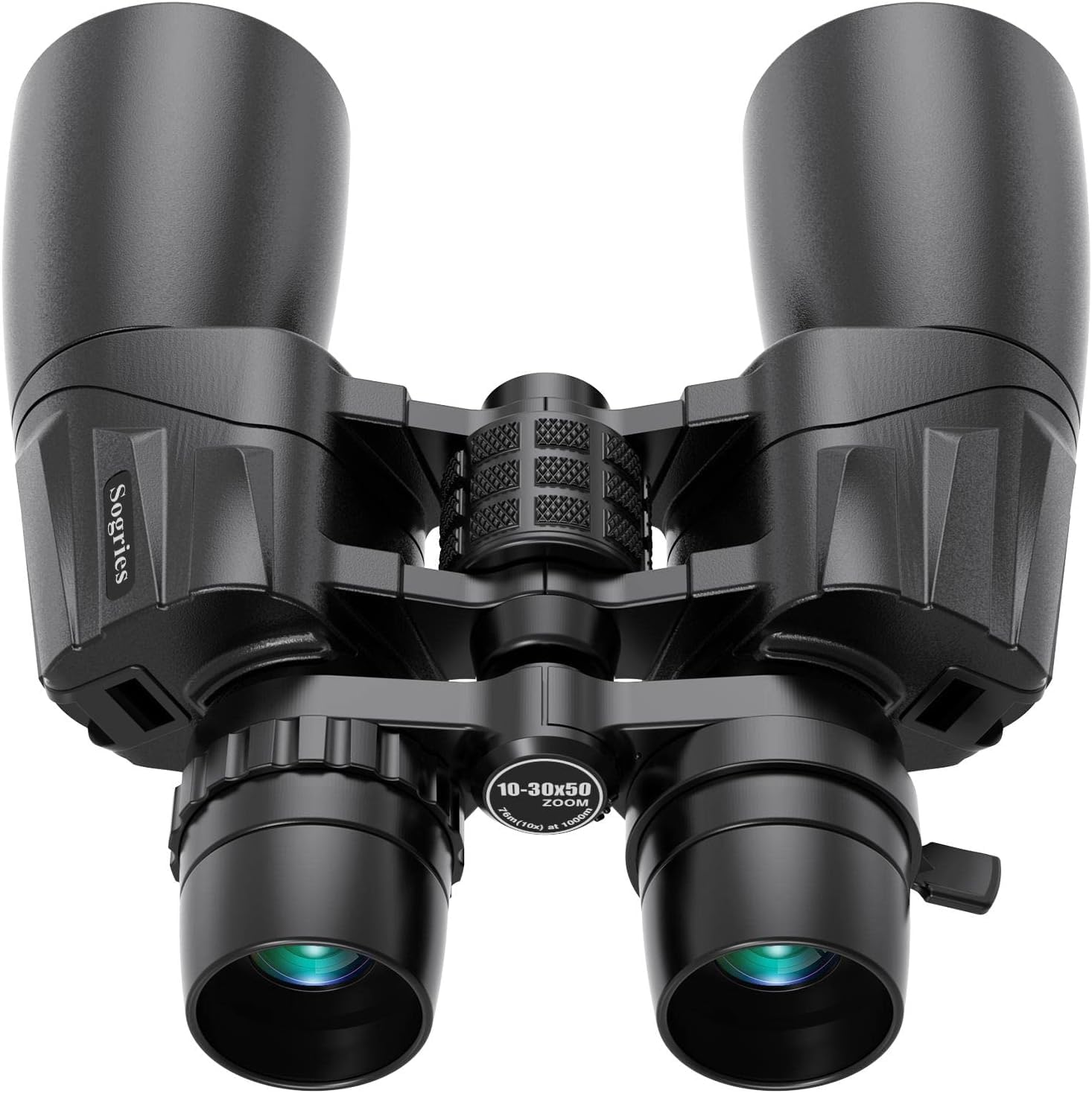
For the plane watcher who needs to zoom from a wide view of the approach path to a tight close-up of a tail fin without switching optics, the Sogries 10-30×50 Zoom Binoculars fill that niche. The variable 10-30x magnification means you can scan the sky at 10x, then zoom to 30x to read text on a parked aircraft. Buyers confirm that “zoom binoculars solve reading distant text in port areas,” which is exactly the use case for airport spotting.
The 50mm objective lens provides a large light-gathering aperture that keeps images bright at lower zoom levels, though the image will dim noticeably as you push the zoom toward 30x, which is a limitation of all variable-power optics. The rubber armor and waterproof seals mean it can handle a sudden rain shower on the observation deck.
The honest truth is that this binocular is heavy, and at full zoom, the image shake is significant — the manufacturer recommends using a tripod, and they are right. This is a versatile tool for a spotter who is willing to carry a small tripod. The standout spec here is the 30x maximum zoom, giving you a level of detail that no fixed-power binocular in this price range can match, but be aware that the weight and shake at high magnification mean it is not ideal for handheld use without support.
Strong points
- 10-30x variable zoom lets you go from wide scans to extreme close-ups
- 50mm objective lens provides good light gathering for a zoom
- 22mm eye relief is excellent for glasses wearers
Before you buy
- Heavy build and significant image shake at high zoom require a tripod
- Image dims at maximum 30x in all zoom binoculars
7. Pentax UP 8-16×21 Green Binoculars

The Pentax UP 8-16×21 is the most affordable and pocketable option in this lineup, offering a zoom range from 8x to 16x in a body small enough to slide into a jacket pocket. For a budget-conscious spotter who wants the flexibility of a zoom without a heavy commitment, this pairs low cost with surprising optical quality. Buyers describe it as a “compact inverse porro prism design; bright, clear image even at max zoom; minimal blackout, sufficient eye relief for glasses.”
The fully-multi-coated optics (coatings on every glass surface to maximize light transmission) and aspherical lens elements (curved lenses that reduce distortions at the edge of the view) provide a sharper image than you would expect from a zoom binocular at this price point. The 21mm objective lens, however, is a major limitation: it gathers far less light than the 50mm lenses on the premium picks, which means the view gets dim in overcast conditions or as you zoom in past 12x.
The definitive reason to choose this binocular is its portability. If you want to carry binoculars in a jacket or small bag on the chance you see something interesting at the airport, and you do not want to deal with the weight or cost of a full-size model, this is the one. Its low light performance is one limitation you accept for the compact size and budget-friendly price.
What we like
- Very compact and lightweight; fits in a jacket pocket
- 8-16x zoom range adds spotting versatility
- Fully-multi-coated optics and aspherical lenses provide good image quality for the class
The downsides
- 21mm objective lens limits low-light and high-zoom performance
- Not waterproof, so caution is needed in wet weather
Understanding the Specs
Magnification and Objective Lens
The first number (like 8x or 12x) tells you how much closer an object will appear — so a plane at 1,000 feet looks like it is 83 feet away with a 12x binocular. The second number (like 42 or 50) is the diameter of the objective lens in millimeters, which determines how much light enters the binocular. A larger objective lens makes the image brighter, especially in low light, but also makes the binocular heavier and larger.
Image Stabilization (IS)
This is a system of gyroscopic sensors and a moving prism that cancels out the small shakes from your hands. For plane watching at 10x magnification or higher, IS is the difference between a usable handheld view and a shaky mess. Models with IS will cost more and require batteries, but they let you hold 12x steady enough to read text on a moving aircraft without a tripod.
Field of View (FOV)
Measured in feet at 1,000 yards (or in degrees), this tells you how wide an area you can see at a given distance. A wider FOV, such as 335 feet on the Nikon Monarch M5, makes it easier to find a plane in the sky and track it as it moves. A narrow FOV, like 285 feet on the Vortex Razor HD, means you will need to pan the binocular more to follow a fast-moving jet.
Eye Relief
This is the distance in millimeters from the eyepiece lens to where your eye needs to be to see the full image. For glasses wearers, a longer eye relief (over about 15mm) is crucial because it allows you to keep your glasses on while still seeing the full field of view without black edges. The Sogries zoom binocular, for example, offers 22mm of eye relief, making it the most glasses-friendly pick on the list.
FAQ
Is 8x or 10x magnification better for plane spotting?
Do I need image stabilization for plane watching?
What is the best objective lens size for plane watching?
Can I use zoom binoculars for plane watching?
What does field of view mean for watching planes?
Final Thoughts: The Verdict
For most buyers, the binoculars for plane watching winner is the Canon 12×36 IS III because its image stabilization makes high-powered handheld viewing practical for reading tail numbers and tracking aircraft. If you want a more portable and budget-friendly stabilized option, grab the Canon 10×30 IS II. And for maximum optical clarity at a fixed spot, the Leupold BX-4 Pro Guide HD 12×50 delivers the brightest, sharpest image of any non-stabilized pick in this guide.