
Our readers keep the lights on and the weekend projects moving. As an Amazon Associate, I earn from qualifying purchases.
The right binocular for sightseeing turns a distant landmark into a tangible memory. A blurry or heavy optic can ruin a sunset hilltop view or a ferry ride past the skyline. Your choice comes down to weight, light-gathering ability, and weather sealing—each spec dictates whether the binoculars stay in your bag or stay glued to your eyes.
I’m Rikta — the co-founder and writer behind FitlyFast.
Whether you are scanning a distant cathedral dome or watching wildlife from a tour bus, matching the magnification and lens size to your specific outing makes all the difference. This guide breaks down the seven top contenders for the best binoculars for sightseeing based on clarity, portability, and weather toughness.
How To Choose The Best Binoculars For Sightseeing
Sightseeing binoculars live and die by three interdependent specs: magnification, objective lens diameter, and field of view. A 10×42 model gathers more light than a 10×25, but the added weight can fatigue your neck on a day-long walking tour. Understanding how these numbers translate to real-world use prevents a costly mismatch.
Magnification vs. Steadiness
An 8x magnification offers a wider, steadier image that is far more forgiving of hand movement—essential when you are standing on a moving train platform or a windy lookout. A 10x brings distant facades closer but amplifies every shake. For general sightseeing, 8x or 10x is the practical sweet spot. Higher zoom ranges often introduce a narrower field and dimmer image unless paired with a tripod.
Lens Size and Low-Light Capability
A 42mm objective lens collects more light than a 25mm lens, delivering a brighter image at dusk or under a canopy of trees. The trade-off is bulk: 42mm binoculars are heavier and less pocket-friendly. For urban sightseeing or daylight hikes, a 25mm or 32mm design packs lighter without sacrificing clarity. For early-morning wildlife viewing or sunset cityscapes, the larger lens pulls ahead.
Weather Sealing for Travel
An IPX7 waterproof rating means the binoculars can survive a drop in a stream or a sudden downpour without fogging internally. Nitrogen purging prevents lens fog during temperature shifts—common when moving from an air-conditioned bus into humid air. Travel-centric models also benefit from rubber armor that absorbs knocks without adding significant weight.
Quick Comparison
On smaller screens, swipe sideways to see the full table.
| Model | Category | Best For | Key Spec | Amazon |
|---|---|---|---|---|
| Nikon 10×42 PROSTAFF P7 | Premium Roof Prism | All-day nature and city viewing | 62.9° apparent field of view | Amazon |
| ZEISS Terra ED 10×42 | Premium ED Glass | Best optical clarity under | 88% light transmission | Amazon |
| Bushnell H2O Xtreme 10×42 | Waterproof Mid-Range | Boat trips and rainy excursions | IPX7 waterproof, BaK-4 prism | Amazon |
| Nikon TRAVELITE EX 8×25 | Compact Travel | Ultra-light everyday carry | 11.1mm eye relief | Amazon |
| Nocs Provisions Standard Issue 10×25 | Stylish Compact | Hiking and minimalist travel | 315ft FOV at 1000yds | Amazon |
| Tanaview 10×50 Compact | Budget Large Objective | Budget-conscious night/low-light use | 50mm objective, FMC coating | Amazon |
| Evil Eye 10-30×50 Zoom | Budget Zoom | General long-range scanning | Zoom 10-30x, BAK7 prism | Amazon |
In‑Depth Reviews
1. Nikon 10×42 PROSTAFF P7

The PROSTAFF P7 is Nikon’s flagship mid-range roof prism, balancing a wide apparent field of view (62.9°) with a lightweight fiberglass-reinforced body. The 42mm objective gathers generous light for twilight cityscapes, while the dielectric high-reflective prism coating pushes color vibrancy far beyond typical sub- glass. Rubber armoring provides a secure grip even in damp conditions, and the locking diopter ring prevents accidental drift during active use.
This binocular shines in all-day sightseeing where you transition from bright sun to shadowed architectural details. The 15.7mm eye relief accommodates eyeglass wearers, and the turn-and-slide eyecups lock into place without wobble. The oil- and water-repellent lens coating sheds raindrops and greasy fingerprints, making field cleaning simple.
Birders on review boards consistently mention that the P7’s clarity rivals older Nikon Monarch models at a lower weight, and users report excellent performance on safari and long hikes. The only trade-off is a slightly narrower close-focus distance compared to dedicated birding binoculars, but for general sightseeing, this is a non-issue.
Why it’s great
- Wide apparent field of view for tracking moving subjects.
- Dielectric prism coating delivers bright, true-to-life colors.
- Locking diopter ring holds setting securely.
Good to know
- Heavier than compact 25mm alternatives for ultralight packs.
- Close-focus distance is not as short as dedicated birding bins.
2. ZEISS Terra ED 10×42

The Terra ED sits at the entry point of ZEISS’s optical legacy, offering 88% light transmission through extra-low dispersion (ED) glass that virtually eliminates chromatic aberration. The Schmidt-Pechan prism design with hydrophobic multi-coating maintains sharpness in wet weather, and the fiberglass-reinforced polycarbonate housing keeps the weight manageable at around 24 ounces.
This model is built for sightseers who notice color fringing on cheaper glass. The ED element renders leaf edges and distant building lines with no purple or green halo. The large center focus wheel is quick to operate, and the 18mm eye relief gives eyeglass wearers a full, unvignetted view. Reviewers frequently describe the Terra as a “budget Zeiss” that outperforms many competitors in its tier.
Field reports highlight the Terra’s sturdiness after drops on rocky trails and its ability to remain fog-free during temperature swings. The included neoprene strap and hard case offer premium carry protection. The main consideration is the price premium, which is justified for users who prioritize absolute optical fidelity over extreme portability.
Why it’s great
- ED glass delivers near-zero chromatic aberration.
- Hydrophobic coating sheds rain and mist easily.
- Robust fiberglass housing with excellent drop protection.
Good to know
- Premium price point limits accessibility.
- Not the lightest option for multi-day backpacking.
3. Bushnell H2O Xtreme 10×42

Bushnell’s H2O Xtreme line is built around a simple promise: total weather resistance. The O-ring sealed chassis and nitrogen purging make this binocular fully IPX7 rated—submersible to one meter for 30 minutes. The fully multi-coated optics and BaK-4 prisms produce a bright, sharp image that holds up in fog, drizzle, and direct spray from boat wakes.
For sightseeing by water—ferry tours, coastal walks, or rainy city days—this model excels where lesser binoculars would fog. The rubber armor provides a nonslip grip even with wet hands, and the twist-up eyecups lock into two positions for eyeglass users. Reviewers note the brightness is a clear step up from older 7×35 models, and the compact roof-prism form factor travels easily.
A common observation among users is that while the optics are excellent after decades of production, the neck strap padding is minimal and the binocular lacks a tripod adapter socket. If you plan to use a monopod or window mount for steady viewing, this omission matters. For handheld day use on the water, it remains a rugged, reliable companion.
Why it’s great
- True IPX7 waterproofing for boat and rain use.
- Bright, clear image with BaK-4 prisms.
- Non-slip rubber grip in wet conditions.
Good to know
- Neck strap pad is basic and could be more comfortable.
- No tripod adapter socket on this model.
4. Nikon TRAVELITE EX 8×25

Nikon’s TRAVELITE EX is built for pure portability. The 8×25 configuration gives you a wide, stable field of view in a package that slips into a jacket pocket or daypack side pouch. The die-cast aluminum body is wrapped in protective rubber, and nitrogen purging with O-ring seals makes it fully waterproof to two meters—rare in this form factor.
The 8x magnification is a strategic choice for sightseeing: it offers a broader, more forgiving image than a 10x, reducing the shakiness that plagues higher-powered compacts. The multilayer-coated optics and aspherical eyepiece lenses minimize distortion at the edges, which matters when scanning panoramic vistas. Eye relief is a comfortable 11.1mm, adequate for most eyeglass wearers.
Reviewers consistently praise the TRAVELITE EX for its sharpness and ruggedness despite its tiny size. The 8×25 configuration is also available in a 10×25 option for those who want a little more reach, though the wider field of the 8x is generally preferred for sightseeing. The only notable downside is that the small objective lens limits low-light performance—dawn and dusk viewing requires a steady hand.
Why it’s great
- Extremely lightweight and pocketable.
- Waterproof and fogproof despite compact size.
- Wide, steady field of view for moving subjects.
Good to know
- Small 25mm objective limits low-light brightness.
- 8x magnification may not suit those wanting maximum reach.
5. Nocs Provisions Standard Issue 10×25

Nocs Provisions rethinks the visual identity of binoculars without sacrificing core specs. The Standard Issue 10×25 weighs only 11.85 ounces and uses fully multi-coated optics with a Swiss-designed Bak4 prism for sharp, bright images. The patented Rugged Wave Grip provides a secure hold in the palm, and the IPX7 waterproof rating guarantees survival through accidental submersion.
This model targets the style-conscious traveler who wants binoculars that match their outdoor aesthetic without feeling like a clunky tool. The multi-stop twist-up eyecup offers three positions, making it easy to find a comfortable eye relief for both glasses wearers and bare eyes. The field of view is a respectable 315 feet at 1,000 yards, adequate for urban sightseeing and trail viewing.
Reviewers note that the Nocs is a great supplement to a larger pair: it is so small and light that you will actually bring it along. The included soft case is minimal, and the strap attachment slots are tight, requiring careful installation. The “No-Matter-What” lifetime warranty adds peace of mind. The 10×25 configuration is best for well-lit scenes—low-light performance is limited by the small objective lens.
Why it’s great
- Extremely lightweight and pocketable.
- IPX7 waterproof with nitrogen purging.
- Unique modern design and lifetime warranty.
Good to know
- Small objective dims in low light.
- Strap slots can be very difficult to install.
6. Tanaview 10×50 Compact
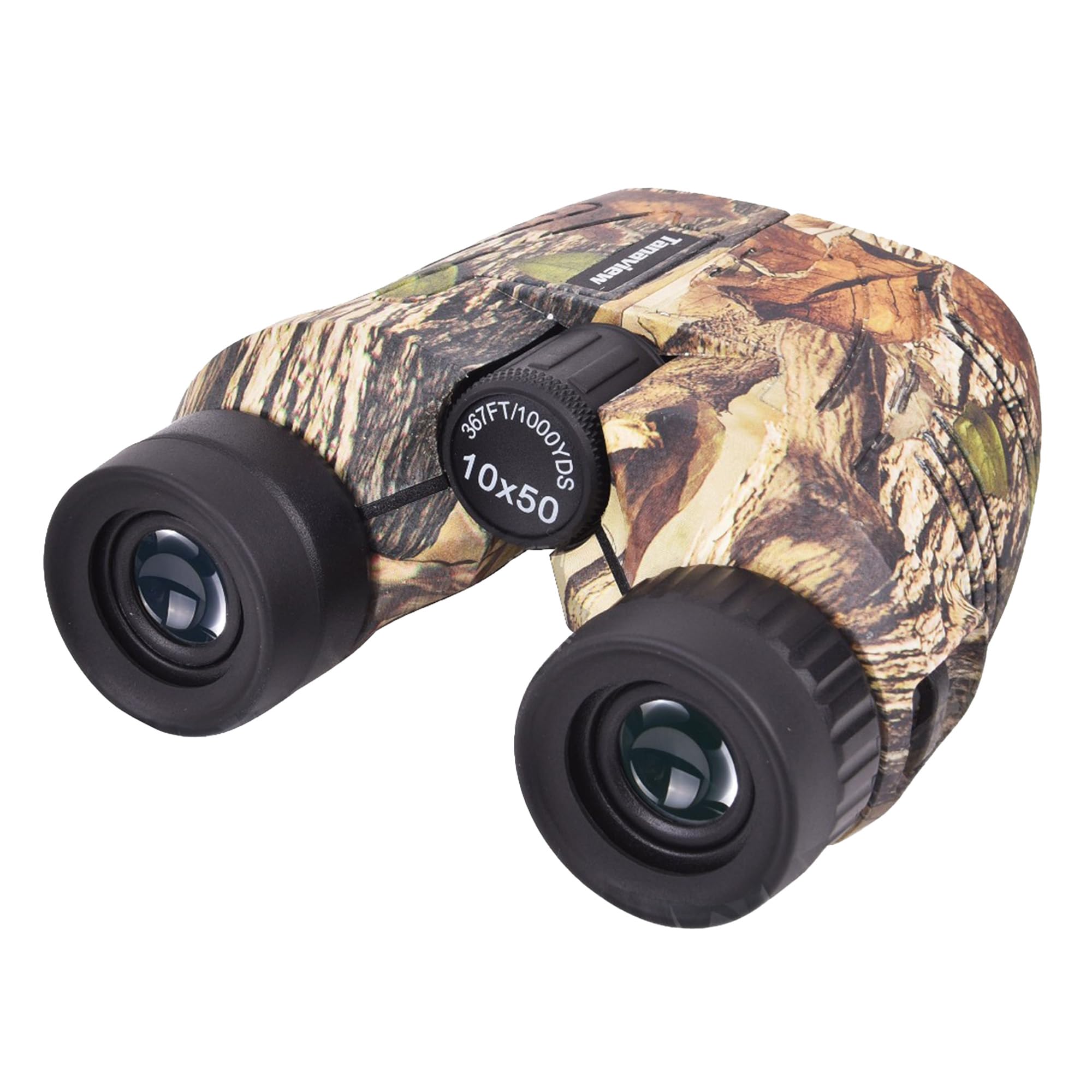
The Tanaview 10×50 proves that a large objective lens does not have to cost a fortune. With a 50mm front element and fully multi-coated (FMC) optics, this binocular captures significantly more light than compact 25mm models, making it a strong choice for low-light sightseeing, such as evening city walks or forest edges at dusk. The BaK4 prism texture ensures minimal light loss within the optical path.
The rubber armor provides shock resistance and a steady grip, and the 18mm eye relief accommodates eyeglass wearers. The binocular is water and fog proof, adding a layer of weather resilience typical of higher-end models. The dioptric adjustment ring fine-tunes for individual vision differences, and the large eyepiece simplifies target acquisition.
User reviews highlight the surprising clarity for the money, with many using it successfully for birding, cruising, and wildlife observation. The main compromise is in build feel—the plastic and glass construction lacks the solid heft of premium metal-bodied models, and the strap is basic. Some users also noted fogging in extreme morning humidity, so keep the lens cloth handy.
Why it’s great
- Large 50mm objective for excellent low-light performance.
- Affordable entry point with FMC coatings.
- Water and fog proof with comfortable eye relief.
Good to know
- Build materials feel less premium than mid-range options.
- Can fog in extreme morning humidity on some units.
7. Evil Eye 10-30×50 Zoom

The Evil Eye 10-30×50 zoom binocular offers versatility that fixed-magnification models cannot match. At 10x, you get a wide, stable view for general scanning; rotating the zoom ring to 30x brings distant details—like a mountain summit or a ship’s name—intimately close. The 50mm objective with FMC glass and BAK7 prism delivers decent brightness for a zoom design, and the anti-fog coating is rated for snow and rain.
The package includes a silicone protective cover, harness strap, and lens cleaning cloth, making it a complete kit for the price. The center focus knob is large and easy to operate with gloves, and the rubber armor offers a nonslip grip. The binocular mounts to any standard tripod via the included anti-shake interface, which is essential for steady viewing at higher zoom settings.
Customer feedback is generally positive, with users praising the clarity and zoom range for the price. However, the 1.76-pound weight is noticeable for extended carry, and the lens covers are reported to be loose and prone to falling off. At 30x, handshake becomes severe without a tripod, and the image dims compared to fixed-power binoculars. It works best as a budget-friendly spotting tool for stationary use.
Why it’s great
- Variable magnification from 10x to 30x for flexible viewing.
- Anti-fog coating works well in cold, damp conditions.
- Complete kit with harness, covers, and tripod adapter.
Good to know
- Heavy for long neck carry or hiking.
- Zoom image dims and shakes without a tripod.
- Lens covers are loose and easy to lose.
FAQ
Is 10x magnification too shaky for sightseeing without a tripod?
Should I get a 25mm or 42mm objective lens for day trips?
What does IPX7 waterproof rating mean for binoculars?
Final Thoughts: The Verdict
For most users, the binoculars for sightseeing winner is the Nikon 10×42 PROSTAFF P7 because it combines a wide apparent field of view with bright, accurate color reproduction and a rugged, weather-sealed build. If you want the absolute best optical clarity for critical viewing, grab the ZEISS Terra ED 10×42. And for a lightweight, pocket-friendly companion for city and trail use, nothing beats the Nikon TRAVELITE EX 8×25.