
Our readers keep the lights on and the weekend projects moving. As an Amazon Associate, I earn from qualifying purchases.
Specs are compiled from manufacturer listings and verified buyer reviews and can change over time — please confirm the key details on the product page before buying.
You want a crisp, bright view at dawn or dusk without blowing your budget. The real challenge with binoculars under $1000 is not the price — it is knowing which specs actually deliver a sharper image and which ones are just numbers on a box. You need to cut through the marketing to find a pair that works for your specific use, whether that is birding, hunting, or stargazing.
I’m Rikta — the founder and writer behind FitlyFast. This guide is built by comparing the manufacturers’ published specifications and the patterns across verified customer reviews, so you get each pick’s real strengths and trade-offs instead of marketing spin.
These six models range from compact travel companions to powerful astronomy tools. The right choice depends on how you plan to use them, so here is your practical guide to the best binoculars under $1000.
Quick Picks
- Nikon Monarch M5 8×42 Binocular — Best Overall
- Vortex Copperhead HD 10×42 Binoculars — Smart Value
- Bushnell H2O Xtreme 10×42 Compact Waterproof Binoculars — Rugged All-Rounder
- GLLYSION 15×54 Binoculars with Harness, Phone Adapter & Bluetooth Remote — Kit Champion
- Sogries 18×70 High Power Binoculars for Adults — Long-Range Powerhouse
- Nikon TRAVELITE EX 8×25 Binoculars — Ultra-Compact
How To Choose The Best Binoculars Under $1000
Three numbers decide how a binocular actually performs: magnification (how close things look), objective lens diameter (how much light gets in), and field of view (how wide a slice of the world you see). Get those three right for your use case, and everything else — coatings, prism type, eye relief — fine-tunes the result.
Magnification vs. Steadiness
More magnification sounds better, but anything above 10x or 12x magnifies every hand tremor and pulse wiggle, making the image jumpy. For handheld use, 8x or 10x is the balance. 15x and 18x models require a tripod for steady viewing, which one reviewer of the 18×70 confirmed plainly: “18×70 binoculars require tripod for steady viewing due to high magnification.”
Lens Coatings Are Not All Equal
“Fully multi-coated” means every air-to-glass surface has multiple anti-reflective layers, boosting light transmission and cutting glare. Cheaper “coated” optics only treat the outer surfaces, so you lose brightness and contrast. For low-light use (dawn, dusk, deep woods), fully multi-coated is the real minimum worth paying for.
Prism Quality: BAK4 Over BK7
BAK4 glass prisms produce a round, bright exit pupil with sharp edges. BK7 prisms give a clipped, square-ish exit pupil that wastes light. If you see “BAK4” in the specs, you are getting the better light path and brighter image — especially important in the twilight hours when every photon counts.
Quick Comparison
| Model | Best For | Magnification | Objective Lens | Field of View | Amazon |
|---|---|---|---|---|---|
| Nikon Monarch M5 8×42 | Premium all-around clarity | 8x | 42 mm | 335 ft | Amazon |
| Vortex Copperhead HD 10×42 | Best value mid-range | 10x | 42 mm | 334 ft | Amazon |
| Bushnell H2O Xtreme 10×42 | Waterproof durability | 10x | 42 mm | — | Amazon |
| GLLYSION 15×54 | All-in-one kit with phone adapter | 15x | 54 mm | 268 ft | Amazon |
| Sogries 18×70 | Stargazing & long-range | 18x | 70 mm | — | Amazon |
| Nikon TRAVELITE EX 8×25 | Compact travel companion | 8x | 25 mm | — | Amazon |
In‑Depth Reviews
1. Nikon Monarch M5 8×42 Binocular
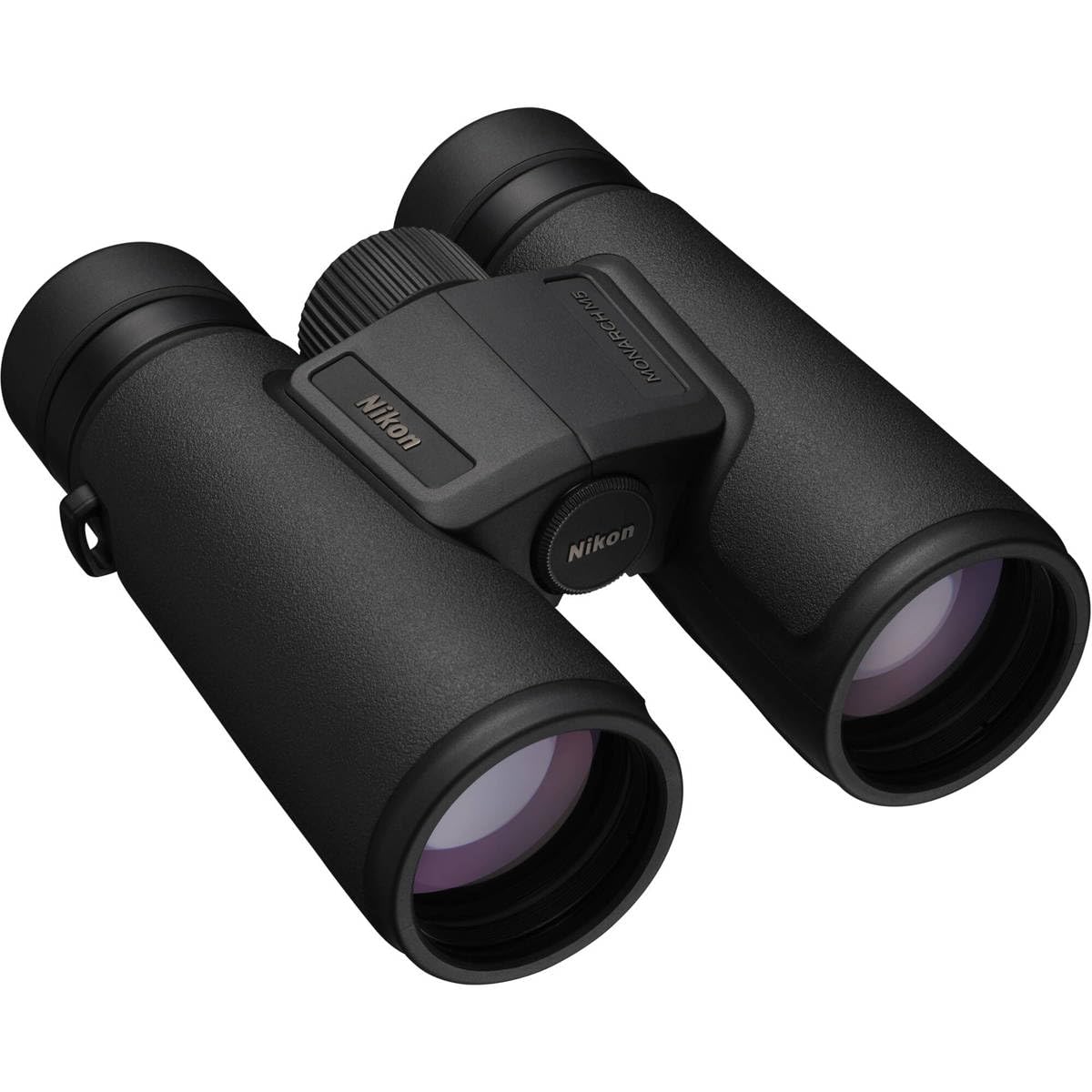
ED glass cuts the colored fringing that ruins a view, so you see true-to-life colors even in tricky light.
The Nikon Monarch M5 8×42 earns the top spot because its Extra-low Dispersion (ED) glass lenses cut chromatic aberration (the colored fringing along edges) so you see true-to-life colors even in tricky light. Dielectric high-reflective multilayer prism coatings push more light to your eyes — handy when you are glassing a shadowy creek bed at dawn or picking out a perched raptor against a bright sky. The 335-foot field of view at 1000 yards lets you track moving birds without constantly re-scanning, and the close-focus capability down to 8.2 feet reveals detail on butterflies or flowers that most full-size binos miss.
Buyers report using these on safari with great results — one reviewer noted they worked well for everything from birdwatching to spotting rhinos from a distance. Another who normally uses high-end Swarovski models picked these up as a lighter-weight option for longer hikes. The 19.5 millimeters of eye relief gives eyeglass wearers a full, unobstructed view, and the twist-up click-stop eyecups lock in your preferred position. The main trade-off, mentioned by several owners, is the narrower field of view than pricier models like the Nikon Monarch HG. But for this price bracket, the edge-to-edge sharpness is tough to top. Skip the Monarch M5 if you need an ultra-compact binocular for daily carry or a high-magnification model for dedicated long-range spotting.
Why it stands out
- ED glass eliminates chromatic aberration for true color
- Dielectric coatings boost low-light brightness
- Waterproof and fogproof nitrogen-purged body
- Close-focus at 8.2 ft captures fine detail
The real limits
- Not as compact as travel-specific models
- Narrower field of view than some high-end competitors
Reach for this if: You want the best optical quality under $1000 for birdwatching, wildlife, and general outdoor use — the ED glass and dielectric coatings deliver clarity that punches well above the price.
Consider something else if: You need an ultra-compact binocular for daily carry or a high-magnification model for dedicated long-range spotting.
2. Vortex Copperhead HD 10×42 Binoculars

HD glass at a mid-range price, with a lifetime warranty that makes it a buy-once investment.
The Vortex Copperhead HD 10×42 costs less than the Nikon Monarch M5, yet its HD optical system delivers color fidelity and edge-to-edge sharpness that one reviewer compared directly to the pricier Diamondback HD 12×50. Fully multi-coated lenses (anti-reflective coatings on every air-to-glass surface) boost light transmission, so you get a bright image even when the sun ducks behind a ridge. The 334-foot field of view is close to the Nikon Monarch M5’s 335 feet, so you are not giving up much panorama width at this lower price.
Owners mention using these for a full hunting season in everything from rain to snow with “no issues,” which speaks to the waterproof and fogproof build. The rubber armor gives a secure, non-slip grip even in wet conditions, and the included GlassPak binocular harness takes the weight off your neck and distributes it across your shoulders — a real plus for long days in the field. The 17 millimeters of eye relief means eyeglass wearers see the full image without shadows. The catch: some owners noted less crisp edges and lower-light performance than pricier models. But with the unlimited, unconditional, fully transferable VIP Warranty — Vortex will repair or replace them if they break — this is a set you buy once and use for years. Look elsewhere if your primary use is astronomy or low-light coastal observation where every extra minute of visibility matters.
The case for buying
- HD glass rivals more expensive Diamondback series
- Unlimited, transferable VIP lifetime warranty
- Includes GlassPak harness and tethered lens covers
- Waterproof, fogproof, shockproof
A few trade-offs
- Slightly softer edge sharpness than premium models
- Low-light performance falls short of top-tier optics
Ideal for: Hunters and outdoor enthusiasts who want good glass with a literal lifetime safety net — the warranty alone makes this a low-risk, high-value pick.
Look elsewhere if: Your primary use is astronomy or low-light coastal observation where every extra minute of visibility matters.
3. Bushnell H2O Xtreme 10×42 Compact Waterproof Binoculars

IPX7 waterproofing means it survives a dunk, so you never worry about rain or splashes.
Bushnell has been making optics for over 70 years, and the H2O Xtreme line answers the needs of the marine and watersports crowd. The O-ring sealed optical system is rated IPX7 (protected against immersion in up to 1 meter of water for 30 minutes), meaning these can survive accidental submersion in standing water — a real peace-of-mind feature when you are fishing, boating, or caught in a downpour. Nitrogen purging keeps the internal lenses from fogging up, so you are not wiping condensation mid-view. The 10×42 configuration (10x magnification, 42mm objective lenses) hits the same balance as the Vortex Copperhead, but with a rugged rubber armor that stays grippy when wet.
Customers note that upgrading from older 8×23 or 7×35 models to this 10×42 is a major leap in brightness and clarity — “much brighter and clearer” is a common refrain. The BaK-4 prisms and fully multi-coated glass surfaces deliver clean, bright images across most lighting conditions. At 17 millimeters of eye relief, the Bushnell matches the Vortex for eyeglass comfort. The notable catch: this specific model has no tripod adapter socket, so if you plan to mount these for extended scanning, you will need a different model. Some users also mention the neck strap is less comfortable than the rest of the build, but swapping it out is a minor fix. Not for you if you need tripod-mounting capability for long-range or astronomy viewing.
Where it shines
- IPX7 waterproof rating for accidental submersion
- Nitrogen-purged and completely fogproof
- BaK-4 prisms & fully multi-coated lenses
- Trusted brand with decades of outdoor optics
Where it falls short
- No tripod adapter socket on this model
- Neck strap comfort is a common complaint
Best suited to: Boaters, kayakers, and anglers who need a binocular that can take a splash or a dunk without worry — the IPX7 rating is the real differentiator here.
Not for you if: You need tripod-mounting capability for long-range or astronomy viewing.
4. GLLYSION 15×54 Binoculars with Harness, Phone Adapter & Bluetooth Remote
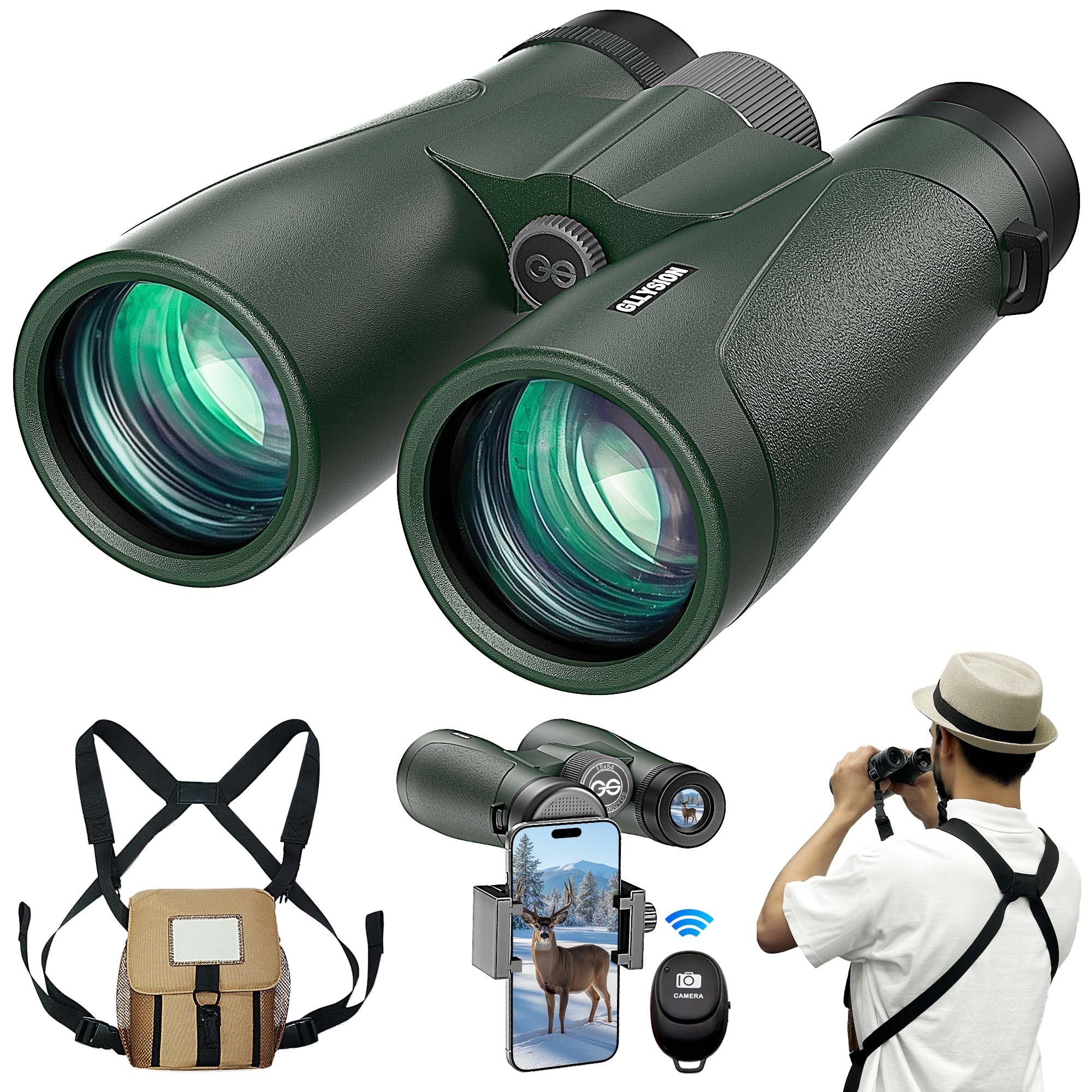
A phone adapter and Bluetooth remote turn this into a digiscoping kit straight from the start.
The GLLYSION 15×54 configuration (15x magnification, 54mm objective lenses) occupies a middle ground between handheld 10x binos and massive astronomy models. The 15x magnification is enough to pull in distant coastal details and deer at the edge of a field. The 15-millimeter eye relief and 4-millimeter exit pupil strike a slightly tighter fit for eyeglass wearers compared to the 17-millimeter eye relief on the Bushnell and Vortex. The BAK4 dielectric-coated prisms and fully multi-coated anti-reflective optics help keep the image bright even as magnification climbs.
What sets this bundle apart from the Nikon Monarch M5 is the included smartphone adapter and Bluetooth camera remote — a combination that one reviewer praised as “excellent for coastal bird watching,” noting that the phone attachment captures clear photos without needing expensive separate lenses. The chest harness (with an X-shaped strap design that spreads weight across your back) and high-capacity carrying case are genuinely useful additions that save you from buying accessories separately. The trade-off is that at 15x, you will want to brace against a solid surface or use a tripod for steady viewing — handheld shakes get magnified along with the image. A few buyers reported missing pieces or minor build issues, so it is worth checking the package contents when it arrives. Skip this if you prefer a compact, grab-and-go binocular and do not plan on using the phone adapter or harness regularly.
The big draws
- Phone adapter + Bluetooth remote for digiscoping
- X-shaped chest harness distributes weight evenly
- BAK4 dielectric-coated prisms for bright images
- Waterproof and fogproof build
What to watch for
- 15x magnification demands steady support
- Some units arrive with minor accessory defects
Perfect for: Birders and travelers who want to share what they see — the phone adapter and remote make this the easiest way to capture digiscoped shots without extra gear.
skip it if: You prefer a compact, grab-and-go binocular and do not plan on using the phone adapter or harness regularly.
5. Sogries 18×70 High Power Binoculars for Adults

70mm objective lenses gather far more light than 42mm binos, so moon craters and star clusters pop into view.
With a massive 70mm objective lens versus the 42mm lenses on the Vortex Copperhead and Bushnell H2O, the Sogries 18×70 is engineered for one job: gathering as much light as possible. The 70mm objective is larger than a 42mm objective, which helps for stargazing and coastal observation in twilight conditions. The aircraft-grade aluminum chassis and BAK4 Porro prisms give it a solid, premium feel, though at roughly 2.75 to 3 pounds, one buyer mentioned it is “best on tripod but usable handheld briefly.”
Reviewers point out excellent clarity and color fidelity, with one owner calling them “phenomenal” for the price and comparing them favorably to models costing five times more. The 18-millimeter eye relief is generous for eyeglass wearers, and the twist-up eyecups adjust in click stops. The tripod adapter hole is hidden under a cap on the front — find that, and you can mount these for steady, shake-free viewing. The real-world magnification measures closer to 15x or 17x according to some users, not the advertised 18x, and the close focus is around 40 feet, so you cannot focus on anything nearby. These are dedicated long-range instruments, not all-around field glasses. Skip in favor of the smaller Nikon Monarch M5 if you want a handheld binocular for hiking, birding, or general carry.
Why it wins for astronomy
- 70mm objectives gather far more light than 42mm binos
- BAK4 Porro prisms for sharp 3D depth perception
- Aircraft-grade aluminum chassis is rugged
- Long eye relief (18mm) for eyeglass wearers
The practical limits
- Requires a tripod for steady viewing at 18x
- Heavy (≈2.75 lbs); too large for hiking or travel
- Close focus of ~40 ft — useless for nearby subjects
- Included strap is low quality per reviewer feedback
Take these home for: Dedicated stargazing, coastal ship tracking, and long-range observation where a tripod is part of the setup — the 70mm aperture is a genuine low-light advantage.
Skip in favor of a smaller model if: You want a handheld binocular for hiking, birding, or general carry.
6. Nikon TRAVELITE EX 8×25 Binoculars

A pocket-sized binocular that disappears into a jacket until you need it — perfect for day hikes and concerts.
The TRAVELITE EX is the polar opposite of the behemoth Sogries 18×70 — a compact 8×25 that prioritizes portability over raw light-gathering. With a 25mm objective lens and an 8x magnification, it delivers a steady, wide field of view that is ideal for tracking birds, watching sporting events, or scanning a trail. The apparent angle of view is 42.7 degrees, and the 3.13-millimeter exit pupil means it works best in good daylight conditions (your pupil needs to be smaller than the exit pupil for a full, bright image).
Buyers consistently praise its compact and lightweight design — one owner called it “the balance for travel” and said they would repurchase immediately if lost. The die-cast aluminum body with rubber armoring provides solid shock resistance and a secure grip. Nikon’s multilayer-coated optics and aspherical eyepiece lenses keep distortion low, delivering sharp, true-color images. The 11.1-millimeter eye relief is tighter than the full-size models in this guide, so eyeglass wearers may not see the full field. It is also waterproof to 2 meters for 5 minutes and fully fogproof, so a sudden rain shower won’t ruin your outing. The trade-off: 25mm objectives cannot compete with 42mm or 54mm binos in low light, so leave these at home if you plan to glass at dusk or dawn. Look for a bigger pair like the Nikon Monarch M5 if you mainly use binoculars in low light, or you need the detail resolution of a 10x or higher magnification.
What makes it a great travel companion
- Extremely compact and lightweight; fits a jacket pocket
- Waterproof to 2m for 5 minutes & fogproof
- Aspherical eyepieces keep edge-to-edge distortion low
- 8x magnification is steady for handheld tracking
What you give up
- Small 25mm objective limits low-light performance
- 11.1mm eye relief may not suit all eyeglass wearers
- Not suitable for stargazing or long-range viewing
Grab these for: Day hikes, travel, concerts, and everyday carry where weight and size matter more than maximum brightness — the TRAVELITE EX is the binocular you will actually have with you.
Look for a bigger pair if: You mainly use binoculars in low light, or you need the detail resolution of a 10x or higher magnification.
Understanding the Specs
Magnification & Objective Lens (8×42, 10×42, 15×54, 18×70)
The first number is how many times closer an object appears — 10x makes a bird at 100 yards look like it is 10 yards away. The second number (in millimeters) is the diameter of the front lens, which controls how much light enters. A bigger objective lens means a brighter image, especially in low light, but it also makes the binocular bigger and heavier. A 10×42 is the all-around balance. 18×70 is a specialist for astronomy. The exit pupil (objective lens size divided by magnification) tells you if the binocular can fill your eye’s pupil in dim light — a bigger exit pupil number is better for dawn/dusk viewing.
Field of View & Eye Relief
Field of view is the width of the area you see at 1000 yards, measured in feet (like 334 feet or 335 feet). A wider field helps you track moving subjects like birds in flight. A narrower field is like looking through a straw. Eye relief is the distance your eye can be from the eyepiece while still seeing the full image — critical if you wear glasses. Look for 15 millimeters or more for comfortable eyeglass use. The Nikon Monarch M5 offers 19.5 millimeters of eye relief, while the compact TRAVELITE EX offers 11.1 millimeters, which is tighter for glasses.
FAQ
What is the best magnification for general handheld use binoculars?
Can I use 18×70 binoculars for birdwatching?
What does BAK4 prism mean and why does it matter?
Will these binoculars fit a standard tripod?
How important is eye relief for eyeglass wearers?
What is the difference between fully multi-coated and multi-coated lenses?
How do I clean the lenses without scratching them?
Which is better for low light — 10×42 or 8×42?
Are the phone adapter binoculars worth buying for digiscoping?
How long will a good pair of binoculars last?
Final Thoughts: The Verdict
For most buyers, the binoculars under $1000 winner is the Nikon Monarch M5 8×42 because it pairs ED glass and dielectric-coated prisms with a rugged waterproof build at a price that leaves room for other gear. If you want the best value with a warranty that never expires, grab the Vortex Copperhead HD 10×42. And for dedicated stargazing or coastal spotting where light-gathering is everything, the standout is the Sogries 18×70 — just bring a tripod.
How We Picked
We do not accept paid placement. Every pick is matched to a real buyer and a real use-case; we do not hands-on test units.
Sources & Methodology
Specifications: manufacturer listings and product documentation. Review insights: verified customer reviews, as of July 2026. Pricing: not shown on this page (it changes often); check the current price via the retailer link.
As an Amazon Associate, FitlyFast earns from qualifying purchases. This does not affect which products we feature.