
Our readers keep the lights on and the weekend projects moving. As an Amazon Associate, I earn from qualifying purchases.
Whether you are scanning the treeline for whitetail, tracking a warbler through dense canopy, or trying to read the name on a distant sailboat, the wrong binoculars turn every outing into an exercise in frustration. A cloudy image, a stiff focus wheel, or a pair that fogs up the moment the weather turns can ruin a trip before it really starts. The market is flooded with options, but the real challenge is finding a pair that delivers genuine optical performance without forcing you to break the bank.
I’m Rikta — the founder and writer behind FitlyFast. I have spent years analyzing market trends and comparing the internal components of consumer optics, from prism types to lens coatings, to find where the real value lives.
After putting the top contenders through deep specification analysis and combing through hundreds of user testimonials, I have settled on a definitive list of the binoculars under $300 that actually earn their keep in the field, whether you are a birder, a hunter, or a casual explorer.
How To Choose The Best Binoculars Under $300
Buying binoculars in the sub-$300 range means you are firmly in the sweet spot where quality optics meet reasonable cost. You do not need to sacrifice clarity or durability, but you do need to prioritize the specs that actually dictate performance. Here is what to look for.
Choose the Right Magnification and Objective Lens
The first number (magnification) determines how close things appear, while the second (objective lens diameter in mm) controls how much light enters the system. An 8×42 configuration is the standard all-rounder: enough magnification for general wildlife and birding with a generous, steady field of view. A 10×42 delivers more reach but will amplify hand shake. For low-light conditions like dawn and dusk, a larger objective (50mm) pulls in more light, but it also adds weight and bulk that you will feel on a long hike.
Invest in Prism Quality and Lens Coatings
The internal prism is the heart of the optical path. BAK-4 prisms are made from higher-density barium crown glass than the cheaper BK-7 alternative, which means a perfectly round exit pupil and less light loss around the edges. On top of that, a “fully multi-coated” lens treatment—where every air-to-glass surface receives multiple anti-reflective layers—is the single biggest factor in delivering a bright, contrast-rich image. Do not settle for any binocular labeled only as “coated.”
Check for Weather Sealing
A pair of binoculars that cannot handle rain, humidity, or a sudden drop into a stream is a liability. Look for an O-ring sealed, nitrogen or argon-purged body. This guarantees the unit is both waterproof and fogproof. Even if you plan to use them only in fair weather, condensation from temperature shifts will cloud internal lenses if the seals are inadequate. This feature alone separates the durable models from the disposables.
Evaluate Eye Relief and Focus Mechanics
If you wear glasses, you need at least 15 millimeters of eye relief to see the full field of view without pressing the eyepieces against your lenses. Twist-up eyecups are a must for quick adjustment between glassed and bare-eye use. The focus wheel should turn smoothly with minimal resistance—a stiff focus will cause arm fatigue and missed opportunities in the field. Similarly, a locking diopter ring prevents accidental adjustments that can throw off the calibration between your eyes.
Quick Comparison
On smaller screens, swipe sideways to see the full table.
| Model | Category | Best For | Key Spec | Amazon |
|---|---|---|---|---|
| Vortex Diamondback HD 8×42 | Roof Prism | All‑day birding & hunting | Dielectric prism coating | Amazon |
| Nikon PROSTAFF P7 10×42 | Roof Prism | Long‑range wildlife & aviation | Phase‑correction coating | Amazon |
| Sogries 10-30×50 Zoom | Porro Prism | Concerts & variable distance | Variable 10-30x zoom | Amazon |
| Nikon TRAVELITE EX 8×25 | Roof Prism | Compact travel & hiking | Aspherical eyepiece lenses | Amazon |
| Bushnell H2O 10×42 | Roof Prism | Wet environments & boating | IPX7 waterproof rating | Amazon |
| Athlon Forerunner 10×42 | Roof Prism | Budget‑conscious birding | BAK‑4 fully multicoated | Amazon |
| Nocs Provisions Standard Issue 10×25 | Roof Prism | Pocket‑size everyday carry | IPX7 waterproof | Amazon |
| Vortex Copperhead HD 10×42 | Roof Prism | Weather‑resistant hunting | HD optical system | Amazon |
| Barska Floatmaster 7×50 | Porro Prism | Floating & marine use | Floating, 23mm eye relief | Amazon |
In‑Depth Reviews
1. Vortex Optics Diamondback HD 8×42

The Diamondback HD sits at the premium edge of this bracket for a reason: it delivers dielectric-coated prisms that push light transmission well beyond what standard silver coatings can manage. The result is an image that stays bright and color-accurate even as the sun drops below the tree line. The 8×42 configuration gives you a generous 393-foot field of view at 1,000 yards, which makes tracking a moving bird through thick brush feel natural and stable.
The chassis is built from a fiberglass-reinforced polycarbonate body wrapped in a thick rubber armor that soaks up incidental impacts. Argon gas purging and O-ring seals keep the optics completely waterproof and fogproof across rapid temperature shifts. The center focus wheel is large and textured, allowing one-finger adjustments even with gloves on. The included GlassPak harness distributes the weight across your shoulders rather than pulling on your neck, which is a welcome design choice for day-long sessions.
Vortex backs this unit with their unconditional VIP warranty—a fully transferable promise to repair or replace the binoculars if they become damaged, regardless of fault. That kind of coverage is rare at this price point and adds significant long-term value. The only real compromise is the barrel design: the 8×42 objective is compact but not pocket-sized, so you will want a chest harness or pack when moving through dense terrain.
Why it’s great
- Dielectric prism coating delivers outstanding brightness and color fidelity in low light
- Argon-purged and O-ring sealed for worry-free performance in rain and snow
- Transferable VIP lifetime warranty provides unbeatable long-term security
Good to know
- Build is slightly heavier than some competitors at 21.9 ounces
- Cannot be fully pocketed; best used with a harness or pack
2. Nikon 10×42 PROSTAFF P7

The PROSTAFF P7 is Nikon’s flagship in the sub-$300 roof prism category, and it earns the title through deliberate optical engineering. The dielectric high-reflective multilayer coating on the prisms ensures that very little light is lost before it reaches your eye, yielding a view that remains crisp and vivid through the fading light of dusk. The 10x magnification gives you that extra reach for open-country scouting or airshow spotting, while the 367-foot field of view keeps the image from feeling tunneled.
Nikon uses a phase-correction coating on the roof prisms to eliminate the phase shift that degrades contrast in simpler roof prism designs. The result is edge-to-edge sharpness that rivals units costing twice as much. The locking diopter ring is a standout feature: it prevents accidental drift when you are moving quickly, so the focus calibration between your eyes stays exactly where you set it. Turn-and-slide eyecups provide multiple stops for fine positioning, and the long eye relief of 15.7 millimeters works comfortably with prescription glasses.
At just under 20 ounces, the PROSTAFF P7 is light enough for a day-long safari or a mountain hike without dragging on your shoulders. The fiberglass-reinforced body with rubber armor absorbs bumps, and the nitrogen-filled interior prevents internal fogging. The only detail worth noting is that the lens caps are tethered but can feel a bit fiddly when reattaching quickly in the field.
Why it’s great
- Dielectric and phase-correction coatings deliver exceptional contrast and brightness
- Locking diopter ring keeps adjustments in place during active use
- Lightweight chassis makes it easy to carry on extended trips
Good to know
- Tethered lens caps are a minor hassle to resecure quickly
- Some users report the focus ring is slightly stiff out of the box
3. Sogries 10-30×50 Zoom Binoculars
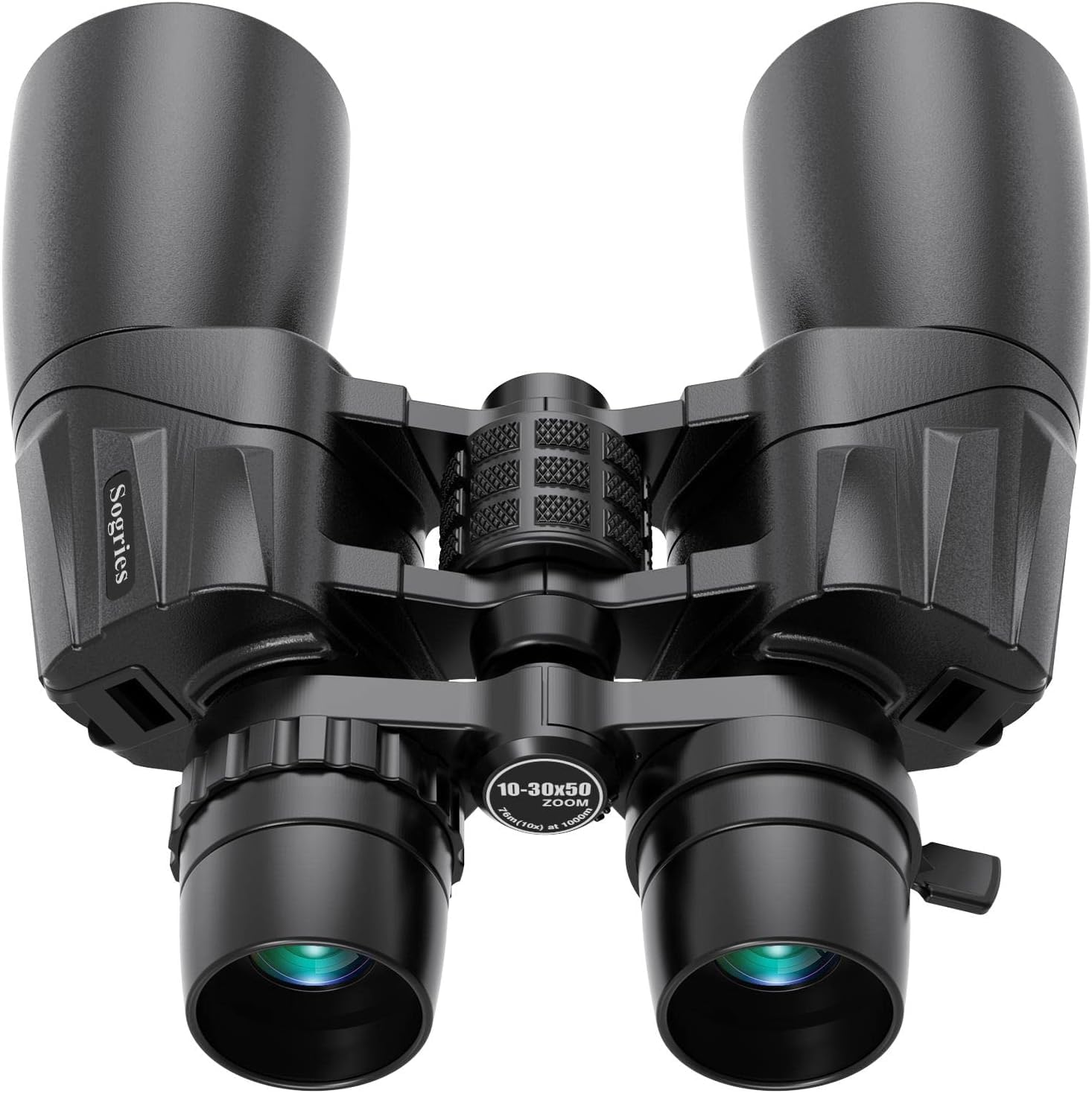
The Sogries zoom binocular stands apart in this list because it is the only option that offers a variable magnification range from 10x all the way up to 30x. That flexibility makes it uniquely suited for scenarios where your target distance changes rapidly—think scanning the stage at a concert, then zooming in on the drummer’s hands, or tracking a soaring raptor, then dialing in on a distant sailboat. The large 50mm objective lenses gather enough light to keep the image bright even at the higher end of the zoom range.
The internal prisms are BAK-4 glass paired with fully multi-coated green film lenses that achieve a claimed light transmittance of 99.5 percent. In practice, this means colors are saturated and glare is well suppressed, even when pointing toward the sun. The zoom lever is smooth enough to transition between extremes without jitter, though you will need to refocus slightly after each magnification change. The body is wrapped in a textured, unscented rubber armor that provides a non-slip grip even with wet hands.
One important consideration is stability: at 30x magnification, any hand shake is amplified dramatically, and the manufacturer explicitly recommends using a tripod for the best experience at high zoom. The binocular comes with a standard tripod adapter thread, but the tripod itself is not included. The 10-year warranty and Climate Pledge Friendly certification add solid reassurance, but the lack of weather sealing is a gap—these are splash-resistant at best, not submersible.
Why it’s great
- Versatile 10-30x zoom range adapts to changing distances in one tool
- BAK-4 prisms with FMC green film produce rich contrast and low glare
- Textured rubber grip keeps handling secure in wet or sweaty conditions
Good to know
- Requires a tripod for stable viewing at 30x magnification
- Weather sealing is limited compared to fully waterproof competitors
4. Nikon TRAVELITE EX 8×25

The TRAVELITE EX is the pair you grab when weight and packability are the top priority. With an 8×25 configuration, it is not built for low-light hunting, but it excels in bright conditions where its aspherical eyepiece lenses eliminate edge distortion and deliver a flat, sharp field of view from center to periphery. At just over 10 ounces, it disappears into a jacket pocket or daypack without noticeable bulk, making it the ideal companion for a day hike or an afternoon at the ballpark.
Nikon’s multilayer-coated optics and high-eyepoint construction give you a forgiving eye box that makes lining up the view fast and intuitive. The turn-and-slide eyecups click into three distinct positions, so both eyeglass wearers and bare-eye users can find a comfortable spot. The click-type diopter adjustment is precise and holds its position during active use. The body is nitrogen-purged and O-ring sealed, holding up to accidental drops in puddles or sudden downpours.
The trade-off is that the 25mm objective simply does not gather enough light for serious use in twilight or dense forest shade. Image brightness drops noticeably after sunset, and the small exit pupil demands a steady hold to avoid blackouts. A few users have reported that the rubber grip can separate from the barrel after repeated heavy use, though this appears to be an isolated manufacturing variance rather than a systemic flaw.
Why it’s great
- Aspherical eyepieces eliminate edge distortion for a sharp, flat field
- Ultra-light at just over 10 ounces, perfect for pocket carry
- Fully waterproof and fogproof in a compact package
Good to know
- 25mm objective limits performance in low-light and overcast conditions
- Occasional reports of rubber grip separating after extended rugged use
5. Bushnell H2O 10×42

Bushnell’s H2O series has been a go-to for boaters and outdoor enthusiasts for years, and the 10×42 model earns its reputation through straightforward, no-nonsense engineering. The O-ring sealed, nitrogen-purged chassis is rated IPX7, meaning it can survive submersion in up to three feet of water for 30 minutes without internal damage. That level of wet-weather protection is rare at this price and makes it a confident choice for kayak trips, fishing excursions, or rainy-season birding.
The fully multi-coated optics are upgraded from Bushnell’s standard H2O line, and paired with BAK-4 prisms, they produce a bright image with good color rendition in full daylight. The 17mm of eye relief is adequate for eyeglass wearers, and the center focus knob turns with a medium resistance that allows precise adjustments. The compact roof prism body fits comfortably in medium to large hands, and the soft rubber armor provides a secure grip even when wet.
The biggest functional gap is the lack of a tripod adapter socket. For a model that is likely to be used on a boat or a spotting scope-style setup, this omission is frustrating. The included neck strap is also a weak point—many users replace it immediately with a wider padded strap. The optical clarity does not match the dielectric-coated premium options, but for pure water resistance and reliable daytime performance, it is a solid workhorse.
Why it’s great
- IPX7 waterproof rating allows full submersion—perfect for marine conditions
- Fully multi-coated optics with BAK-4 prisms for bright daytime views
- Compact roof prism design is easy to stow on a boat or in a pack
Good to know
- No tripod adapter socket limits stability for long-range spotting
- Included neck strap is thin and less comfortable than aftermarket options
6. Athlon Optics Forerunner 10×42
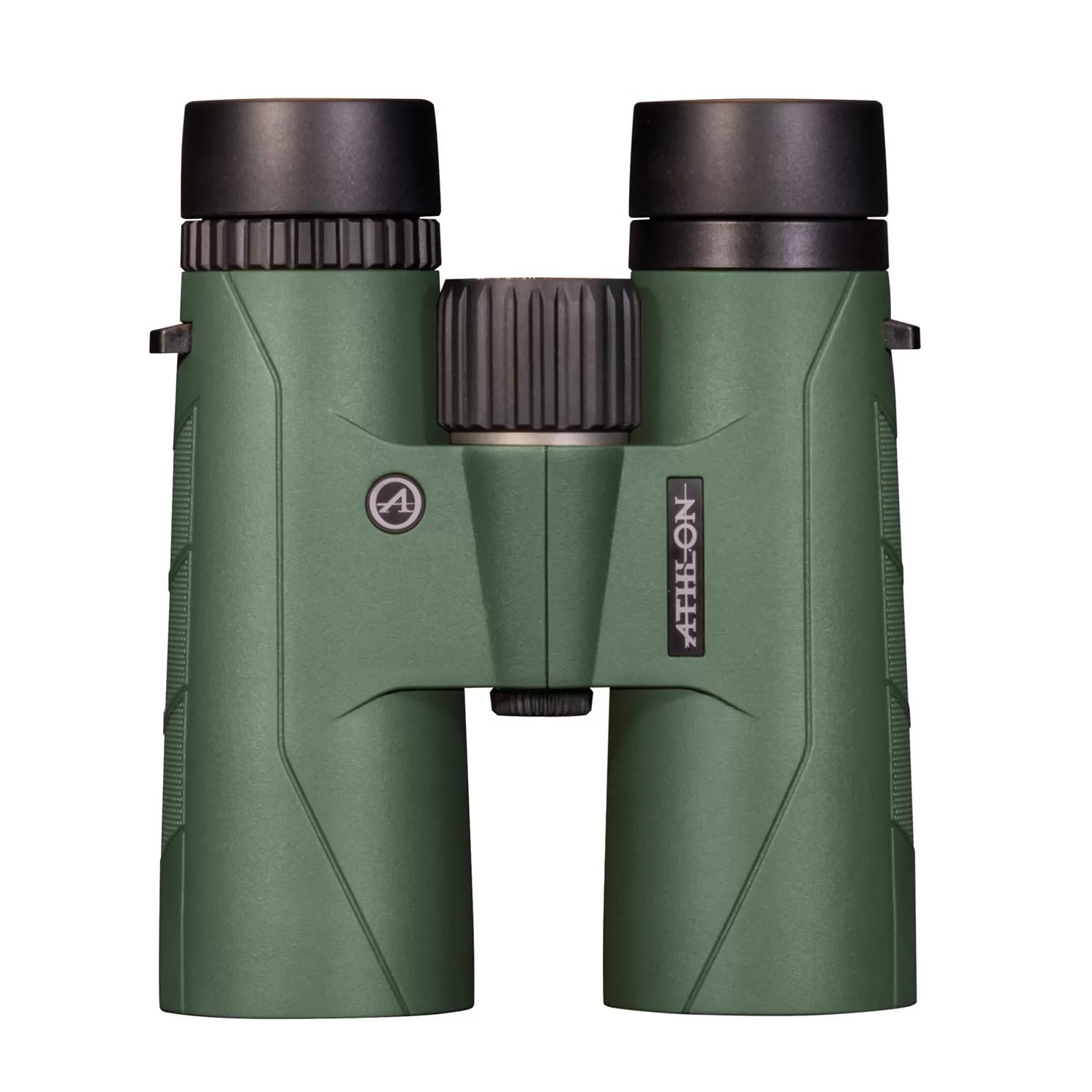
Athlon has carved out a reputation for bringing competitive optics to the value-focused segment, and the Forerunner 10×42 is a direct example of that strategy. The binocular uses BAK-4 prisms and fully multicoated glass to produce an image that is surprisingly bright and sharp for its price tier, with good contrast on overcast afternoons. The 4.2mm exit pupil is standard for a 10×42 and provides a comfortable eye box once the diopter is dialed in.
The aluminum and glass body feels solid in hand without being excessively heavy, tipping the scales at 1.5 pounds. The twist-up eyecups have intermediate stops that work well with glasses, and the extended eye relief reduces eye strain during extended glassing sessions. The focus knob is smooth with no dead spots, and the locking diopter ring is a welcome practical touch that prevents calibration drift when the binocular is bouncing in a pack.
The primary limitation is the absence of more advanced prism coatings. Without phase-correction or dielectric coatings, the image suffers a slight loss of contrast compared to the premium models in this bracket. The included case and harness are decent quality, but the lens caps are basic and can pop off easily when stored in a pocket. For the buyer who prioritizes solid fundamentals over luxury coatings, this is a strong entry point.
Why it’s great
- Solid BAK-4 prism and multicoated glass produce a bright image for the price
- Locking diopter ring preserves calibration during active transport
- Twist-up eyecups with intermediate stops accommodate eyeglass users well
Good to know
- Lacks phase-correction and dielectric coatings found on pricier options
- Lens caps are basic and can detach easily in a crowded bag
7. Nocs Provisions Standard Issue 10×25

Nocs Provisions took the compact binocular concept and refined it with an aesthetic that appeals to the modern outdoor enthusiast. The Standard Issue 10×25 weighs only 11.85 ounces and slides into a purse or hip pocket without noticeable bulk, making it a genuine grab-and-go companion for urban birding, travel, or simply carrying everywhere on the off chance you need a closer look. The Swiss-designed BAK-4 prisms and fully multi-coated optics deliver a surprisingly detailed image for such a small package.
The build quality punches above its weight class: the rubber housing features a patented Rugged Wave Grip that prevents slipping even in wet or sweaty hands, and the IPX7 rating means the unit can survive submersion up to three feet for 30 minutes. The multi-stop twist-up eyecups offer three distinct positions, giving eyeglass wearers a usable view without pressing glass against glass. The field of view is 315 feet at 1,000 yards, which is respectable for a 10×25 and adequate for tracking birds in open woodland.
At 10mm of eye relief, the eye box is tighter than full-size binoculars, requiring precise alignment to avoid blackouts. The neck strap slots are extremely narrow, making installation frustrating—several users have reported needing to cut and tape the strap ends to thread them through. The lifetime “No-Matter-What” warranty is a strong selling point, but the strap issue and the 10mm eye relief make this a specialized choice rather than a universal recommendation.
Why it’s great
- Ultra-compact and lightweight design is genuinely pocketable for everyday carry
- IPX7 waterproof rating provides confidence in rain or accidental submersion
- Lifetime warranty reflects confidence in the build
Good to know
- 10mm eye relief means a tight eye box that struggles with eyeglass use
- Strap installation is unusually difficult due to very narrow attachment slots
8. Vortex Copperhead HD 10×42

The Copperhead HD is Vortex’s entry point into true high-definition optics, and it brings most of the durability features from the higher-end lineup into a more accessible package. The HD optical system uses select glass elements to reduce chromatic aberration and improve edge-to-edge sharpness, resulting in an image that looks clean and neutral across the frame. The fully multi-coated lenses maximize light transmission in this price tier, delivering a view that stays bright in overcast conditions without washing out colors.
The build is classic Vortex: a rubber-armored body that is waterproof, fogproof, and shockproof, built to survive a full hunting season in the back of a truck or a drop onto rocky soil. The 17mm eye relief is generous enough for all-day comfort, and the center focus wheel is dampened for smooth, precise adjustments. The included GlassPak harness and comfort neck strap give you two carrying options out of the box, which is a value-add that few competitors match at this level.
The optical quality is noticeable behind the premium Diamondback model—the Copperhead lacks the dielectric prism coating, so contrast in low-angle sun is a step behind. Some users report that edge sharpness falls off faster than the Diamondback at longer distances. It is also slightly heavier than the PROSTAFF P7, weighing in at around 21 ounces. Still, the VIP warranty and rugged construction make it a reliable choice for a hunter who needs a binocular that can take abuse.
Why it’s great
- HD glass elements reduce chromatic aberration for a cleaner image
- Waterproof, fogproof, and shockproof construction handles hard field use
- Includes both a GlassPak harness and neck strap for flexible carrying
Good to know
- Lacks dielectric prism coating, so contrast trails pricier models
- Edge sharpness drops off noticeably at the periphery of the frame
9. Barska Floatmaster 7×50 Marine Binoculars
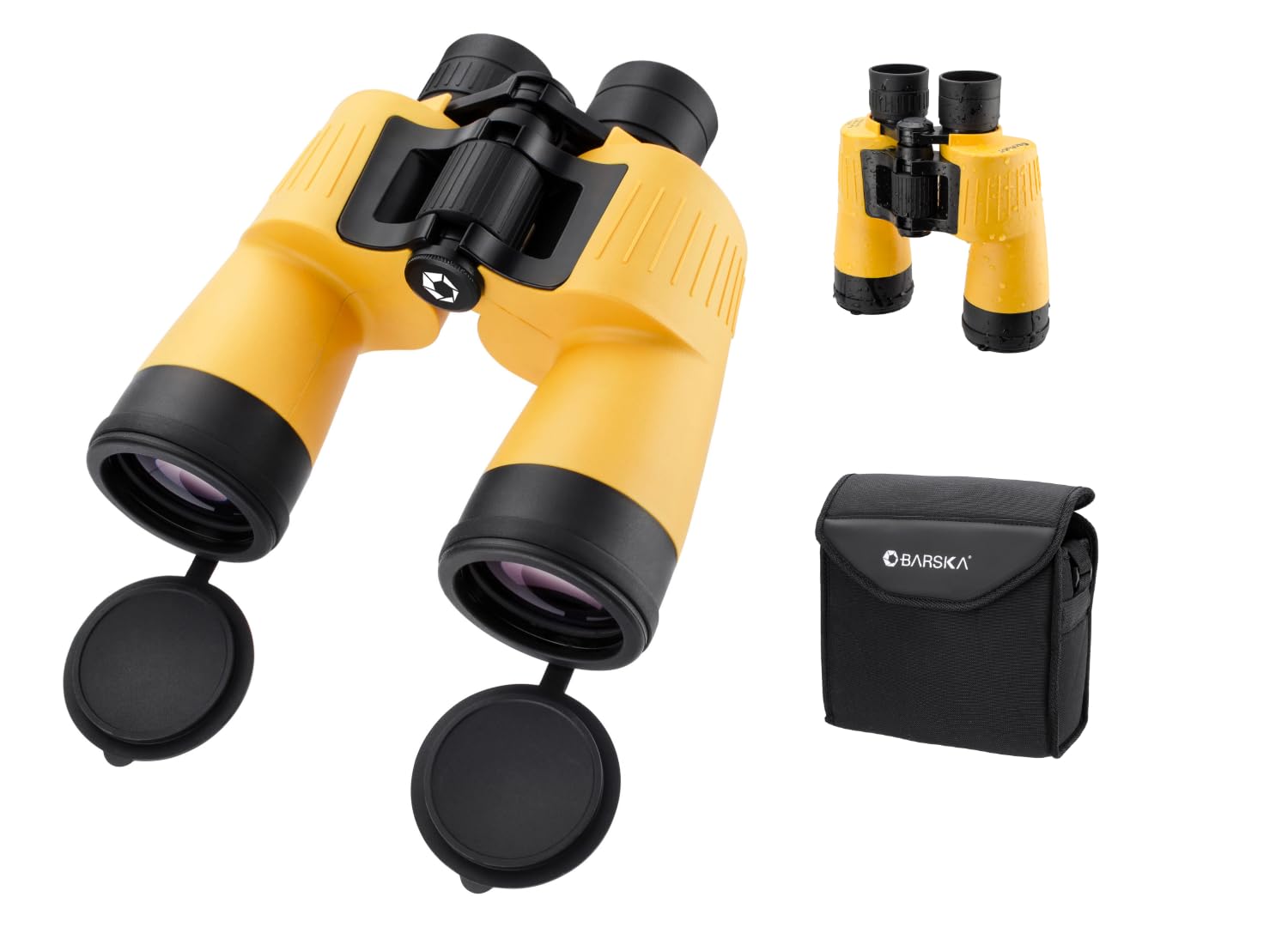
The Barska Floatmaster fulfills a specific niche that few budget-tier binoculars even attempt: it is designed to float on water. The buoyant rubber body means that if you knock it off the gunwale of a boat, it will bob to the surface rather than sinking to the bottom of the lake. For kayakers, canoeists, and saltwater anglers, that alone justifies the purchase. The classic 7×50 configuration is optimized for low-light marine use, with a 7.1mm exit pupil that matches the dilation of the human eye in dim conditions.
The fully multi-coated optics and BAK-4 prisms produce a surprisingly bright and steady image for the price, with a generous 367-foot field of view at 1,000 yards. The 23mm of eye relief is the longest in this roundup, allowing comfortable viewing even while wearing polarized sunglasses. The dry nitrogen purging prevents internal fogging, and the O-ring seals make the unit waterproof and shockproof in addition to its buoyancy. The bright yellow color makes it easy to spot if it goes overboard.
The focus knob is stiff out of the box—several users note that it requires two fingers to turn, which slows down adjustments when tracking a moving target. The close focus distance is approximately 75 to 80 feet, meaning you cannot use these for butterflies or dragonflies at close range. At 7x magnification, the image is very steady but lacks the reach of 10x models for long-distance glassing. If you need a marine-specific instrument that keeps you from losing it in the drink, this is your pick.
Why it’s great
- Floating design is a literal lifesaver for boaters and kayakers
- 23mm eye relief accommodates sunglasses and eyeglasses comfortably
- 7×50 configuration provides a bright, stable image in low marine light
Good to know
- Focus knob is stiff and requires two fingers to operate smoothly
- Close focus of 75+ feet prevents use for nearby insects or close subjects
FAQ
What does fully multi-coated mean in a binocular spec?
Is 10×42 always better than 8×42 for birdwatching?
Why do some binoculars need a tripod for high magnification?
Can I use binoculars for stargazing in the sub-300 range?
Final Thoughts: The Verdict
For most users, the binoculars under $300 winner is the Vortex Diamondback HD 8×42 because it combines dielectric-coated prisms, an argon-purged waterproof body, and a transferable lifetime warranty into a single package that handles everything from forest birding to mountain scouting. If you want a compact travel companion that slips into a jacket, grab the Nikon TRAVELITE EX 8×25. And for variable-distance use at concerts or on the water, nothing beats the versatile zoom range of the Sogries 10-30×50.