
Our readers keep the lights on and the weekend projects moving. As an Amazon Associate, I earn from qualifying purchases.
Standard plastic trash bags sit in landfills for centuries, fragmenting into microplastics that contaminate soil and waterways. Biodegradable alternatives offer a way out of that cycle — but only if they actually break down without tearing, leaking, or costing a small fortune. The materials, certifications, and real-world durability vary wildly from one roll to the next, so knowing exactly what you’re buying is the only way to avoid the greenwashing trap.
I’m Rikta — the founder and writer behind FitlyFast. I analyze compostable polymer blends, ASTM certification tiers, and real leak-test performance data to separate serious eco bags from landfill-bound impostors.
Whether you compost kitchen scraps, manage a household recycling bin, or simply want to reduce your plastic footprint, this guide to the best biodegradable trash bags will help you pick a bag that holds up to daily abuse and actually degrades as promised.
How To Choose The Best Biodegradable Trash Bags
Picking the right eco-friendly bag means looking past the green label and checking three things: the certification standard, the material thickness, and how the bag seals. A bag that claims to be biodegradable but lacks a BPI or TUV Austria mark often just fragments into microplastics — which isn’t real biodegradation. Thickness, measured in mils, directly determines whether your wet coffee grounds and melon rinds poke through before trash day. And the closure type — drawstring, fold-top, or tie — affects how confidently you can carry a full load to the curb without spillage.
Certification Standards: BPI, TUV, and ASTM
A bag labeled “biodegradable” is meaningless without third-party certification. The Biodegradable Products Institute (BPI) certifies bags that meet ASTM D6400, meaning they will break down in a commercial composting facility within a set timeframe. TUV Austria’s OK Compost HOME certification is stricter — it guarantees the bag degrades in a residential compost pile at lower temperatures. If you plan to home-compost, look specifically for HOME certification. BPI alone requires industrial heat and microbes that backyard bins may not reach.
Material Composition: Cornstarch vs. PBAT vs. Paper
Most compostable bags are made from a blend of PLA (polylactic acid, derived from cornstarch), PBAT (a biodegradable polyester), and sometimes cellulose or paper. PLA-based bags feel crisp and hold shape well but can become brittle in cold weather. PBAT adds flexibility and tear resistance, which is why premium blends combine both. Paper bags, like the Hytrend option, are naturally breathable and great for wet food waste, but they lack the stretch of polymer blends. If you need a bag that cinches around a full bin, polymer blends win; if you want a rigid liner for a small countertop pail, paper works nicely.
Thickness (Mil) and Leak Resistance
Mil thickness is the single best predictor of durability in a compostable bag. A 0.6-mil bag is fine for dry, lightweight waste but will tear if you toss a heavy jar or wet vegetable scraps. A 1-mil bag handles heavier loads, though compostable materials are inherently less elastic than polyethylene, so sharp objects are always a risk. Some bags, like the AIRNEX cornstarch model, go up to 0.25 mm (roughly 10 mil), which is very thick for the category. A thicker bag is less likely to leak but will also take slightly longer to degrade — a trade-off worth considering based on your trash volume and typical waste wetness.
Quick Comparison
On smaller screens, swipe sideways to see the full table.
| Model | Category | Best For | Key Spec | Amazon |
|---|---|---|---|---|
| HoldOn 13-Gallon | Premium Plant-Based | Heavy-duty kitchen use with wet waste | PBAT/PLA blend, drawstring | Amazon |
| Airnex 13 Gal | Premium Cornstarch | Home composters wanting thick leakproof liners | 0.25 mm thickness, OK Compost HOME | Amazon |
| SUPERBIO 13 Gal | Mid-Range | Standard kitchen trash with drawstring convenience | 1 mil thickness, BPI/Seedling | Amazon |
| Matter Variety Pack | Premium Multi-Size | Replacing all plastic bags in the kitchen | Biopolymer, BPI & TUV HOME certified | Amazon |
| Hytrend Food Waste Bag | Value Paper | Small countertop compost pails | Paper, 5.7 liter capacity | Amazon |
| Reli. 33 Gallon | Mid-Range Large | Large bins, moderate-weight waste | HDPE with EPI additive, 0.6 mil | Amazon |
| Amazon Basics 13 Gal | Budget Plastic | Budget bulk buying, no eco requirements | 0.9 mil plastic, drawstring | Amazon |
In‑Depth Reviews
1. HoldOn 13-Gallon Trash Bags

HoldOn’s plant-based blend of PBAT, PLA, and cornstarch creates a bag that feels closer to traditional plastic than most compostable options. At 2.7 pounds for a 40-count roll, the material density is noticeably higher than thin 0.6-mil alternatives, giving it structural integrity even when the bin holds wet food scraps, coffee grounds, and takeout containers. The triple-ply construction resists leaks, and long-term users report no seepage after a full week of use.
The multi-way flex material and reinforced drawstring make tying and carrying straightforward, though a handful of reviews mention the drawstring can detach when the bag is very full. That’s a common trade-off with compostable drawstrings — PLA is less elastic than petroleum-based plastic. The BPI certification confirms industrial compostability, but the bag holds up well enough for everyday kitchen trash, not just light compost duty. It’s most at home in a standard 13-gallon tall bin used for mixed household waste.
For anyone transitioning from conventional plastic, HoldOn offers the closest feel and performance, with the added benefit of being a Certified B Corp. The only real friction is the price per bag, which sits at the higher end of the category, but the durability justifies it for households that generate moderate to heavy kitchen waste.
Why it’s great
- Triple-ply construction prevents leaks even with wet contents.
- Multi-way flex material resists tearing better than most compostable bags.
- BPI certified and free of BPA and PFOA.
Good to know
- Drawstring can detach if the bag is overloaded.
- Higher cost per bag than mid-range options.
- Requires industrial composting facility to fully break down.
2. AIRNEX Compostable Kitchen Trash Bags 13 Gal
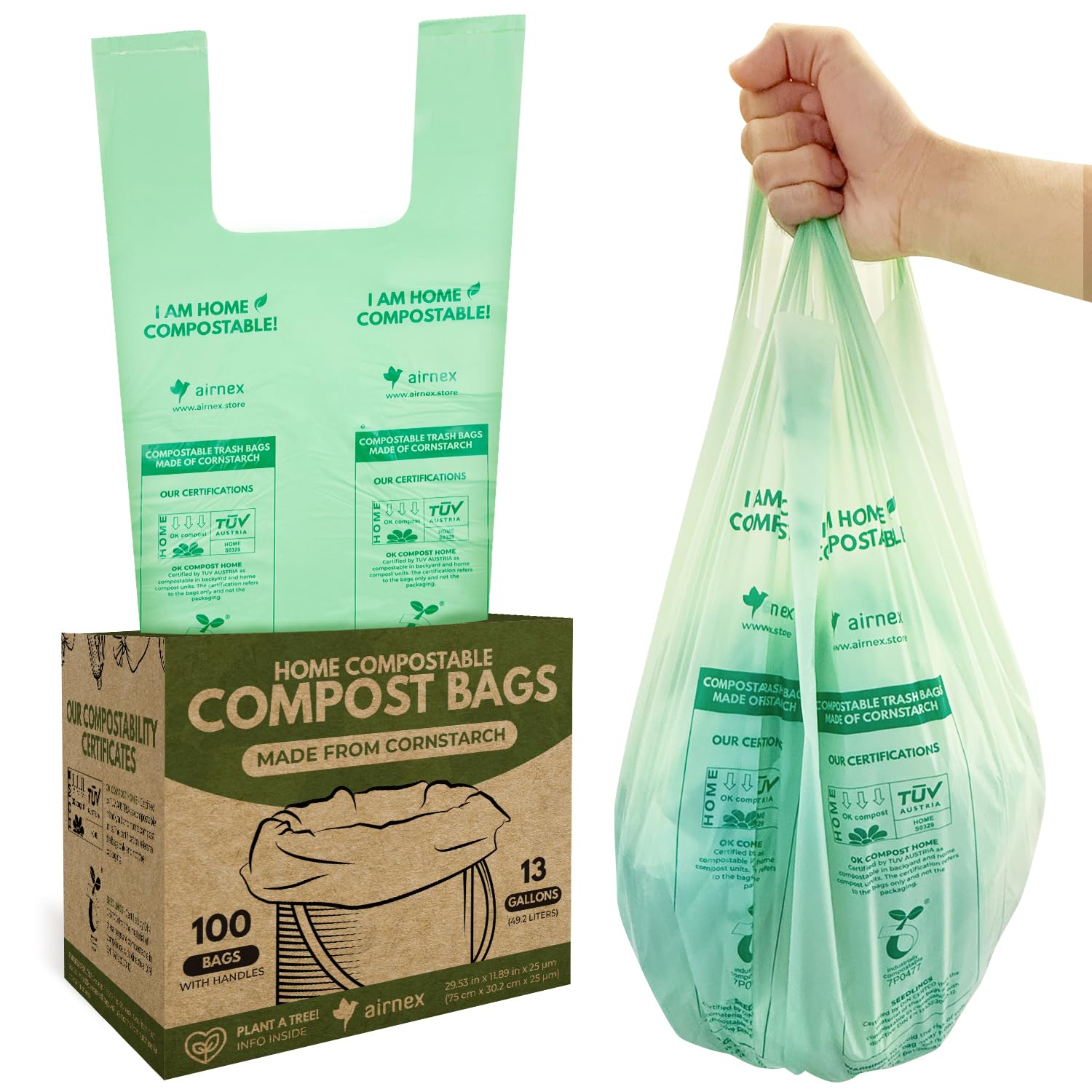
What sets AIRNEX apart is the 0.25 mm thickness — roughly 10 mil, which is exceptionally thick for a compostable kitchen bag. Most competing bags hover around 0.6 to 1 mil, so this is a clear step up in leak resistance and tear strength. The cornstarch-based material feels substantial and holds up to 50 pounds of food scraps without sagging or splitting, making it a strong choice for households that compost heavy, wet waste.
Certification is where AIRNEX really pulls ahead. The bags carry both TUV Austria OK Compost HOME and Seedling certifications, meaning they degrade in home compost piles, not just industrial facilities. That’s rare in the 13-gallon segment. Users report reliable breakdown in backyard bins, though the thick material does take slightly longer to disappear than thinner paper or PLA-only bags. The 100-count box is practical — the dispenser-style opening lets you grab one bag at a time without unrolling the entire roll.
The trade-off is flexibility. The thick cornstarch blend is less supple than PBAT-based bags, so tying a tight knot can require a bit more effort. It fits bins labeled “under 13 gallons” comfortably. For anyone serious about home composting who doesn’t want to worry about leaks, this is the strongest liner on the market.
Why it’s great
- 0.25 mm thickness offers superior leak and tear protection.
- OK Compost HOME certified — breaks down in backyard piles.
- Convenient 100-count dispenser box saves space.
Good to know
- Thick material is less flexible, making knot-tying stiffer.
- Higher per-bag cost than thinner alternatives.
- Breakdown in home compost takes slightly longer due to thickness.
3. SUPERBIO 13 Gallon Compostable Drawstring Bag
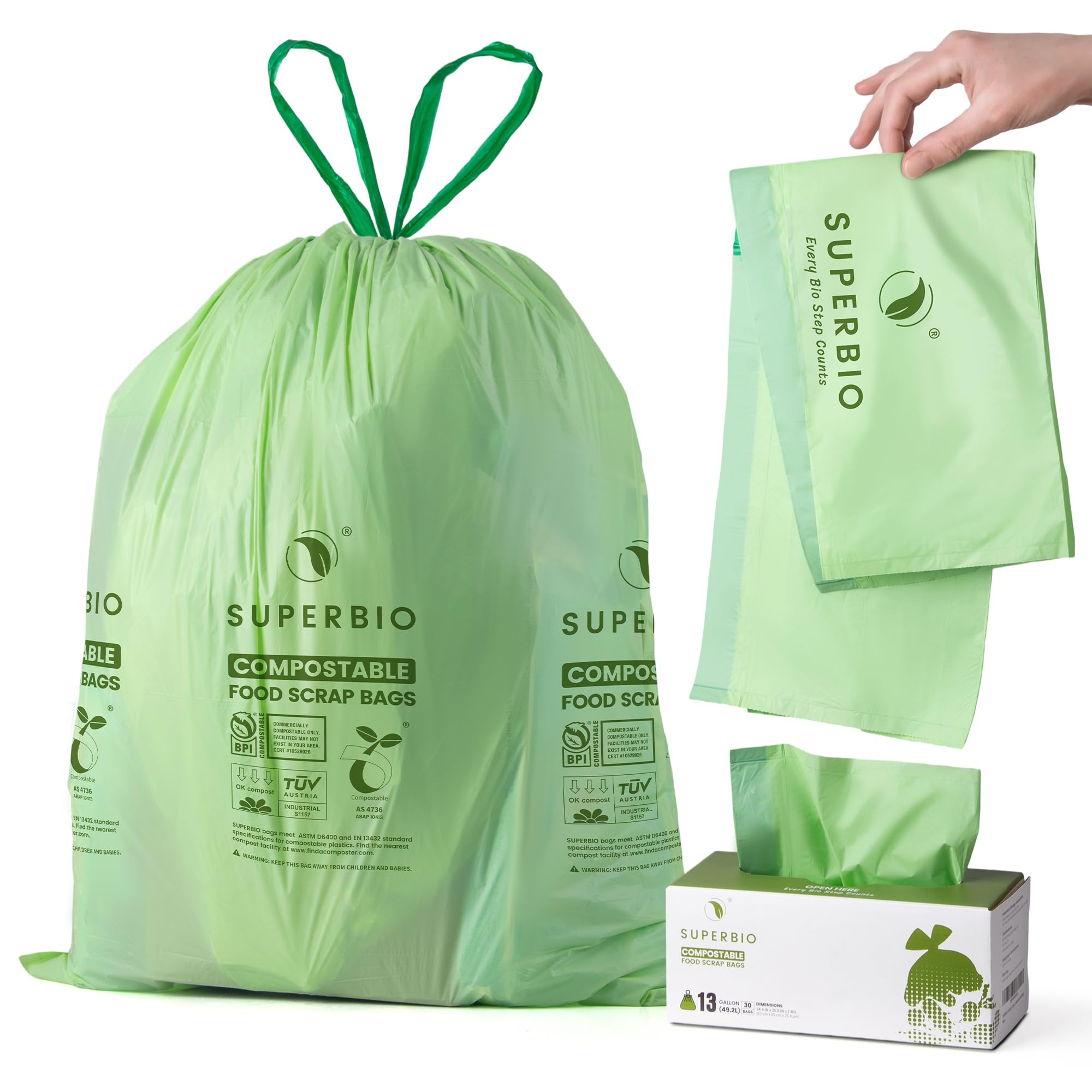
SUPERBIO hits the sweet spot between cost and performance for the average kitchen. At 1 mil thick, these bags are sturdy enough for daily food waste — coffee grounds, vegetable peels, and paper takeout containers — without feeling flimsy. The drawstring closure works reliably for tying and carrying, though a subset of users report the pull tabs can detach if you cinch them too aggressively. That’s a minor durability note, not a dealbreaker for most households.
The certification stack is comprehensive: BPI, Seedling, and OK Compost INDUSTRIAL all back the ASTM D6400 compliance. That means they break down fully in a commercial composting environment. The bag dimensions (25.2 x 25.6 inches) fit standard 13-gallon tall bins without excess slack. The 30-count roll is modest, but the price per bag puts it squarely in the mid-range — cheaper than premium options like HoldOn or AIRNEX, but more expensive than conventional plastic.
One important note: like most compostable bags, SUPERBIO has a shelf life of about one year and should be stored in a cool, dry place. Wet organic waste left inside for more than three days can accelerate breakdown, so regular disposal is part of the routine. For light to moderate kitchen waste with decent turnover, this is the most balanced option.
Why it’s great
- 1 mil thickness handles moderate wet waste without tearing.
- Triple certified (BPI, Seedling, OK Compost INDUSTRIAL).
- Drawstring closure is easy to tie and carry.
Good to know
- Drawstring tabs can detach under heavy loads.
- 30-count roll means more frequent repurchasing.
- Not suitable for home composting — requires industrial facility.
4. Matter Compostable Assorted Kitchen Bags
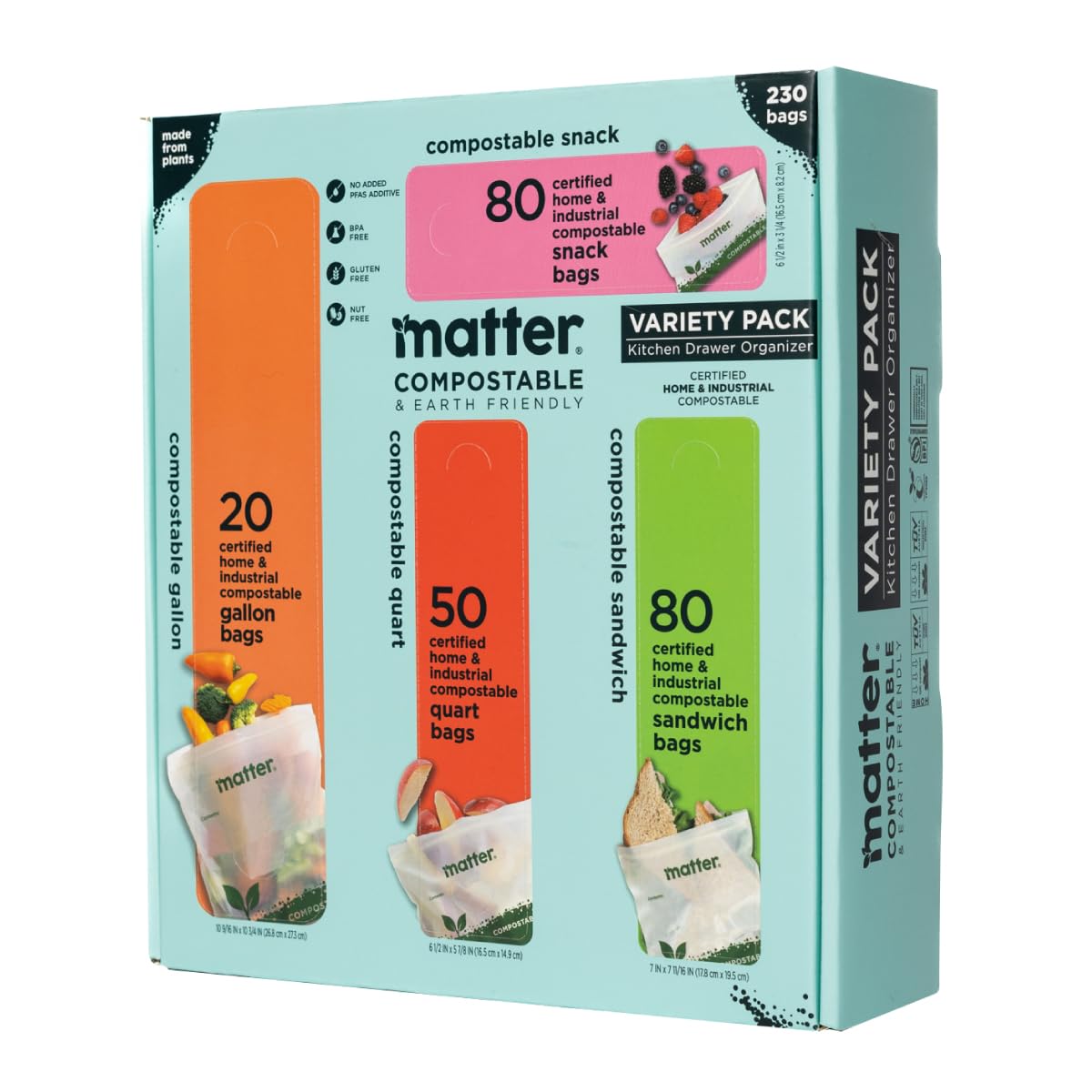
Matter’s 230-count variety pack is the only entry on this list that replaces multiple types of plastic bags in one purchase. The set includes snack, sandwich, quart, and gallon bags, all made from a biopolymer that’s BPI and TUV Austria certified for both industrial and home composting. The material feels similar to standard Ziploc-style bags — flexible, sealable, and strong enough for refrigeration and freezer use without becoming brittle.
The dispenser box design is genuinely thoughtful: each size has its own compartment with perforated openings, so you can grab one bag at a time without digging through a drawer. Reusability is a standout feature — users report washing and reusing the sandwich and snack bags multiple times before composting them, which extends the value considerably. The lack of size markings on the bags themselves is a minor irritation, but the compartment layout partially compensates for that.
If you’re trying to eliminate plastic from your entire kitchen, not just the trash can, this pack covers sandwich storage, produce bags, and small waste liners in one shipment. The gallon bags work well as small trash liners for bathroom or office bins. The only real miss is that the gallon and quart bags don’t have gusseted bottoms, so they stand less firmly when open compared to traditional plastic bags.
Why it’s great
- Replaces snack, sandwich, quart, and gallon plastic bags in one kit.
- Certified home compostable (TUV HOME) — no industrial facility needed.
- Durable enough to wash and reuse multiple times.
Good to know
- No size markings on individual bags — easy to confuse sizes.
- Quart and gallon bags lack gusseted bottoms.
- Higher upfront cost for the variety, but strong per-bag value.
5. Hytrend Kitchen Food Waste Paper Bag

Hytrend takes a completely different approach: paper, not polymer. These 5.7-liter bags are designed specifically for small countertop compost pails, where breathability is actually an advantage. Paper allows moisture to evaporate rather than pool at the bottom, which reduces the slimy condensation that often collects inside sealed compostable plastic bags. Users consistently report no leaking, no odor, and no condensation issues — even with wet coffee filters and vegetable scraps sitting for a day or two.
The foldable top design is simple but effective: you fold the top edge over the rim of your pail and secure it with the included white card or a clip. The bags are certified by BNQ and BPI, confirming they break down in both municipal and home composting systems. The 35-count box is a relatively small quantity, but the compact size means they’re easy to replace frequently. They fit standard one-gallon buckets and small countertop bins perfectly.
Paper bags won’t stretch, so they’re not suitable for heavy or sharp items that could puncture them. And they’re limited to small pails — there’s no equivalent for a 13-gallon kitchen bin. But for the specific use case of daily kitchen scrap collection, they outshine plastic-based compostable bags in odor control and moisture management.
Why it’s great
- Breathable paper design eliminates condensation and odor buildup.
- BNQ and BPI certified for home and industrial composting.
- Foldable top fits standard one-gallon pails securely.
Good to know
- Small 5.7-liter capacity — only suitable for countertop pails.
- Paper material lacks stretch and can tear on sharp objects.
- 35-count box is a small quantity for frequent replacement.
6. Reli. Biodegradable 33 Gallon Trash Bags

Reli. targets a different kind of buyer — someone who needs a large 33-gallon bag for a compactor, workshop, or big household bin, and wants a degradable option without paying premium per-bag prices. These bags use an EPI oxo-degradable additive blended into standard HDPE plastic, which means they fragment when exposed to moisture, oxygen, and soil, per ASTM D6954. That’s not the same as full biodegradation into biomass, but it does accelerate breakdown compared to ordinary plastic.
At 0.6 mil, the material is thin relative to the 33-gallon capacity, so heavy loads of yard waste or sharp recyclables can push the limits. Multiple users note that the bags handle typical household trash well but tear if overstuffed or dragged across rough surfaces. The green tint is a visual cue that differentiates them from standard black or white plastic. They come in a 100-count roll, which brings the cost per bag down substantially compared to certified compostable brands.
The key consideration here is certification — the ASTM D6954 standard covers degradation via additive technology, not compostability. If your local waste service accepts only BPI-certified compostable bags, these won’t qualify. But for general trash destined for a landfill where accelerated degradation is still better than inert plastic, Reli. offers a practical middle ground for large-bin users on a budget.
Why it’s great
- Large 33-gallon capacity at a low per-bag cost.
- ASTM D6954 certified for oxo-degradation in soil/moisture conditions.
- 100-count roll provides long-term supply.
Good to know
- 0.6 mil thickness tears more easily than premium bags.
- Oxo-degradation is fragmentation, not full compostability.
- Not accepted in BPI-only composting programs.
7. Amazon Basics Tall Kitchen Drawstring Trash Bags

Amazon Basics sits at the opposite end of the spectrum from certified compostable options. These are conventional HDPE plastic bags, not biodegradable or compostable. They’re included here as a baseline comparison point — the 0.9-mil thickness is thicker than most budget plastic bags, and the 200-count bulk pack delivers the lowest per-bag cost of any entry on this list. The drawstring closure is reliable and rarely snaps, a point echoed across hundreds of user reviews.
Performance-wise, these bags do exactly what standard plastic bags do: they hold waste securely, resist tearing well for daily use, and have no special storage requirements. The unscented version has no chemical smell, which is a plus for sensitive noses. The 13-gallon size fits standard tall kitchen bins with plenty of room. Users consistently report lasting nearly a year on a single box for a typical household.
The environmental trade-off is obvious: these bags will sit intact in a landfill for centuries. If your goal is strictly to reduce plastic waste at the lowest possible cost, these don’t serve that mission. But for budget-focused buyers who need a reliable, no-fuss bag and aren’t concerned with biodegradation, Amazon Basics delivers proven value that outperforms every eco bag on price and sheer tear resistance.
Why it’s great
- 0.9-mil plastic provides excellent tear and leak resistance.
- 200-count box at a very low per-bag cost.
- Reliable drawstring closure with minimal breakage.
Good to know
- Standard plastic — not biodegradable or compostable.
- Persistent environmental footprint in landfills.
- No third-party eco certifications.
FAQ
Can I put biodegradable trash bags in my home compost pile?
Why do compostable bags sometimes tear more easily than plastic?
Do biodegradable bags have a storage shelf life?
Can I use compostable bags for any type of waste?
Final Thoughts: The Verdict
For most users, the best biodegradable trash bags winner is the HoldOn 13-Gallon because it combines the closest feel to conventional plastic with genuine BPI certification and strong leak resistance for everyday kitchen waste. If you want home-compostable certification and maximum tear strength, grab the AIRNEX 13 Gal. And for replacing every plastic bag in your kitchen with a certified home-compostable option, nothing beats the Matter Variety Pack.