
Our readers keep the lights on and the weekend projects moving. As an Amazon Associate, I earn from qualifying purchases.
The difference between a satisfying day of birding and a frustrating blur often comes down to the glass in your hands. Squinting through a dim, shaky image at a warbler thirty yards away feels like watching a movie through a dirty window — the details that identify the bird, the feather iridescence, the subtle eye ring, all vanish. Finding a pair of binoculars that deliver bright, crisp optics without exceeding your budget requires knowing which specs actually matter and which are just marketing fluff.
I’m Rikta — the co-founder and writer behind FitlyFast. For this guide, I spent hours sorting through the engineering specs, customer feedback, and real-world trade-offs of a dozen models to separate the true performers from the also-rans in the mid-range and premium tiers.
Whether you scan marsh edges at dawn or track flitting warblers through dense canopy, the right tool transforms a hobby into a passion. This is your clear path to the best birding binoculars under $200.
How To Choose The Best Birding Binoculars Under $200
In this price bracket, you can access genuine HD glass systems and fully multi-coated prisms without sacrificing weather sealing. The key is understanding which trade-offs are acceptable for your primary birding environment — dense forests demand a wider field of view, while open wetlands reward higher magnification.
Magnification and Objective Lens: The 8×42 Sweet Spot
An 8x magnification with a 42mm objective lens is the consensus choice for serious birding. The 5.25mm exit pupil matches the dilation of the human pupil in moderate light, delivering bright images during early morning and late afternoon — exactly when many species are most active. A 10×42 yields a smaller 4.2mm exit pupil, which can feel dimmer in twilight, but the extra reach helps identify distant raptors or shorebirds. For most birders, 8x provides a steadier hand-held image and a wider field of view for tracking movement.
Coatings and Prism Glass: Clarity Starts Here
Fully multi-coated (FMC) lenses apply anti-reflective layers to every air-to-glass surface, boosting light transmission by several percent compared to multi-coated or coated options. Combined with BaK-4 prisms — which reflect more internal light than BK-7 prisms — FMC optics separate a glass from a $200 glass in low-light edge sharpness. Dielectric prism coatings, found on higher-end models in this range, push brightness even further by reflecting nearly 99% of incoming light.
Waterproofing and Fogproofing: Non-Negotiable for Birding
Birding happens in all weather. O-ring seals and nitrogen purging prevent internal fogging when you move from a warm car into cold, damp air. An IPX7 rating — meaning the binoculars survive submersion in one meter of water for 30 minutes — gives confidence in a sudden downpour. Without this seal, moisture can eventually degrade the prism coatings and encourage internal mold.
Quick Comparison
On smaller screens, swipe sideways to see the full table.
| Model | Category | Best For | Key Spec | Amazon |
|---|---|---|---|---|
| Nikon PROSTAFF P7 10×42 | Premium | Day-long field scanning | Dielectric prism coating | Amazon |
| Nocs Provisions Field Issue 8×42 | Premium | Ultra-wide field tracking | 394-ft field of view | Amazon |
| OPMOD Vortex Diamondback HD 10×42 | Mid-Range | HD resolution at a mid-range price | ArmorTek scratch-resistant coating | Amazon |
| Nikon TRAVELITE EX 8×25 | Mid-Range | Ultra-portable packing | 12.1-ounce weight | Amazon |
| Timorn HD 8×42 | Mid-Range | All-in-one kit with phone adapter | 5.2mm exit pupil | Amazon |
| Bushnell H2O Xtreme 10×42 | Budget-Friendly | Wet-weather boating and birding | IPX7 waterproof rating | Amazon |
| Vortex Copperhead HD 10×42 | Budget-Friendly | Unconditional lifetime warranty value | HD optical system | Amazon |
In‑Depth Reviews
1. Nikon PROSTAFF P7 10×42

Nikon’s PROSTAFF P7 represents the upper boundary of this price bracket, and it earns the top slot by delivering dielectric high-reflective prism coating — a feature usually reserved for optics costing significantly more. The 10×42 configuration provides strong reach for open-field scanning, and the fully multi-coated lenses produce a bright image with natural color reproduction. The locking diopter ring is a thoughtful detail that prevents accidental adjustments when you are hiking or storing the binoculars in a pack.
Build quality feels solid without being heavy. The fiberglass-reinforced polycarbonate body keeps the weight manageable, and the rubber armor provides a secure grip in damp conditions. The 15.7mm of eye relief accommodates eyeglass wearers comfortably, and the turn-and-slide eyecups lock into position firmly. Field of view measures 367 feet at 1,000 yards — wide enough for scanning treelines but slightly narrower than an 8x sibling.
Low-light performance is where this glass pulls ahead of the mid-range competition. Dielectric coatings on the roof prisms reflect roughly 99% of incoming light, which translates to visible feather detail roughly 15–20 minutes deeper into twilight compared to standard silver-coated prisms. It is a meaningful advantage for birders who chase owls or woodcocks at dusk.
Why it’s great
- Dielectric prism coating maximizes low-light brightness
- Locking diopter ring holds your focus setting
- Oil- and water-repellent lens coating for easy cleaning
Good to know
- 10x may feel shaky for some users without a steady rest
- Field of view narrower than 8x alternatives
2. Nocs Provisions Field Issue 8×42
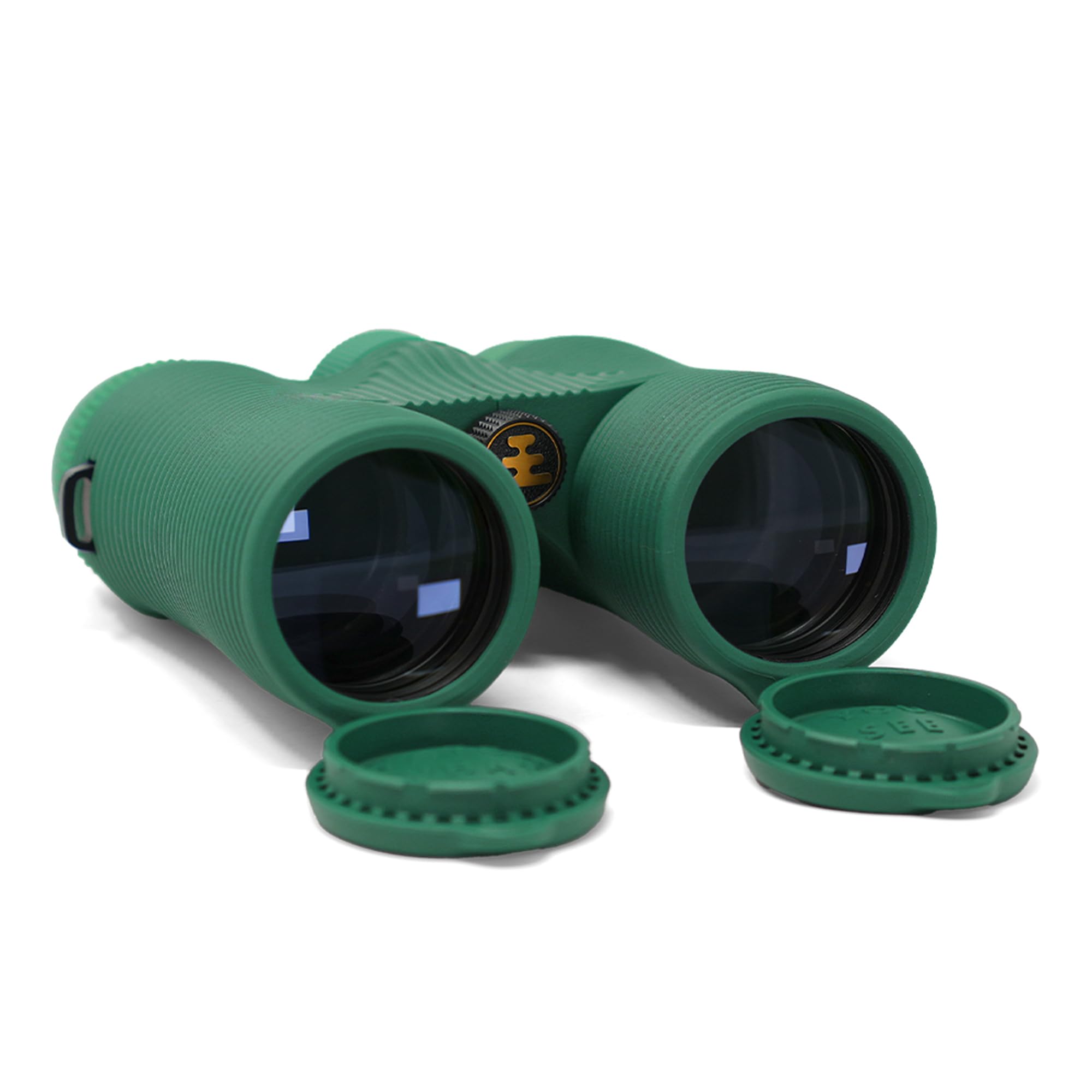
Nocs Provisions designed the Field Issue for the birder who values an immersive, wide perspective over pure magnification. The 394-foot field of view at 1,000 yards is generous — it lets you locate a moving bird and track it without constantly repositioning the binoculars. The 8x magnification keeps the image steady in hand, and the 5.4mm exit pupil delivers a bright view even as the sun drops behind the trees.
The multi-stop twist-up eyecups offer 20.4mm of eye relief, one of the highest figures in this roundup, making it exceptionally comfortable for users who wear glasses. The patented Rugged Wave Grip housing is textured enough to hold securely with wet or gloved hands. Swiss-designed BaK-4 prisms paired with fully multi-coated optics produce crisp, accurate color without the chromatic aberration you sometimes see in cheaper glass.
IPX7 waterproofing means these can handle a drop in a stream or a full rain shower without worry. The “No-Matter-What” lifetime warranty backs the purchase, and the company donates 1% of sales to environmental causes. The included case and strap are functional but basic — you may want to upgrade the neck strap for longer days in the field.
Why it’s great
- Wide field of view ideal for tracking fast-moving birds
- Long eye relief works well with eyeglasses
- Lifetime warranty and eco-conscious brand
Good to know
- 8x magnification limits long-range detail on distant subjects
- Accessories are basic compared to competing kits
3. OPMOD Vortex Diamondback HD 10×42

The Vortex Diamondback HD line is a reference point in the mid-range binocular market, and this OPMOD-exclusive version in Wolf Gray delivers the same optical performance with a slightly different aesthetic. The HD (high-density) glass system uses select glass elements to minimize chromatic aberration, yielding a clean image with good edge-to-edge sharpness. Dielectric coating is absent here, but the phase correction on the roof prisms ensures contrast remains high.
ArmorTek is one of the most practical features on this model — an ultra-hard, scratch-resistant coating on the exterior lenses that repels oil and dirt. In the field, this means you can wipe dust and fingerprints off without introducing micro-scratches. The rubber armor is grippy without being tacky, and the focus wheel turns smoothly with no play. The included GlassPak harness is a genuine value add for long walk-and-scan sessions.
Where the Diamondback HD falls slightly short of the premium tier is in absolute low-light transmission. It is bright and clear in good light, but in deep twilight, the dielectric-coated PROSTAFF P7 will show more detail. Still, for general birding from mid-morning through late afternoon, this is a very capable performer backed by Vortex’s unconditional lifetime warranty.
Why it’s great
- HD glass system reduces color fringing
- ArmorTek coating resists scratches and smudges
- Unconditional lifetime warranty from Vortex
Good to know
- Lacks dielectric prism coating found on higher-priced models
- Slightly heavier than some competitors at 1.07 kg package weight
4. Nikon TRAVELITE EX 8×25

At just 12.1 ounces, the Nikon TRAVELITE EX 8×25 is the binocular you will actually pack on every hike, carry-on, and day trip. The compact 25mm objective lens limits low-light performance compared to 42mm models, but for daytime birding in open habitats, the view is bright and sharp. The aspherical eyepiece lenses reduce distortion at the edges, a feature often missing in ultra-compact designs.
Build quality is excellent for the size class — a die-cast aluminum chassis wrapped in rubber armor feels dense and durable, not hollow. Nitrogen purging and O-ring seals make these waterproof to two meters for five minutes, so a sudden downpour is not a concern. The turn-and-slide eyecups offer 11.1mm of eye relief, which is tight for some eyeglass wearers but workable with shorter eye relief needs.
The trade-off for portability is the smaller exit pupil — 3.13mm. In overcast conditions or deep woods, the image will look noticeably dimmer than a 42mm glass. But for the birder who lives out of a backpack and values weight savings above all, this is the best compact option in the group. The field of view is a respectable 262 feet at 1,000 yards.
Why it’s great
- Extremely lightweight and easy to pack
- Aspherical eyepieces deliver good edge sharpness
- Waterproof and fogproof construction
Good to know
- Small 3.13mm exit pupil limits low-light performance
- 11.1mm eye relief may not suit all eyeglass wearers
5. Timorn HD 8×42

Timorn positions this 8×42 as a complete birding starter kit, and the bundle delivers real value. Beyond the binoculars themselves, you receive a smartphone adapter and a compact tripod — useful for digiscoping or sharing a sighting on social media without investing in separate accessories. The 8×42 configuration provides a generous 5.2mm exit pupil, which produces a bright view during early morning and late afternoon birding sessions.
The fully multi-coated green film coating and BaK-4 prisms deliver clear, contrasty images. Field of view is 430 feet at 1,000 yards, one of the widest in this roundup, making it well-suited for scanning large wetland areas or open meadows. The twist-up eyecups with 15mm of eye relief offer decent comfort, though the diopter adjustment ring sits near the focus wheel and can be bumped accidentally — a few users noted that the setting sometimes drifts mid-walk.
The included tripod is lightweight and functional for steadying the view, but it is not built for heavy abuse. The phone adapter works with most standard smartphones and allows you to take passable digiscoped photos. For the birder who wants everything in one box without hunting for separate accessories, this is a well-rounded choice.
Why it’s great
- Wide 430-foot field of view for open-area scanning
- Includes phone adapter and tripod for digiscoping
- Large 5.2mm exit pupil for twilight brightness
Good to know
- Diopter ring can shift position accidentally during use
- Included tripod is basic and not very sturdy
6. Bushnell H2O Xtreme 10×42

Bushnell has a decades-long reputation in outdoor optics, and the H2O Xtreme lives up to its name with an IPX7 waterproof rating — fully submersible to one meter for 30 minutes. The fully multi-coated glass surfaces maximize light transmission through the BaK-4 prisms, and the 10×42 format gives you genuine reach for scanning shorelines and treetops. The O-ring sealed, nitrogen-purged body keeps fogging at bay in cold, wet conditions.
Build quality is rugged. The rubber armor is thick and provides a secure grip even when wet. Eye relief measures 17mm — very generous for glasses users — and the twist-up eyecups offer a positive click at each stop. The included case, strap, and lens covers are adequate for casual use. A notable omission is the lack of a tripod adapter thread, so if you plan to mount these for extended observation sessions, look elsewhere.
Optical performance is strong for the price point. The image is bright and clear in good light, with color fidelity that feels natural. At the edges, there is a slight softness compared to the HD-class optics from Vortex and Nikon, but for the savings, this is a fair trade. This is an excellent backup pair or a first binocular for someone who spends a lot of time on the water or in rainy climates.
Why it’s great
- IPX7 waterproof rating for submersion and heavy rain
- Generous 17mm eye relief for eyeglass wearers
- Affordable entry point with reliable Bushnell quality
Good to know
- No tripod adapter socket for mounting
- Edge sharpness not as clean as premium HD models
7. Vortex Copperhead HD 10×42

The Vortex Copperhead HD brings HD optical glass to a price point that undercuts most competitors, making it a compelling entry point into high-definition birding. The HD system reduces color fringing noticeably compared to standard optics, delivering clean, true-color views of bird plumage. Fully multi-coated lenses boost light transmission, and the 10×42 format gives you the reach needed for observing wary species at a distance.
The build is tough. Rubber armor covers the entire body, providing a non-slip grip in wet or cold conditions. Waterproof, fogproof, and shockproof ratings mean this binocular can survive field abuse. The 17mm eye relief is comfortable for glasses. The included GlassPak harness is a practical touch — it distributes the weight across your shoulders and keeps the binoculars secure against your chest while hiking.
Optically, the Copperhead HD is slightly less bright at the edges in dim light compared to the Diamondback HD and noticeably softer than the PROSTAFF P7 with its dielectric coating. The center of the view is sharp, but edge-to-edge clarity is not as consistent. For the price, this is an honest value proposition: you get HD glass and Vortex’s unlimited, unconditional lifetime warranty at an accessible entry point.
Why it’s great
- HD glass system at a budget-friendly price
- Unlimited, unconditional VIP lifetime warranty
- Includes comfortable GlassPak harness
Good to know
- Edge sharpness drops off compared to higher-tier models
- Low-light performance lags behind dielectric-coated competitors
FAQ
Is 8×42 or 10×42 better for general birding?
What does fully multi-coated mean for birding binoculars?
Do I need a waterproof and fogproof binocular for birding?
Can eyeglass wearers comfortably use binoculars in this price range?
Final Thoughts: The Verdict
For most users, the best birding binoculars under $200 winner is the Nikon PROSTAFF P7 10×42 because it combines dielectric prism coating, a locking diopter, and excellent build quality at a price that undercuts comparable models. If you want a wide, immersive field of view for tracking birds through dense habitat, grab the Nocs Provisions Field Issue 8×42. And for the birder who needs waterproof reliability on a tighter budget, nothing beats the Bushnell H2O Xtreme 10×42.