
Our readers keep the lights on and the weekend projects moving. As an Amazon Associate, I earn from qualifying purchases.
The leap from a casual viewer to a dedicated birder often comes down to a single tool: a pair of binoculars that can resolve the fine feather detail of a warbler at dawn without turning your wallet into a casualty. Below $500, the market is crowded with options promising ED glass, phase-coated prisms, and nitrogen-purged bodies, but only a handful deliver the crisp, bright, color-true image that makes birding genuinely addictive.
I’m Rikta — the co-founder and writer behind FitlyFast. My analysis of this category involved cross-referencing customer field reports against concrete optical specifications like ED glass elements, dielectric prism coatings, and exit pupil measurements to separate genuine performance from marketing noise.
This guide breaks down the nine most compelling birding binoculars under $500 available right now, with a focus on the real-world specs that matter when you are scanning tree lines in low light or tracking a fast-moving hawk against a bright sky.
How To Choose The Best Birding Binoculars Under $500
Picking the right binoculars for birding under $500 means balancing optical quality with build durability. The difference between a frustrating session of blurry smudges and a breathtaking view of a Blackburnian warbler at sixty yards comes down to a few key specifications that you should prioritize.
ED Glass — The Chromatic Aberration Killer
Extra-low Dispersion glass is the most impactful optical upgrade available under $500. Standard glass inevitably introduces color fringing — a purple or green halo along high-contrast edges like a bird against a bright sky. ED glass suppresses this dispersion, delivering a cleaner, more neutral image. Models like the Sogries 12×50 ED, Wingspan Skyview, and both ZEISS Terra ED units use ED glass, and the difference is immediately visible in side-by-side comparisons.
Prism Coatings: Phase and Dielectric
Roof prism binoculars need phase-correction coatings to prevent light from interfering with itself, which dulls the image. Dielectric coatings further boost reflectivity across the visible spectrum, increasing brightness by up to 15-20%. The Celestron TrailSeeker explicitly features both, making its optical performance punch well above its tier.
Magnification vs. Stability
8x magnification provides a wider field of view and a steadier image, which is generally preferable for forest birding where subjects move quickly and branches obstruct clear sightlines. 10x offers more reach for open habitats like shorelines or fields but amplifies hand shake and narrows your field of view. 12x, as seen on the Sogries, pushes into tripod territory for extended use.
Quick Comparison
On smaller screens, swipe sideways to see the full table.
| Model | Category | Best For | Key Spec | Amazon |
|---|---|---|---|---|
| Nikon MONARCH M7 8×42 | Mid-Range | Wide FOV & low-light | 435 ft FOV, ED glass | Amazon |
| ZEISS Terra ED 8×42 | Premium | Zeiss optical pedigree | 88% light transmission | Amazon |
| ZEISS Terra ED 10×42 | Premium | Extended reach & clarity | 10x, hydrophobic coating | Amazon |
| Celestron TrailSeeker 8×42 | Mid-Range | Best value & phase coating | 426 ft FOV, dielectric | Amazon |
| Vanguard Endeavor ED 10×42 | Mid-Range | Long-range & ergonomics | ED glass, 340 ft FOV | Amazon |
| Wingspan Skyview 8×42 | Mid-Range | Close focus & compact | ED glass, 393 ft FOV | Amazon |
| Nikon TRAVELITE EX 8×25 | Budget | Ultra-portable travel | 11.1 mm eye relief | Amazon |
| Sogries 12×50 ED | Budget | High power & ED glass | IPX7, 5.8° FOV | Amazon |
| Celestron Outland X 10×50 | Budget | Value & 50mm brightness | 289 ft FOV, BaK-4 | Amazon |
In‑Depth Reviews
1. Nikon MONARCH M7 8×42

The Nikon MONARCH M7 stands as the finest all-around performer in this price tier. Its 435-foot field of view at 1,000 yards is genuinely expansive, letting you track a moving warbler through dense canopy without losing the bird against a branch. The ED glass elements and dielectric-coated prisms produce an image that is crisp, bright, and neutral in color rendition, with minimal chromatic aberration even under harsh midday light.
At 8×42, the exit pupil of 5.3 mm is generous enough for comfortable use in dawn and dusk conditions. The locking diopter is a thoughtful touch that prevents accidental adjustment, a common frustration with cheaper models. The rubber-armored, nitrogen-purged body is fully waterproof and fogproof, and the overall weight stays manageable for extended carrying.
Customer reports consistently highlight the sharpness and low-light capability, with many noting that the optics rival binoculars costing significantly more. The primary trade-off is a focus wheel that some users find slightly stiff initially, but this typically loosens with use. For the birder who wants uncompromising glass without crossing the $500 line, this is the pick.
Why it’s great
- Widest field of view in its class for easy subject tracking
- ED glass and dielectric coatings deliver outstanding color and brightness
- Locking diopter prevents accidental focus drift
Good to know
- Focus wheel can be stiff out of the box
- Premium price near the upper end of the budget
2. ZEISS Terra ED 10×42
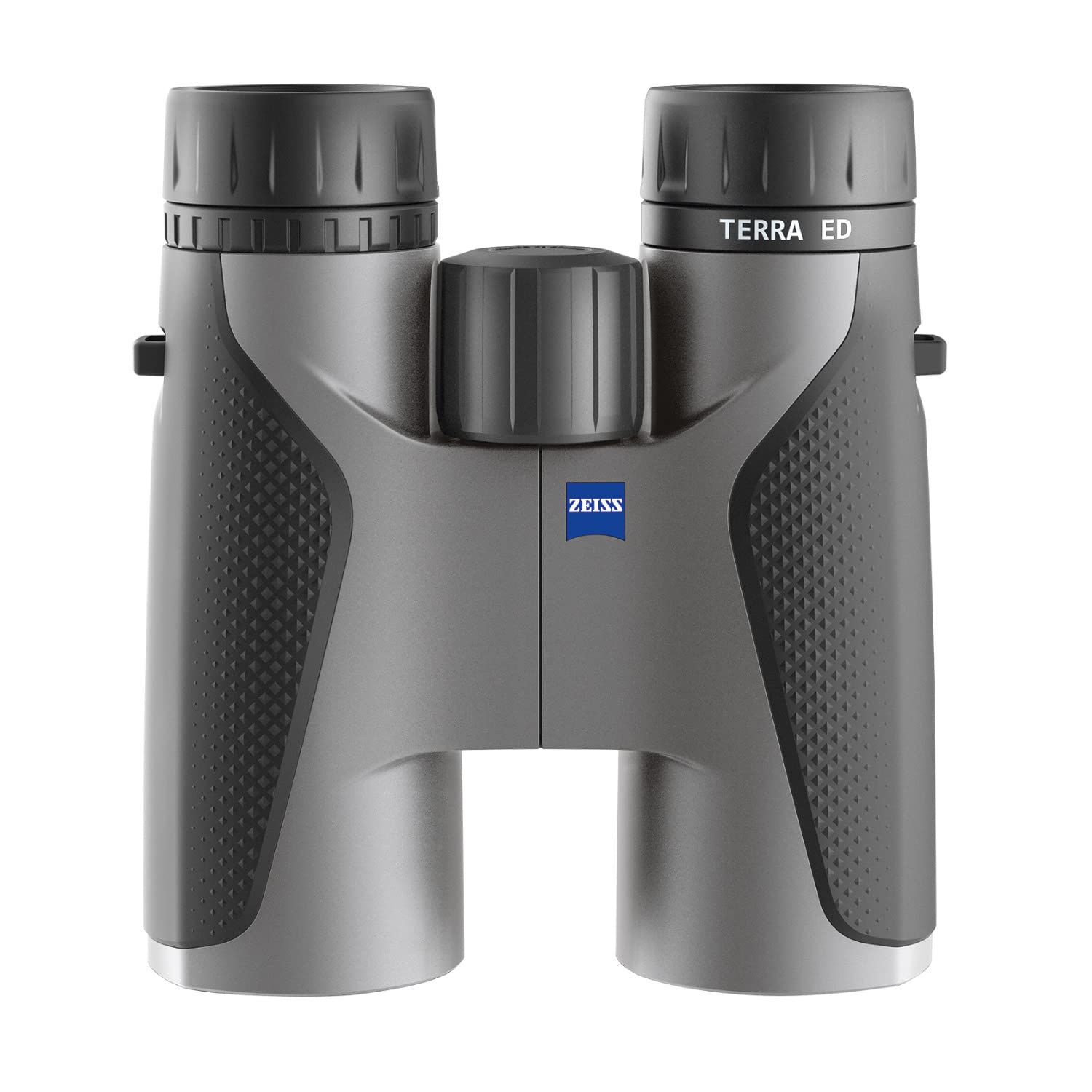
The ZEISS Terra ED 10×42 brings German optical engineering into the sub-$500 space, and the results are immediate. The Schmidt-Pechan prism system with ED glass achieves 88% light transmission, producing a bright, high-contrast image that reveals feather textures and subtle color variations that cheaper binoculars miss. The 10x magnification is ideal for open habitats where birds are at longer range.
The hydrophobic multi-coating on the lenses sheds water and resists smudges, which is genuinely useful when birding in damp mornings or near coastal spray. Eye relief at 18 mm is excellent for eyeglass wearers, providing a full field of view without vignetting. The fiberglass-reinforced polycarbonate body is lighter than magnesium alternatives, making it easy to carry on long hikes.
Field reports consistently crown this the best 10x option under $500, with many comparing its clarity favorably to Vortex and Nikon models in higher price brackets. The 330-foot field of view is narrower than the 8×42 version, which is expected with higher magnification. For the birder who needs reach without sacrificing image quality, this is a strong choice.
Why it’s great
- Zeiss ED glass and coatings deliver exceptional clarity and contrast
- Long 18 mm eye relief is ideal for eyeglass users
- Hydrophobic coating keeps lenses clear in wet conditions
Good to know
- 10x magnification narrows the field of view for close-range work
- Polycarbonate body feels less premium than metal builds
3. ZEISS Terra ED 8×42
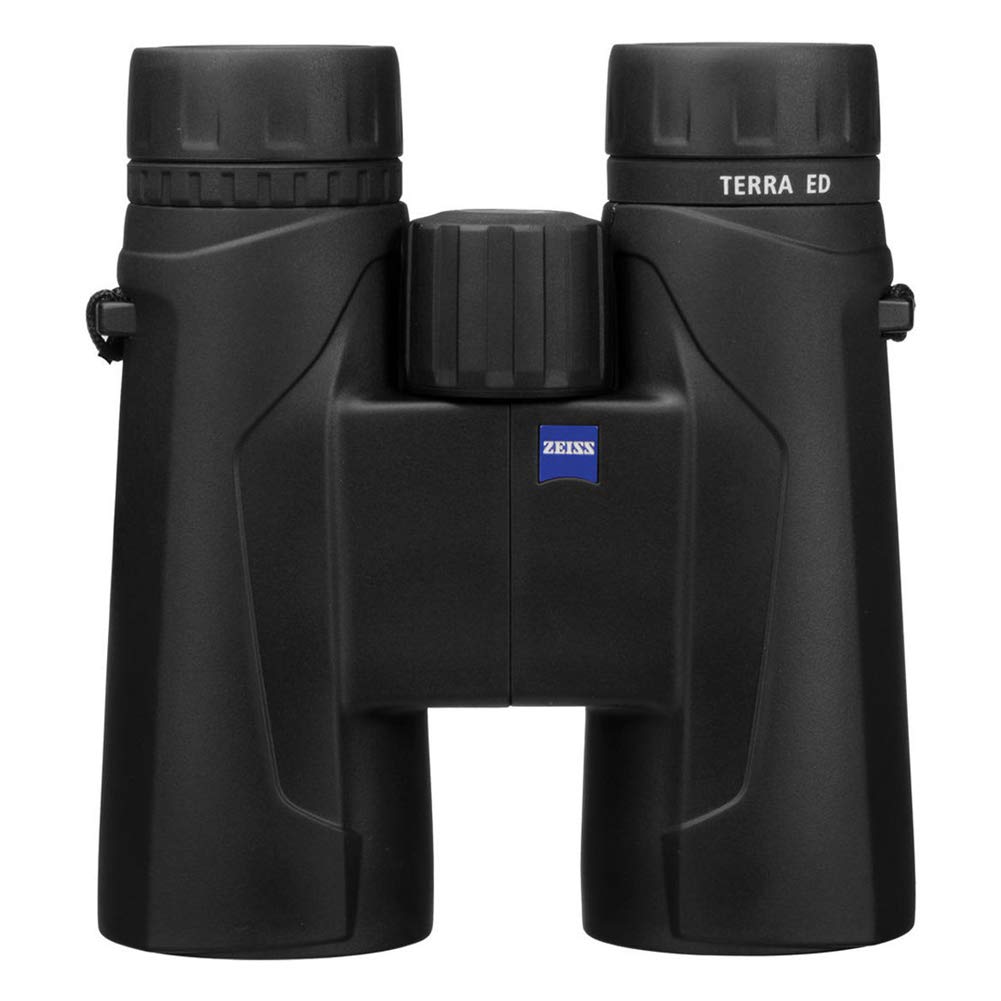
The 8×42 version of the ZEISS Terra ED swaps the reach of its 10x sibling for a noticeably wider field of view and easier hand-holding stability. This makes it the better choice for forested environments, where birds appear suddenly and move quickly through branches. The optical quality is identical — 88% light transmission and Schott ED glass produce vivid, aberration-free views.
The large focus wheel is positioned to fall naturally under the index finger, and the fast-focus gearing lets you snap from a bird at 20 feet to one at 200 feet with a quarter-turn. This responsiveness is a genuine advantage when tracking hyperactive species like kinglets or warblers. The included hard case and harness strap add real value for field use.
Customer feedback nearly universally praises the image quality, with many calling it the best binocular they have owned at this price. The 315-foot field of view is not the widest in this guide, but the image clarity and color accuracy more than compensate. For birders who prioritize optical purity over maximum FOV, this is a top contender.
Why it’s great
- Zeiss ED glass provides outstanding clarity and color accuracy
- Fast-focus wheel allows rapid target acquisition
- Hydrophobic coating maintains clear view in wet weather
Good to know
- Field of view narrower than some competitors at this price
- Polycarbonate body less rugged than magnesium frame
4. Celestron TrailSeeker 8×42

The Celestron TrailSeeker 8×42 is the value king of this list, offering optical performance that rivals models costing nearly twice as much. The key is its phase and dielectric coatings on BaK-4 prisms, which dramatically boost light transmission and contrast. The result is an image that appears brighter and more saturated than its price would suggest, with minimal chromatic aberration.
The magnesium alloy body keeps weight low while providing excellent durability, and the 426-foot field of view is wide enough for comfortable scanning. The close focus of 6.5 feet is exceptional for butterfly study or inspecting nearby flowers. Metal multi-stop eyecups are a durability upgrade over the plastic found on many competitors.
Frequent owner reports describe it as optically matching the Vortex Diamondback HD at a lower price point. The focus wheel tension is slightly lighter than ideal, but most users adjust quickly. For the birder who wants maximum performance per dollar, the TrailSeeker is a compelling choice.
Why it’s great
- Dielectric coatings deliver brightness usually found at higher prices
- Magnesium frame is light yet durable
- Wide field of view with 6.5-foot close focus
Good to know
- Focus wheel has slightly lighter tension than ideal
- Eyecups may feel shallow for some users
5. Vanguard Endeavor ED 10×42

The Vanguard Endeavor ED 10×42 is a purpose-built long-range instrument that rewards patient scanning. The ED glass and phase-coated BaK-4 prisms deliver sharp, color-accurate detail at distances where lesser binoculars lose resolution. The 340-foot field of view is standard for the 10×42 format, but the open-bridge design provides an unusually secure and comfortable grip.
The focus mechanism is exceptionally smooth, requiring only about three-quarters of a turn to go from minimum focus to infinity. This rapid adjustment is a boon when tracking a bird moving through varied distances. The locking diopter ring is another practical feature that prevents accidental changes during a session.
User reports consistently place it above the Leupold Cascade in side-by-side comparisons, praising the clarity and build quality. Some users note minor color fringing in high-contrast scenarios, but this is minimal and typical for the price. For dedicated long-range viewing at shorelines or fields, this is a solid performer.
Why it’s great
- ED glass and phase coatings deliver excellent long-range detail
- Open-bridge design provides ergonomic comfort
- Fast, smooth focus mechanism for quick adjustments
Good to know
- Minor chromatic aberration visible in extreme contrast
- Weight (25.8 oz) is noticeable on long walks
6. Wingspan Skyview 8×42

The Wingspan Skyview 8×42 distinguishes itself with a remarkably short close focus of roughly two meters, making it the best choice for birders who also want to inspect butterflies, dragonflies, or flowers at intimate range. The ED glass and phase-correction coatings produce a sharp, bright image with excellent color fidelity and minimal chromatic aberration throughout its focus range.
The field of view is 393 feet at 1,000 yards, which is slightly narrower than the Nikon M7 or Celestron TrailSeeker but still comfortable for general scanning. The rubber-armored body has thoughtful ergonomic features like thumb grooves that improve grip stability during long holds. The diopter adjustment is located on the body rather than the eyepiece, which is a preference point for some users.
Customer feedback highlights extraordinary clarity for the price, with many noting that the binocular reveals details — such as individual feather patterns at sixty yards — that were invisible through prior binoculars. The strap attachment can be fiddly, but the optical performance outweighs this inconvenience. For the birder who values versatility across distance ranges, this is a strong pick.
Why it’s great
- Exceptional close focus (2 meters) for butterfly and dragonfly study
- ED glass and phase coatings produce sharp, color-accurate images
- Lightweight and compact with ergonomic thumb grooves
Good to know
- Field of view is not the widest in its class
- Strap attachment system can be difficult to secure
7. Nikon TRAVELITE EX 8×25

The Nikon TRAVELITE EX is the most portable binocular in this lineup, and its compact size makes it a prime candidate for day hikes where every ounce counts. The 8×25 configuration uses multilayer-coated optics and an aspherical eyepiece to deliver a surprisingly sharp, color-true image for such a small package. The 12×25 variant is also available for those wanting more reach in the same compact form factor.
The nitrogen-purged body is waterproof to two meters and fogproof, ensuring reliable performance in changing weather conditions. The click-type diopter maintains its setting during transport, and the turn-and-slide eyecups accommodate eyeglass wearers with good eye relief. The field of view is understandably narrower than full-size binoculars, but adequate for general birding in open settings.
Reviews consistently mention how easy these binoculars are to carry, and how well they perform for their size. The compact design minimizes arm shake even at 12x magnification. For the birder who prioritizes pocketability and is willing to sacrifice some low-light performance, the TRAVELITE EX is a reliable travel companion.
Why it’s great
- Ultra-compact and lightweight for easy carry
- Waterproof and fogproof despite small size
- Clear, sharp image for a compact binocular
Good to know
- Small objective lens limits low-light performance
- Field of view is narrow compared to 42mm models
8. Sogries 12×50 ED

The Sogries 12×50 ED is a high-magnification binocular that brings ED glass and a wide 335-foot field of view to a configuration usually plagued with chromatic aberration. The fully multi-coated optics and BaK-4 roof prisms combine to deliver an image that is bright and sharp for a 12x model, with color fringing well-controlled. The 50mm objective lenses gather substantial light, making this usable even in low-light conditions.
The IPX7 waterproof rating means it can survive submersion, and the nitrogen filling prevents internal fogging in humid environments. The rubber-armored body has an ergonomic matte texture that provides a secure grip even when wet. At 12x magnification, a tripod adapter is recommended for extended viewing sessions, though many users find it steady enough for short bursts.
User feedback is overwhelmingly positive, with many comparing the clarity to binoculars costing significantly more. The weight is substantial due to the 50mm objectives, but the optical payoff is real. For the birder who wants the reach of 12x without the typical image degradation, this is a compelling choice.
Why it’s great
- ED glass controls chromatic aberration well for a 12x model
- IPX7 waterproofing for extreme weather reliability
- Wide field of view for a high-power binocular
Good to know
- 12x magnification requires steady hands or tripod for best results
- Weight is significant for extended handheld use
9. Celestron Outland X 10×50

The Celestron Outland X 10×50 is the budget-friendly entry point for birders who want the light-gathering advantages of a 50mm objective lens without stretching their budget. The multi-coated optics and BaK-4 prisms produce a bright image with good contrast, making this a capable choice for early-morning or late-afternoon birding sessions when light levels drop.
The 289-foot field of view is narrower than the 8×42 models in this list, which is expected for a 10x configuration. The rubber-armored polycarbonate body is rugged and waterproof, with nitrogen purging to prevent fogging in damp conditions. Built-in tripod adapter threads allow for stable viewing when needed, and the included accessories cover the basics.
Owner reviews consistently praise the clarity and value, with many noting its effectiveness for both birding and stargazing. The 17.4 mm eye relief is comfortable for most users. For the birder entering the hobby or looking for a secondary binocular that delivers solid performance at a modest cost, the Outland X is a practical choice.
Why it’s great
- 50mm objective lenses provide excellent light gathering
- Rugged polycarbonate body with full waterproofing
- Great value for a 10×50 configuration
Good to know
- Multi-coated optics are less effective than fully multi-coated alternatives
- Field of view is narrow due to 10x magnification
FAQ
Is ED glass worth the extra money under $500?
Should I choose 8x or 10x magnification for birding?
What does the IPX7 waterproof rating mean for binoculars?
Final Thoughts: The Verdict
For most users, the birding binoculars under $500 winner is the Nikon MONARCH M7 8×42 because it combines the widest field of view in its class with ED glass and a locking diopter, delivering an uncompromising viewing experience that handles everything from forest warblers to marsh hawks. If you want the precision of German optical engineering and a hydrophobic coating that sheds morning dew, grab the ZEISS Terra ED 8×42. And for the birder who prioritizes maximum value and dielectric-coated brightness without breaking the bank, nothing beats the Celestron TrailSeeker 8×42.