
Our readers keep the lights on and the weekend projects moving. As an Amazon Associate, I earn from qualifying purchases.
Birding demands a camera that can pull a distant sparrow off a branch three football fields away, resolve the iridescence on a hummingbird’s throat, and still be light enough to carry on a dawn trail. Phone cameras fail at this range, and bulky DSLR rigs with a 500mm lens cost a fortune and weigh down your pack. A dedicated bridge camera fills this gap — a single body with a built-in super-telephoto lens that delivers the equivalent of 1200mm, 2000mm, or even 3000mm of reach without changing glass.
I’m Rikta — the co-founder and writer behind FitlyFast. I’ve spent hours dissecting zoom ratios, stabilization systems, sensor sizes, and autofocus architectures to give you the clearest view of what each bridge camera actually delivers for birders.
Whether you need to identify the subtle wing pattern of a juvenile Cooper’s hawk or simply capture a sharp frame of a kingfisher mid-dive, choosing the right birding bridge camera hinges on how much reach and stabilization you can actually hand-hold in the field.
How To Choose The Best Birding Bridge Camera
Birding bridge cameras all look similar from the outside, but the internal specs that matter — zoom reach, stabilization fidelity, sensor noise handling, and autofocus reliability — vary widely. Understanding these four areas will prevent a purchase that leaves you with blurry warbler shots and a sore shoulder.
Optical Zoom Range and Equivalent Focal Length
The defining spec for birding is the optical zoom ratio expressed as the 35mm equivalent focal length at the telephoto end. A model with a 24-1200mm lens gives you 50x optical zoom; a 24-2000mm lens is roughly 83x; and the 24-3000mm lens hits 125x. More reach lets you fill the frame with a perched bird at greater distance, but every millimeter past 1500mm amplifies camera shake and atmospheric haze, often forcing you onto a tripod or monopod for crisp results.
Image Stabilization Performance
All bridge cameras include some form of optical image stabilization (OIS), but the effectiveness is measured in “stops” of shutter speed improvement. A system rated for 3.5 stops lets you shoot at 1/100s instead of 1/800s at full zoom. Panasonic’s POWER O.I.S. and Hybrid O.I.S. are known for smooth handheld performance up to around 1200mm. Nikon’s Dual Detect Optical VR on the P950 and P1000 is purpose-built for the extreme 2000mm and 3000mm ranges, though even the best stabilization can’t fully eliminate the need for a solid support at those lengths.
Sensor Size and Low-Light Capability
Every bridge camera in this category uses a 1/2.3-inch sensor — the same size found in many compact point-and-shoots. This small sensor limits dynamic range and creates visible noise above ISO 800. For birding in overcast forests or at dawn and dusk, models with a slightly wider maximum aperture at the telephoto end (f/5.6 or f/6.3 vs f/6.5) have a small advantage. No bridge camera will match a micro four-thirds or APS-C sensor for low-light bird photography, but raw file support helps you recover shadow detail in post.
Autofocus System and Burst Speed
Birding often requires tracking a moving subject. Contrast-detect autofocus is standard on these cameras, but the speed of the lens motor and the number of autofocus points vary. A camera that can shoot at 5 to 7 frames per second with continuous autofocus gives you a much better chance of catching a bird taking off or landing. Hybrid autofocus systems, like those in select Panasonic models, add phase-detect points that improve tracking reliability for birds in flight.
Quick Comparison
On smaller screens, swipe sideways to see the full table.
| Model | Category | Best For | Key Spec | Amazon |
|---|---|---|---|---|
| Nikon COOLPIX P1000 | Premium Superzoom | Maximum reach (3000mm) | 125x optical zoom | Amazon |
| Nikon COOLPIX P950 | Mid-Range Zoom | 83x optical / bird ID | 83x optical zoom | Amazon |
| Canon Powershot SX70 Renewed | Premium Compact | Travel + wildlife mix | 65x optical zoom | Amazon |
| Panasonic LUMIX FZ80D | Mid-Range Power | 4K video extraction | 60x optical zoom | Amazon |
| Panasonic LUMIX ZS99 (Silver) | Pocket Superzoom | Pocketable concert/travel | 30x optical zoom | Amazon |
| Panasonic LUMIX TZ/ZS99 (Black) | Pocket Superzoom | Leica lens pocket carry | 30x optical zoom | Amazon |
| Panasonic LUMIX TZ/ZS99 (White) | Pocket Superzoom | Discreet white body walk | 30x optical zoom | Amazon |
| Panasonic LUMIX ZS99 Bundle (Black) | Kit Superzoom | All-in-one starter kit | 30x optical zoom | Amazon |
| Leica V-LUX 3 | Legacy Premium | Leica glass / macro | 24x optical zoom | Amazon |
| Minolta Pro Shot 20MP | Entry-Level Zoom | Budget 67x zoom | 67x optical zoom | Amazon |
| Kodak PIXPRO AZ653 | Entry-Level Zoom | Budget 65x zoom | 65x optical zoom | Amazon |
In‑Depth Reviews
1. Nikon COOLPIX P1000
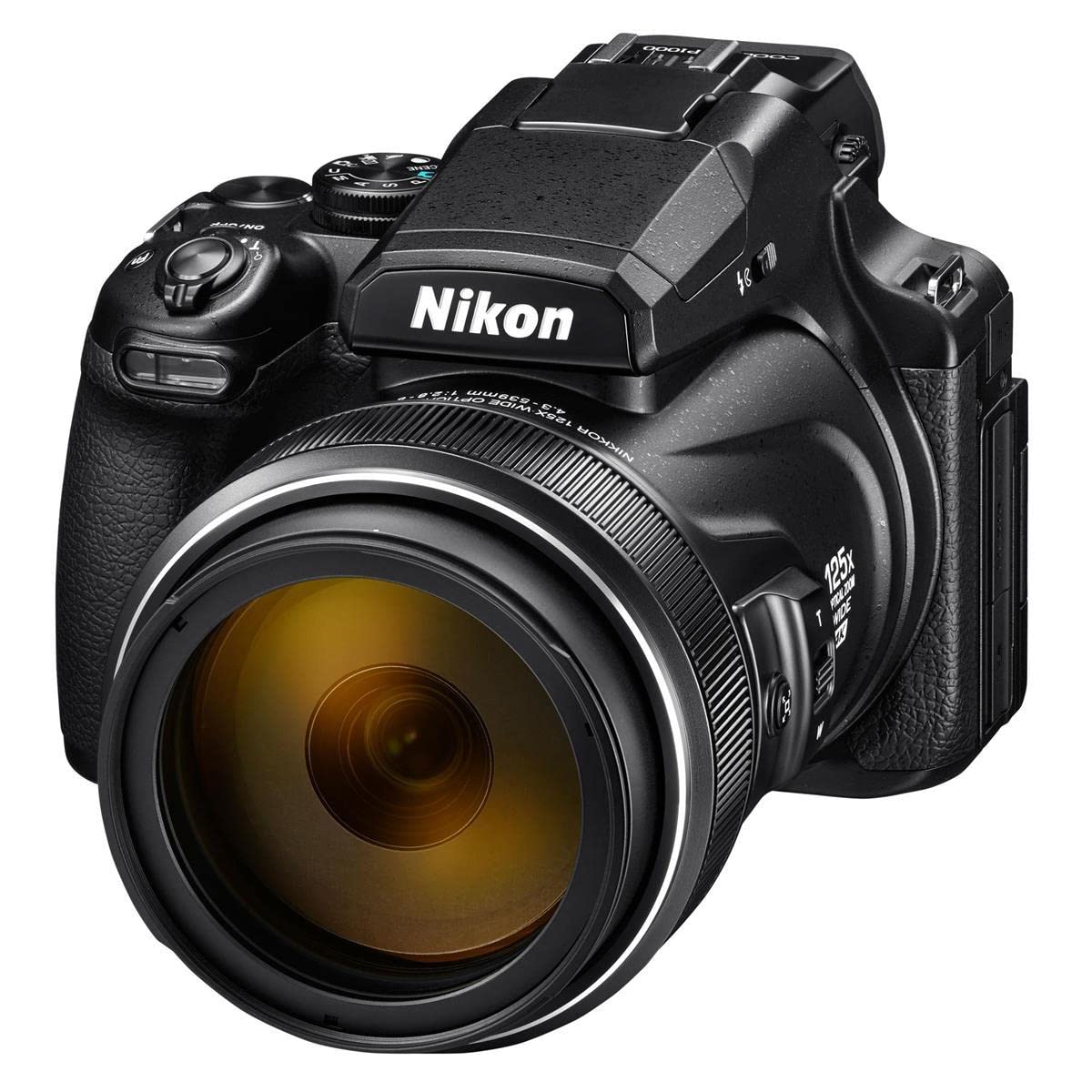
The Nikon COOLPIX P1000 delivers the longest optical zoom ever put on a bridge camera — 125x, reaching a full-frame equivalent of 3000mm. For birders who need to identify species at extreme distances or document the lunar surface detail next to a perched owl, this sheer reach is unmatched. The Dual Detect Optical VR stabilization helps hand-hold shots up to about 1500mm, but beyond that a monopod or tripod becomes essential for crisp frames.
In good daylight, the 16-megapixel sensor and raw format support produce images detailed enough for ID documentation and cropping. The vari-angle 3.2-inch LCD and high-resolution OLED electronic viewfinder (EVF) make composition easy in bright sun. Autofocus is contrast-detect and can struggle with fast-flying birds, especially at the telephoto end, but the manual focus ring is precise enough for experienced shooters to compensate.
The main trade-offs are bulk and weight — this camera is noticeably larger than the P950 and requires a dedicated bag. Battery life is adequate for a half-day shoot, but an extra battery is a wise investment. For anyone who demands the absolute maximum focal length in a single-lens solution, the P1000 is the definitive tool.
Why it’s great
- Unrivaled 3000mm optical reach captures birds others miss
- Raw format gives editing flexibility for shadow recovery
- Excellent EVF and vari-angle LCD for field use
Good to know
- Heavy and bulky for long hikes
- Stabilization needs a tripod beyond 1500mm
- Autofocus can hunt on fast-moving birds
2. Nikon COOLPIX P950

The Nikon COOLPIX P950 offers 83x optical zoom, reaching a 35mm equivalent of 2000mm, and includes dedicated Bird and Moon scene modes that automatically adjust shutter speed and exposure for common wildlife scenarios. This camera is a sweet spot for serious hobbyists who want massive reach without jumping to the P1000’s size and price. The 16-megapixel sensor produces good detail in bright conditions, and the raw format is available for post-processing.
Image stabilization is effective enough to hand-hold at 2000mm in good light, though a tripod still improves keeper rates. The vari-angle LCD and electronic viewfinder are clear and responsive. Autofocus is contrast-detect with a manual focus assist via the prominent lens ring — a feature birders rely on when the camera can’t decide on a distant twig. Burst shooting hits roughly 7 frames per second, which is fast enough for take-off sequences.
Where the P950 falls short is low-light performance; like all 1/2.3-inch sensor cameras, noise becomes visible above ISO 800. The macro mode is decent but not outstanding. For birders who need excellent reach in a manageable body, the P950 delivers the best balance of zoom, weight, and price in Nikon’s superzoom line.
Why it’s great
- Excellent 2000mm reach for bird ID
- Dedicated Bird and Moon scene modes
- Raw support and manual focus ring
Good to know
- Small sensor limits low-light quality
- Autofocus occasionally hunts on zoomed subjects
- Macro performance is average
3. Canon Powershot SX70 Renewed

The Canon Powershot SX70 pairs a 65x optical zoom (21-1365mm equivalent) with a 20.3-megapixel CMOS sensor and the DIGIC 8 image processor, making it one of the higher-resolution bridge cameras in this comparison. The extra megapixels give you more cropping flexibility, which is useful for tight bird shots. 4K video and 4K time-lapse modes add creative options for documenting behavior.
The 0.39-inch OLED electronic viewfinder has roughly 2.36 million dots, providing a crisp view for framing. Tiltable 3-inch LCD and built-in Wi-Fi make sharing quick. Autofocus is contrast-detect with 99 points and works reliably for perched birds, though it can be slow in low contrast. The optical image stabilization is rated well for its class and helps at the telephoto end.
As a renewed unit, consistency of battery health and cosmetic condition can vary. The 65x zoom is powerful but falls short of the 83x and 125x options for extreme distance birding. For birders who value portability and 4K features alongside a solid 1365mm reach, the SX70 is a strong option.
Why it’s great
- High 20.3MP sensor for flexible cropping
- Sharp OLED EVF with good eye relief
- 4K video and time-lapse built in
Good to know
- Renewed condition may vary
- Autofocus can lag in low contrast
- Only 65x zoom vs some competitors
4. Panasonic LUMIX FZ80D

The Panasonic LUMIX FZ80D delivers a 60x optical zoom (20-1200mm equivalent) with POWER O.I.S. stabilization and the unique 4K Photo mode, which lets you extract 8-megapixel stills from 4K video bursts. For birders who miss the split-second of a kingfisher diving, this feature is a game-changer — you shoot video and pull the sharp frame later. The 2,360K-dot LVF electronic viewfinder is bright and clear even in direct sunlight.
Autofocus uses contrast detection with 39 points, and the Post Focus feature lets you shift the focal point after capture, which is handy when a branch partially obscures the bird. The camera is lightweight at roughly 1.3 pounds, making it comfortable for all-day hikes. The 4K video at 30p is solid for beginner-to-intermediate wildlife videography.
The main limitation is sensor noise: images get grainy above ISO 400, and low-light performance is the weakest of the premium-tier options. There is no Wi-Fi, so transferring images requires a card reader. For budget-conscious birders who value 4K extraction and decent 1200mm reach, the FZ80D is the best value pick.
Why it’s great
- 4K Photo extraction captures action perfectly
- Post Focus corrects focus after the shot
- Lightweight and easy to carry on trails
Good to know
- No Wi-Fi for quick sharing
- Image quality degrades above ISO 400
- Autofocus hunts in low light
5. Panasonic LUMIX ZS99 (Silver)

The Panasonic LUMIX ZS99 in silver packs a 30x optical zoom (24-720mm equivalent) into a body small enough to slip into a jacket pocket. This is the most portable option for birders who want a “always with you” camera for opportunistic sightings during travel or daily walks. The Leica DC lens is sharp through the zoom range, and the 20.3-megapixel sensor produces vibrant, detailed images.
Hybrid O.I.S. with 5-axis correction keeps 720mm shots steady, and the tiltable 1,840k-dot touchscreen is useful for low-angle shots. 4K video at 30p and 4K Photo burst capture add flexibility. Built-in Bluetooth 5.0 and Wi-Fi enable fast transfers to your phone via the Panasonic Image App.
The trade-off is the limited 720mm reach — enough for garden birds and large waterfowl, but insufficient for small warblers at distance. The small 1/2.3-inch sensor performs best in good light. This camera is a compromise for birders who prioritize pocketability over extreme telephoto reach.
Why it’s great
- Fits in a pocket for everyday carry
- Leica lens delivers sharp, contrasty images
- Excellent stabilization for a compact body
Good to know
- 720mm is limited for distant small birds
- Low-light performance is typical of small sensors
- No built-in electronic viewfinder
6. Panasonic LUMIX TZ/ZS99 (White)

The white version of the Panasonic LUMIX TZ/ZS99 offers the same 30x Leica zoom and 4K video capabilities as its black counterpart, but in a lighter, heat-reflective body that stays cooler in direct sun. For birders in tropical or desert environments, the white finish is a practical advantage. The 24-720mm lens covers wide landscapes and moderate telephoto shots of egrets, herons, and larger perching birds.
The tiltable touchscreen and USB-C charging are traveler-friendly features, and the dedicated Send Image button with Bluetooth 5.0 makes sharing IDs with fellow birders fast. The camera handles well in auto mode for beginners, while manual controls (P, A, S, M) satisfy more experienced shooters. 4K photo burst at 30 fps is useful for capturing quick wing stretches.
Like all ZS99 variants, the 720mm reach is insufficient for serious birding at range. The autofocus uses contrast detection, which can be slow in low contrast. For casual birders who value a white body for heat management and a compact form factor, this is a smart pick.
Why it’s great
- White body stays cooler in hot sun
- Compact enough for pocket carry
- Fast Bluetooth sharing for quick IDs
Good to know
- 720mm zoom is limited for small birds
- Contrast-detect autofocus in low contrast
- No EVF on this model
7. Panasonic LUMIX ZS99 Bundle (Black)
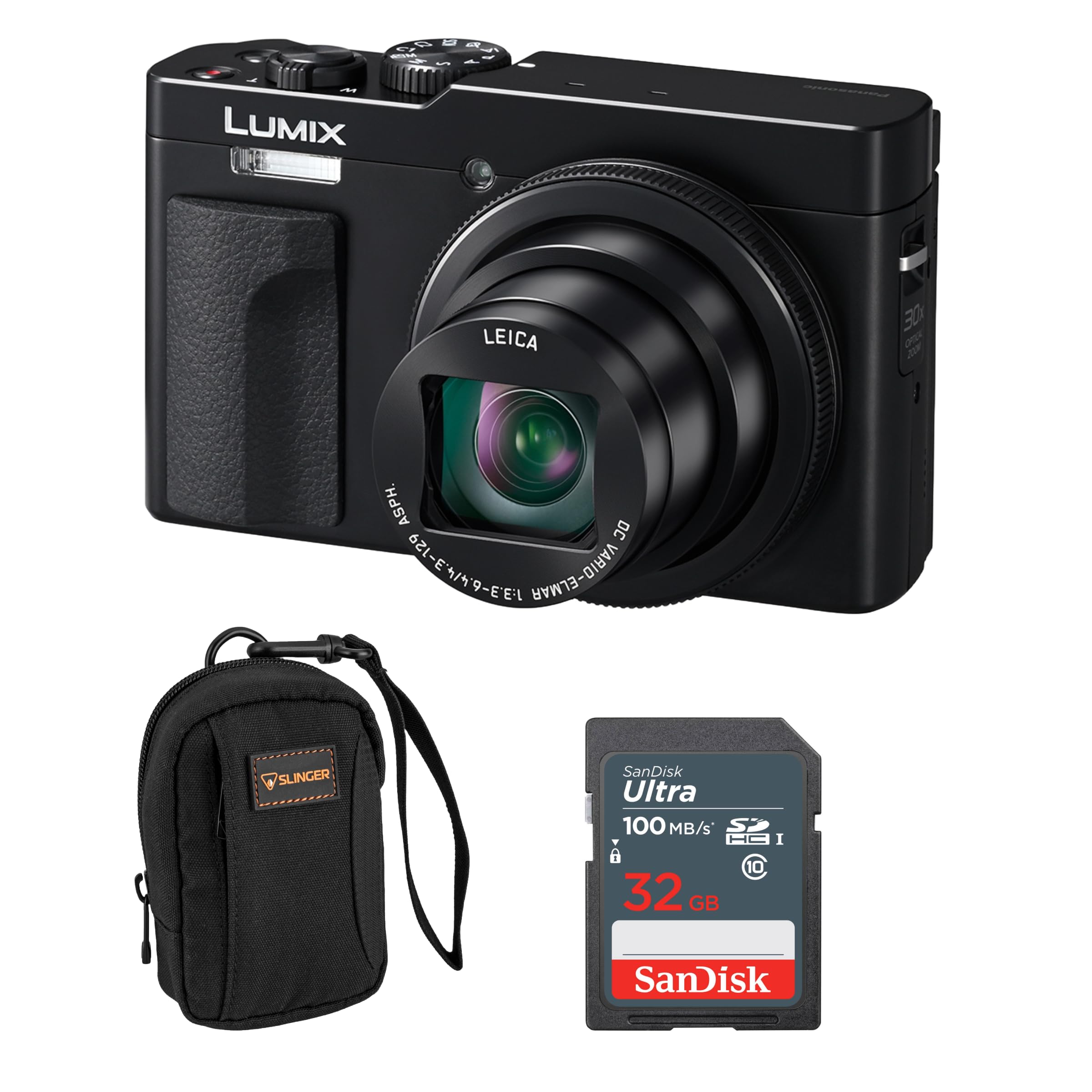
The Panasonic LUMIX ZS99 bundle in black includes the camera body, a Slinger Alpine camera bag, and a SanDisk 32GB SD card, making it a complete start-up kit for birders who don’t want to source accessories separately. The core camera is identical to other ZS99 variants — a 30x Leica zoom (24-720mm), 20.3MP sensor, 4K video, and Bluetooth/Wi-Fi connectivity in a pocket-sized body.
The included bag has enough padding for the camera and a spare battery, though it won’t accommodate a large tripod. The 32GB card holds roughly 1,200 raw images or about 30 minutes of 4K video, which is adequate for a day trip. The camera’s tiltable touchscreen and USB-C charging are appreciated for field use.
As with the other ZS99 models, the 720mm reach limits serious birding at distance. The bundle is ideal for casual birders or travelers who want a single purchase that covers the essentials and want a camera that fits in a small bag.
Why it’s great
- Ready-to-go kit with bag and SD card
- Leica lens quality in a very compact body
- USB-C charging and fast wireless sharing
Good to know
- 720mm reach is limiting for birding
- Bag is small, no tripod storage
- Low light performance typical of small sensors
8. Leica V-LUX 3

The Leica V-LUX 3 is an older model (released 2011) with a 24x optical zoom (25-600mm equivalent) and a 12.1-megapixel CMOS sensor. While the zoom range is modest by modern bridge camera standards, the Leica Vario-Elmarit lens produces exceptional color rendering and micro-contrast that makes feather details pop. In good light, the images have a character that exceeds what the spec sheet suggests.
Full HD video recording and a 3-inch LCD are functional but dated. The autofocus uses contrast detection and is slower than modern bridge cameras. The body feels solid but lightweight, and the macro mode focuses down to 1 cm for butterfly and flower shots. The 12.1-megapixel resolution is adequate for web sharing and small prints.
The V-LUX 3 is not suitable for modern birding demands — 600mm is short for most species, video is only 1080p, and the battery is not included in the box. Its value lies in the Leica lens quality for collectors or those who prioritize image character over reach. For practical birding, newer options with 60x to 125x zoom are far more capable.
Why it’s great
- Leica lens delivers superb color and contrast
- Excellent macro down to 1cm
- Solid build quality for its era
Good to know
- Only 600mm reach, short for birding
- Slow autofocus by modern standards
- Battery not included; older model
9. Kodak PIXPRO AZ653
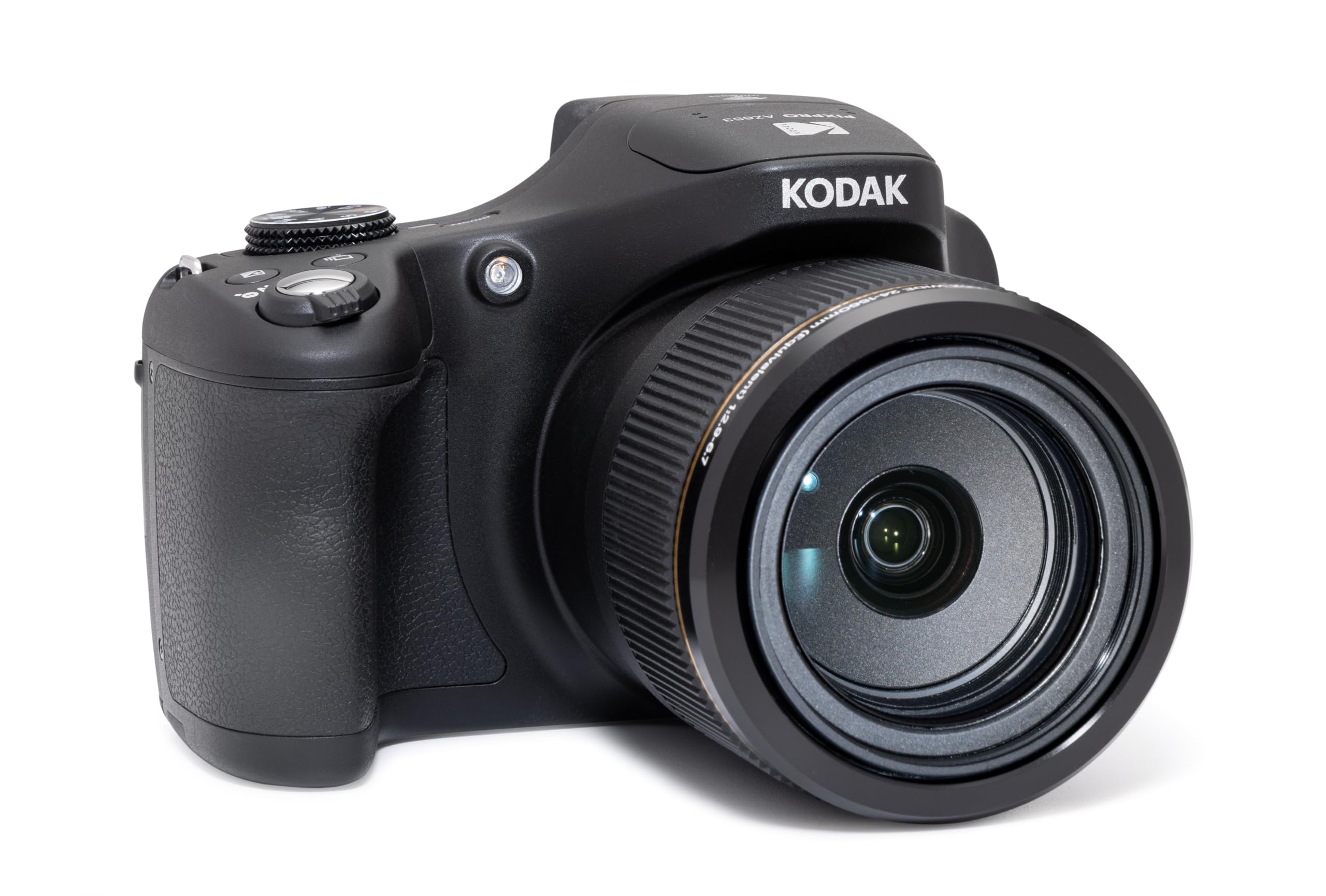
The Kodak PIXPRO AZ653 offers a 65x optical zoom (24-1560mm equivalent) with a 20-megapixel BSI CMOS sensor and optical image stabilization at a competitive entry point. The 1560mm reach is sufficient for mid-distance birding — herons, egrets, and larger waterfowl fill the frame well. The 3-inch LCD and diopter-adjustable electronic viewfinder provide clear composition.
Full HD 1080p video at 30 fps is acceptable for casual clips, and the PIXPRO Remote Viewer app enables wireless transfer of stills to a smartphone. The camera supports raw file capture, allowing for post-processing latitude. Burst shooting reaches 5 fps, which is adequate for slow action sequences.
The build quality feels less robust than Panasonic or Nikon options, and the autofocus can be slow in low light. The fixed LCD screen is a limitation for low-angle bird photography. For birders on a strict budget who need 65x zoom capability and are willing to accept slower operation, the AZ653 is a functional entry-level tool.
Why it’s great
- Budget-friendly 1560mm reach
- Raw file support for editing
- Wireless transfer via app
Good to know
- Fixed LCD limits low-angle shots
- Autofocus is slow in dim light
- Build feels less premium than competitors
10. Minolta Pro Shot 20MP

The Minolta Pro Shot 20MP provides 67x optical zoom (roughly 20-1340mm equivalent) and a 20-megapixel sensor with optical image stabilization, all at a very accessible price point. The zoom range is competitive for its class, and the included 16GB SD card and basic accessories make it a grab-and-go option for beginning birders. The articulating 3-inch LCD is a rare and valuable feature at this price level, allowing low-angle shots.
Smart features include face, smile, and blink detection, along with 27 scene modes that simplify shooting. Wi-Fi connectivity enables remote control and image transfer via the Minolta app. The camera records Full HD 1080p video at 30 fps, adequate for casual documentation.
Reliability reviews are mixed, with some units experiencing battery drain and quality control issues. The menus are reportedly unintuitive, requiring a learning curve. Image quality at full zoom is acceptable in good light but degrades quickly in overcast conditions. For absolute beginners who prioritize zoom reach and articulating screen over build consistency, the Minolta Pro Shot is a starting point.
Why it’s great
- Articulating LCD screen for low-angle bird shots
- Competitive 67x zoom at this price
- Wi-Fi remote control functionality
Good to know
- Mixed reliability reports from users
- Complex and unintuitive menu system
- Image quality drops in low light
11. Minolta Pro Shot 20MP (Red)
The red variant of the Minolta Pro Shot 20MP shares identical specifications with the standard model — 67x optical zoom, 20-megapixel sensor, optical image stabilization, Full HD video, and Wi-Fi connectivity. The red color is a purely aesthetic choice, but it can make the camera easier to spot in a cluttered bag or on a trail bench.
The 67x zoom provides solid reach for a budget birding camera, and the articulating LCD is genuinely useful for shooting from ground level at waterfowl or other low-perching species. Scene modes tailored to different lighting conditions help beginners get usable results without diving into manual settings.
The same reliability concerns apply as the standard model — some units arrive with battery issues or card reader defects. The menus remain a weak point, and autofocus can be inconsistent at full telephoto. For budget-conscious birders who prefer a red body for visibility or style, this camera offers the same capabilities as its neutral-colored counterpart.
Why it’s great
- Red body is easy to spot in the field
- Articulating LCD for creative bird angles
- 67x zoom at a very accessible price
Good to know
- Same inconsistent reliability as standard model
- Menus are confusing for new users
- Limited low-light and fast-motion performance
FAQ
What is the best focal length for bird photography with a bridge camera?
Do birding bridge cameras work well in low light?
Can I shoot birds in flight with a bridge camera?
Is raw format support important for a birding bridge camera?
How much zoom do I need for backyard birding?
Final Thoughts: The Verdict
For most users, the birding bridge camera winner is the Nikon COOLPIX P950 because it delivers the best balance of 2000mm reach, dedicated bird scene modes, raw support, and manageable size for hiking. If you want the absolute maximum reach for distant species and moon detail, grab the Nikon COOLPIX P1000. And for budget-conscious birders who value 4K photo extraction and lightweight portability, nothing beats the Panasonic LUMIX FZ80D.