
Our readers keep the lights on and the weekend projects moving. As an Amazon Associate, I earn from qualifying purchases.
Choosing a birding scope means committing to hours of sharp, stable glassing — whether you’re picking out feather detail on a distant heron or counting the bands on a duck’s wing at dawn. A mediocre scope delivers haze, chromatic aberration, and eye fatigue that turns an afternoon of birding into a chore. A well-chosen one becomes the lens through which you rediscover the field.
I’m Rikta — the co-founder and writer behind FitlyFast. I’ve spent years dissecting optical specifications, comparing prism types, and analyzing lens coatings to separate genuine performance from marketing gloss in the spotting scope market.
This guide cuts through the confusion to help you find the right fit for your bin, your budget, and your local patch. This is the complete buyer’s manual for selecting your next birding scope.
How To Choose The Best Birding Scope
Selecting a birding scope involves balancing magnification range, objective lens size, glass quality, and ergonomics. A scope that works for open-water duck flights may be overkill for a woodland trail. Here are the critical factors to weigh before buying.
Objective Lens Diameter & Light Gathering
The objective lens (measured in millimeters) determines how much light enters the scope, directly impacting brightness at dawn and dusk. A larger lens (80mm or 85mm) provides a brighter image in low light but adds weight and bulk. A 65mm objective is more pack-friendly and sufficient for most daylight birding, while a 50mm or 60mm scope offers maximum portability for short hikes. Your local light conditions and the species you chase should dictate this choice.
Glass Quality & Coating Technology
The optical glass inside the scope dictates resolution, color accuracy, and contrast. Standard glass often shows chromatic aberration — a purple or green fringe around high-contrast edges like a white egret against a dark tree line. ED (Extra-low Dispersion) glass nearly eliminates this artifact, delivering true-to-life color and razor-sharp detail. Pair this with fully multi-coated lenses, which maximize light transmission across all air-to-glass surfaces, and a BAK4 prism, which produces a round, bright exit pupil instead of a clipped one.
Angled vs. Straight Eyepiece Design
An angled eyepiece positions your head naturally when the scope is mounted on a tripod at the correct height, making long sessions more comfortable. It also simplifies sharing the scope with others because the eyepiece angle stays consistent when the tripod rotates. A straight eyepiece is easier to acquire moving birds quickly, but often forces you to crouch or lean. Angled scopes also integrate more easily with digiscoping adapters and smartphones.
Magnification Range & Field of View
A 20-60x zoom range is the standard sweet spot for birding. At 20x you can scan a marsh for movement, and at 60x you can study a bird’s beak shape or leg bands. The trade-off is that at maximum magnification the image dims, the field of view narrows, and any tripod shake becomes amplified. Scopes with wider field-of-view numbers at 20x let you find and track birds faster before zooming in for detail.
Quick Comparison
On smaller screens, swipe sideways to see the full table.
| Model | Category | Best For | Key Spec | Amazon |
|---|---|---|---|---|
| Vortex Diamondback HD | Angled | All-day glassing & low-light | HD optical system with 85mm lens | Amazon |
| Celestron Regal M2 65ED | Angled | Digiscoping & general birding | ED glass, dual-speed focus | Amazon |
| Leupold SX-4 Pro Guide HD | Straight | Long-range clarity & durability | DiamondCoat 2 lens coating | Amazon |
| Maven CS.1 15-45×65 | Angled | Backcountry & packability | 2.5 lb weight, ED glass | Amazon |
| Gosky 20-60×80 | Angled | Value with wide-angle comfort | 55mm extra-large eyepiece | Amazon |
| Athlon Argos HD 20-60×85 | Angled | Budget HD glass | Argon-purged, 85mm objective | Amazon |
| Bushnell Trophy Xtreme | Straight | Entry-level ruggedness | Fully multi-coated, 1/4-20 mount | Amazon |
| Athlon Talos 20-60×80 | Straight | First scope for the range & field | Nitrogen-purged, aluminum body | Amazon |
| WOZEL 25-75×80 | Straight | Versatile starter kit | Fully multi-coated, BAK4 prism | Amazon |
In‑Depth Reviews
1. Vortex Optics Diamondback HD Spotting Scope

The Vortex Diamondback HD represents the point where price and performance converge for serious birders. Its 85mm objective lens gathers ample light for those twilight hours when warblers are active, and the HD optical system cuts chromatic aberration significantly — white birds against bright sky stay true without purple fringing. The built-in helical focus wheel allows fast, fine adjustments without overshooting your target.
Construction is robust with O-ring sealing and argon purging, ensuring the scope remains fogproof even when you move from a cold car to humid morning air. The rubber armor provides a confident grip, and the Arca-Swiss compatible foot means you can mount it directly on modern tripod heads without an extra plate. At 3.8 pounds it balances well on a mid-weight tripod.
The adjustable twist-up eyecups accommodate eyeglass wearers comfortably, and the built-in sunshade cuts glare on bright days. The included neoprene cover protects the body during transport. While the eye relief can feel tight to some users, the overall optical performance and Vortex’s unconditional lifetime warranty make this a scope you buy once and rely on for years.
Why it’s great
- Exceptional light transmission and color fidelity from the HD system.
- Arca-Swiss compatible foot eliminates need for adapter plates.
- VIP Warranty is unconditional, unlimited, and fully transferable.
Good to know
- Some users report minor chromatic aberration at high contrast edges.
- Requires a sturdy tripod due to the weight of the 85mm objective.
2. Celestron Regal M2 65ED Spotting Scope

Celestron’s Regal M2 65ED is a digiscoper’s dream. The extra-low dispersion glass delivers razor-sharp, color-corrected images that rival scopes costing significantly more, while the included T-mount adapter lets you attach a DSLR directly. The dual-speed focus — a fast coarse knob and a slow fine knob — allows pin-sharp adjustments, which is essential for capturing a bird’s eye on camera.
The rotating tripod mount with click stops makes switching between horizontal and vertical compositions effortless. At 4.5 pounds it feels solid, but the weight is biased toward the rear, so you’ll want a tripod head that can handle the imbalance. The 16-48x zoom eyepiece provides a wider low-power view than many 20-60x competitors, making it easier to locate your subject before zooming in.
Celestron’s proprietary XLT coatings — borrowed from their observatory telescopes — maximize light transmission, keeping images bright even at 48x in overcast conditions. The soft carrying case is padded and functional, and the build quality inspires confidence in varied weather. If digiscoping is your primary goal, this is the most complete package in its class.
Why it’s great
- ED glass virtually eliminates chromatic aberration for color-accurate images.
- T-mount adapter included for effortless DSLR digiscoping.
- Dual-speed focus mechanism enables precise fine-tuning.
Good to know
- Tail-heavy design may require repositioning the mounting ring for balance.
- Focus mechanism location can feel awkward on the first few outings.
3. Leupold SX-4 Pro Guide HD 20-60x85mm Spotting Scope

Leupold builds the SX-4 Pro Guide HD for the birder who needs absolute optical clarity in the most demanding conditions. The DiamondCoat 2 ion-assist lens coating delivers industry-leading light transmission and scratch resistance, meaning this scope stays bright and clear even after years of field use. The straight eyepiece design is excellent for quickly tracking birds in flight, and the built-in 1/4-20 rotatable tripod adapter makes mounting straightforward.
Optically, the SX-4 produces an incredibly bright and crisp image from 20x all the way to 60x. Color fidelity is outstanding — you’ll see the subtle iridescence on a Brewer’s Blackbird wing without any false tinting. Eye relief is generous for eyeglass wearers, and the fast-focus mechanism lets you acquire targets quickly. The 85mm objective gathers enough light for use during early morning or late evening birding sessions.
The aluminum housing is shrouded in a thick rubber armor that provides a secure grip in wet conditions. Leupold’s reputation for ruggedness is well-earned, and this scope feels like a tool built for decades. The trade-off is its larger size and premium price point. If your birding involves long distances, low light, and rough conditions, the SX-4 is a top-tier investment.
Why it’s great
- DiamondCoat 2 coatings maximize brightness and abrasion resistance.
- Exceptionally crisp and clear across the entire zoom range.
- Generous eye relief works well with prescription glasses.
Good to know
- Larger objective makes it less packable than 65mm competitors.
- Price premium over similar-spec scopes from other brands.
4. Maven CS.1 Spotting Scope 15-45x65mm

The Maven CS.1 is designed for the birder who hikes miles for a sighting. At just 2.5 pounds, it’s one of the lightest scopes on this list with premium ED glass, making it ideal for backcountry birding where every ounce matters. The 15-45x magnification range trades a bit of top-end reach for a wider low-power field of view, which helps you find birds moving through denser habitat.
Optical quality is superb for the weight class. The ED glass delivers crisp, true-color images with minimal chromatic aberration, and the fully multi-coated eyepiece design maintains brightness across the zoom range. The angled body is comfortable for tripod-mounted viewing, and the rotating tripod collar allows you to position the eyepiece perfectly without moving the tripod legs.
The waterproof and fogproof housing is built to withstand mountain weather, and the rubberized exterior provides a secure grip in cold or wet conditions. The double-sided microfiber bag protects the scope without adding bulk. The trade-off for the 65mm objective is slightly less light gathering at dawn and dusk compared to larger scopes, but the portability makes it a fair compromise.
Why it’s great
- Extremely lightweight at 40.4 oz for extended hiking.
- ED glass delivers sharp, color-accurate images that punch above the price.
- Rotating tripod collar provides flexible viewing angles.
Good to know
- Lacks a neoprene body armor for additional weather sealing.
- Magnification adjustment ring can feel stiff initially.
5. Gosky Spotting Scope 20-60×80
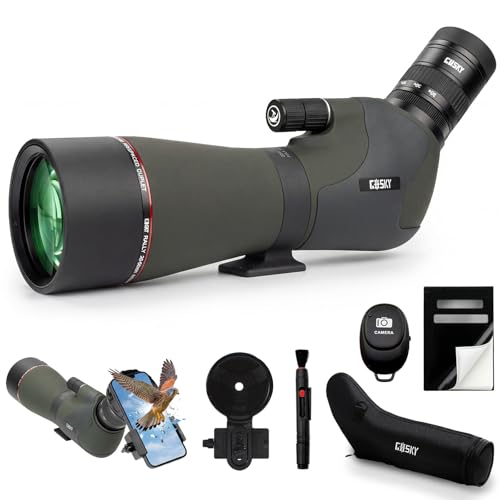
Gosky breaks the mold of budget scopes by prioritizing eyepiece comfort. The upgraded 55mm extra-large eyepiece significantly reduces eye strain during extended bird watching sessions, making this a fantastic choice for birders who glass for hours. The 20-60x zoom range covers all typical birding distances, and the 80mm objective lens gathers sufficient light for dawn starts.
The dual-speed focusing system — a coarse focus for quick target acquisition and a fine focus for sharp detail — works smoothly and intuitively. The angled body with a rotating ring allows easy sharing between multiple viewers, and the included smartphone adapter is functional for digiscoping. The IPX7 waterproof and fogproof rating means it can handle rain and humidity without fogging internally.
The BAK4 prism ensures a round exit pupil without shadow clipping, and the HD high-definition lenses produce an image that rivals scopes costing double. The carrying case is compact enough for day hikes but snug with the tripod mount attached. Some users find the fine focus knob a bit loose, but the overall optical performance and comfort at this price point is exceptional.
Why it’s great
- Extra-large 55mm eyepiece reduces eye fatigue over long glassing sessions.
- Dual-speed focus (coarse and fine) for precise adjustments.
- Excellent value with IPX7 waterproofing and BAK4 prism.
Good to know
- Fine focus knob can feel loose, leading to image shake at 60x.
- Included tripod is adequate but benefits from a heavier upgrade.
6. Athlon Optics Argos HD 20-60×85 Spotting Scope

The Athlon Argos HD is the gateway into true HD glass without breaking the budget. The 85mm objective lens and fully multi-coated optics provide bright, sharp images that reveal fine feather detail at distances well beyond typical binocular range. The image clarity is impressive for the price, with good color accuracy and contrast that makes bird identification easier in varied light.
The 45-degree angled eyepiece with a rotating tripod ring allows comfortable viewing at multiple heights, making it easy to share with a field partner. The focus ring is generously sized and smooth, and the twist-up eyepiece accommodates glasses. Argon purging ensures the scope stays fogproof in sudden temperature shifts, and the rubber-armored body absorbs the bumps of field use.
At 68 ounces, it’s not the lightest option, but it is well-balanced on a standard tripod. The included soft case provides decent protection. The primary limitation is that low-light performance begins to degrade above 40x, and the depth of field narrows significantly at 60x. For most daytime birding and mid-range distances, this scope delivers HD quality at a fraction of the cost of premium competitors.
Why it’s great
- HD glass provides sharp, color-accurate images at a mid-range price.
- Large 85mm objective gathers ample light for low-light birding.
- 45-degree angled eyepiece and rotating ring for flexible positioning.
Good to know
- Image quality softens at 60x, especially in low light.
- Heavier than compact 65mm scopes; requires a solid tripod.
7. Bushnell Trophy Xtreme Spotting Scope

Bushnell’s Trophy Xtreme is built for the birder who needs a tough, no-nonsense scope that can handle being thrown in the car or stuffed in a daypack. The body is ruggedized with a thick rubber armor, and it includes both a hard and soft case — a rarity at this price point. The fully multi-coated glass delivers a clear, bright image that is more than adequate for identifying common backyard and wetland species.
The included tabletop tripod and window mount add versatility, allowing you to set up in a blind or use it from a vehicle window. The 1/4-20 tripod mounting shoe is standard, so you can upgrade the tripod later. The straight eyepiece design makes it easy to acquire birds on the move, and the rubber cup provides comfortable eye placement.
While the glass doesn’t match the resolution or color fidelity of ED-equipped scopes, it punches well above its weight for the price. The primary drawback is the lack of an angled eyepiece option, which can lead to neck strain during prolonged use. The front lens cover fits loosely and may pop off in the field. For a first scope or a backup unit, the Trophy Xtreme offers solid durability and value.
Why it’s great
- Ruggedized body with both hard and soft cases included.
- Comes with window mount for vehicle-based birding.
- Fully multi-coated glass delivers a bright image for the price.
Good to know
- Straight eyepiece can cause neck fatigue during long sessions.
- Front lens cover fits loosely and may detach easily.
8. Athlon Optics Talos 20-60×80 Spotter Scope

The Athlon Talos is the scope I recommend to birders and shooters who want to dip their toe into spotting scopes without a large commitment. The 20-60x magnification range and 80mm objective are standard, but the nitrogen purging and fully multi-coated lenses are features usually found at higher price points. The image quality is clear enough to read license plates at half a mile and see individual daubs on a canvas at the range.
The aluminum body keeps the weight manageable for short hikes, and the included tabletop tripod is functional if not rock-solid. The straight eyepiece and simple two-knob system (focus and zoom) make operation intuitive. The sunshade is a nice addition for reducing glare on bright days, and the tethered objective lens cover prevents loss.
Where the Talos shows its price point is at the upper end of the zoom range — image quality drops after 40x, and the eye relief is short, which can be frustrating for eyeglass wearers. The tripod is stable enough for casual use but will amplify wind shake at high magnification. As a starter scope for daytime birding or as a backup for more serious optics, the Talos delivers excellent value.
Why it’s great
- Fully multi-coated lenses and nitrogen purging at an entry-level price.
- Lightweight aluminum body with a functional sunshade.
- Simple, intuitive focus and zoom knobs.
Good to know
- Image sharpness degrades beyond 40x magnification.
- Short eye relief can be problematic for glasses wearers.
9. WOZEL 25-75×80 Spotting Scope
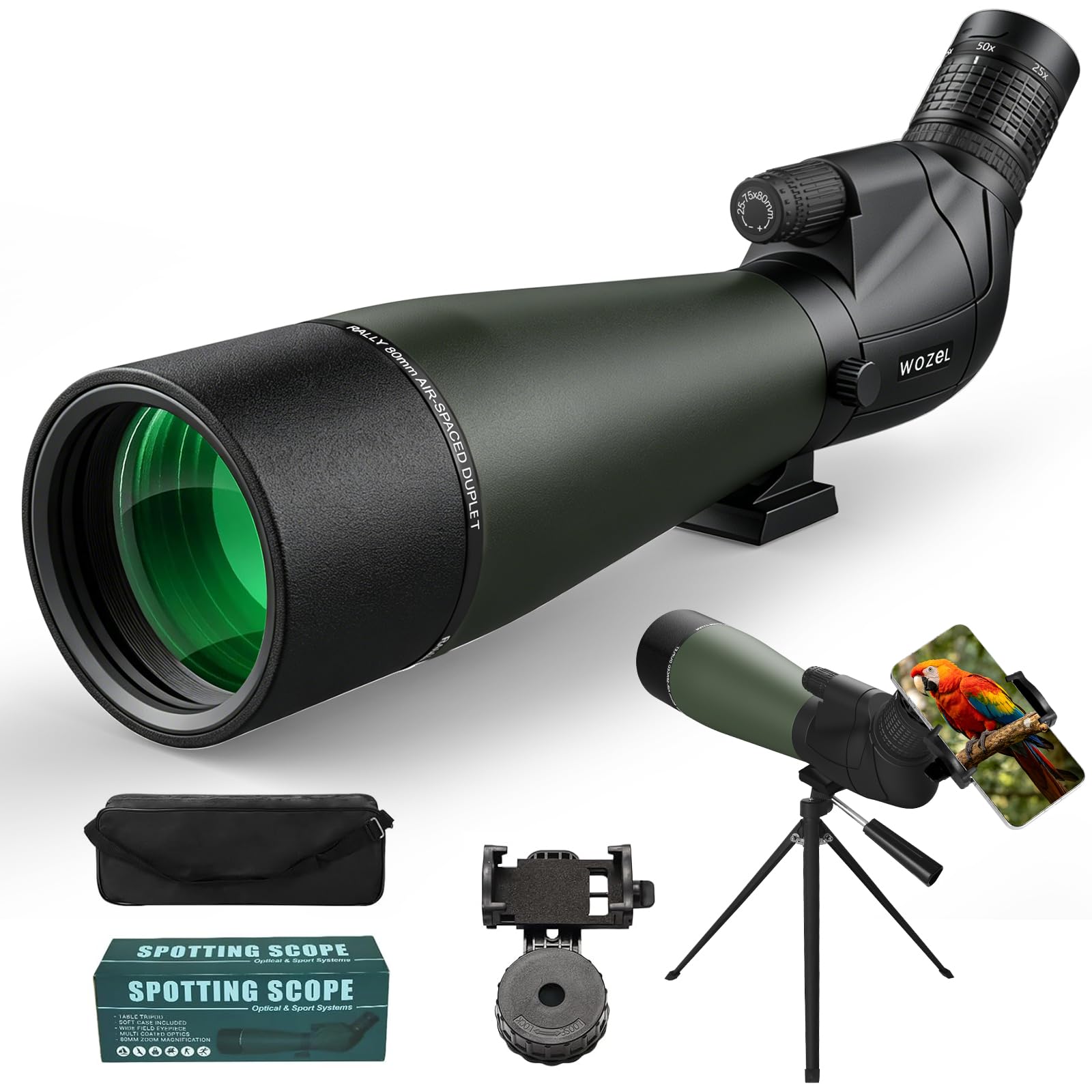
The WOZEL 25-75×80 is the complete kit for the birder on a tight budget. The set includes the scope, a tripod, a phone adapter, a carrying bag, lens covers, and a cleaning cloth — everything you need to start birding immediately. The 80mm fully multi-coated objective lens with a BAK4 prism delivers a surprisingly bright and crisp image for the price point, with good color fidelity for identifying warbler plumage.
The zoom range extends to 75x, which is higher than most scopes on this list. While this is useful for extreme long-distance viewing, the image does dim and shake becomes noticeable without a very stable tripod. The included tripod is functional at lower magnifications but will struggle at 75x in wind. The phone adapter is a nice addition for digiscoping, though aligning the phone lens can be finicky.
Build quality is solid for the price — the housing is nitrogen-filled and O-ring sealed, making it fully waterproof and fogproof. The retractable sunshade is a thoughtful feature for reducing glare. The scope excels for daytime birding and is a fantastic entry point for the hobby. Experienced birders may want to upgrade the tripod quickly, but the optical core of the kit is genuinely impressive for its cost.
Why it’s great
- Complete kit with scope, tripod, phone adapter, and carrying case.
- BAK4 prism and fully multi-coated lens deliver bright, clear images.
- Fully waterproof and fogproof with nitrogen-filled housing.
Good to know
- Included tripod is too flimsy for stable viewing at 75x.
- Phone adapter requires patience to align properly.
FAQ
What magnification range is best for birding?
Should I choose an angled or straight eyepiece for birding?
What does ED glass do for spotting scopes?
Can I use a spotting scope for digiscoping?
Is a larger objective lens always better for birding?
Final Thoughts: The Verdict
For most users, the birding scope winner is the Vortex Diamondback HD because it pairs exceptional HD optics with a rugged, argon-purged build and the industry’s best unconditional warranty — making it a reliable long-term partner for any birder. If you want digiscoping capabilities straight out of the box, grab the Celestron Regal M2 65ED. And for long-distance clarity in the toughest conditions, nothing beats the Leupold SX-4 Pro Guide HD.