
Cutting aluminum with the wrong saw blade is a fast track to ruined material, dangerous kickback, and a workshop floor covered in melted plastic gums. A standard wood-cutting blade grabs, heats up, and leaves jagged edges that require hours of filing. The solution is a blade designed specifically for non-ferrous metals, with a high tooth count and a specialized grind geometry that shears through aluminum extrusions, sheets, and tubes without snagging or burning.
I’m Rikta — the co-founder and writer behind FitlyFast. I’ve spent hundreds of hours cross-referencing tooth geometries, arbor sizes, and carbide compositions to identify which blades actually deliver on their promise of clean, burr-free cuts for the DIYer and the professional.
This buying guide breaks down the key specs and real-world performance of the top contenders to help you find the absolute best blade for cutting aluminum for your miter, table, or circular saw — no guesswork, no wasted cash.
How To Choose The Best Blade For Cutting Aluminum
Selecting an aluminum-cutting blade comes down to matching the blade’s physical specs to your saw type and the material thickness you cut most often. A few critical criteria separate a blade that lasts from one that dulls mid-cut.
Tooth Count and Grind Geometry
For aluminum, higher tooth counts (60 to 200 teeth for 10-inch blades) produce smoother finishes. The grind geometry matters even more. A Triple Chip Grind (TCG) alternates a beveled tooth with a flat raker, creating a scraping action that prevents the aluminum from grabbing the blade. Avoid Alternate Top Bevel (ATB) grinds, which can chip aluminum edges.
Hook Angle
Blades designed for non-ferrous metals typically have a negative or low hook angle (often -5° to 5°). This reduces the blade’s tendency to self-feed and grab the workpiece, giving you more control and preventing dangerous kickback. A standard 15° to 20° positive hook angle is a red flag for aluminum.
Coating and Plate Material
A non-stick coating (such as Perma-SHIELD or Black Ice) reduces friction, heat buildup, and material gumming on the blade body. Laser-cut stabilizer vents help dissipate noise and vibration, which directly translates to smoother cuts and longer blade life.
Quick Comparison
On smaller screens, swipe sideways to see the full table.
| Model | Category | Best For | Key Spec | Amazon |
|---|---|---|---|---|
| Diablo D1080N (10″) | Premium | Heavy daily use & thick extrusions | 80 TCG, -5° hook, Perma-SHIELD | Amazon |
| CRALY C10100AL (10″) | Premium | Thin stock & high-volume framing | 100 TCG, 2.5mm thin kerf | Amazon |
| Diablo D0756NA (7-1/4″) | Mid-Range | Cordless circular saw portability | 56 TCG, 7-1/4″ diameter | Amazon |
| TOMAX TMA10801 (10″) | Mid-Range | Budget-minded DIY hobbyists | 80 TCG, electrophoretic coating | Amazon |
| FOXBC FOX1080TCG (10″) | Value | Versatile non-ferrous & plastic | 80 TCG, 0.094″ kerf | Amazon |
| IVY Classic 35056 (10″) | Specialty | Ultra-thin aluminum & vinyl | 200 T, high-carbon steel | Amazon |
| Makita T-01410 (6-1/2″) | Compact | Fine crosscutting & cordless saws | 40T, 5/8″ arbor, thin kerf | Amazon |
In‑Depth Reviews
1. Diablo D1080N (10″)
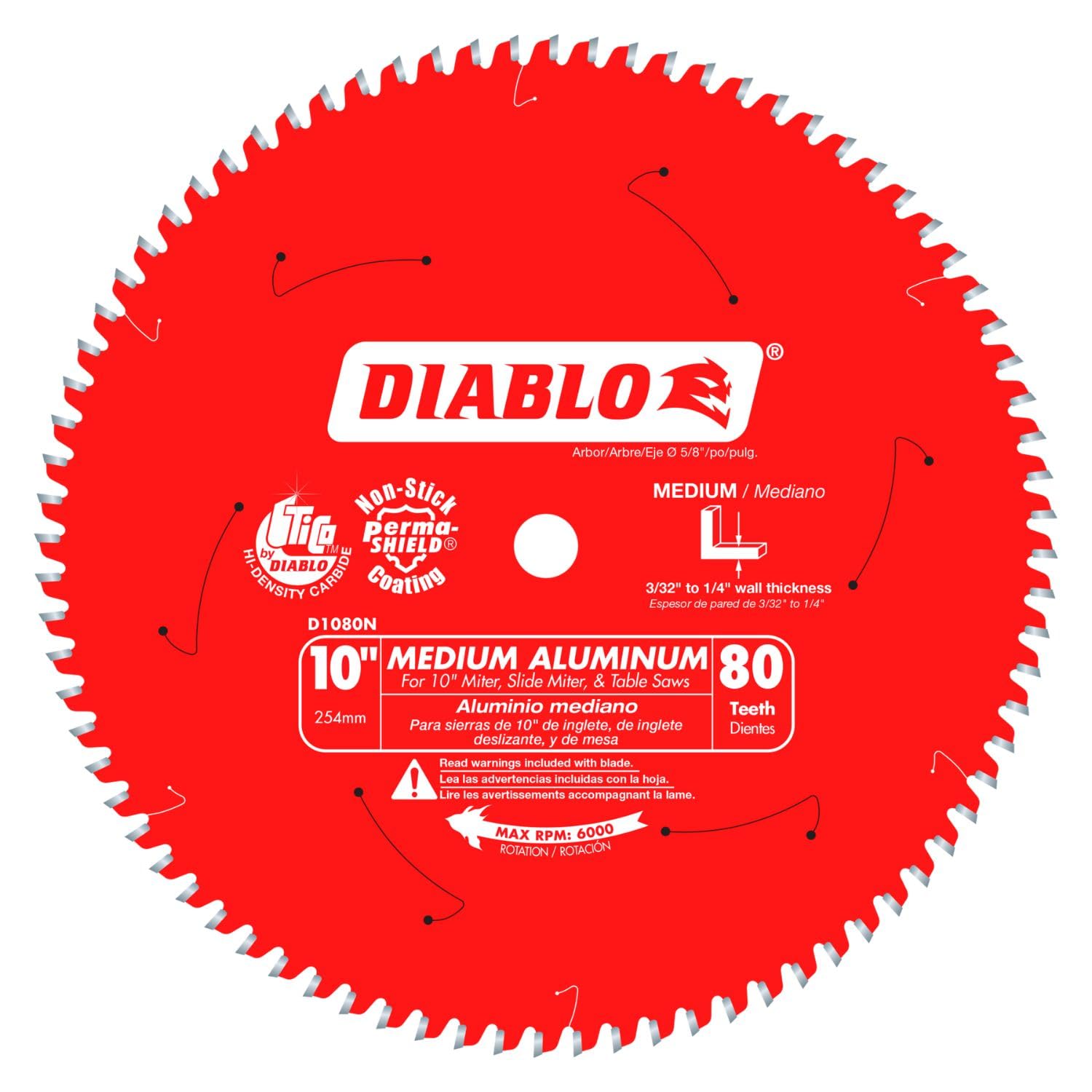
The Diablo D1080N is the benchmark for serious aluminum cutting. Its 80-tooth TCG grind paired with a -5° negative hook angle gives you total control on a miter or table saw — the blade won’t grab the stock, reducing the risk of dangerous self-feeding. The TiCo micro-grain carbide tips are bonded with Tri-Metal Shock-Resistant Brazing, meaning this blade takes the repeated shock of cutting 6061 extrusions and T-slot profiles without chipping.
Real-world users report it cuts 1/16-inch aluminum sheet perfectly and produces a sanding-free edge on ABS and acrylic. The Perma-SHIELD non-stick coating keeps gumming to a minimum, and the laser-cut stabilizer vents noticeably reduce the high-pitched ring that cheaper blades produce. At a 0.094-inch kerf with a 0.071-inch plate, it strikes a fine balance between waste and stability.
The only real downside is its price point — it sits at the high end of the market. But for anyone cutting aluminum daily on a 10-inch saw, the D1080N pays for itself in reduced rework and extended sharpness. It is the definitive pick for the professional shop or the fastidious hobbyist.
Why it’s great
- Exceptional burr-free cuts on thick extrusions
- Negative hook angle adds critical safety control
- Non-stick coating resists aluminum gumming
Good to know
- Higher per-blade cost compared to value options
- Not optimized for thin sheet stock under 1/16″
2. CRALY C10100AL (10″)
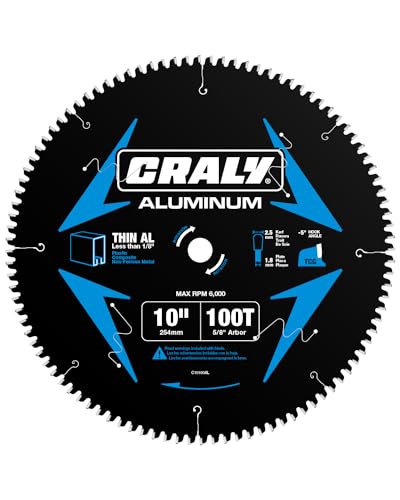
The CRALY C10100AL packs 100 TCG teeth into a 10-inch format, making it one of the highest tooth counts you can get without jumping to a specialty steel blade. This tooth density is ideal for thin aluminum stock — closet rods, railing, and 1/8-inch sheet — where a lower tooth count would leave chatter marks. The thin kerf (2.5mm) also means less material waste and less strain on the saw motor.
The Black Ice non-stick coating does serious work preventing aluminum from welding onto the carbide tips, a common problem when cutting soft alloys. Users confirm over 100 cuts on closet rods with zero degradation in surface finish. Laser-cut expansion slots and stabilizer vents keep the blade running cool and quiet even during long framing runs.
Because this blade is designed for thin stock, it is not ideal for cutting heavy wall tubing or thick plates. Pushing it through 1/4-inch or thicker aluminum risks overheating the thin carbide. But for anyone cutting light-gauge aluminum, plastic, or composite materials, the CRALY delivers the smoothest finish in its class.
Why it’s great
- Ultra-smooth finish on thin aluminum railing and rods
- Non-stick coating reduces friction and gumming
- Thin kerf conserves motor power on cordless saws
Good to know
- Not recommended for heavy extrusions over 1/4″
- Thin carbide tips may dull faster on coarse stock
3. Diablo D0756NA (7-1/4″)
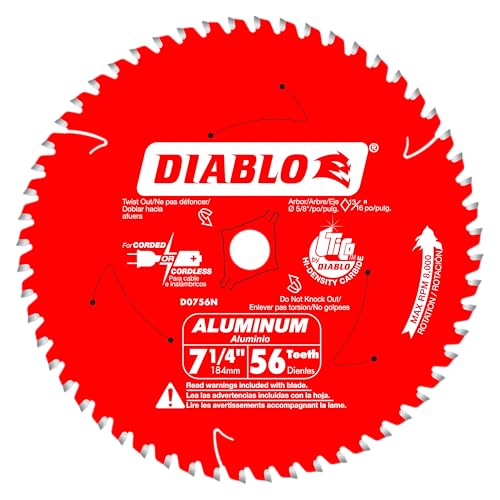
When you need portability, the Diablo D0756NA brings the same engineering as its larger sibling but in a 7-1/4-inch package that fits most cordless circular saws. With 56 TCG teeth and the same Tri-Metal Shock-Resistant Brazing, it handles thick aluminum plate (up to 1/4-inch) with surprising ease. Users report cutting 1/4-inch aluminum plate and angles on a DeWalt 20V saw with cuts cleaner than a plasma cutter.
The Perma-SHIELD non-stick coating and laser-cut stabilizer vents are present here too, keeping the blade cool during extended cuts. This is critical because cordless saws have less torque than corded models — the D0756NA’s thin kerf and TCG grind reduce drag, maximizing the number of cuts per battery charge.
The trade-off is that this is a dedicated metal-cutting blade — the manufacturer advises against using it on wood. Also, the smaller diameter limits depth of cut, so it is not the right choice for cutting 6-inch aluminum channels or large extrusions on a miter saw. But for on-site work with a circular saw, this is the gold standard.
Why it’s great
- Excellent for thick aluminum plate with cordless saws
- Tri-Metal brazing handles impact and shock
- Non-stick coating prevents gumming on long cuts
Good to know
- Not intended for wood or general-purpose use
- Small diameter limits capacity on deep cuts
4. TOMAX TMA10801 (10″)

The TOMAX TMA10801 is a classic mid-range option that punches above its weight for light-to-moderate aluminum work. Its 80-tooth TCG grind and electrophoretic coating provide decent corrosion resistance and a smooth cut on extrusions up to 1.5 inches. Users cutting 1/4-inch aluminum angle and schedule 80 PVC conduit on miter saws report clean edges with no melting.
Where this blade shines is on the hobbyist bench. If you are cutting a few aluminum beams for a shop jig or some PVC for a weekend project, the TOMAX delivers results comparable to blades costing significantly more. The limited lifetime warranty also adds peace of mind for the occasional user.
Heavy daily use reveals the limits: some users note vibration on older table saws and the cut finish is not as silky as premium options. Additionally, the labeling is printed on the wrong side for some saw orientations — a minor but annoying detail. It is a strong choice for the DIYer who needs an aluminum blade without the premium price tag.
Why it’s great
- Great price-to-performance for occasional use
- Cuts extrusions and PVC smoothly
- Limited lifetime warranty backs the purchase
Good to know
- Can vibrate on older or less rigid saws
- Label orientation may not match all saw setups
5. FOXBC FOX1080TCG (10″)

The FOXBC FOX1080TCG is a strong value proposition for anyone cutting a mix of non-ferrous metals and plastics. Its 80-tooth TCG geometry and high-density tungsten carbide tips cut thin (1/16-inch) to medium (1/4-inch) aluminum stock with a buttery smooth finish. Users praise its performance on flat bar, angle, and square tubing, noting it competes well with top-brand blades at a lower entry point.
This blade also handles plastics, fiberglass, and brass without chipping or melting, making it a versatile shop blade for someone who works with multiple materials. The laser-cut stabilizer vents effectively trap noise, so it runs quieter than many blades in this tier. It comes well-packaged with protective tubing, a detail that speaks to overall QC.
Longevity is the open question — most users report initial cuts are excellent but have not tested the blade over hundreds of cuts. For occasional or consistent medium-volume use, this is a smart buy. For a full-time fabrication shop, the premium-tier Diablo may edge it out on lifespan.
Why it’s great
- Smooth burr-free cuts on aluminum and brass
- Quieter operation due to stabilizer vents
- Versatile across multiple non-ferrous materials
Good to know
- Long-term durability still unproven in reviews
- May struggle with very thick extrusions over 1/2″
6. IVY Classic 35056 Swift Cut (10″)
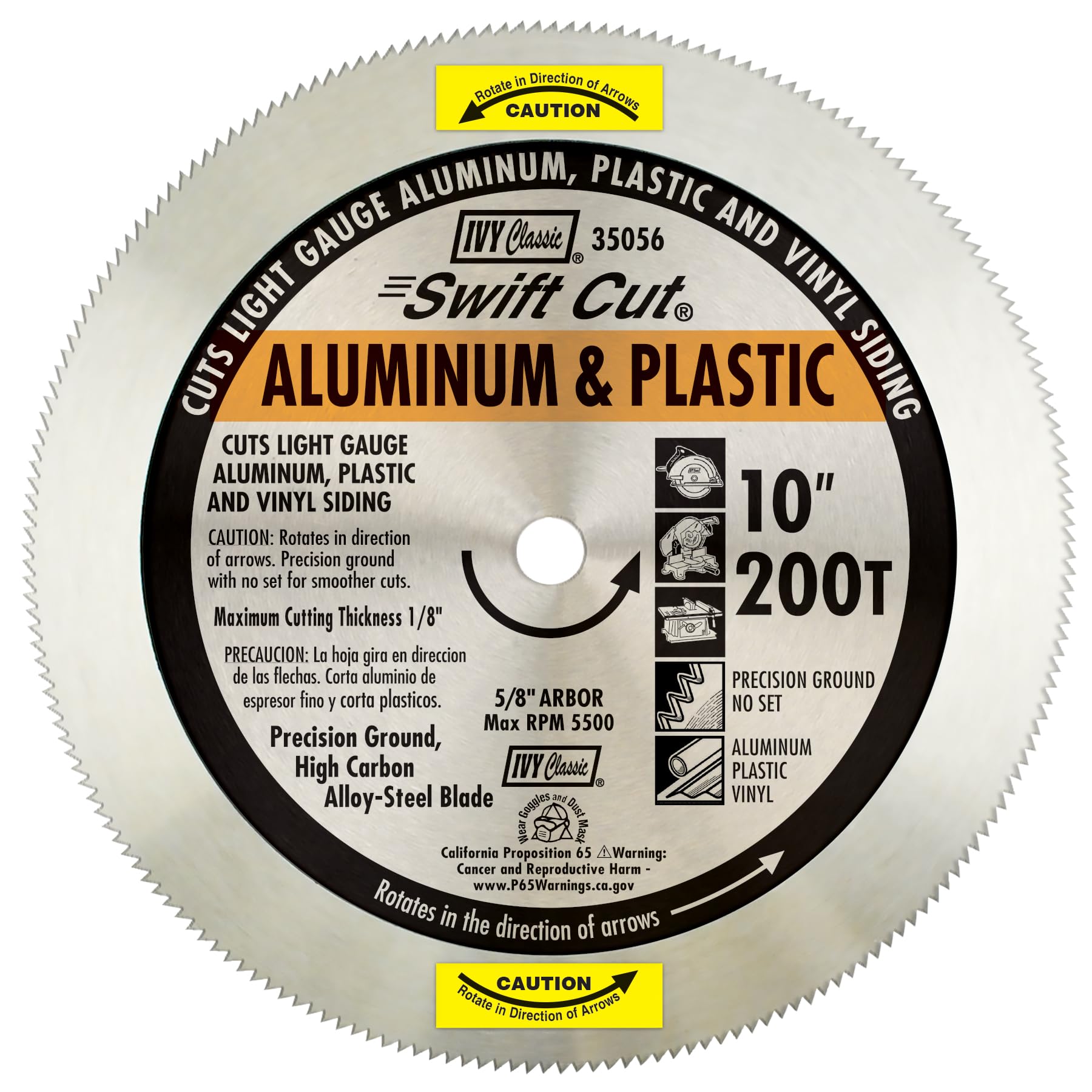
The IVY Classic 35056 Swift Cut is a highly specialized tool: a 200-tooth high-carbon alloy steel blade for cutting light gauge aluminum, plastic, and vinyl siding up to 1/8-inch thick. The precision-ground teeth have no set, which means they slice rather than saw, leaving an almost glass-like finish on plexiglass and thin sheet metal.
Users report accurate, clean cuts on plexiglass with no melting when maintained at a steady feed rate. For thin aluminum railing trim or vinyl siding, this blade is fast and leaves zero burrs. It is also very reasonably priced given its unique tooth count. The manufacturer explicitly warns that it is not for material thicker than 1/8-inch — pushing it risks blade failure.
The biggest downside is that it is a steel blade, not carbide-tipped, so it will dull faster on abrasive materials. Also, some units have the rotation arrow printed backwards from the factory, so double-check orientation before mounting. This is a laser-focused tool for a specific job — if that job is cutting thin, delicate materials, nothing else comes close at this price.
Why it’s great
- Extremely fine finish on thin sheet and plexiglass
- Very affordable for a 200-tooth blade
- No-set teeth eliminate chipping on delicate stock
Good to know
- Only safe for materials 1/8″ and under
- Steel body dulls faster than carbide-tipped blades
7. Makita T-01410 (6-1/2″)
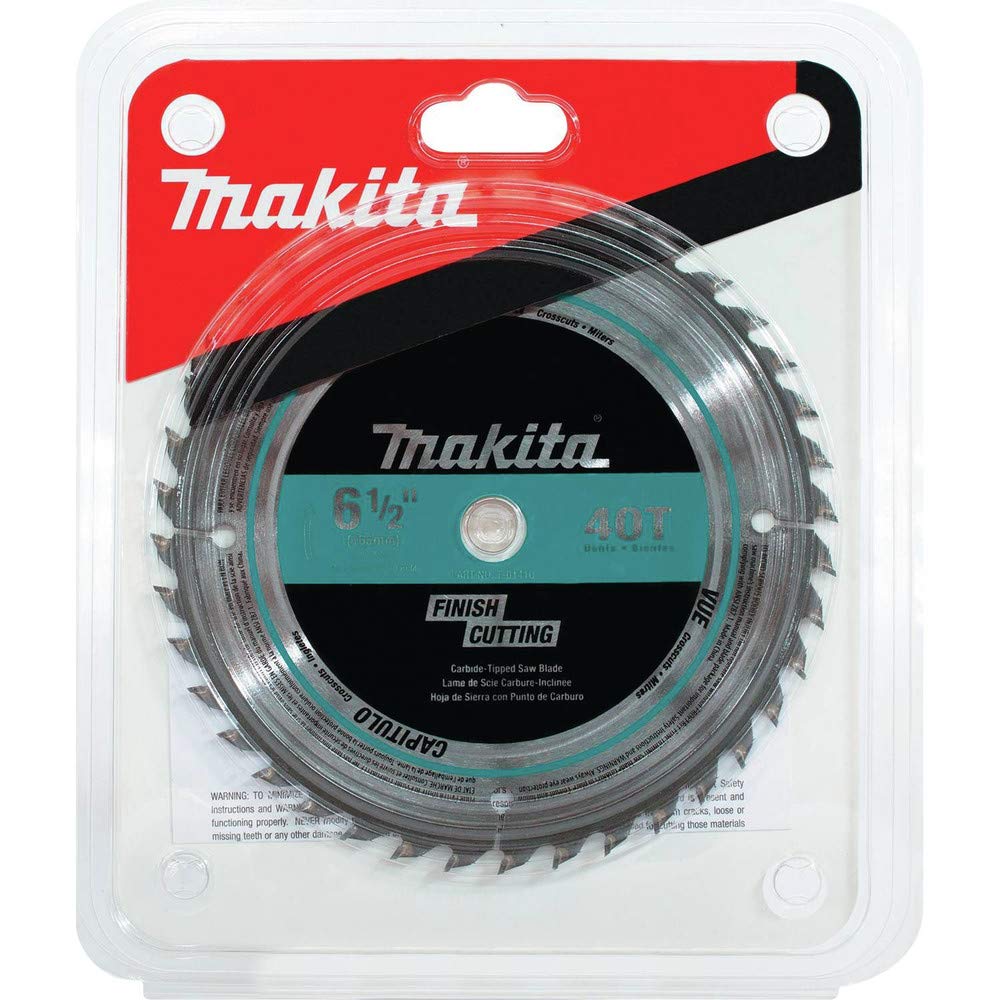
The Makita T-01410 is a 6-1/2-inch 40-tooth carbide-tipped blade designed specifically for cordless circular saws. Its ultra-thin kerf (0.05 inches) minimizes drag on the motor, giving you more cuts per battery charge. Users report it cuts laminate flooring and HDF with zero chipping, and it performs similarly on thin aluminum for finer trim work.
What makes this blade notable for aluminum cutting is its hand-tensioned steel plate, which ensures true, wobble-free rotation even in high-vibration cordless saws. The carbide tips are sharp out of the box and hold an edge well through moderate cutting sessions. Several users say it outperforms Diablo and DeWalt blades in this specific size class for clean crosscuts.
The limitation is the 40-tooth count — it is not as smooth as a 60- or 80-tooth blade on thicker aluminum sections. Also, the 6-1/2-inch diameter restricts depth of cut, so it is best for cutting sheet goods and thin stock. For anyone running a compact cordless circular saw who needs a dedicated fine-cut blade, this is a reliable, well-built choice.
Why it’s great
- Thin kerf extends cordless saw battery life
- Hand-tensioned plate ensures true cuts
- Outperforms some premium brands in same size
Good to know
- 40 teeth limit smoothness on thicker aluminum
- Small diameter restricts maximum cut depth
FAQ
Can I use a wood-cutting blade on aluminum?
What is the ideal tooth count for a 10-inch aluminum blade?
Do I need lubricant when cutting aluminum with a saw blade?
Why does my aluminum blade feel like it is grabbing the material?
Final Thoughts: The Verdict
For most users, the best blade for cutting aluminum winner is the Diablo D1080N because it combines a correct TCG grind, a safe negative hook angle, and the most durable carbide tips on the market for daily professional use. If you want the smoothest finish on thin aluminum railing and sheet stock, grab the CRALY C10100AL — its 100-tooth thin kerf design cuts like a laser. And for on-site portability with a cordless circular saw, nothing beats the Diablo D0756NA for cutting thick aluminum plate with a battery-powered tool.