
A diamond blade that binds, glazes over, or disintegrates halfway through a paved surface is not just a wasted accessory—it is lost time and a safety risk. Abrasive asphalt wears standard blades fast because the silica content in the mix works like sandpaper against the bond matrix, so the wrong choice means you are fighting the material instead of slicing through it.
I’m Rikta — the co-founder and writer behind FitlyFast. I’ve spent hundreds of hours analyzing diamond blade bond formulations, segment heights, and arbor compatibility across the most demanding cutting environments to separate short-lived knockoffs from tools that hold up under continuous use.
Whether you are patching a driveway, cutting expansion joints in fresh asphalt, or demolishing an old parking lot, the right tool makes the difference between a smooth job and a frustrating one. This guide breaks down the specifications that matter most to help you find the best blade for cutting asphalt that matches your saw and budget.
How To Choose The Best Blade For Cutting Asphalt
Asphalt is a composite of aggregate and bitumen, and its abrasive nature demands a diamond blade with a soft-to-medium bond that exposes fresh diamonds as it wears. A bond that is too hard polishes the diamonds rather than releasing them, turning the cutting edge into a smooth friction surface that generates heat and stalls. Understanding three critical specs will help you avoid that failure.
Bond Hardness and Diamond Grit
Soft-bond blades are formulated for hard, abrasive materials like asphalt and green concrete. The bond erodes at a controlled rate so new diamond particles are constantly exposed. A blade marketed as “general purpose” or “concrete only” usually uses a medium-to-hard bond that glazes over on asphalt, cutting slowly and wearing unevenly. Look for a blade explicitly labeled for asphalt or abrasive masonry materials.
Segment Design and Height
Segmented rims with deeper gullets clear slurry and debris better than continuous rims, preventing heat buildup. Undercut protection—a raised segment edge that reduces wear on the steel core—adds significant life. Segment height around 10–15 mm gives you more usable diamond before the blade is spent, which matters when you are cutting hundreds of linear feet.
Arbor Size and Saw Compatibility
Most walk-behind saws and large handheld cut-offs use a 1-inch arbor, but Asian and European models sometimes require a 20 mm or 25.4 mm bore. Many blades include a reducing ring or bushing to adapt between sizes. Verify your saw’s arbor diameter before buying and check that the included bushing matches it. Running a blade with the wrong arbor fit causes dangerous vibration and core damage.
Quick Comparison
On smaller screens, swipe sideways to see the full table.
| Model | Category | Best For | Key Spec | Amazon |
|---|---|---|---|---|
| Cougar HD Supreme | Heavy-Duty | Reinforced concrete & asphalt | Segment thickness 0.125 in | Amazon |
| RHAPSODY Asphalt Blade | Asphalt Specific | Green concrete & asphalt | Segment height 10 mm | Amazon |
| Trabo Segmented Rim | Multi-Masonry | Pavers & natural stone | Blade thickness 0.12 in | Amazon |
| Inwell Asphalt Cutting | Asphalt Specific | Thin precise cuts | Segment thickness 3.55 mm | Amazon |
| Bosch DB1241S | Mid-Range | Pavers & soft brick | Standard segmented rim | Amazon |
| ORIXTREME 14 in | General Purpose | Concrete & masonry | Segment height 15 mm | Amazon |
| ORIXTREME 12 in | Entry Level | Brick & block | Segment height 13 mm | Amazon |
In‑Depth Reviews
1. Cougar HD 14 Inch Supreme

The Cougar HD uses the highest diamond concentration in its class, and that density translates directly into cutting speed on reinforced concrete and asphalt. One contractor reported reducing a curb cut from 15 minutes down to 4–5 minutes, which is exactly the kind of time savings a professional needs when the saw is running. The drop-segment undercut protection prevents the steel core from wearing prematurely, so the blade stays usable longer even when you are grinding through hard aggregate and rebar.
The 14-inch diameter and 1-inch arbor (with included 20 mm bushing) fit most walk-behind saws and high-HP handheld cut-offs up to 5,460 rpm. Users who cut 180 linear feet through 50-year-old steel-reinforced slab reported minimal wear, and several noted the blade lasted an entire job where cheaper alternatives would have been replaced twice. The lifetime warranty against warping and cracking adds confidence for buyers who need a blade that can survive repeated heavy use.
It is the heaviest option on this list in terms of diamond density, and that premium comes with a premium price. For occasional light patching or small DIY cuts, the cost may be hard to justify, but for anyone who makes a living cutting asphalt and concrete, the Cougar HD pays for itself in reduced downtime.
Why it’s great
- Fastest cut speed on reinforced materials
- Undercut protection extends core life
- Covers asphalt, green concrete, and rebar
Good to know
- Premium price point not ideal for one-off jobs
- Heavier than general-purpose blades
2. RHAPSODY 14 Inch Asphalt Blade
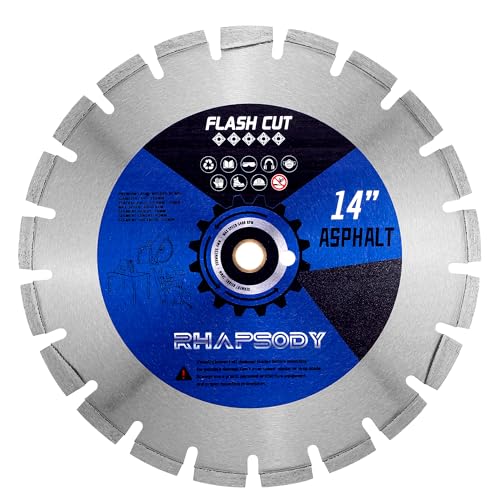
RHAPSODY designed this blade specifically for asphalt and green concrete (poured within 72 hours), and the wedge segments provide deliberate undercut protection that stops the core from wearing at the segment base. The deep U-shaped gullets improve air cooling and chip deflection, which is critical when you are dry cutting asphalt because the bitumen softens and clogs a standard gullet quickly. Users reported clean cuts on fresh slabs with no signs of dulling after 30 linear feet.
The 10 mm segment height is shorter than the 15 mm found on many concrete blades, but the softer bond formulation is what matters for abrasive materials. The blade comes with a 1-inch arbor and a 20 mm bushing, making it compatible with most handheld power saws and walk-behind models. At this price point, it hits a sweet spot for contractors who cut asphalt regularly but do not want to pay for the absolute top-tier diamond density.
One reviewer noted an imbalance issue at very high RPM on a Stihl TS420, causing vibration at full throttle. This appears to be a batch QC variation, but if you plan to run the blade on a high-horsepower masonry saw consistently, it is worth inspecting for wobble on first spin-up.
Why it’s great
- Specifically formulated for asphalt bond
- Wedge segments protect core from undercut
- Good value for regular asphalt work
Good to know
- Occasional QC imbalance reported at max RPM
- Shorter segment height than concrete blades
3. Trabo 14 Inch Segmented Rim
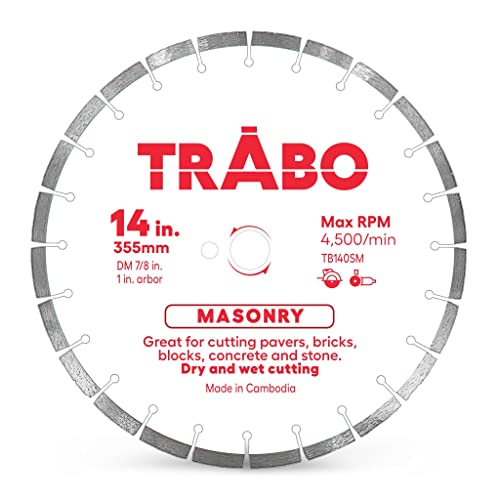
The Trabo blade is 0.12 inches thick with a carbon steel core, and it is designed to cut cement, pavers, concrete with rebar, and natural stone. One user specifically praised its performance on 20-year-old asphalt, describing cuts “like butter” on an 80-foot run at 1 to 1.75 inches deep with no binding. That kind of real-world testimonial matters because old asphalt often contains embedded gravel that would glaze a general-purpose blade.
It comes with a 1-inch arbor and a ⅞-inch brass reducing ring glued inside the package—make sure you find that ring before discarding the packaging. The blade works on angle grinders and circular saws, and it can cut wet or dry. The segmented rim clears debris effectively, and the diamond concentration is appropriate for multi-material jobs where you switch between pavers, block, and asphalt in the same day.
Some users noted it is not ideal for 4-inch thick concrete slabs; it shines on lighter masonry and asphalt surfaces. For heavy demolition of thick reinforced concrete, a thicker core blade with higher diamond density is a better match.
Why it’s great
- Excellent on old asphalt and pavers
- Brass reducing ring included
- Versatile across multiple materials
Good to know
- Not designed for thick reinforced concrete
- Reducing ring is easy to miss in packaging
4. Inwell 14 Inch Asphalt Cutting Blade
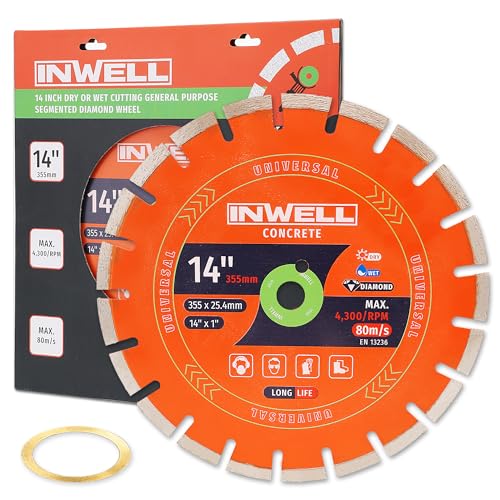
The Inwell blade is engineered for asphalt with a super-thin 3.55 mm kerf that minimizes material waste and reduces the load on your saw. Thinner kerf means less drag, which helps smaller handheld saws maintain RPM through the cut. The 12 mm segment height provides good diamond volume for the price, and the blade comes with a 20 mm reducing ring for arbor flexibility.
Users who cut granite, pavers, and retaining wall blocks reported consistent performance with appropriate wear rates. One reviewer noted it wore out after cutting two bathroom sink holes in granite—reasonable for a blade at this price tier. The manufacturer explicitly recommends it for dry or wet cutting of asphalt and concrete, so you can use it with or without water depending on your job site setup.
The thin profile is a double-edged sword: it reduces saw strain and waste, but it also means the blade has less structural mass to dissipate heat during long continuous cuts. For short-duration cuts on driveways and patios, it works well. For deep trench cuts that run 30 feet non-stop, a thicker blade handles thermal load better.
Why it’s great
- Thin kerf reduces saw load and waste
- Good segment height for the price
- Includes 20 mm reducing ring
Good to know
- Thin profile less forgiving on heat buildup
- Wears faster on very hard stone
5. Bosch DB1241S 12 Inch
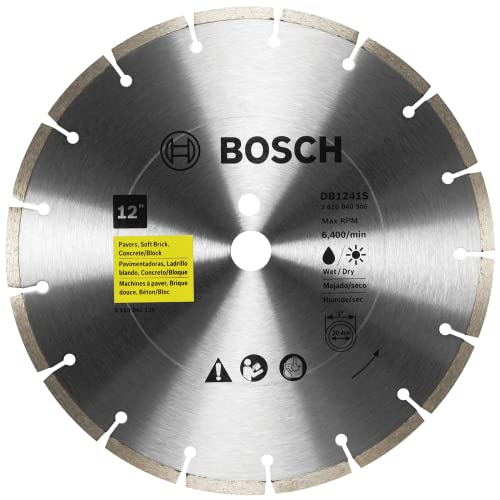
The Bosch DB1241S is a 12-inch segmented rim blade with a 1-inch arbor and a tensioned steel core that stays stable at speed. It uses a medium diamond bond formulated for universal rough cuts in pavers, soft brick, and concrete block. The taller segment height compared to lower-tier blades adds cutting life, and the consistent diamond distribution prevents uneven wear that would cause wobble.
Users consistently praise its performance on 2-inch concrete pavers, cutting quickly and smoothly on a circular saw with water cooling. Several reviewers noted it cuts through concrete blocks with no problem and holds up well for residential masonry projects. Bosch’s reputation for core stability means less vibration, which translates to cleaner cuts and less operator fatigue.
This blade is not intended for heavy asphalt work—the medium bond will glaze if used continuously on abrasive asphalt. It excels as a general-purpose masonry blade for pavers, block, and tile, and it is a solid backup blade to keep in the truck for smaller jobs where you do not want to wear out a premium asphalt-specific blade.
Why it’s great
- Tensioned core for low vibration
- Fast cuts on pavers and block
- Trusted brand with consistent QC
Good to know
- Medium bond not ideal for continuous asphalt
- 12-inch size limits depth on thick cuts
6. ORIXTREME 14 Inch Segmented
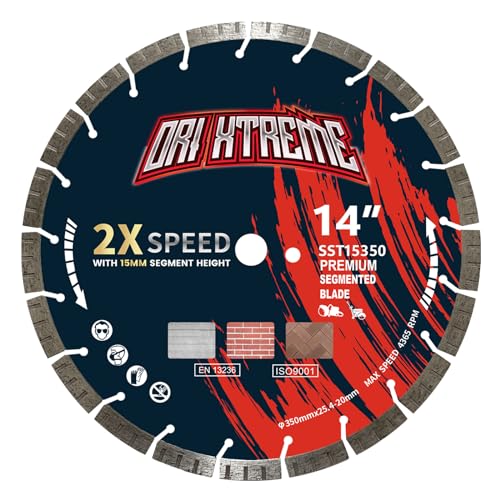
The ORIXTREME 14-inch blade features a 15 mm segment height—the tallest in this lineup—which provides more diamond volume and longer cutting life before the segments wear down to the core. It uses a segmented design with cooling slots that improve airflow and dissipate heat, making it suitable for wet or dry cutting of concrete, brick, block, stone, and masonry. The manufacturer explicitly notes it is not recommended for asphalt or green concrete, so treat it as a masonry specialist.
Users report cutting through 2 5/8-inch brick for about 80 cuts before noticing a slowdown, which is respectable for a mid-range blade. Several reviewers compared it favorably to blades costing more at big-box retailers, noting similar performance at a lower price. The 21-tooth design produces a smooth finish with minimal chipping on dense block.
The hard bond that gives it longevity on concrete is exactly what makes it unsuitable for asphalt. If you are cutting asphalt, this blade will glaze and generate excessive heat. Keep it for block, brick, and general concrete work, and switch to a soft-bond blade for asphalt jobs.
Why it’s great
- Tall 15 mm segments extend blade life
- Smooth cuts on brick and block
- Good value versus retail store blades
Good to know
- Not designed for asphalt or green concrete
- Hard bond glazes on abrasive materials
7. ORIXTREME 12 Inch Segmented

The 12-inch ORIXTREME is a compact segmented blade with a 13 mm segment height and a 1-inch arbor that accepts a 20 mm bushing. It is designed for construction workers, maintenance crews, and DIY users who operate circular saws, masonry saws, table saws, or handheld electric saws. The cooling slots improve airflow and dust removal, which helps maintain cutting speed during dry use.
Users report it cuts cleanly through paving bricks, concrete, and block with minimal chipping. One reviewer noted it lasted about 80 cuts through 2 5/8-inch brick before slowing, which is good for a blade in this size and price tier. Several users recommended it for light masonry work where a larger 14-inch blade would be overkill.
Like its 14-inch sibling, this blade is explicitly not recommended for asphalt or green concrete. The bond is too hard for abrasive materials, and using it on asphalt will cause glazing and premature failure. For cutting block, brick, and general concrete on a smaller saw, it is a capable and affordable option.
Why it’s great
- Compact size suits smaller saws
- Clean cuts on brick and block
- Affordable entry-level option
Good to know
- Not for cutting asphalt or green concrete
- Wears faster than taller segment blades
FAQ
Can I use a concrete blade to cut asphalt?
Should I cut asphalt wet or dry?
What diameter blade do I need for my saw?
How do I know when the blade is worn out?
Final Thoughts: The Verdict
For most users, the blade for cutting asphalt winner is the Cougar HD Supreme because it combines the highest diamond concentration with undercut protection for aggressive cutting speed and extended life. If you want a dedicated asphalt-specific blade at a lower price, grab the RHAPSODY Asphalt Blade. And for compact multi-material jobs where you switch between pavers and asphalt in the same day, nothing beats the Trabo Segmented Rim.