
Our readers keep the lights on and the weekend projects moving. As an Amazon Associate, I earn from qualifying purchases.
A blade that wanders or chips the edge on a 3 cm slab turns a premium granite countertop into scrap material. The wrong rim profile also kicks back dust clouds that coat your entire jobsite, while the correct bond matrix sheds grit at the right rate to keep the cut cool and the stone intact. Each of these failures traces directly to one purchase decision.
I’m Rikta — the co-founder and writer behind FitlyFast. My buying guides come from comparing segment height, arbor fit, rim type, and grit density across dozens of diamond blade models to find the configurations that consistently deliver clean, straight passes through hard stone.
Whether you are scribing a sink cutout or ripping a full slab, the right blade for cutting granite determines whether your edge needs a polishing pad or a replacement slab. This guide narrows the field to seven blades that earn their place on a stone fabricator’s cart.
How To Choose The Best Blade For Cutting Granite
Granite ranks among the hardest natural stones on the Mohs scale, which means a general‑purpose masonry blade dulls fast and generates excessive heat that glazes the bond. A blade purpose‑built for granite uses a specific diamond concentration and metal bond that exposes fresh grit as the old particles wear, maintaining a consistent cut depth without loading up.
Rim Type: Continuous vs. Turbo vs. Segmented
A continuous rim delivers the smoothest edge on polished granite with almost zero chipping, making it the default choice for finish work and exposed edges. Turbo rims add small slots that improve cooling and debris removal, which helps on long straight cuts where heat buildup can warp a thin core. Segmented rims cut aggressively but leave a ragged edge that requires secondary grinding on granite, so they work best for demolition or rough sizing.
Bond Hardness and Diamond Grit
Granite demands a soft bond that releases diamond particles quickly so the blade never stops cutting. A bond that is too hard glazes over and requires dressing after every few passes. Grit size also matters: coarse grit (40/50) removes material fast but leaves a rough surface, while fine grit (80 or higher) produces a polished‑ready edge. For countertop work, a fine‑grit continuous rim blade offers the best balance of speed and smoothness.
Arbor Size and Tool Compatibility
Most angle grinders use a 5/8‑11 threaded arbor, while larger tile saws and bridge saws often accept a 7/8‑5/8 arbor with a reducing ring. A blade that does not seat flush against the flange introduces runout that causes chattering and uneven wear. Check your tool’s arbor specification before ordering, and look for blades that include reducing bushings to fit multiple spindle sizes.
Quick Comparison
On smaller screens, swipe sideways to see the full table.
| Model | Category | Best For | Key Spec | Amazon |
|---|---|---|---|---|
| BOSCH DBC0701 | Continuous Rim | Chip‑free polished edges | 7 in., 2‑1/2 in. cutting depth | Amazon |
| SHDIATOOL 4 in. | Vacuum Brazed | Fast grinding and shaping | 40/50 diamond grit, 2.3 mm thick | Amazon |
| DIEX 4″ 5‑Pack | Super Thin Turbo | Precision cuts in thin porcelain | 0.05 in. kerf, 1.2 mm thick | Amazon |
| Diapro 4″ 5‑Pack | Super Thin Turbo | Fast clean cuts on granite | 1.2 mm thickness, 4 in. diameter | Amazon |
| Diapro 4″ Premium 5‑Pack | Super Thin | Multi‑material stone cutting | Segment height 3/8 in., 7/8″ or 5/8″ arbor | Amazon |
| OSTEK 4″ 5‑Pack | Super Thin Turbo | Ceramic and granite tile | X‑tooth design, 1.2 mm thick | Amazon |
| solidure 4″ 5‑Pack | Compact Turbo | Dry cutting on small jobs | 7/8″‑5/8″ arbor, compact rim | Amazon |
In‑Depth Reviews
1. BOSCH DBC0701 7 in. Continuous Rim Diamond Wheel
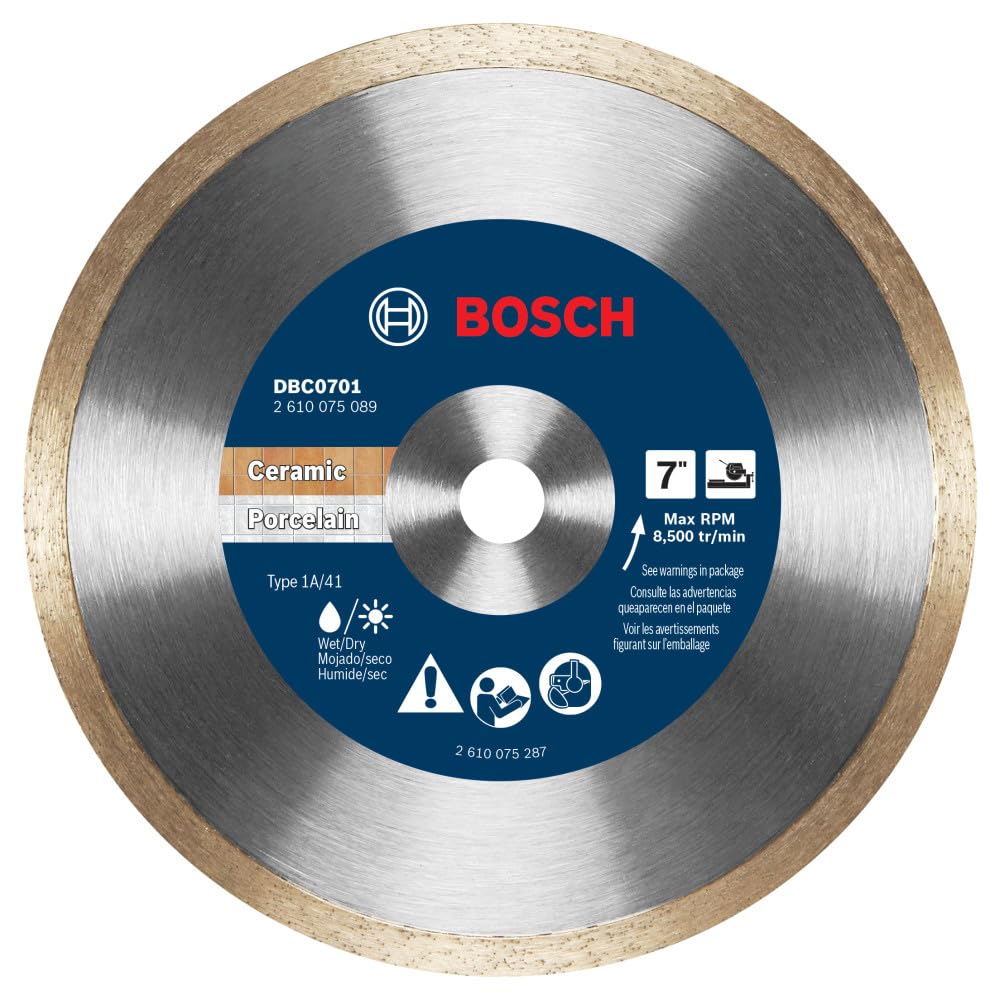
The Bosch DBC0701 uses a continuous rim with a fine diamond formula and a softer bond matrix engineered specifically for chip‑free cuts in hard, delicate stone. Rated at 20,100 rpm, it handles both wet and dry operation on tile saws and angle grinders with a standard 5/8 in. arbor. The design prioritizes a smooth finish over material removal speed, making it the top choice for exposed granite edges where every chip shows.
Reviewers consistently note the low vibration and stable tracking during long passes through marble and porcelain. The blade holds its edge across 30‑plus tile cuts without needing dressing, which indicates the bond is releasing grit at the correct rate for natural stone. The 2‑1/2 inch cutting depth covers most countertop thicknesses in a single pass.
This blade is not intended for heavy grinding or rapid material removal; its strength is precision. If you are cutting sink openings or finishing edges on polished granite, the DBC0701 leaves a surface that can go straight to the polishing pad with minimal buffing.
Why it’s great
- Continuous rim produces nearly zero edge chipping on polished granite
- Fine diamond grit leaves a finish that reduces post‑cut polishing work
- Low vibration during extended cuts improves control and cut accuracy
Good to know
- Not designed for fast material removal or grinding tasks
- Best performance requires wet cutting for thermal management
2. SHDIATOOL Diamond Granite Cutting Wheel, 4 Inch
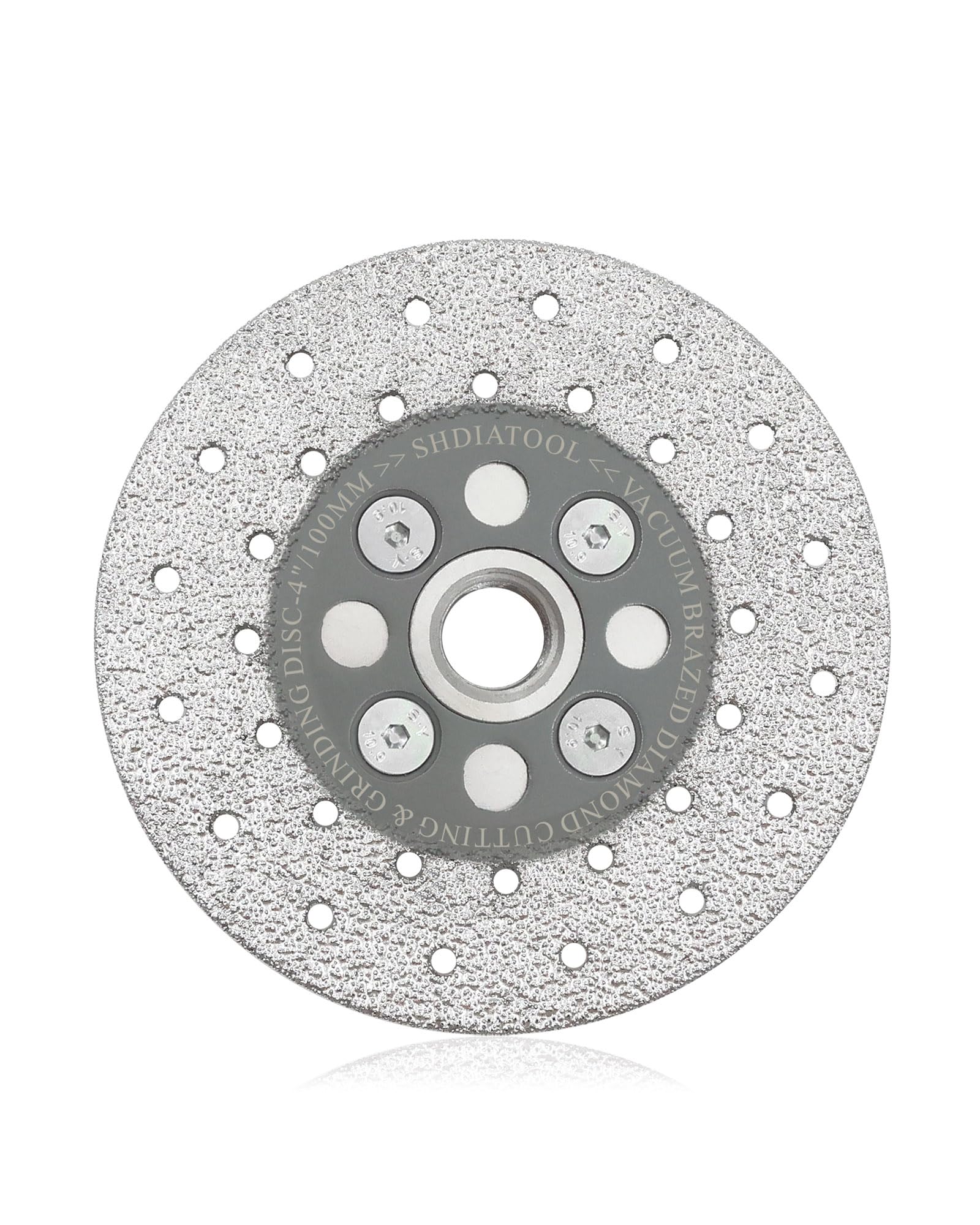
The SHDIATOOL 4‑inch wheel uses a vacuum‑brazed construction that bonds diamond particles directly to the steel core, creating a single layer of exposed grit that cuts aggressively without glazing. The 40/50 coarse grit and 2.3 mm thickness make it a dual‑purpose tool for both cutting and light grinding, especially useful for shaping edges and smoothing sink cutout holes in granite slabs.
Users report that the wheel lasts through multiple kitchen sink installations in sandstone and granite with minimal wear, and several note the fast cutting speed on straight passes. The 5/8‑11 threaded arbor fits standard angle grinders without adapters. Because the diamonds are brazed rather than electroplated, the working life extends significantly before the layer wears through.
This wheel leans more toward speed and versatility than finish quality. The coarse grit leaves a surface that requires sanding or polishing before it matches a factory edge.
Why it’s great
- Vacuum‑brazed diamond layer lasts longer than electroplated alternatives on granite
- Coarse 40/50 grit removes material quickly for shaping and grinding
- Dual‑sided diamond exposure allows aggressive cutting from either direction
Good to know
- Rough edge requires additional polishing for finished countertop work
- Not ideal for thin porcelain tile where chip‑free cuts are needed
3. DIEX Super Thin Diamond Tile Blade 4″ 5‑Pack
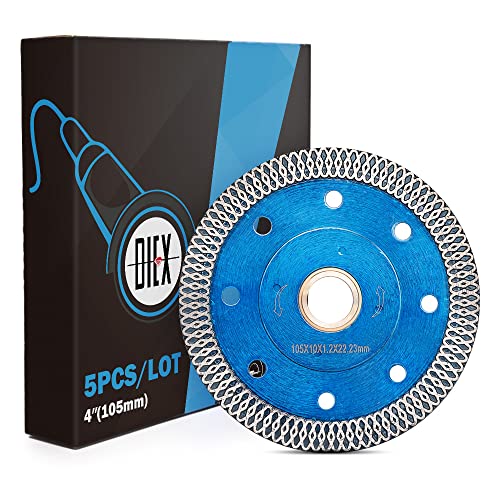
The DIEX 4‑inch blade uses an X‑tooth rim profile and a super‑thin 0.05‑inch kerf that wastes minimal stone while maintaining a smooth cut path. The pack includes five blades, which brings the per‑blade cost significantly below single‑blade alternatives. Professional tile setters report that these blades handle the 45‑degree miter cuts that snap cutters cannot manage, delivering the precision needed for porcelain and granite tile work.
Each blade is rated for wet or dry cutting with handheld machines. The thin core runs cooler than thicker blades, reducing the risk of thermal damage to the stone edge. One user noted that a chip developed after a binding event, but the blade did not shatter, suggesting the steel core has acceptable impact resistance.
The trade‑off is that the extreme thinness requires a stable tool and steady feed pressure. Pushing too hard can cause the core to deflect, leading to a wavy cut. For controlled, precision work on tile and thin granite slices, this pack offers exceptional value.
Why it’s great
- Ultra‑thin kerf minimizes material waste on expensive granite tile
- Five‑blade pack provides excellent per‑blade cost savings
- Handles precision miter cuts that standard blades struggle with
Good to know
- Thin core can deflect if feed pressure is too aggressive
- Not suited for heavy grinding or shaping tasks
4. Diapro 4 Inch Diamond Turbo Saw Blade 5‑Pack
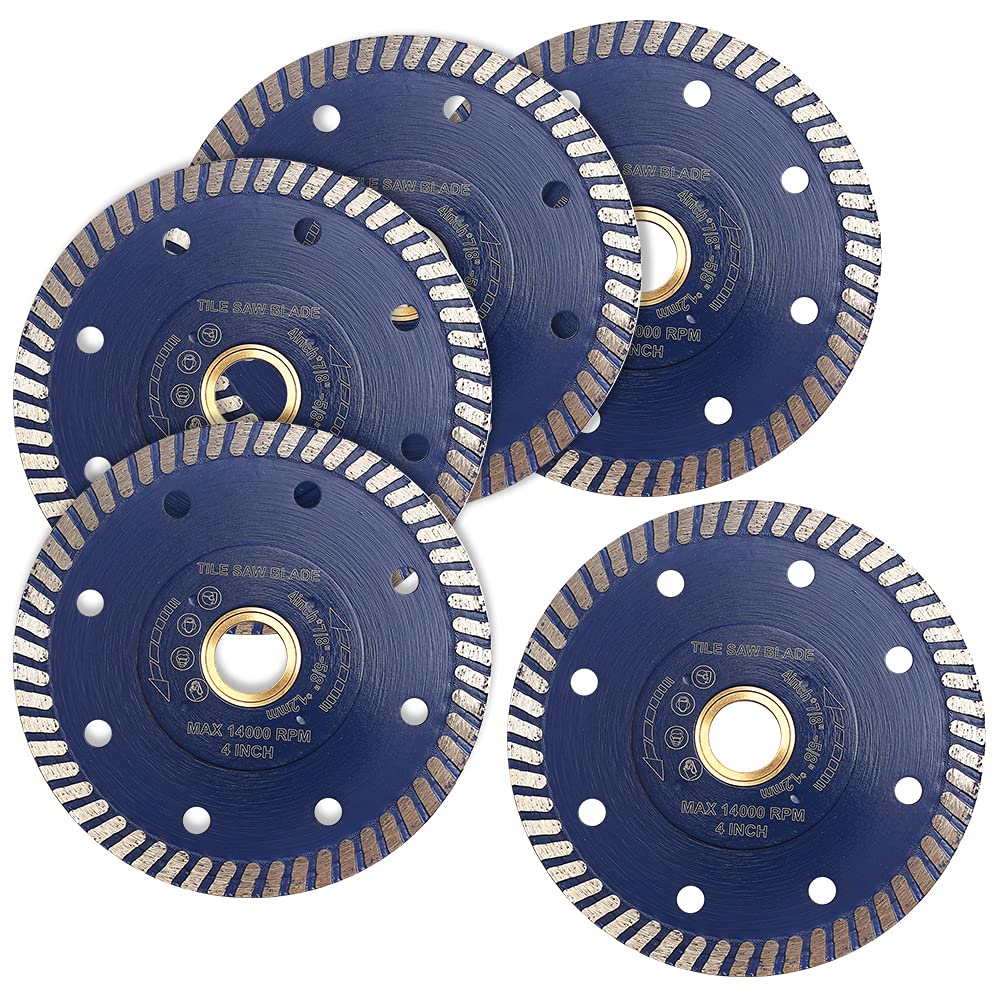
The Diapro 4‑inch blade uses a thin turbo rim and core profile that balances fast cutting with a chip‑free finish on granite, marble, and ceramic tile. The hot‑pressed diamond segments are bonded at high temperature for longer segment life compared to sintered alternatives. The arbor accepts both 7/8‑ and 5/8‑inch spindles, giving it wide compatibility with angle grinders and tile saws.
Users describe the cuts as clean and fine across various tile types. The turbo slots help evacuate debris, which keeps the cut zone cool during dry operation. Some users note that the blade can be aggressive on softer tiles, occasionally causing chipping if not used with water. The 1.2 mm thickness feels robust enough for straight cuts without the flex seen in ultra‑thin designs.
This blade sits in the middle of the spectrum between speed and finish. It removes material faster than a continuous rim but leaves a cleaner edge than a segmented blade. For general granite tile work where both speed and edge quality matter, this five‑pack delivers consistent performance.
Why it’s great
- Turbo rim design provides faster cutting than continuous rim without excessive chipping
- Hot‑pressed segments extend blade life compared to standard sintered bonds
- Dual arbor size fits most angle grinders and tile saws
Good to know
- Can chip softer tile if run dry at high speed
- Not as smooth as a dedicated continuous rim blade for polished edges
5. Diapro 4 Inch Super Thin Diamond Cutting Blade 5‑Pack

This Diapro five‑pack shares the super‑thin platform but adds a 3/8‑inch segment height that gives the blade more cutting depth before the bond wears through. The design targets granite, sandstone, quartz, and porcelain, making it one of the more versatile packs in this guide. Users report clean, accurate cuts through multiple floor and backsplash installations without chipping.
Several reviews highlight the blade’s ability to cut stone tiles on a 7‑inch tile saw with precision. The super‑thin core reduces material waste, which matters when cutting expensive granite tile. One user building an outdoor kitchen noted that the blade cut everything stone‑related with absolute precision, including denser materials that previously caused glazing on other blades.
The thin core demands careful handling. If the arbor nut is over‑tightened or the blade binds, the core can distort. For controlled cuts on a stable saw, this pack offers a good balance of longevity and finish quality across multiple stone types.
Why it’s great
- 3/8‑inch segment height provides extended cutting depth per blade
- Versatile across granite, sandstone, quartz, and porcelain
- Consistent chip‑free performance on multiple installations
Good to know
- Super‑thin core can warp if the blade binds during a cut
- Not recommended for heavy grinding or aggressive feed rates
6. OSTEK 4 Inch Super Thin Porcelain Saw Blade 5‑Pack
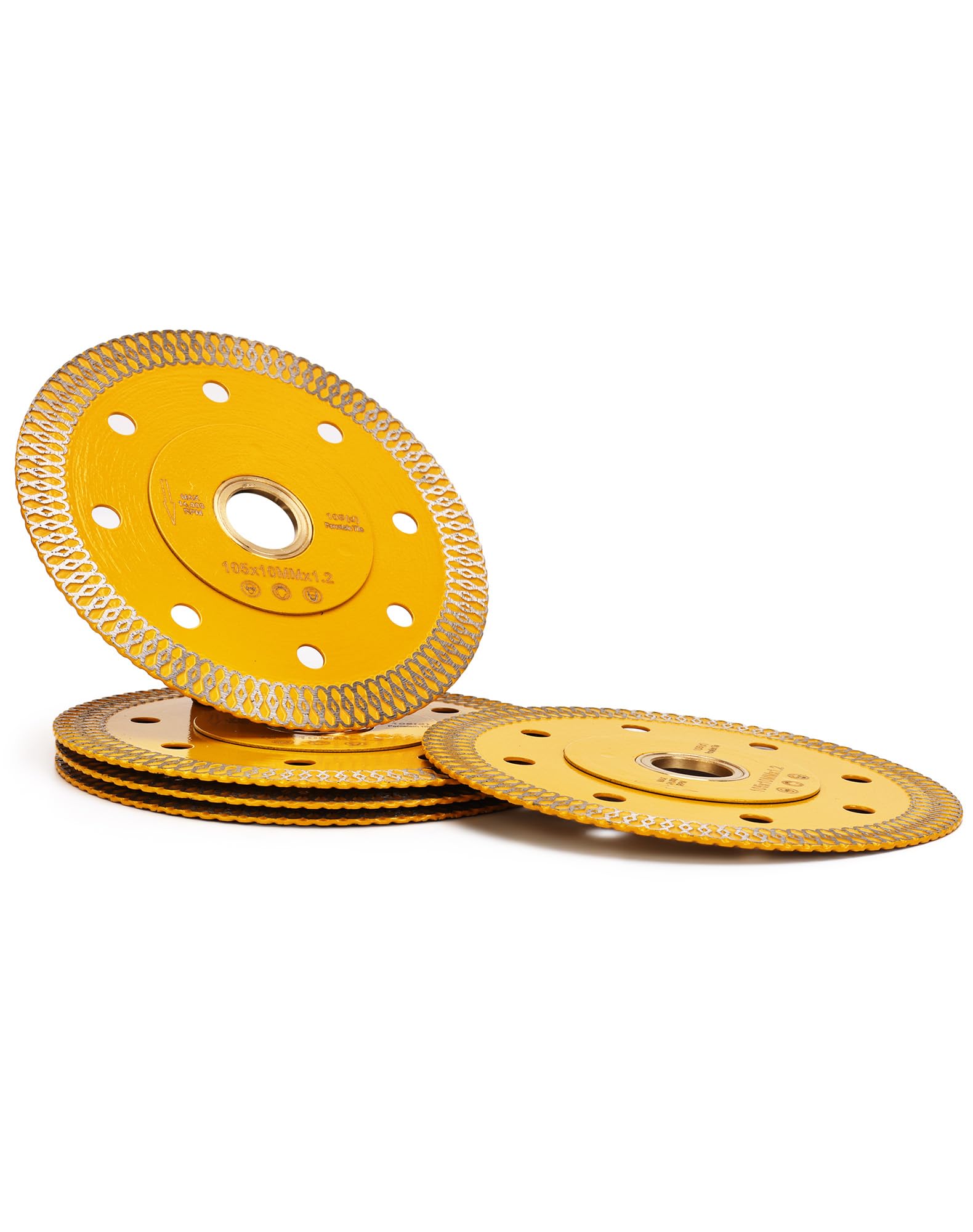
The OSTEK 4‑inch blade uses an X‑tooth geometry that alternates cutting angles to reduce vibration and improve chip clearance. Users report that it cuts thin glazed ceramic tile like butter, with minimal chipping on the glazed surface. The 1.2 mm thickness and super‑thin profile keep material loss low, which is critical when matching tight grout lines on granite tile layouts.
A tile setter with over 20 years of experience rated this blade highly for its cut quality relative to cost. The high‑temperature diamond extraction process extends blade life, and the universal compatibility with handheld machines makes it easy to use for irregular shapes and corners. Some users note that at 8,500 rpm on a circular saw, the cut is fast but not as smooth as a dedicated continuous rim blade.
This blade is best suited for thin‑gauge granite tile and porcelain where the main concern is chip‑free cutting rather than deep slab work. The five‑pack provides enough blades to complete multiple bathroom or kitchen backsplash projects without reordering.
Why it’s great
- X‑tooth design reduces vibration for cleaner cuts on thin tile
- Cuts glazed ceramic with minimal edge chipping
- Five‑blade pack covers multiple projects at low per‑blade cost
Good to know
- Not ideal for thick granite slab cutting
- Cut smoothness decreases without water cooling
7. solidure 4″ Super Thin Diamond Saw Blade 5‑Pack
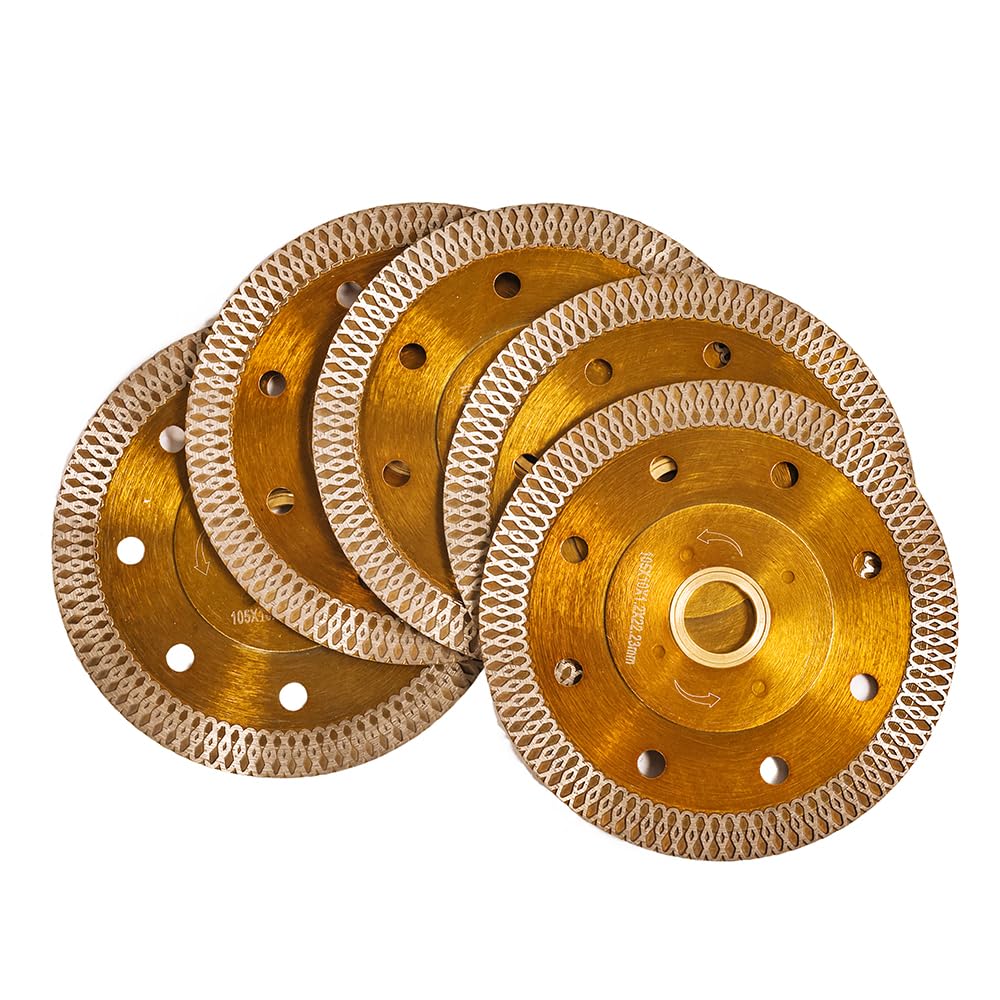
The solidure 4‑inch blade uses a compact turbo rim with a cooler running design that improves both life and cutting speed. The 7/8‑5/8‑inch arbor includes a reducing ring for tool compatibility. Users report clean cuts on porcelain, but some noted that the kerf is wider than expected, which can leave a chipped edge on softer tile if not cut upside down.
One user found that the blade did not fit securely in an older wet cutter machine without a custom arbor bushing, which caused runout and chattering. Another user said the blade cuts tile fine but the wider kerf requires accounting for material loss in tight layouts. The gold‑colored core resists corrosion during wet cutting.
This pack suits dry cutting on smaller granite tile jobs where portability matters more than absolute edge finish. The compact design runs cooler than full‑size turbo blades, reducing the risk of burning the stone during extended dry passes. For wet saws, verify that your machine’s arbor bushing matches the 5/8‑inch opening.
Why it’s great
- Compact turbo rim runs cooler during dry cutting
- Corrosion‑resistant gold core holds up in wet environments
- Five‑blade pack handles multiple project phases
Good to know
- Wider kerf than spec may cause chipping on thin tile without workarounds
- Older wet saws may require a custom arbor bushing for a secure fit
FAQ
Can I use a blade made for ceramic tile on granite slab?
Does the arbor size affect cut accuracy on an angle grinder?
Why does my granite blade stop cutting after a few passes?
Final Thoughts: The Verdict
For most users, the blade for cutting granite winner is the BOSCH DBC0701 7 in. Continuous Rim Diamond Wheel because its continuous rim and fine diamond formula produce chip‑free edges that skip the polishing step on exposed granite countertops. If you want a multi‑pack for grinding and shaping sink cutouts, grab the SHDIATOOL 4 Inch Diamond Cutting Wheel. And for precision thin‑kerf cuts on granite tile with minimal waste, nothing beats the DIEX Super Thin 4″ 5‑Pack.