
Our readers keep the lights on and the weekend projects moving. As an Amazon Associate, I earn from qualifying purchases.
A dedicated blade for cutting metal eliminates the mess and inaccuracy of abrasive wheels, delivering clean, burr-free edges on aluminum extrusions, steel pipe, and sheet metal without the heat warping or constant wheel replacements. The wrong choice here means wasted material, dangerous kickback, or a blade that dulls in minutes on stainless steel.
I’m Rikta — the co-founder and writer behind FitlyFast. I’ve spent dozens of hours comparing tooth geometries, carbide grades, and arbor compatibility across circular, miter, and reciprocating saw blades to identify the best performers for metal cutting.
This guide ranks blades by tooth count, grind type, and material compatibility so you can match the right blade for cutting metal to your specific saw and workpiece.
How To Choose The Best Blade For Cutting Metal
Metal cutting blades rely on specific tooth grinds, hook angles, and materials that differ sharply from wood-cutting blades. Choosing based on the workpiece thickness and alloy type determines whether you get a smooth edge or a dangerous bind-up.
Tooth Count and Grind Type
For non-ferrous metals like aluminum and brass, a Triple Chip Grind (TCG) blade with 56 to 80 teeth produces a clean, chip-free finish. Fewer teeth (24 to 48) cut faster but leave a rougher edge. For steel and iron, a carbide-tipped blade with a negative hook angle prevents the blade from grabbing the workpiece.
Hook Angle and Arbor Size
A negative hook angle (typically -5 to -10 degrees) is critical for metal — it reduces self-feeding and keeps the cut controlled. Standard arbors are 5/8-inch for most circular and miter saws, but check for diamond knockouts that adapt to 1-inch arbors on larger tables saws.
Quick Comparison
On smaller screens, swipe sideways to see the full table.
| Model | Category | Best For | Key Spec | Amazon |
|---|---|---|---|---|
| Diablo D0756N | Circular Saw Blade | Thick aluminum plate & angle | 56 TCG teeth, 0.106″ kerf | Amazon |
| Diablo D0748CF | Circular Saw Blade | Steel, alloy iron, & pipe | 48 TCG teeth, Cermet II tips | Amazon |
| Oshlun SBNF-072560 | Circular Saw Blade | Aluminum channel & solid surface | 60 TCG teeth, negative hook | Amazon |
| SHDIATOOL 7″ Diamond | Diamond Cut-Off Wheel | Multimaterial: steel, rebar, masonry | 2.6 mm kerf, 8730 RPM max | Amazon |
| Milwaukee 49-22-3329 | Reciprocating Blade Set | Demolition & multi-material cutting | 12-piece bi-metal, 18 TPI max | Amazon |
| TOMAX TMA10801 | Circular Saw Blade | Light hobbyist aluminum & PVC | 80 TCG teeth, 10-inch diameter | Amazon |
| IVY Classic 35050 | Circular Saw Blade | Thin aluminum, plastic, & plexiglass | 128 teeth, 5/8″ arbor | Amazon |
In‑Depth Reviews
1. Diablo D0756N 7-1/4″ 56-Tooth Aluminum Blade
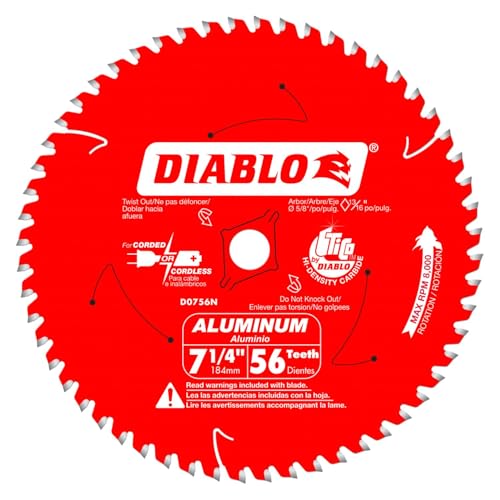
Diablo’s D0756N is engineered specifically for thick aluminum — the 56-tooth TCG grind and -6-degree hook angle prevent the blade from grabbing or self-feeding, which is the primary danger when cutting non-ferrous plate and angle on a circular saw. The 0.106-inch kerf clears chips efficiently, and the Perma-Shield non-stick coating resists the gumming that plagues standard wood blades on aluminum.
User reports confirm clean cuts through 1/4-inch aluminum plate and angle using a DeWalt 20V cordless saw, with edge quality described as better than a plasma cutter. The blade maintained sharpness after 20 short cuts and several long passes, with no burr formation that would require secondary filing.
Diablo’s laser-cut stabilizer vents are absent on this model, but the thick plate and carbide tips absorb vibration well. The blade is not rated for steel, so reserve it exclusively for aluminum, brass, bronze, and plastic stock.
Why it’s great
- Clean, burr-free cuts on thick aluminum plate
- Non-stick coating prevents aluminum residue buildup
- Negative hook angle improves safety during cuts
Good to know
- Not for steel or ferrous metals
- Premium price compared to commodity blades
2. Diablo D0748CF 7-1/4″ 48-Tooth Steel Demon

The Steel Demon D0748CF uses Cermet II carbide tips — a ceramic-metal composite that withstands the abrasion of alloy steel, iron, and galvanized pipe far longer than standard carbide. The 48-tooth TCG grind and triple-chip geometry produce a smooth edge on materials that would instantly dull a wood blade. Laser-cut stabilizer vents reduce vibration and keep the blade cool during prolonged cuts.
Reviews show this blade cut through 1/4-inch Corten steel plate “like butter” and 3-inch schedule 40 galvanized pipe without generating heat that would discolor the metal. A novice user reported 24 clean cuts on 1/16-inch steel with minimal sparking. The blade does produce small hot chips, so full face protection is essential.
Some users experienced tooth breakage when binding the blade, which is a risk with any carbide-tipped metal blade. Taking shallow passes and using the saw at maximum depth setting minimizes this risk. The blade is also effective on aluminum, but the D0756N is better optimized for non-ferrous work.
Why it’s great
- Cuts steel and iron with no heat buildup
- Stabilizer vents reduce noise and vibration
- Edge quality eliminates secondary filing
Good to know
- Teeth can chip if blade binds during cut
- Not ideal for thin sheet metal under 1/16″
3. Oshlun SBNF-072560 7-1/4″ 60-Tooth Non-Ferrous Blade

Oshlun’s SBNF-072560 is a professional-grade blade with C-1 carbide tips precision-ground in a TCG geometry, designed specifically for aluminum, brass, bronze, and copper. The negative hook angle is aggressive enough to prevent kickback on miter saws and table saws while still feeding smoothly through thick extrusions. Heat vents in the blade body reduce thermal expansion during extended runs.
In testing, one user made 90 cuts through 2×8-inch aluminum channel with no measurable degradation in cut quality between the first and last cut. Another logged over 100 cuts on aluminum fence sections before noticing any dulling. The blade also works well on acrylic and solid-surface materials like Corian without chipping.
The 60-tooth count strikes a strong balance — faster cuts than an 80-tooth blade but smoother finish than a 40-tooth. The blade runs noticeably cooler than unvented alternatives, which is critical when cutting thick aluminum stock that can trap heat and expand against the kerf.
Why it’s great
- Holds edge for 90+ cuts on heavy aluminum channel
- Heat vents prevent blade warping during long cuts
- Clean cuts on brass, copper, and solid surface
Good to know
- Produces hot metal debris requiring full PPE
- Not rated for steel or iron cutting
4. SHDIATOOL 7-Inch Diamond Cutting Wheel
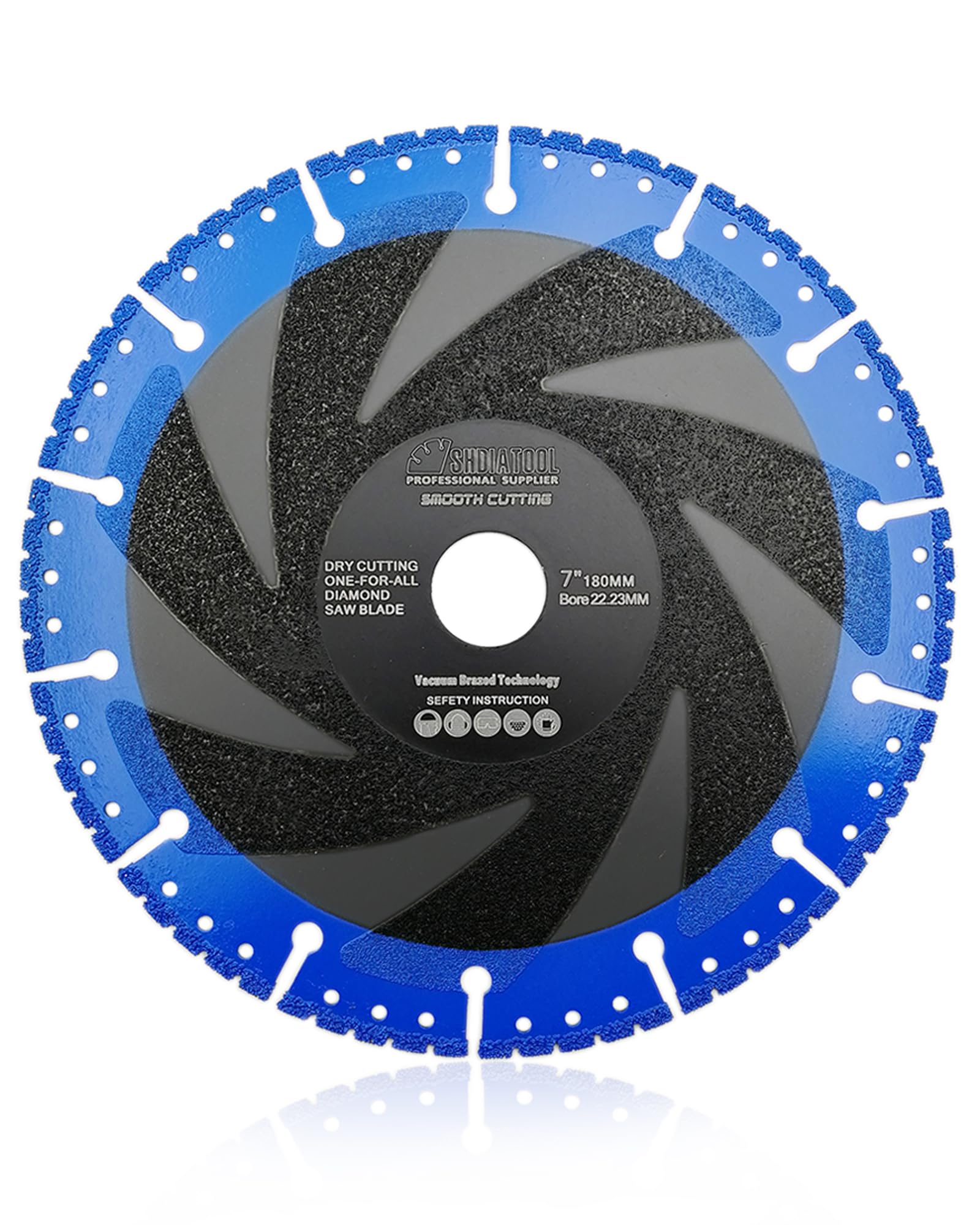
Unlike carbide-tipped circular saw blades, the SHDIATOOL uses vacuum-brazed industrial diamond grains permanently fused to a heat-treated high-speed steel core. This construction resists the extreme heat and abuse of cutting through rebar, cast iron, stainless steel, and reinforced concrete — materials that would destroy a standard blade in seconds. The abrasive grains coat both sides of the core, delivering smooth cuts with less sparking than composite abrasive wheels.
Users report the wheel survives heavy abuse including bending and cutting thick steel tubes without segment loss. The wide 2.6 mm kerf cuts slower than a thin-kerf carbide blade but lasts far longer — one user estimates it outlasts a dozen abrasive wheels. The diamond edge also cuts aluminum up to 1/4-inch thick, though steel remains its primary strength.
The trade-off is speed: the diamond segments cut by abrasion rather than shearing, so each pass takes longer than a carbide-tipped blade. The wheel is best suited for an angle grinder or circular saw with a 7/8-inch arbor. Expect a wider kerf that removes more material than a standard carbide blade.
Why it’s great
- Extremely long life on steel, rebar, and masonry
- Less sparking than abrasive wheels
- Cuts multiple material types without changing blades
Good to know
- Wider kerf removes more material per cut
- Slower cutting speed than carbide-tipped blades
5. Milwaukee 12-Piece Bi-Metal Reciprocating Blade Set

For demolition work where you encounter wood, metal, and plastic in the same tear-out, Milwaukee’s 12-piece bi-metal set provides a dedicated TPI for each material. The set includes 18 TPI blades for thin metal (ideal for conduit and sheet metal), 14 TPI for thicker steel, 8 TPI for general-purpose wood cutting, and 5 TPI aggressive raker teeth for plunging into wood. All blades use double relief angle geometry to reduce tooth stress and extend life.
The bi-metal construction — high-speed steel teeth welded to a flexible alloy steel back — resists the snapping that mono-metal blades suffer under the vibration of a Sawzall. Users report the storage case adjusts to hold blades up to 9 inches, and a prior set from this same pack lasted over a decade of occasional use. The 18 TPI blades cut through steel studs, pipe, and angle iron with minimal burr.
This set lacks the ultra-high TPI (24+) needed for razor-smooth cuts on thin gauge metal. For heavy structural steel or thick plate, a dedicated carbide-tipped circular blade is more efficient. But for on-site remodeling where you chase metal pipes inside wood walls, this set covers the full range.
Why it’s great
- Full range of TPI for wood, metal, and plastic
- Bi-metal construction resists breakage under vibration
- Includes adjustable storage case
Good to know
- Not designed for thick steel plate or structural beams
- Storage case holds blades up to 9 inches only
6. TOMAX 10-Inch 80-Tooth Aluminum Blade

The TOMAX TMA10801 brings 80 TCG teeth on a 10-inch body, making it a solid match for 10-inch miter saws and table saws used for cutting aluminum extrusions, PVC conduit, and other non-ferrous materials. Construction-grade carbide tips resist wear, and an electrophoretic coating protects the blade body from rust and corrosion — a useful feature when cutting wet PVC or working in humid conditions.
Users cutting 1.5-inch aluminum extrusions on a Ryobi miter saw report an outstanding finish with no need for deburring. The 80-tooth count produces a near-polished edge on aluminum angle and schedule 80 PVC, though the PVC debris volume is surprisingly high — plan to cut outdoors. One hobbyist cut 1/4-inch aluminum on a 12-inch chop saw with clean results when the material was clamped securely.
The 10-inch size limits compatibility to saws that accept that diameter. Noise on older table saws can be significant, likely due to the blade resonating rather than any balance issue. For occasional DIY use on aluminum and plastic, the TOMAX delivers performance at a modest investment compared to premium brands.
Why it’s great
- 80 teeth produce a polished, burr-free edge
- Electrophoretic coating resists rust and corrosion
- Good value for hobbyist and occasional use
Good to know
- Noisy on older or less rigid saws
- 10-inch diameter limits saw compatibility
7. IVY Classic 35050 7-1/4″ 128-Tooth Aluminum Blade
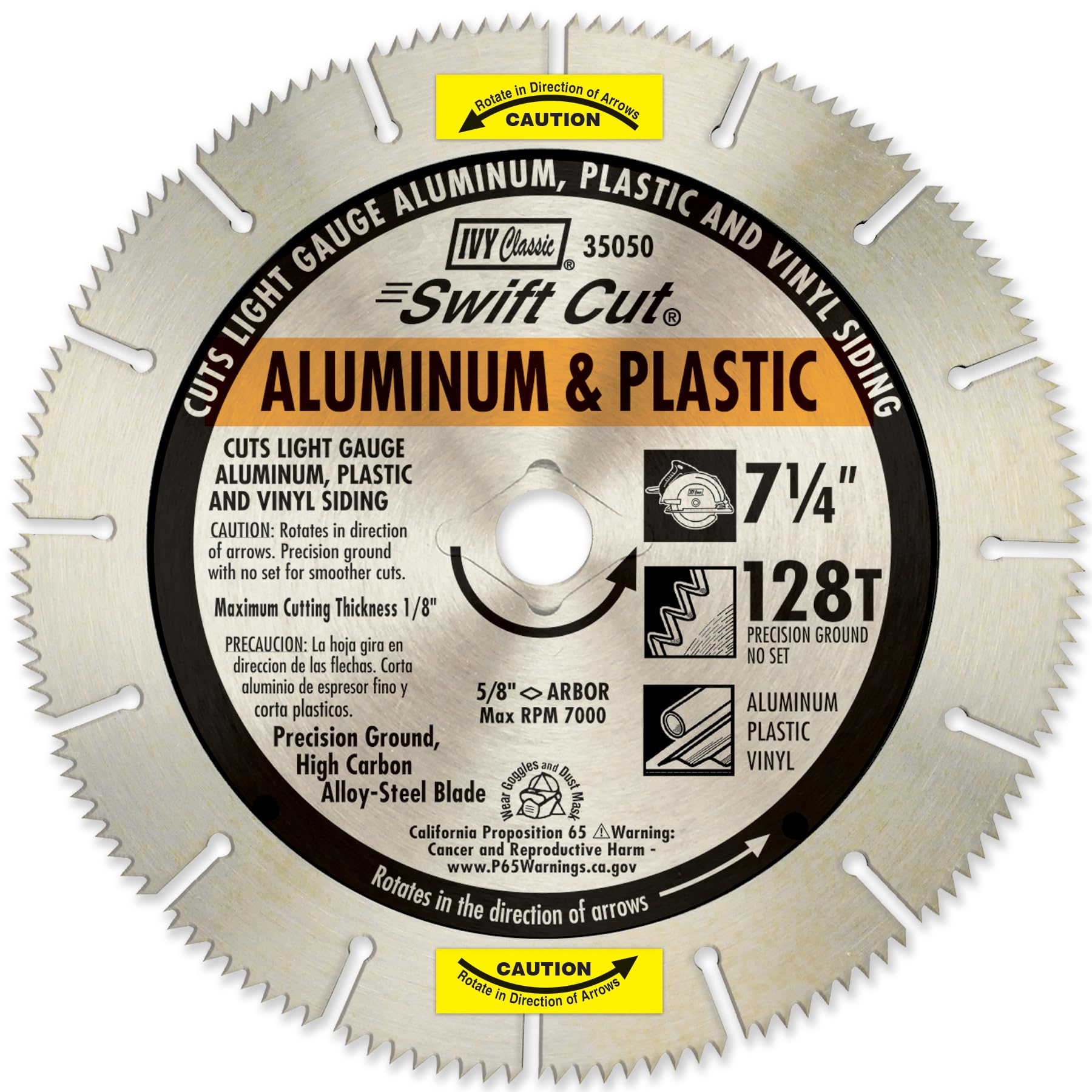
The IVY Classic 35050 uses an unusually high 128-tooth count on a high-carbon alloy steel body, designed exclusively for thin-gauge materials up to 1/8-inch thick — including light aluminum, vinyl siding, plexiglass, and plastic sheeting. The precision-ground teeth have no set, meaning the kerf is exactly the blade thickness, producing smooth, chip-free edges on acrylic and polycarbonate.
Users report it cuts 1/8-inch plexiglass cleanly on a table saw without melting the edge, provided you feed at a consistent speed. The expansion slots help manage heat buildup, which is critical when cutting plastics that soften and gum. One reviewer noted the rotation arrow is printed backward on some units — verify the spin direction matches your saw before assuming the blade is incorrectly manufactured.
The blade is not designed for material thicker than 1/8-inch aluminum or any steel. Attempting thicker cuts risks binding and tooth damage. For thin sheet metal, aluminum flashing, or plastic panels, the IVY Classic is an precise, cost-effective option — but its material limits are strict.
Why it’s great
- Very high tooth count produces glass-smooth edges
- Expansion slots reduce heat and prevent warping
- Budget-friendly entry point for thin metals and plastics
Good to know
- Limited to materials 1/8-inch thick or less
- Not suitable for any ferrous metal or thick aluminum
FAQ
Can I use a standard wood-cutting blade for aluminum or steel?
What is the difference between a diamond cutting wheel and a carbide-tipped blade for metal?
Does a negative hook angle matter for cutting metal on a miter saw?
How do I prevent aluminum from sticking to the blade teeth?
Final Thoughts: The Verdict
For most users, the blade for cutting metal winner is the Diablo D0756N because its 56-tooth TCG grind, negative hook angle, and Perma-Shield coating deliver clean, safe cuts on thick aluminum without gumming. If you need to cut steel and alloy iron, grab the Diablo D0748CF Steel Demon with Cermet II tips for ferrous metals. And for demolition work where you hit everything from wood to metal pipe, nothing beats the Milwaukee 12-Piece Bi-Metal Set for versatility across reciprocating saw applications.