
Our readers keep the lights on and the weekend projects moving. As an Amazon Associate, I earn from qualifying purchases.
Porcelain tile’s extreme density and hardness punish cheap blades—causing chipped edges, glazed-over diamonds, and wandering cuts that waste material. Choosing the right diamond blade is the difference between a sharp, time-saving cut and a frustrating pile of cracked tile.
I’m Rikta — the co-founder and writer behind FitlyFast. I spend my time analyzing blade metallurgy, diamond bond formulas, and kerf geometry to separate the tools that actually cut porcelain from the ones that just spin.
After sifting through a market full of bonded abrasives and thin-rim claims, I’ve narrowed the field to seven serious contenders. This guide helps you choose the best blade for cutting porcelain tile by matching the right diamond concentration, core stability, and rim design to your specific saw and job.
How To Choose The Best Blade For Cutting Porcelain Tile
Porcelain isn’t ceramic. Its higher density and lower porosity demand a diamond blade with a softer metal bond that constantly erodes to expose fresh diamond grit. A hard-bond blade intended for soft marble will glaze over on porcelain, turning the cutting edge into a friction-heated polishing surface that won’t cut.
Continuous Rim vs Segmented vs Turbo
For porcelain tile, the continuous rim (a solid, unbroken diamond edge) produces the smoothest finish with the least chipping. Turbo rims add small serrations for faster cutting but can leave a slightly rougher edge on rectified porcelain. Full segmented blades (gaps between teeth) are for brick and masonry—skip them for finish tile work.
Kerf Thickness and Core Stability
A thinner blade—roughly 0.045 to 0.060 inches—removes less material per cut, reducing saw motor strain and producing a tighter kerf. But thin blades need a tensioned steel core to resist side-load wander. Look for a blade with a stiffening hub or a laminated center if you plan to cut 24-inch large-format tiles where any wobble becomes visible.
Arbor Size and Saw Compatibility
Most tile saws use a 5/8-inch arbor. Some angle grinders and smaller saws use a 7/8-inch or 1-inch arbor. Check the arbor size of your tool and look for a blade that either fits directly or includes a brass reducing ring—most quality blades in this category ship with an adapter.
Quick Comparison
On smaller screens, swipe sideways to see the full table.
| Model | Category | Best For | Key Spec | Amazon |
|---|---|---|---|---|
| Alpha Porcellana PT10A | Premium | Lippage-free finish cuts | .002″ Runout tolerance | Amazon |
| PEARL P4 Thin Mesh Turbo | Premium | Ultra-clean chipping control | 1.5mm thin kerf mesh rim | Amazon |
| DEWALT DW4764 | Premium | High-volume contractor jobs | .060″ thin kerf / 10″ diameter | Amazon |
| MK Diamond MK-225 Hot Dog | Mid-Range | Thin strips and bevel cuts | .050″ ultra-thin kerf | Amazon |
| DEWALT DW4765 | Mid-Range | Angle grinder tile work | 4.5″ diameter / 7/8″ arbor | Amazon |
| TOOLEAGUE 10-Pack | Budget | High-volume multi-material cutting | 1.2mm kerf / 10 blades per pack | Amazon |
| Delta Diamond Piranha 10″ | Mid-Range | 10″ tile saw compatibility | .090″ rim / 11mm tall diamond segment | Amazon |
In‑Depth Reviews
1. Alpha Porcellana PT10A
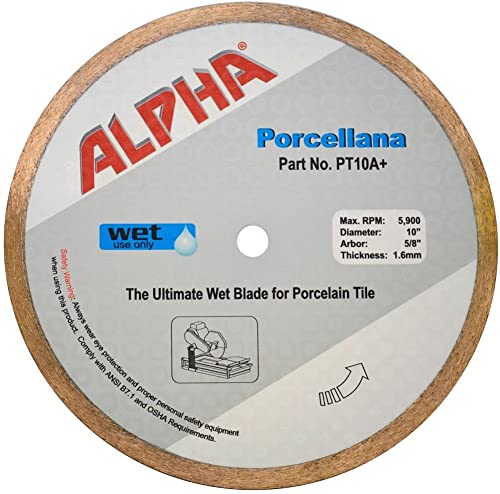
The Alpha Porcellana PT10A delivers a measured runout of just 0.002 inches—meaning the blade spins with virtually no wobble. On rectified 12×24 porcelain tiles, this core stability translates into cuts that are indistinguishable from the factory edge, eliminating the need for diamond pad clean-up. Users report cutting Italian porcelain without any visible chip-out, and the blade runs whisper-quiet compared to general-purpose options.
The continuous rim design is optimized exclusively for wet cutting, producing a polished finish that holds up to exposed-edge installations like shower curbs and tile-trim transitions. The diamond bond is formulated specifically for the hardness of porcelain, so it doesn’t glaze over mid-job. The blade does chip glass tile, confirming it is purpose-built for hard stone and porcelain rather than mixed materials.
If you’re installing large-format porcelain and the finished edge will be visible, this is the blade that saves you from hand-finishing every cut. It is the top performer among the five blades one verified reviewer tested in direct comparison, including blades from DeWalt and Ridgid.
Why it’s great
- Near-zero runout ensures wobble-free, glass-smooth cuts
- Produces factory-level finish on rectified porcelain
- Long lifespan with consistent performance across large jobs
Good to know
- Premium-tier investment—justified for finish work
- Wet cutting only; not rated for angle grinder dry use
- Will chip glass tile; avoid for mixed-material jobs
2. PEARL Abrasive P4 Thin Mesh Turbo

The P4’s defining feature is its thin mesh pattern rim, which keeps the blade running cool while delivering nearly chip-free cuts on brittle, hard materials. Users consistently report cuts that are indistinguishable from factory edges on 12×24 porcelain tiles, even on Mohawk-grade hard porcelain that causes other blades to chatter. The extra-thin kerf reduces strain on smaller tile saw motors and allows the blade to make precise, straight cuts.
A laminated center hub stiffens the core of this 7-inch blade, adding stability that prevents the wander common in thin-rim designs. The diamond bond is engineered to self-sharpen, maintaining cut speed even as the blade wears. One verified reviewer cut over 40 tiles with zero chipping straight out of the box, without any break-in period.
The P4’s turbo rim geometry cuts slightly faster than a pure continuous rim, making it a good compromise for contractors who need both speed and finish quality. Some users note that the blade’s performance declines after roughly 80% of its lifespan, but within its prime cutting range it competes with blades costing significantly more.
Why it’s great
- Near 100% chip-free cuts on hard porcelain from first use
- Laminated center hub prevents blade wander
- Cool-running mesh design extends blade life
Good to know
- Performance drops after heavy use; best for job-specific purchase
- Premium price point but still below top-tier Alpha blade
- 7-inch size may require adapter for some saws
3. DEWALT DW4764 10-Inch

The DW4764 is a 10-inch continuous rim blade built for volume—verified users report cutting more than 700 square feet of ceramic and porcelain tile on a single blade with minimal chipping. The blade’s .060-inch kerf balances material removal with motor load, and the steel core is tensioned to stay flat at high operating temperatures, reducing the risk of flexing during deep cuts on large-format tile.
Users note that the blade initially produces small chips on some porcelain tiles, but these disappear after a short break-in period as the bond equalizes. Regular dressing with a silicon carbide grinding wheel or an old brick keeps the diamonds exposed and the cut speed consistent. The blade cuts paving bricks and porcelain smoothly without overheating, provided the feed rate is kept moderate.
For contractors installing floor tile across multiple rooms, the DW4764 offers the durability and price-to-life ratio that makes it a standard recommendation. It is not the absolute cleanest finishing blade on this list, but it handles high volume without wearing out mid-project. Pair it with a dressing block to maximize its lifespan.
Why it’s great
- Exceptional durability—700+ square feet per blade in field use
- Tensioned core resists heat distortion during long runs
- Affordable enough for high-volume replacement
Good to know
- Requires dressing to maintain peak cut speed
- Minor chipping on initial cuts before break-in
- Only for wet cutting tile saws
4. MK Diamond Hot Dog MK-225 7-Inch

The MK-225’s .050-inch kerf is the thinnest on this list, making it the go-to blade for cutting porcelain tiles into narrow strips—some users report cutting 1mm-wide strips without breakage on a QEP 7-inch wet saw. The thin rim reduces waste and puts less strain on smaller saw motors, but it demands a flat, low-runout saw arbor to prevent blade wander. The blade runs with less than 10 thousandths of an inch runout out of the box.
On large-format Spanish porcelain with a rippled texture, the Hot Dog blade produces cuts with no chipping, even on thin angle cuts. The finer diamond grit size reduces chip-out on dense tile but also means the blade may wear faster than thicker competitors—verified users note it lasts through a single large project with many bevel cuts, then needs replacement. The stiffening and cooling slots help maintain straight cutting on hard porcelain, reducing the risk of the blade binding.
This is a specialist blade for jobs where precision and thin kerf matter more than outright longevity. If you need to cut skinny strips of rectified tile or make bevel cuts on thick material, the MK-225 handles it with less material stress than a wider blade. Keep the water flowing and avoid forcing the cut.
Why it’s great
- Ultra-thin kerf allows precise 1mm strip cuts
- Minimal chipping on textured and hard porcelain
- Low runout improves cut accuracy on small saws
Good to know
- Faster wear rate than thicker blades—plan for replacement
- Thin rim may wander on uneven arbor or 45-degree cuts
- Requires consistent water flow to prevent heat buildup
5. DEWALT DW4765 4.5-Inch

The DW4765 is a 4.5-inch continuous rim blade designed for angle grinders and small handheld cutters. It ships with a brass arbor reducer that adapts to both 5/8-inch and 7/8-inch spindles, making it compatible with most grinder setups. The high diamond concentration is optimized for fast cutting on porcelain, and verified users report clean cuts on marble and ceramic with zero chipping when using a wet saw setup.
On an angle grinder, the blade generates heavy dust and demands full PPE—goggles, face mask, and gloves. Users find it effective for cutting slate, limestone, and glazed ceramic tile when run wet, though some note minor chipping on certain ceramic tiles when using a grinder at high RPM. Running the blade at a slower speed or using masking tape along the cut line reduces chip-out.
For a blade in this size and price tier, the DW4765 offers reliable edge quality and good lifespan. It is not the finishing blade for exposed edges on high-end porcelain, but it is a solid choice for plumbers, electricians, and DIYers who need to notch tiles or cut around fixtures with an angle grinder. The brass arbor adapter is a practical inclusion that broadens its compatibility.
Why it’s great
- High diamond concentration delivers fast cut rate on porcelain
- Includes brass arbor reducer for 5/8″ and 7/8″ spindles
- Versatile—works on angle grinders and small tile saws
Good to know
- Dry cutting on grinder produces heavy dust
- May chip some ceramic tiles at high RPM
- Not intended for large-format rectified finish work
6. TOOLEAGUE 10-Pack 4.5-Inch

TOOLEAGUE’s 10-pack of 4.5-inch blades brings the per-unit cost down to entry-level territory without sacrificing basic performance on porcelain. The 1.2mm kerf is thin enough to reduce motor strain on handheld cutters, and the X-gear rim design is intended for both dry and wet use. Verified users report clean cuts on 3/4-inch porcelain outdoor pavers using a corded wet tile saw, with minimal chip-out and no perceptible wear after dozens of cuts.
The blades fit most tile saws with 7/8-inch or 5/8-inch arbors and work on handheld angle grinders. While the diamond concentration is not as high as the premium options, users find the surface finish adequate for cuts that will be covered by trim or grout. A verified reviewer noted that these blades cut cement board well, adding to their versatility for multi-trade work.
For a homeowner tiling a single bathroom floor or a DIYer needing multiple blades for different tools, this pack makes economic sense. Expect to cycle through blades faster than with a single premium blade, but the lower upfront cost allows you to keep a fresh blade on the tool without worrying about wear. The thin kerf also reduces stress on lower-power saws.
Why it’s great
- Low per-blade cost for high-volume or multi-tool use
- Thin kerf reduces motor strain on smaller saws
- Versatile—works on tile, cement board, and stone
Good to know
- Lower diamond concentration means faster wear on hard porcelain
- Not for finish-grade exposed edge cuts
- Best suited for cuts hidden by trim or grout
7. Delta Diamond Piranha 10-Inch
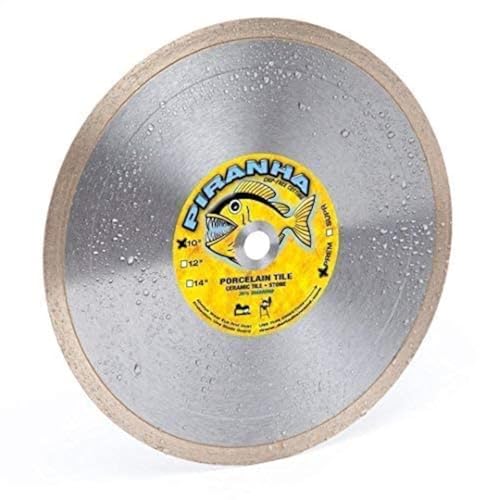
The Delta Piranha features an 11mm tall diamond rim—taller than most competitors in this price bracket—which extends blade life by providing more diamond volume before the blade needs replacement. The .090-inch rim is thicker than the hot-dog style blades, adding stability for straight cuts on porcelain tile. Verified users report that it cuts hard agate and petrified wood faster than other blades, indicating the bond is aggressive enough for dense porcelain.
On porcelain tile, the blade produces minimal chipping and responds well to sharpening with a dressing stone when the cut speed slows. The 5/8-inch arbor fits most standard tile saws, and the blade’s max safe RPM is rated at 6,115. A small number of users note that the central plastic insert can be fragile—treating it gently during installation and cleaning prevents dislodging.
The Delta Piranha is a solid mid-range pick for a 10-inch tile saw. It does not deliver the ultra-smooth finish of the Alpha Porcellana, but its tall rim and lifetime warranty against material defects make it a low-risk choice for the serious DIYer or light professional use. The thicker rim provides extra stability for less experienced operators who may be prone to side-loading the blade.
Why it’s great
- 11mm tall diamond rim extends usable blade life
- Thicker .090″ core provides stable straight cuts
- Lifetime warranty against warping, cracking, defects
Good to know
- Central plastic insert can dislodge if handled roughly
- Thicker kerf removes more material than thin-rim options
- Not as chip-free on rectified tile as premium blades
FAQ
Why does my diamond blade stop cutting porcelain tile mid-project?
Can I use a dry-cut diamond blade on porcelain tile?
What arbor size do most porcelain tile blades use?
Final Thoughts: The Verdict
For most users, the best blade for cutting porcelain tile winner is the Alpha Porcellana PT10A because its near-zero runout and purpose-specific diamond bond produce factory-quality edges on rectified tile without post-cut finishing. If you want the best balance of chipping control and cut speed for a wider range of porcelain hardnesses, grab the PEARL P4 Thin Mesh Turbo. And for high-volume contractor work where durability and cost-per-square-foot matter most, nothing beats the DEWALT DW4764 10-Inch.