
Our readers keep the lights on and the weekend projects moving. As an Amazon Associate, I earn from qualifying purchases.
The first time you stand in front of a bladeless fan, the lack of spinning plastic feels wrong. Then the air hits you — smooth, uninterrupted, as if the room itself exhaled. That sensation is the entire category in a nutshell: you trade the visual chaos of exposed blades for a quieter, more deliberate airflow that doesn’t chop the breeze into discrete chunks. But inside that simple promise lives a maze of motor specs, oscillation angles, noise floors, and cleanability quirks that most buyers never see until they unbox the wrong one.
I’m Rikta — the founder and writer behind FitlyFast. I’ve spent the last several seasons cross‑referencing motor torque curves, air‑velocity claims against real‑world decibel ratings, and filter‑maintenance cycles to separate the fans that truly move air from those that merely whisper about it.
Whether you need a whisper‑quiet companion for a nursery or a wide‑swinging tower that can push air across an open‑concept living room, finding the right best bladeless fan means balancing oscillation coverage with noise tolerance and long‑term maintainability.
How To Choose The Best Bladeless Fan
Bladeless fans look similar at a glance, but the internal differences — motor type, air‑amplification geometry, oscillation mechanism, and filter integration — shift real‑world performance dramatically. Here are the specs that separate a smart investment from a regret.
Motor Type: Brushed vs. Brushless DC
Brushless DC motors are the gold standard for bladeless towers. They run cooler, consume less electricity, and produce virtually no electromagnetic hum at low speeds. A brushed motor, by contrast, introduces friction noise that worsens over time and often limits the lowest speed to something far from silent.
Oscillation Reach and Air Projection
Oscillation isn’t just about degrees — it’s about whether the fan can throw air across the length of your room. Look for a fan that projects airflow at least 25–30 feet. Narrow oscillation (45°–70°) suits bedside or desk use, while 90° and up is necessary for larger spaces.
Noise Floor and Speed Granularity
The quietest bladeless fans hover around 20–28 dB on their lowest setting, which is quieter than a library. But that number means nothing if the fan has only 3 speeds. More speed steps (8 or 10) let you dial in exactly the breeze level you want without jumping from near‑silent to audible.
Ease of Maintenance
Bladeless fans collect dust on the air intake, not on spinning blades. A removable rear grille that snaps off for quick cleaning extends the fan’s lifespan. Fans with built‑in washable air filters add purification to the deal, but those filters need periodic replacement.
Quick Comparison
On smaller screens, swipe sideways to see the full table.
| Model | Category | Best For | Key Spec | Amazon |
|---|---|---|---|---|
| Shark TurboBlade TF202S | Premium High‑End | Ultra‑customizable coverage | 180° oscillation, pivots & twists | Amazon |
| Dyson Cool AM07 | Premium High‑End | Sleek design, silent low speed | Air Multiplier, 10 speeds | Amazon |
| Lasko Elevation 42”–54” | Mid‑Range | Adjustable height for tall beds | 31 ft/s, 28 dB, 90° oscillation | Amazon |
| DREO 2026 Upgraded DC | Mid‑Range | Quiet operation, fine speed control | 20 dB, 8 speeds, brushless DC | Amazon |
| PELONIS 40 Inch | Entry‑Level Mid | Budget‑friendly reliable cooling | 26 ft/s, 93° oscillation | Amazon |
| Antarctic Star T42 | Entry‑Level Mid | Quiet, small‑room coverage | 22 dB low speed, 6 speeds | Amazon |
| Lasko Ascend OST100 | Budget Friendly | Air filtration plus cooling | 29 ft/s, included CarbonX filter | Amazon |
In‑Depth Reviews
1. Shark TurboBlade Fan TF202S

The Shark TurboBlade rethinks what a tower fan can do by adding a pivot joint that lets you rotate the head vertically and horizontally, plus twistable vents that throw air in two directions simultaneously. With 180° of oscillation, dual blades, and an Air Blanket mode that spreads airflow horizontally across a bed or sofa, this fan covers more floor area than any single‑direction tower. The 10 speed and 10 noise‑level tiers let you find the exact threshold between breeze and background sound.
Owners report strong, consistent airflow at distances up to 15 feet on speed 5, with the low end being genuinely quiet enough for sleep. The Dust Defense system captures particles on the intake, and the wipe‑clean bladeless loop keeps maintenance trivial — no grille screws or blade fins to disassemble. The brushed charcoal finish with gold accents looks modern without screaming for attention.
The unit is wider than a traditional tower (31.5 inches across the wings), so it demands more floor space. The remote has a slight learning curve and the fan produces a noticeable jet‑like hum at speeds 6–10. But for sheer versatility of airflow direction, the TurboBlade sets a new bar.
Why it’s great
- Pivot, twist, and 180° oscillation cover every corner
- 10 speed/10 noise tiers for precise tuning
- Wipe‑clean bladeless design with Dust Defense
- Air Blanket mode is perfect for bed‑level cooling
Good to know
- Wide footprint requires more floor space
- Audible jet hum at high speeds
- Remote responsiveness varies slightly
2. Dyson Cool AM07 Air Multiplier

Dyson’s AM07 uses Air Multiplier technology to draw in surrounding air and accelerate it through a loop amplifier, producing a smooth, unchopped stream that feels natural rather than mechanical. The 70° oscillation is narrower than many rivals, but the consistency of the output — no buffeting, no turbulence — makes it feel more like a room‑wide shift in temperature than a targeted blast. Ten speeds give fine control, and the lowest settings are nearly silent, producing only a gentle white noise.
The magnetic remote that docks on top of the loop solves the “where did the remote go” problem elegantly. The sleep timer can be set in 15‑minute increments up to 9 hours, and the Iron/Blue glossy finish looks sculptural rather than appliance‑like. Owners consistently praise its build quality and the fact that no replacement filters are required — just a periodic wipe of the loop and intake grille.
Airflow projection is weaker than a comparably sized conventional tower fan due to the turbine design redirecting air horizontally. At maximum speed the noise is noticeable, and the 70° oscillation means it covers less arc than budget alternatives. This is a premium aesthetic choice for those who prioritize silence at low speeds and a clean visual line.
Why it’s great
- Very quiet on low‑mid speeds
- Magnetic remote docks on the fan
- No filters to replace, easy wipe‑clean
- Modern sculptural design
Good to know
- Airflow weaker than blade fans at distance
- 70° oscillation is narrower than budget towers
- Loud at top speed
3. Lasko Elevation Tower Fan

The Lasko Elevation is built around a simple insight: not everyone’s bed or desk is 42 inches off the floor. Its telescoping column adjusts from 42 to 54 inches, letting you position the airflow exactly where you need it — at mattress height for sleepers who want direct cooling without the noise of a bedside fan. The 90° oscillation and 31 ft/s airspeed cool spaces up to 40 feet away, and the AirSense technology automatically adjusts speed based on room temperature.
Four speeds and four wind modes (Custom, Auto, Night, Nature) give enough variety for most bedrooms, and the lowest two settings are genuinely quiet at 28 dB. The remote includes a display‑dimming feature so the LED panel doesn’t disturb sleep, and the narrow vent opening means you can direct airflow to a single person without cooling the whole room. Owners love the height range and the fact that the fan’s footprint remains small despite its tall reach.
The middle section of the fan column is a solid plastic panel — air doesn’t flow through the center — so the effective vent height is split into upper and lower segments. Some users find the motor louder at level 3 and 4. The design feels a little basic compared to metal‑trimmed rivals, but for adjustable height at a mid‑range price, it’s hard to beat.
Why it’s great
- Height extends to 54 inches for tall beds
- Narrow vent opening targets one person
- Very quiet on speed 1 and 2
- AirSense auto‑adjusts with room temp
Good to know
- Center column is solid — no airflow through middle
- Not silent at higher speeds
- Basic plastic finish
4. DREO 2026 Upgraded DC Motor Tower Fan

DREO’s entry combines a brushless DC motor with an algorithmic impeller design and the Coanda effect to move 28 ft/s of air while hitting a floor of 20 dB — quieter than a library. That noise floor is the lowest in this roundup, making it a top candidate for nurseries, home offices, or any space where background hum is unacceptable. The 8 speed settings and 4 modes (Normal, Natural, Sleep, Auto) give you 32 possible airflow combinations, so there’s almost never a gap between “too weak” and “too strong.”
The removable rear grille and impeller make cleaning genuinely tool‑free — you can pop the back off and wipe the blades in seconds. The 90° oscillation with tuned airflow ensures the breeze reaches the corners, and the LED screen auto‑shuts off after use so there’s no light pollution at night. Owners consistently note that it moves air well even at low settings and that the mute button on the remote is a thoughtful touch.
Some users report that the fan loses noticeable airflow strength after a year or two of continuous use, eventually becoming more of a white‑noise machine than a cooling device. The build is mostly plastic, and the remote lacks a backlight. Still, for the combination of silence and speed granularity at a mid‑range price, the DREO is a compelling choice.
Why it’s great
- 20 dB noise floor — barely audible
- 8 speeds + 4 modes for fine tuning
- Easy rear‑grille cleaning
- Display auto‑shuts off for sleep
Good to know
- Airflow can diminish after 2 years
- Remote is basic, no backlight
- Primarily plastic construction
5. PELONIS 40 Inch Bladeless Tower Fan

PELONIS delivers a 40‑inch tower that hits a wind speed of 26 ft/s with 93° oscillation — slightly more sweep than the typical 90° — and a Sensi Cool Algorithm that adjusts the fan speed based on ambient room temperature. The three speeds and six modes (Normal, Natural, Sleep with two variants each) sound more complex than they are, but the sleep mode notably runs at the same speed as the highest setting according to some users, which limits its utility for light sleepers.
The top‑mounted LED display is bright enough to see across the room but can be distracting at night without a dimming option — several owners recommend pointing the display away from the bed. Assembly takes under five minutes with no tools, and the 15‑hour programmable timer is generous. The remote works up to 30 feet away, though the remote itself lacks grip and the model number isn’t printed for easy replacement.
Customer reviews report excellent cooling even on lower speeds and praise the tall, stable footprint that takes up very little floor space. The fan is not the quietest at higher speeds (a soft mid‑pitch hum appears during oscillation), but for an entry‑level price that undercuts most competitors, the airflow‑to‑value ratio is outstanding.
Why it’s great
- Very low price for 40‑inch height and 26 ft/s
- 93° oscillation covers extra room area
- Temperature‑sensing algorithm
- Tool‑free assembly under 5 minutes
Good to know
- Sleep mode equals highest speed setting
- LED display stays bright, can’t dim
- Remote lacks grip and replacement info
6. Antarctic Star T42 Tower Fan
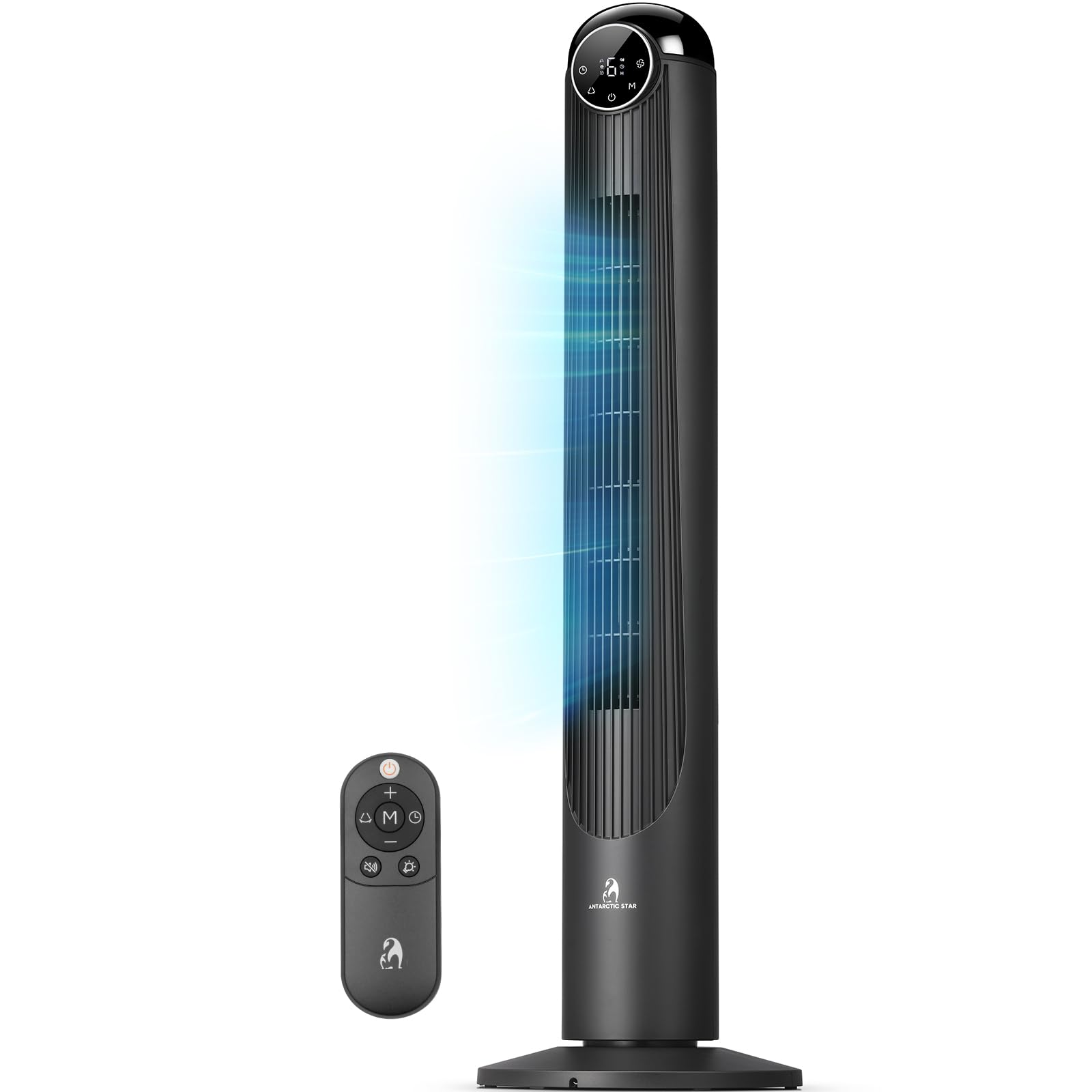
The Antarctic Star T42 brings a 42‑inch tower into the same price bracket as shorter fans, offering a claimed 22 dB at low speed — quieter than most competitors at the entry level. The 6 speeds and 4 modes (Normal, Nature, Sleep, Smart) give you more granular control than the typical 3‑speed budget fan, and the Smart mode adjusts airflow based on ambient temperature, a feature usually reserved for mid‑range units.
A hidden carry handle on top and a back‑mounted remote slot solve two common annoyances: moving the fan from room to room and losing the remote. The removable rear grille snaps off for cleaning without tools, and the LED display auto‑dims 30 seconds after the last button press — no glow disturbing sleep. Buyers consistently mention that the fan is “very quiet” and that the airflow is surprisingly strong for the price.
Some customers report that the fan has been working well for weeks but can’t yet speak to long‑term durability. The painted plastic finish feels fine but not premium. The oscillation is smooth, but the air projection at higher speeds is not as far‑reaching as that of the DREO or Lasko Elevation. For a small‑ to medium‑sized room where quiet operation at a budget price matters most, the T42 delivers.
Why it’s great
- Very quiet at low speed (22 dB)
- Remote slot built into the back
- Smart mode adjusts with room temp
- Auto‑dimming display won’t disturb sleep
Good to know
- Long‑term durability not yet proven
- Air projection weaker than pricier towers
- Painted plastic finish feels basic
7. Lasko Ascend Tower Fan OST100

The Lasko Ascend stands out in the budget segment by integrating a CarbonX air filter into a tower fan, capturing dust, lint, and pet hair while pushing 29 ft/s of oscillating airflow. This dual‑function approach means you get a gentle cooling breeze and passive air cleaning from the same footprint — a meaningful bonus for allergy sufferers. The 90° oscillation projects air up to 40 feet, and the 4 speeds plus 4 wind modes (Custom, Auto, Night, Nature) offer solid customization for the price.
AirSense technology senses the room temperature and adjusts speed accordingly, and the Night Mode keeps operation quiet during sleep. The LED panel has 4 brightness levels including Off, so you can black out the display completely in a dark room. Owners consistently praise the quiet operation at low speeds and the easy filter access via a removable panel — many were shocked to see how much dust the CarbonX filter trapped after just a few weeks.
The airflow capacity (360 CFM) is lower than some mid‑range competitors, so this fan is best suited to smaller‑to‑medium rooms rather than open‑concept spaces. The design is functional rather than sleek, and the remote feels slightly cheap. But with its child‑lock feature, Blue Plug safety fuse, and filter‑based air cleaning, the Ascend is a smart choice for homes with pets or seasonal allergies where budget matters.
Why it’s great
- Integrated air filter catches dust and pet hair
- 29 ft/s airflow with 40‑foot projection
- Display can be turned completely off
- Child lock and safety fuse for peace of mind
Good to know
- Lower CFM limits room size
- Filter needs periodic replacement
- Design and remote feel budget‑grade
FAQ
Why would someone choose a bladeless fan over a traditional blade fan?
Is a higher CFM number always better for a tower fan?
Can I leave a bladeless fan running all night?
Final Thoughts: The Verdict
For most users, the best bladeless fan winner is the Shark TurboBlade TF202S because its pivot‑and‑twist versatility, 180° oscillation, and 10‑speed tuning cover nearly any room layout. If you want a sleek, near‑silent fan with a built‑in magnetic remote and no filters to replace, grab the Dyson Cool AM07. And for a budget‑friendly tower that also filters airborne dust and pet hair, nothing beats the Lasko Ascend OST100.