
Our readers keep the lights on and the weekend projects moving. As an Amazon Associate, I earn from qualifying purchases.
That familiar chopping sound from a spinning blade fan is actually turbulence — disrupted air slamming into stationary blades. A bladeless tower fan eliminates that noise source entirely, drawing air through a hidden impeller and accelerating it through a ring or vent. The result is a smooth, continuous column of airflow that feels more like a natural breeze than a mechanical blast. For anyone sleeping lightly, working from home, or sharing a room with a baby, the difference between a blade fan’s buffet of chopped air and a bladeless fan’s laminar stream is the difference between restless and restful.
I’m Rikta — the co-founder and writer behind FitlyFast. I’ve spent hundreds of hours reading through spec sheets, customer reviews, and noise-floor measurements to surface the quietest and most effective cooling solutions on the market.
Whether you are after whisper-silent sleep mode, smart home integration, or a compact design that fits a bookcase nook, narrowing down the field comes down to a few core metrics — and that is exactly where best bladeless tower fan choices separate themselves from the noise.
How To Choose The Best Bladeless Tower Fan
The wrong fan leaves you either shivering in one spot or feeling nothing at all three feet away. With bladeless designs, three parameters control everything: delivered airflow volume, oscillation reach, and noise floor at your preferred speed.
Airflow Volume vs. Perceived Breeze
CFM (cubic feet per minute) is the honest measure of how much air a fan moves. A model rated at 1515 CFM will shift the room’s air faster than one rated at 500 CFM, but the advertised “ft/s” number only tells you peak velocity at the vent — not how far that air travels before dissipating. Check CFM first, then look at oscillation width.
Noise Floor — Not All decibels Are Equal
A fan rated at 25dB might sound quieter than a 29dB model in a silent bedroom, but the quality of that sound matters. DC brushless motors produce a smooth whoosh; lower-quality motors can introduce a high-frequency whine even at low dB. Always look for user comments about “tone” — a low hum is sleep-friendly, a pitchy whine is not.
Oscillation Angle and Pivot
Standard oscillation is 70-90 degrees. Premium units push to 150 or 180 degrees. For a single person at a desk, 70 degrees is fine. For a living room with multiple people, wider oscillation means fewer “dead zones.” Pivot features (tilting the fan head) let you aim the air stream up or down — critical if the fan sits low and you want airflow at face level while sleeping.
Quick Comparison
On smaller screens, swipe sideways to see the full table.
| Model | Category | Best For | Key Spec | Amazon |
|---|---|---|---|---|
| Dreo Cruiser Pro T2S | Smart | Whole-room smart cooling | 1076 CFM / 25dB | Amazon |
| GoveeLife 42″ | Premium | App-controlled customization | 1515 CFM / 27dB | Amazon |
| Shark TurboBlade TF202S | Versatile | Pivot & multi-directional airflow | 180° oscillation / 10 speeds | Amazon |
| Dyson Cool AM07 | Iconic | Sleek design + low maintenance | 10 levels / 70° oscillation | Amazon |
| Lasko Apex 42″ | Mid-Range | Pet-friendly mesh filter | 29 ft/s / 360 CFM | Amazon |
| PELONIS Bladeless | Bladeless | Safe household with kids/pets | 1200 CFM / 22dB | Amazon |
| Dreo Tower Fan 307 | Value | Budget-friendly quiet sleep | 25 ft/s / 8H timer | Amazon |
In‑Depth Reviews
1. Dreo Cruiser Pro T2S

The Dreo Cruiser Pro T2S bridges the gap between smart integration and raw cooling power. Its 28 ft/s wind speed and 1076 CFM output make it capable of cooling a master bedroom or open-concept living area, while the DC brushless motor drops the noise floor to an impressive 25dB — quiet enough for a baby’s nursery. App, voice, and remote control give you flexibility whether you prefer tapping a phone screen or speaking to Alexa.
Users consistently note that the “sleep mode” gradually ramps down speed through the night, and the automatic temperature sensing adjusts airflow without manual intervention. The 90-degree oscillation is standard for this class, but the real advantage is the 42-inch height that places airflow at torso level even when the fan sits on the floor.
Reliability is the main concern here. Several reviews note the unit failing after 12-15 months, though Dreo’s support team was responsive with replacements. If you want smart features and robust CFM without stepping into the premium tier, this is the sweet spot.
Why it’s great
- Very low 25dB noise at night
- 1076 CFM moves air across a large room
- Full Alexa and Google Assistant support
Good to know
- Some units reported failure after 12-15 months
- Remote buttons are flat and hard to differentiate in the dark
2. GoveeLife 42″ Tower Fan

The GoveeLife 42” is the most feature-dense bladeless tower fan in this lineup. With 12 wind speeds, 5 modes, and a staggering 1515 CFM, it can push enough air across a 300-square-foot room to feel like central AC. The 150-degree oscillation is nearly double the standard — meaning fewer stagnant corners. The built-in thermostat can pair with GoveeLife thermo-hygrometers to auto-adjust fan speed based on room temperature.
Owners highlight the asymmetrical oscillation (you can set it to sweep 30 degrees left and 120 degrees right, for example) and the aromatherapy box that diffuses essential oils through the airflow. The 27dB noise level on low is a touch louder than the Dreo, but the extra CFM and smart scheduling through the Govee app make it feel like a premium investment that integrates into a broader smart home ecosystem.
The unit is 42 inches tall with a 12.9-inch square base, so it occupies more floor space than the Shark or Dyson. If you want a fan that does everything — schedule, thermostat link, RGB nightlight, and aromatherapy — the GoveeLife delivers unmatched control depth.
Why it’s great
- Extremely high 1515 CFM airflow
- 150° oscillation for wide room coverage
- Thermostat integration with GoveeLife sensors
Good to know
- Larger base footprint (12.9” square)
- 27dB is slightly louder than the quietest competitors
3. Shark TurboBlade TF202S

The Shark TurboBlade is a physics experiment you plug into a wall. It pivots vertically and horizontally, its dual blades twist independently, and you can switch between “Tower Mode” (focused vertical column) and “Air Blanket Mode” (wide horizontal spread). The 180-degree oscillation — the widest in this list — ensures that no corner of the room stays dead. The 10 speed levels are matched with 10 noise levels, giving you granular control over the trade-off between cooling power and sound.
Users rave about the “Air Blanket” feature, which creates an even, smooth sheet of air across a bed — ideal for couples where one person runs hot and the other doesn’t. The pivot mechanism lets you tilt the fan head to point airflow upward into a lofted bed or downward at a desk. The included “Dust Defense” filter helps keep the internal impeller clean without disassembly.
Quietness depends on speed: levels 1-5 are genuinely unobtrusive, but levels 6-10 introduce a low airplane-like hum. Some units have been reported to develop a thumping sound during oscillation after extended use. And at nearly 45 inches tall and 32 inches wide at the base, it demands floor space.
Why it’s great
- Pivot and twist head for multi-directional airflow
- 180° oscillation — widest available
- Air Blanket mode creates even coverage across a bed
Good to know
- Loud thumping reported on some units during oscillation
- Large footprint; requires floor space
4. Dyson Cool AM07

The Dyson Cool AM07 is the reference design that defined the bladeless category. Its Air Multiplier technology accelerates surrounding air through a ring amplifier, producing a smooth, uninterrupted stream. With 10 precise airflow settings and a sleep timer that runs up to 9 hours, it is purpose-built for bedside use. The magnetic remote clips neatly onto the top of the unit — a small detail that solves the “lost remote” problem permanently.
Owners consistently praise the build quality and the lack of replacement filters — just wipe the loop ring clean with a microfiber cloth. At low speeds, the AM07 is nearly silent, producing a gentle white noise that many find sleep-friendly. The 70-degree oscillation is narrower than the GoveeLife or Shark, but in a bedroom or home office, that range is sufficient to avoid feeling like you are sitting in a wind tunnel.
Airflow at distance is the trade-off. The AM07 outputs 500 liters per second, which is less volumetric than the Dreo or GoveeLife units. Users sitting more than 8-10 feet away report feeling less breeze compared to a traditional bladed fan. It is premium-priced for its performance class, but the design and durability justify the cost for buyers who prioritize aesthetics and simplicity.
Why it’s great
- Iconic bladeless design — easy to clean
- Magnetic remote stores on the unit
- Very quiet on low speeds; stable white noise
Good to know
- Airflow weaker at distances over 8-10 feet
- Narrow 70° oscillation compared to competitors
5. PELONIS Bladeless Tower Fan
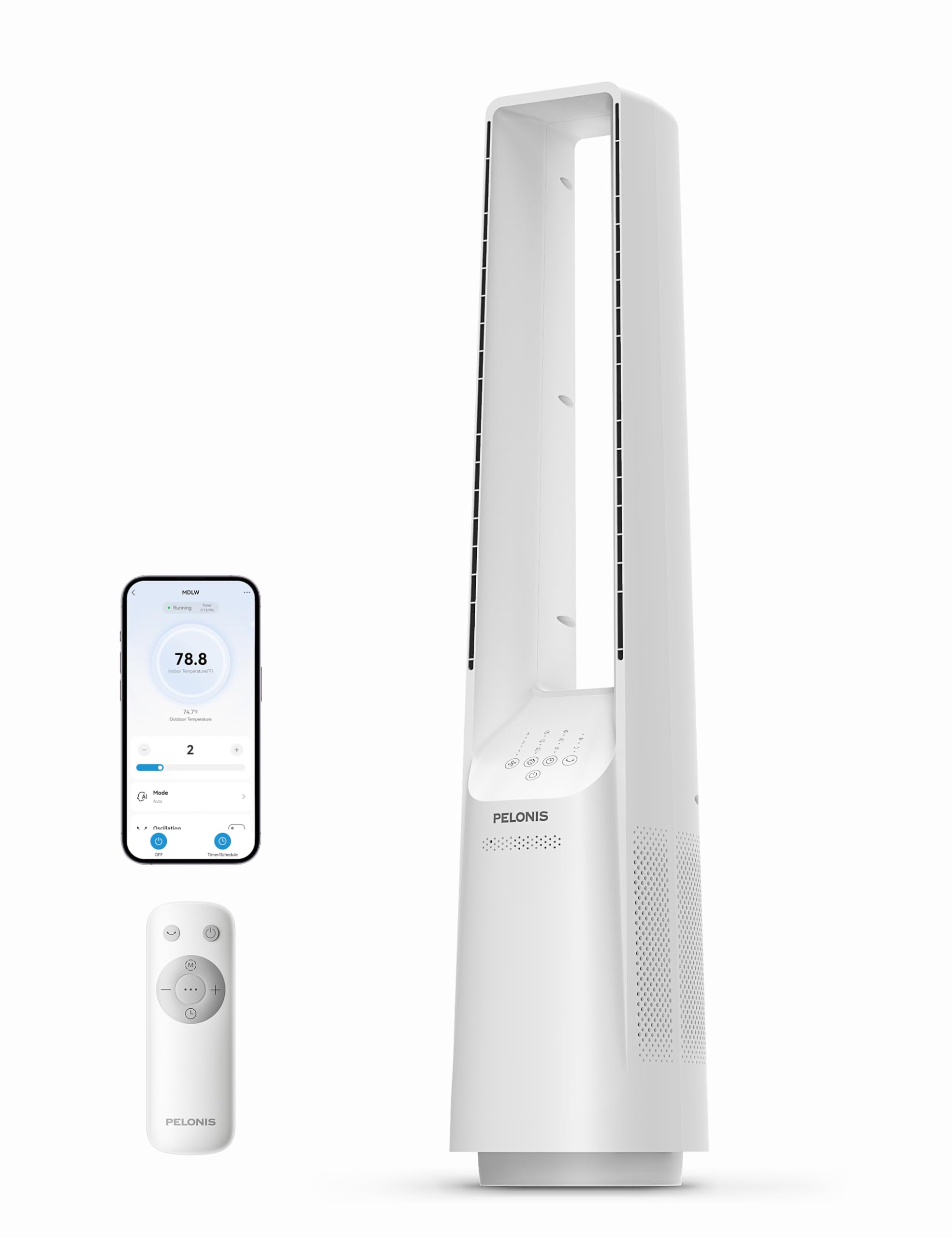
The PELONIS Bladeless Tower Fan punches above its placement with a 1200 CFM rating and a claimed noise floor of 22dB — among the quietest in the entire list. Its 120-degree oscillation is wider than the standard 90 degrees, and the bladeless construction makes it safe for households with toddlers or pets. Smart home integration covers Alexa and Google Assistant, though the included remote is absent in some units — a point that has drawn a few complaints.
Users remark that the fan circulates air effectively in rooms up to about 200 square feet, with the vertical slats channeling a broad sheet of air rather than a focused jet. On low setting, you can hold a conversation or watch TV without any interference. The auto-shutoff after 10-15 hours is a safety feature not clearly documented in the manual, but it prevents the motor from overheating during extended use.
The trade-off is build quality feel. The painted plastic finish doesn’t match the premium tactility of the Dyson or Shark. And while the fan is lightweight at just over 10 pounds, that lightness makes it easier to tip over on carpeted floors if bumped. For a smart, quiet, high-CFM option at a accessible price point, the PELONIS is a strong contender.
Why it’s great
- Very quiet 22dB operation at low speeds
- 1200 CFM — high volume for the price tier
- Bladeless safety design for kids and pets
Good to know
- Remote not always included in box
- Plastic finish feels less durable than premium options
6. Lasko Apex 42″

The Lasko Apex 42” is a solid mid-range fan that stands out for one practical reason: a built-in mesh filter that captures pet hair, dust, and lint before it enters the motor. For pet owners, this is the difference between cleaning the fan twice a year and cleaning it twice a month. The fan delivers 29 ft/s peak velocity with 4 wind modes and AirSense technology that adjusts speed based on ambient temperature.
Assembly is tool-free and takes about five minutes. At 29 dBA on low, it is not the quietest fan in this list — you will hear it in a silent bedroom — but the noise profile is a smooth whoosh rather than an irritating whine. The 12-hour timer, child lock, and dimmable display make it bedroom-friendly, and the 42-inch height places airflow at seated or standing torso level.
The biggest criticism is that the fan’s peak airflow feels modest compared to the Dreo or GoveeLife units. Several reviewers note that it is best suited for small to medium rooms (under 200 square feet) and that the highest speeds are necessary to feel a significant breeze across a living room. If your space is compact and you have shedding pets, the filter alone makes the Apex a practical choice.
Why it’s great
- Built-in mesh filter catches pet hair and dust
- Easy tool-free assembly
- Child lock and dimmable display for bedroom use
Good to know
- Airflow feels weak in rooms over 200 sq ft
- 29 dBA is audible — not as quiet as competitors
7. Dreo Tower Fan 307

The Dreo Tower Fan 307 is the entry-level option that refuses to cut corners on the fundamentals. At 25 ft/s peak speed with a 90-degree oscillation range and an 8-hour timer, it covers the basics of a bladeless tower fan without any smart features or app connectivity. The removable rear grille and impeller wheel make cleaning straightforward — a maintenance advantage that many premium fans overlook.
Users consistently mention the quiet sleep mode, which automatically dims the display and reduces speed to a barely-audible level. The remote control stores in a built-in compartment on the back of the fan, solving the “where did I put the remote” issue without magnets. The 36-inch height is shorter than the 42-inch models, so it works best when placed on a low table or near floor-level seating.
The limitation is airflow volume. With a smaller motor and no DC brushless technology, the 307 moves less total air than the Cruiser Pro T2S or the GoveeLife. It is sufficient for a 12×12 bedroom or a home office desk area, but don’t expect to cool an open-plan living room. For a budget-friendly, quiet sleep companion, the Dreo 307 delivers reliable performance without complexity.
Why it’s great
- Removable grille for easy cleaning
- Remote compartment on the back prevents loss
- Very quiet sleep mode with display auto-off
Good to know
- Limited airflow volume for larger rooms
- No smart or voice control features
FAQ
Is a bladeless tower fan truly quieter than a blade fan?
How often should I clean a bladeless tower fan?
Can a bladeless tower fan cool an entire room like an air conditioner?
What does “Air Multiplier” technology actually do differently?
Do bladeless tower fans work for large living rooms or open floor plans?
Final Thoughts: The Verdict
For most users, the best bladeless tower fan winner is the Dreo Cruiser Pro T2S because it delivers high CFM airflow, very low noise, and full smart home integration at a price that undercuts the premium tier. If you want maximum customization and app control, grab the GoveeLife 42″ Tower Fan with its 150-degree oscillation and thermostat pairing. And for a flexible multi-directional airflow system that can pivot and blanket a room, nothing beats the Shark TurboBlade TF202S.