
Our readers keep the lights on and the weekend projects moving. As an Amazon Associate, I earn from qualifying purchases.
Stripping layered paint, stubborn rust, or heavy mill scale from a steel surface demands an abrasive that cuts fast without embedding itself into the substrate. The wrong media turns a weekend project into a cloud of wasted effort, clogging your nozzle and leaving a contaminated surface that rejects new coatings. Choosing the right grit and material type — from hard aluminum oxide to gentle walnut shells — determines whether you burn through the job in minutes or fight the media for hours.
I’m Rikta — the co-founder and writer behind FitlyFast. I’ve spent hundreds of hours cross-referencing Mohs hardness ratings, mesh sizes, and cycle-life data to rank the media that actually strips metal clean on the first pass.
This guide compares the top contenders across hardness, reusability, and substrate safety to help you pick the absolute best blasting media for removing paint from metal without damaging your parts or your wallet.
How To Choose The Best Blasting Media For Removing Paint From Metal
Paint removal on metal demands an abrasive hard enough to fracture the coating but not so aggressive that it gouges or warps the substrate. The decision hinges on three variables: Mohs hardness, grit mesh size, and whether you need to reuse the media for multiple parts.
Mohs Hardness — The Decisive Cut Factor
Aluminum oxide sits at Mohs 9, making it the dominant choice for stripping thick paint and rust from steel. Crushed glass (Mohs 5–6) cuts aggressively but fractures quickly, while walnut shell (Mohs 4.5–5) stays gentle enough for soft metals like aluminum and brass. Match the hardness to your base metal to avoid etching or warping thin-gauge surfaces.
Grit Mesh Size — Speed vs. Finish
Coarse grits (18–40 mesh) dislodge paint in fewer passes but leave a rough profile that may need sanding before a new finish. Fine grits (80–100 mesh) produce a smoother surface and reach into crevices, but they remove material more slowly. For heavy paint on steel, 40–60 mesh hits the sweet spot between removal speed and surface prep quality.
Reusability and Cycle Life
Aluminum oxide lasts up to ten times longer than glass or mineral abrasives because it resists shattering on impact. Walnut shell media degrades gradually and can be reused several times before losing cut, making it cost-effective for softer substrates. Crushed glass and glass beads break down faster, so budget for more frequent replacement when working on large surface areas.
Quick Comparison
On smaller screens, swipe sideways to see the full table.
| Model | Category | Best For | Key Spec | Amazon |
|---|---|---|---|---|
| TITGGI #80 Aluminum Oxide | Aluminum Oxide | Fast paint & rust removal on steel | Mohs 9 hardness, 80 grit | Amazon |
| HDURCIR 100 Grit Aluminum Oxide | Aluminum Oxide | Finer surface finish pre-cerakote | 100 grit, 14 lb bucket | Amazon |
| GRITSMITH #40-60 Walnut Shell | Walnut Shell | Gentle paint removal on soft metals | Mohs 4.5–5, 5 lb bag | Amazon |
| Interactivia #7 Glass Beads | Glass Bead | Peening & debris removal without dimension change | 60–80 mesh, 8 lb | Amazon |
| Interactivia 18-40 Walnut Shell | Walnut Shell | Eco-friendly stripping on wood & soft metal | 18–40 grit, 8 lb | Amazon |
| Interactivia #50 Crushed Glass | Crushed Glass | Heavy rust removal on thick steel | 30–60 mesh, 19 lb | Amazon |
| GRITSMITH 18-40 Walnut Shell 10lb | Walnut Shell | Large-volume polishing & light paint removal | 18–40 grit, 10 lb bag | Amazon |
In‑Depth Reviews
1. TITGGI #80 Grit Aluminum Oxide Blast Media (8 LBS)

Brown fused aluminum oxide at Mohs 9 hardness puts this media just below diamond on the scale, making it the fastest choice for stripping multi-layer paint and rust from steel substrates. The 80 grit strikes an ideal balance — aggressive enough to cut through heavy coatings in a single pass but fine enough to leave a profile that doesn’t require heavy post-blast sanding. Users report consistent performance in both handheld blast guns and dedicated cabinets, with the media holding its edge through multiple cycles without rapid breakdown.
The 8-pound bucket packaging prevents the moisture intrusion that plagues cardboard boxes, and the material is 100% free of crystalline silica, which addresses respiratory safety concerns common with traditional sand. Recyclability is a standout feature — aluminum oxide lasts roughly ten times longer than silica or mineral abrasives, reducing the frequency of media change-outs on large restoration projects. The barrel pattern allows even flow through standard siphon feed systems without clumping.
Real-world feedback from automotive restoration and heavy-equipment users confirms that this media removes moderate rust from rims and prep-coats old parts for new paint without embedding into the metal.
Why it’s great
- Mohs 9 hardness cuts paint and rust faster than any other consumer media
- 10x longer cycle life than silica or mineral abrasives
- Silica-free and reusable, lowers material cost per project
Good to know
- 8 lb bucket is adequate for small to medium jobs; large panels may need a second bucket
- 80 grit profile is rougher than finer grits if you need a mirror-like pre-paint finish
2. HDURCIR Aluminum Oxide 14 LBS 100 GRIT
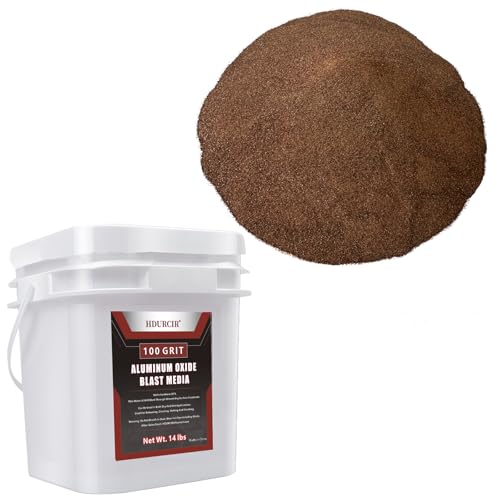
Stepping to 100 grit, this HDURCIR media offers a finer cut profile that is better suited for surface preparation directly before coating application — particularly Cerakote and other thin-film finishes. The 14-pound bucket provides roughly 75 percent more volume than the 8-pound standard, making it the better cost-per-pound option for users who go through media quickly. The aluminum oxide hardness at Mohs 9 ensures the same shatter resistance and reusability as the TITGGI product, just in a finer mesh.
User reports highlight consistent particle size distribution with minimal dust generation during use — a sign of proper grading. The media works wet or dry, which is helpful for containment in cabinets where moisture suppression reduces airborne particulates. On mini bike rims and automotive brackets, the 100 grit removed paint evenly without leaving deep scratches that would require additional sanding steps before priming.
One practical note: the media ships in a plastic bag inside the bucket, so users should empty the entire contents into the bucket for storage to prevent moisture trapping between layers. Overall, this is the smarter bulk buy for anyone who wants aluminum oxide performance with a finer finished surface and doesn’t want to pay a premium per pound for the brand name.
Why it’s great
- 14 lb bucket delivers one of the best per-pound values in aluminum oxide
- 100 grit leaves a smoother surface, ideal for Cerakote pre-prep
- Consistent particle size reduces nozzle clogging
Good to know
- Finer grit removes paint slower than 80 or 60 mesh on thick coatings
- Plastic inner bag should be emptied into the bucket to keep media dry
3. GRITSMITH #40-60 Ground Walnut Shell Media (5 LBS)

When the substrate matters more than speed — such as stripping paint from aluminum, brass, or thin-gauge sheet metal — walnut shell media is the go-to choice. The GRITSMITH #40-60 ground walnut shells sit at Mohs 4.5–5, which is hard enough to fracture paint and grease without deforming soft metals. The 40–60 mesh range is coarse enough to lift paint layers in a tumbler or blast cabinet but fine enough to reach into lettering and recessed details without bridging.
Sustainability is a genuine benefit here: walnut shells are all-natural, biodegradable, and silica-free, which reduces respiratory hazards compared to mineral abrasives. Users report that this media works exceptionally well in rotary tumblers for cleaning thousands of brass casings — the shells absorb oils and carbon fouling without scratching the brass surface. The 5-pound bag is compact and fits most small tumblers or handheld blast gun hoppers without overflowing.
One caveat: walnut shells degrade faster than aluminum oxide, so the media darkens with use as it absorbs contaminants and breaks down into finer particles. For paint removal on large steel panels, this is not the fastest choice; reserve it for delicate substrates where preserving surface thickness is the priority. The price per pound is slightly higher than bulk mineral media, but the substrate safety justifies the premium for soft-metal work.
Why it’s great
- Mohs 4.5–5 hardness safely strips paint without damaging soft metals
- Silica-free and biodegradable — safer for enclosed spaces
- Excellent media for tumblers, absorbs oils and carbon residue
Good to know
- Degrades faster than aluminum oxide, requiring more frequent replacement
- 5 lb bag is best for small projects; large jobs need multiple bags
4. Interactivia #7 Glass Beads (8 lb, 60–80 Mesh)
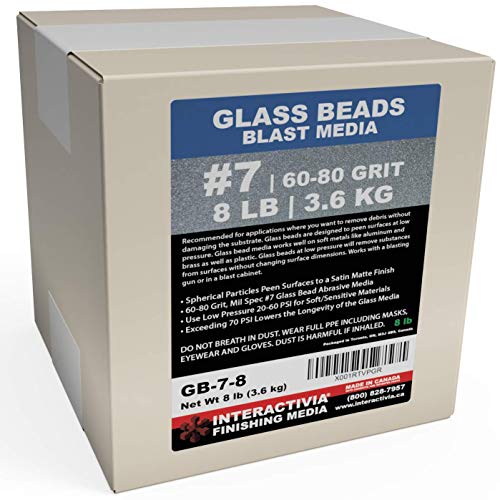
Glass beads occupy a unique niche between abrasive cutting and surface peening. The #7 grade from Interactivia uses spherical beads in the 60–80 mesh range that clean debris, carbon, and light oxidation without changing the dimensional tolerance of the part. This makes the media ideal for applications where you cannot afford to remove any base metal — such as cleaning intake valves, aluminum engine cases, or plastic trim pieces prior to refinishing.
The key distinction from crushed glass is the bead shape: round particles produce a peening effect that work-hardens the surface while removing contaminants, which can actually improve fatigue life on high-stress components. Users confirm that on soft metals like aluminum and brass, the beads at low pressure (40–60 PSI) remove stains and old clear coat without leaving the etched profile that angular abrasives create. The 8-pound bucket provides enough media for several valve-cleaning sessions or a set of aluminum wheels.
The downside is speed — glass beads cut slower than aluminum oxide or crushed glass because the round shape glides off stubborn paint rather than biting into it. For heavy paint removal on thick steel, this is not the primary choice; it excels as a finishing media after the bulk paint has been stripped. The price per pound sits in the mid-range, and the media is reusable until the beads shatter into angular dust, which typically takes several cycles on moderate debris.
Why it’s great
- Spherical beads peen surfaces and remove debris without removing base metal
- Ideal for soft metals, plastic, and engine carbon cleaning
- Reusable across multiple cleaning cycles before breaking down
Good to know
- Cut speed is slower than angular abrasives — not for heavy paint stripping
- Requires consistent low pressure; high PSI reduces the peening benefit
5. Interactivia 18-40 Grit Ground Walnut Shell Media (8 lbs)
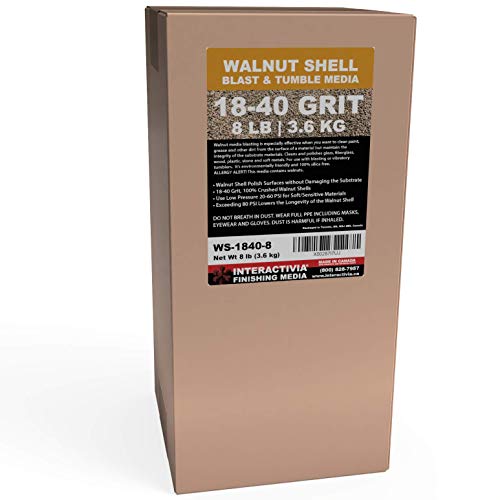
This Interactivia offering uses a coarser 18–40 grit walnut shell than the GRITSMITH #40-60, which translates to faster material removal on paint and grease while still staying gentle enough for wood, plastic, and soft metals. The 8-pound weight hits a middle ground between small-sample bags and bulk buckets, making it suitable for both blast cabinet work and vibratory tumblers. The loose bulk density of roughly 40–50 lb/ft³ means the bag has more actual media volume than a comparable weight of dense mineral abrasive.
Users specifically call out its effectiveness on engine carbon cleaning — the coarser particles dislodge baked-on deposits from intake valves without damaging the valve stem or seats. The silica-free composition and biodegradable nature make this a responsible choice for shops that go through high volumes of media and want to minimize hazardous waste disposal. On pincushion stuffing and anti-skid applications, the shells hold up as a non-toxic filler alternative.
The coarser grit does leave a slightly more textured surface than the #40-60 grade, so if you need a smooth pre-paint finish on soft metal, you may want to follow up with a finer media or sanding step. Also, the price point is slightly higher per pound than the larger 10-pound GRITSMITH bag, so users with heavy volume demands should compare the unit costs before committing.
Why it’s great
- 18–40 grit range removes paint and carbon faster than finer walnut grades
- Silica-free and fully biodegradable — safer for the shop environment
- Works for blast cabinets, tumblers, and non-abrasive filler uses
Good to know
- Coarse grit leaves a textured surface that may need refinement before painting
- Per-pound cost is higher than the larger 10 lb alternative
6. Interactivia #50 Crushed Glass Abrasive (19 lb, 30–60 Mesh)

When the job calls for removing thick rust scale or multiple layers of industrial paint from heavy-gauge steel, crushed glass delivers superior cutting power at a lower bulk density than mineral abrasives. The Interactivia #50 media uses angular particles in the 30–60 mesh range (559 to 254 microns) that fracture on impact to create fresh sharp edges, accelerating material removal. The 19-pound bucket provides roughly 40 percent more surface-cleaning capacity per dollar compared to aluminum oxide due to the lower density of glass.
Users tackling car subframes and heavy equipment confirm that this media strips thick rust scale down to bare metal in a single pass. The crushed glass is inert, non-flammable, and non-fibrogenic, and the crystalline silica-free formulation addresses health concerns associated with traditional sand blasting. Because glass shatters more readily than aluminum oxide, the media does not last as long per cycle, but the lower upfront cost per pound makes it viable for one-time large-scale projects where reusability is less critical.
One common user observation: the fine dust from crushed glass tends to cloud the blast cabinet view more quickly than denser abrasives, so a proper dust collection system is essential. For detailed parts with tight corners, some users found that the coarser 30–60 mesh bounced off recessed areas, while a finer 100 grit worked better. Choose this media for flat, heavily-corroded steel panels where you want maximum bite and minimum cost per square foot of coverage.
Why it’s great
- Angular particles cut thick rust and paint faster on steel substrates
- Lower bulk density covers more surface area per pound than aluminum oxide
- Silica-free and made from recycled glass — environmentally responsible
Good to know
- Short cycle life — glass fractures quickly, best for one-time large jobs
- Finer particles cloud the cabinet; requires good dust extraction
7. GRITSMITH 18-40 Grit Ground Walnut Shell Media (10 LBS)
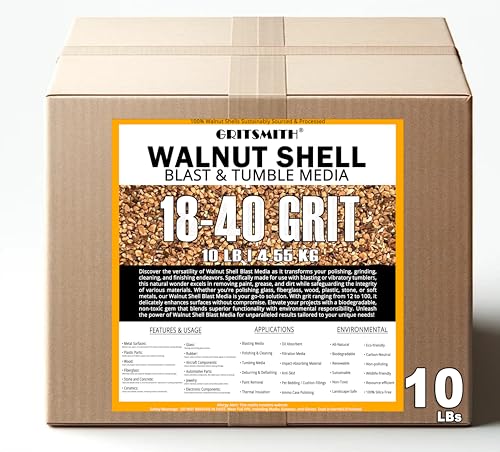
The 10-pound GRITSMITH bag is the largest walnut shell option in this comparison, delivering the best per-pound value for users who need sustained gentle cleaning on large batches of parts. The 18–40 grit range (particle diameter 0.42 mm to 1 mm) provides the same non-toxic, silica-free performance as the smaller bags but with enough volume to fill a medium blast cabinet hopper or a large vibratory tumbler in a single pour. The Mohs hardness stays at 4.5–5, preserving the substrate-safe profile that makes walnut shell the first choice for brass, aluminum, and wood.
Users running large-scale brass casing cleaning operations report that this media lasts through thousands of rounds before darkening from oil and carbon absorption. The all-natural composition means no synthetic binders or chemical additives that could leave residue on finished parts. For anti-slip applications and modeling fillers, the 10-pound bag provides more than enough material to complete multiple projects without repurchasing.
The trade-off is the same as with any walnut media: it degrades progressively during use, and the coarser 18–40 grit leaves a more pronounced texture on surfaces compared to finer grades. If your goal is a polished finish straight from the blast cabinet, you will need to either mix this with a finer media or follow up with a separate polishing step. For bulk gentle stripping on soft substrates, however, this is the most economical walnut shell option available.
Why it’s great
- 10 lbs provides the best per-pound value in walnut shell media
- Non-toxic, silica-free, and biodegradable — safe for indoor use
- Suitable for large-volume tumbling and blast cabinet work on soft metals
Good to know
- Coarse grit leaves a textured finish; may need subsequent refinement
- Degrades with use and darkens as it absorbs contaminants
FAQ
What grit size should I use to remove paint from steel without pitting the surface?
Can I reuse walnut shell media after stripping paint from metal?
Is crushed glass or aluminum oxide better for removing car body paint?
Final Thoughts: The Verdict
For most users, the best blasting media for removing paint from metal winner is the TITGGI #80 Grit Aluminum Oxide because its Mohs 9 hardness and 80 grit mesh cut paint fast on steel while lasting ten times longer than mineral abrasives, delivering the best balance of speed, reusability, and surface profile. If you want a finer pre-paint finish for Cerakote work, grab the HDURCIR 100 Grit Aluminum Oxide for its 14-pound value and smoother cut. And for delicate soft-metal parts where substrate safety is the priority, nothing beats the GRITSMITH #40-60 Walnut Shell Media.