
Our readers keep the lights on and the weekend projects moving. As an Amazon Associate, I earn from qualifying purchases.
Removing thick, layered paint from metal, wood, or concrete without damaging the base surface is the defining challenge of any restoration or prep project. The wrong blasting media etches the metal, leaves a residue that rejects new coatings, or simply turns into dust against stubborn automotive primer. Choosing the right abrasive is the difference between a clean, profile-ready surface and a damaged workpiece that requires hours of repair work.
I’m Rikta — the co-founder and writer behind FitlyFast. After analyzing dozens of abrasive formulations, particle sizes, and hardness ratings, I’ve broken down exactly which media cuts through paint layers efficiently and which preserves the substrate for flawless refinishing.
This guide ranks the blasting media for removing paint by performance characteristics like Mohs hardness, grit size, reusability, and surface finish quality so you can select the right tool for your specific stripping job.
How To Choose The Best Blasting Media For Removing Paint
Selecting the right blasting media for paint removal requires matching the abrasive hardness to the substrate material and the paint’s thickness. Aggressive media removes paint fast but can warp thin sheet metal or etch soft aluminum. Softer media preserves delicate surfaces but bogs down on heavy rust and multiple coats of old paint. The key variables are Mohs hardness, grit size, media shape, and reusability cycle.
Mohs Hardness and Substrate Compatibility
Aluminum oxide sits at 9 on the Mohs scale, making it ideal for stripping paint from steel, iron, and thick substrates where etching is acceptable. Glass beads rank around 5.5, which cleans aluminum and fiberglass without removing base material. Walnut shells score roughly 2.5, safe for wood and soft metals but ineffective against industrial-grade coatings. Match the media hardness below the substrate hardness to avoid pitting or warping.
Grit Size and Paint Removal Speed
Coarse grits between 30 and 60 remove multi-layer automotive paint quickly but leave a rough anchor profile. Medium grits around 80 to 100 balance cutting speed with a finish suitable for primer adhesion. Fine grits above 120 are better for light paint removal and surface preparation before cerakote or powder coating, but they require longer blasting time on thick coatings.
Reusability and Dust Generation
Angular media like aluminum oxide fractures into sharper particles during use, maintaining cutting efficiency for multiple cycles. Rounded media such as glass beads break down into fine dust after a few passes, reducing visibility inside the cabinet. Soft organic media like walnut shells degrade quickly and are generally single-use. Recyclable media cost more upfront but deliver lower cost per square foot on large projects.
Quick Comparison
On smaller screens, swipe sideways to see the full table.
| Model | Category | Best For | Key Spec | Amazon |
|---|---|---|---|---|
| #80 Grit Aluminum Oxide (TITGGI) | Aluminum Oxide | Fast paint & rust removal on steel | Mohs 9 hardness, 80 grit | Amazon |
| #120 Aluminum Oxide (INTERACTIVIA) | Aluminum Oxide | Fine paint prep for cerakote | Mohs 9 hardness, 120 grit | Amazon |
| Aluminum Oxide 100 Grit (HDURCIR) | Aluminum Oxide | Mid-range stripping & surface prep | 14 lbs bulk, 100 grit | Amazon |
| Crushed Glass 30-60 Grit (INTERACTIVIA) | Crushed Glass | Heavy rust on thick steel | 19 lbs, 30-60 mesh | Amazon |
| 10 Pack Strip Discs (LAIWOO) | Abrasive Disc | Angle grinder paint removal | 4.5″ disc, 11000 RPM | Amazon |
| #10 Glass Beads (INTERACTIVIA) | Glass Beads | Cleaning without etching aluminum | 100-170 mesh, extra fine | Amazon |
| Ground Walnut Shell 18-40 Grit (INTERACTIVIA) | Organic Shells | Delicate surfaces & tumbling | 18-40 grit, silica-free | Amazon |
In‑Depth Reviews
1. #80 Grit Aluminum Oxide Blast Media (TITGGI)

This brown fused aluminum oxide media sits at 9 on the Mohs scale, just below diamond, making it the most aggressive entry on this list for cutting through thick paint, rust, and mill scale. The 80 grit particle size strikes an effective balance — coarse enough to strip multiple layers rapidly yet fine enough to leave a 1.5 to 2.5 mil anchor profile that primer and paint grip without additional sanding. Users report consistent performance in both handheld blasting guns and cabinet setups, with the angular grains fracturing into sharp edges that maintain cutting action across multiple reuse cycles.
The 8-pound bucket packaging is practical for the home shop: the plastic container seals tight to keep moisture out, and the weight is manageable for refilling a standard 20-pound pressure pot. A single bucket handles roughly 15 to 20 square feet of heavy automotive paint removal before the media fines-out and needs replacement. Because aluminum oxide contains no detectable crystalline silica, this media is safer for use in enclosed blasting cabinets compared to silica sand, though respiratory protection is still required.
Customer feedback highlights its effectiveness on rusty rims and prep work for cerakote applications. The hardness means it will etch glass and soft aluminum quickly, so it is best reserved for steel, iron, and concrete substrates where aggressive stripping is the priority. For anyone blasting frames, suspension components, or heavy machinery, this is the media that gets the job done without clogging or losing edge.
Why it’s great
- Mohs 9 hardness strips paint and rust faster than glass or organic media
- Lasts roughly 10 times longer than silica sand before breaking down
- 100% recycled, silica-free composition works wet or dry
Good to know
- 80 grit leaves a visible anchor profile unsuitable for thin sheet metal
- 8-pound bucket goes fast on large restoration projects
2. #120 Aluminum Oxide (INTERACTIVIA)

This 120-grit aluminum oxide media fills the niche between coarse stripping and finishing prep. With a specific gravity of 3.9 and bulk density of 115–125 pounds per cubic foot, it delivers aggressive cutting power at a finer particle size that leaves a smoother surface profile compared to 80-grit variants. The angular shape etches glass beautifully for a frosted finish, but its primary strength is prepping steel, stainless, and aluminum parts for cerakote and powder coating where a consistent matte texture is required.
The 8-pound container is supplied by Interactivia with the same plastic bucket format that resists crushing in shipping. Users in cabinetry and gun finishing consistently report that this grit flows well through standard siphon-feed blasters without bridging, and it produces minimal dust compared to crushed glass. Because aluminum oxide is non-reactant, there is zero risk of embedding silicate particles that could cause coating adhesion failure later in the finishing process. Each grain is sharp and durable, allowing multiple passes over the same part before the media becomes too fine to cut effectively.
Customer reviews note that 120 grit is the preferred starting point for etching glass and prepping muzzle brakes for cerakote. The finer particle means it removes paint more slowly than coarser aluminum oxide, but the resulting surface is more uniform and requires less manual clean-up. For anyone moving from heavy stripping into prep-stage blasting, this grit bridges the gap between speed and quality.
Why it’s great
- Fine angular grit etches glass and preps metal for coating without deep gouging
- High bulk density means fewer refills per cabinet session
- Silica-free and non-reactant, safe for coating preparation
Good to know
- Slower paint removal than 80-grit or crushed glass
- Consumable cost per part adds up for high-volume stripping
3. Aluminum Oxide 14 LBS 100 GRIT (HDURCIR)
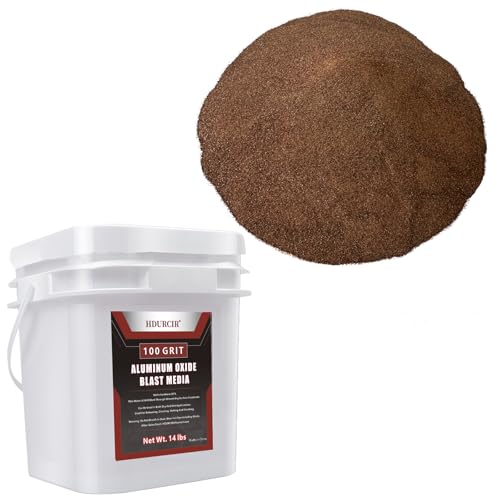
This 14-pound supply of 100-grit aluminum oxide delivers nearly double the volume of the standard 8-pound buckets at a price point that makes it the most economical entry in the mid-range tier. The 100 grit is the sweet spot for users who need one media that handles both paint stripping and surface profiling without switching between coarse and fine grades. It cuts through automotive primer and single-stage paint efficiently while leaving a 2.0 to 3.0 mil profile that epoxy and urethane coatings adhere to reliably.
The media arrives packed in a plastic bag inside a sturdy bucket, which prevents moisture absorption during storage. Users running blast cabinets report consistent flow through the gun with minimal clogging, and the angular grains stay sharp through roughly 10 to 15 hours of cabinet time before significant breakdown. Because it works wet or dry, this media is also suitable for outdoor dustless blasting setups where water suppression is used to control airborne particulate. The Mohs 9 hardness ensures it removes mill scale and heavy corrosion on stainless steel and aluminum without requiring excessive pressure.
Customer feedback consistently mentions the value proposition: more media for less per-pound cost compared to smaller packages, with performance identical to name-brand aluminum oxide. One reviewer noted that a single 14-pound bucket prepped all four mini bike rims for cerakote with media to spare. The only practical downside is that 100 grit can be too aggressive for thin gauge sheet metal, where the sharp grains may cause warping from the heat generated during blasting.
Why it’s great
- 14 pounds of 100-grit media offers best cost-per-pound in this lineup
- Versatile enough for stripping, cleaning, and profiling with one grit
- Packed in sealed bag inside bucket for long-term storage
Good to know
- 100 grit may warp thin sheet metal from cutting friction
- Not ideal for delicate substrates like fiberglass or soft plastic
4. 30-60 Grit Crushed Glass Abrasive (INTERACTIVIA)

This crushed glass media at 30 to 60 mesh is the heaviest-hitting option in this roundup for removing thick rust and corrosion from heavy steel components. The 19-pound box contains sharp, angular glass particles that cut aggressively through multiple layers of paint, mill scale, and flaking rust on car subframes and industrial equipment. Because the media is angular rather than spherical, it fractures into additional cutting edges during use, though the breakdown rate is faster than aluminum oxide, meaning each batch has a shorter effective life inside the cabinet.
The 303-ounce unit count translates into roughly 30 to 40 square feet of heavy-duty stripping before the media fines out and clouds the cabinet visibility. Users running siphon-feed blasters need to ensure their nozzle is large enough to handle the 30-grit particles — a 1/4-inch or larger nozzle prevents clogging at the tip. The box weight of 19 pounds is substantial, so the packaging must be transferred to a bucket for convenient pouring into the blaster pot. For heavy rust on thick steel where speed is the priority and cost-per-blast is secondary, this crushed glass media outperforms everything except aluminum oxide at similar grit.
Customer reviews divide into those who love the raw cutting power and those who caution that the media clouds the cabinet quickly. One reviewer stripped a full car subframe effectively, while another noted that coarser does not always mean better for detailed parts — the larger particles bounce off intricate contours rather than cutting into them. For flat steel panels and frame rails, this media is unmatched for speed, but it is a poor choice for thin metal or delicate restoration work.
Why it’s great
- 30-60 mesh cuts through mill scale and heavy rust faster than finer grits
- 19-pound supply provides extensive coverage for large parts
- Angular glass particles fracture to maintain cutting action
Good to know
- Breaks down faster than aluminum oxide, clouding cabinet visibility
- Not suitable for thin sheet metal or parts with complex contours
5. 10 Pack Strip Discs (LAIWOO)

These 4.5-inch strip discs represent a different category of paint removal — they mount to an angle grinder rather than a blasting cabinet, making them the correct choice when you need to strip paint from a localized area without setting up a full sandblasting rig. The diamond-infused nylon mesh construction cuts through automotive paint, primer, and rust without gouging the underlying metal, leaving a finish that is ready for primer without additional sanding. Each disc lasts through roughly two hours of continuous use, and the 10-pack strips an entire car in under two hours based on multiple user reports.
The 7/8-inch arbor fits standard angle grinders, and the 11,000 RPM maximum speed rating ensures safe operation at typical grinder speeds. The nylon mesh is flexible enough to follow curved panels without catching edges, and it does not load up or clog like traditional flap discs when cutting through soft paint layers. Users note that the dust generated is fine and airborne, so a full-face respirator is mandatory, but the lack of vibration or balance issues makes extended use less fatiguing than grinding discs. The discs are not compatible with drill-mounted paint eaters, only 4.5-inch angle grinders.
Customer feedback consistently reports exceptional durability compared to budget strip discs, with one reviewer noting four to five times the lifespan of the equivalent from a major hardware chain. The discs remove mill scale effectively but tend to disintegrate faster on sharp edges. For anyone whose project involves removing paint from a car body, steel beams, or concrete without investing in a blasting cabinet and compressor, this is the fastest mechanical alternative that still protects the substrate.
Why it’s great
- Strip discs remove paint and rust faster than flap discs without gouging metal
- Each disc lasts 4-5 times longer than budget equivalents
- Flexible nylon mesh follows curved body panels without catching
Good to know
- Produces fine airborne dust requiring a respirator
- Discs disintegrate faster on sharp edges and corners
6. #10 Glass Beads (INTERACTIVIA)

These #10 glass beads at 100-170 mesh are the polar opposite of the heavy-cutting media above. Rounded glass beads impact the surface at high velocity but do not cut in the same way as angular particles — they peen the surface, removing light paint, oxidation, and dirt without removing base material. This makes them the media of choice for cleaning aluminum intake manifolds, brass parts, and plastic components where preserving dimensional accuracy matters more than stripping speed. The extra-fine mesh leaves a smooth, matte finish that requires no additional surface prep before painting.
The 8-pound box contains beads that are sieved to a tight tolerance, ensuring consistent particle size across the entire batch. Because the beads are spherical, they produce less dust than crushed glass or aluminum oxide, which improves visibility inside the blast cabinet and reduces the load on the dust collection system. The downside is that glass beads break down faster — after roughly 5 to 10 cycles, the beads fracture into fine dust and lose peening effectiveness. Users should budget for more frequent media replacement compared to aluminum oxide.
Customer feedback emphasizes the gentle cleaning action on aluminum rims and car parts, leaving a clean surface without etching. One reviewer specifically noted using these beads for prepping car parts for painting and achieving an excellent finish. However, for heavy paint removal on steel, these beads are too fine — they will not cut through thick automotive primer or mill scale efficiently. Reserve them for final cleaning, light paint removal, and finishing work on soft metals.
Why it’s great
- Spherical beads clean aluminum and brass without removing base material
- Extra-fine 100-170 mesh leaves a smooth, paint-ready satin finish
- Low dust production improves cabinet visibility during use
Good to know
- Breaks down faster than angular media, requiring more frequent replacement
- Ineffective for removing thick automotive paint or heavy rust
7. Ground Walnut Shell Media 18-40 Grit (INTERACTIVIA)
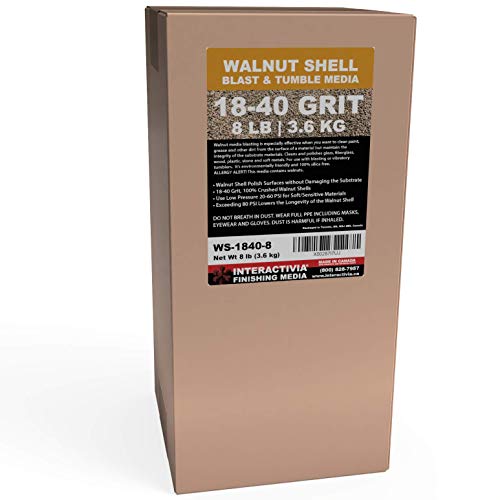
Ground walnut shell media at 18-40 grit is the softest abrasive in this guide, with a Mohs hardness of roughly 2.5. It removes paint, grease, and carbon buildup from delicate surfaces without etching glass, scratching wood, or warping thin metal. The organic particles are biodegradable and silica-free, making them the safest option for operators who blast in open environments without sophisticated PPE beyond a basic respirator. A single pass on carbon-coated intake valves or painted wood furniture lifts the coating without damaging the underlying material.
The 8-pound bag has a loose bulk density of approximately 40 to 50 pounds per cubic foot, meaning it flows easily through blasting guns and vibratory tumblers without bridging. Unlike angular mineral media, walnut shells do not fracture into sharper pieces — they gradually erode into finer dust, so each batch is effectively single-use for heavy stripping. The 18-40 grit range is fine enough for carbon cleaning on engine valves but coarse enough to remove light paint from wood and plastic. Users adding brass cleaner report effective brass polishing, though the media is too coarse for fine jewelry finishing.
Customer reviews split between users who appreciate the gentle cleaning action on engine intake valves and those who find it too soft for heavy-duty paint removal. One user specifically carbon-cleaned B7 RS4 intake valves with fantastic results, while another found the walnut shell too abrasive for fine coin polishing. For paint removal on metal surfaces, walnut shells require longer blasting times compared to aluminum oxide or crushed glass, making them best suited for final cleaning, carbon removal, and delicate substrate restoration where preservation is the priority.
Why it’s great
- Safe for wood, plastic, and soft metals where mineral media would etch
- Silica-free and biodegradable, lower respiratory risk than sand
- Effective for carbon cleaning on engine intake valves
Good to know
- Single-use media that degrades faster than mineral alternatives
- Too soft for multi-layer automotive paint or heavy rust removal
FAQ
Can I reuse aluminum oxide media for multiple paint removal projects?
What grit should I use to remove automotive paint without damaging the metal?
Is crushed glass better than aluminum oxide for removing rust?
Final Thoughts: The Verdict
For most users, the blasting media for removing paint winner is the #80 Grit Aluminum Oxide (TITGGI) because its Mohs 9 hardness and 80-grit particle size strip multi-layer paint and rust quickly on steel while delivering exceptional reusability. If you need a finer prep surface for cerakote or powder coating, grab the #120 Aluminum Oxide (INTERACTIVIA). And for delicate substrates where etching is unacceptable, nothing beats the Ground Walnut Shell Media for safe, silica-free cleaning.