
Our readers keep the lights on and the weekend projects moving. As an Amazon Associate, I earn from qualifying purchases.
A misshapen sweater or a lopsided granny square can undo hours of careful work. A dedicated surface lets you pin each stitch into precise alignment while it dries, turning a wobbly piece of fabric into a crisp, professional finish. The right board keeps pins buried deep and holds your project flat, whether you are steam blocking a lace shawl or wet blocking a chunky scarf.
I’m Rikta — the co-founder and writer behind FitlyFast. I have spent many hours researching fiber-art tools and analyzing how material density, grid accuracy, and board thickness affect the blocking process for knitters and crocheters.
This guide evaluates seven interlocking mat-and-pin sets so you can find the best blocking board for knitting that matches your project size and preferred finishing method.
How To Choose The Best Blocking Board For Knitting
A blocking board is a simple tool, but small differences in material, thickness, and grid design separate a frustrating experience from a reliable one. Focus on three factors to narrow your options.
Board Material and Thickness
High-density EVA foam at least 0.75 inches thick holds T-pins firmly without letting them push through to the table underneath. Thinner mats may cause pins to lean or protrude on the back, especially under tension from a tightly stretched sweater body. Rubber mats offer a similar feel but may lack printed grid lines that help square up uneven edges.
Grid Accuracy and Interlocking Fit
A 1-inch grid lets you measure stitch gauge directly on the board and align corners symmetrically. Check that the printed lines match exactly at the seams between two tiles; a misaligned grid defeats the purpose of using a blocking board for sizing. The puzzle-edge joints should snap together without gaps so the surface stays flat when you pin across multiple mats.
Total Surface Area and Configuration
Most 9-pack kits create a work area of roughly 36 by 36 inches, which is enough for a lap blanket, a sweater body, or multiple squares. If you plan to block large shawls or oversize cardigans, consider whether the kit allows you to buy a second set that joins seamlessly. The included storage bag matters less for blocking quality but helps keep all pieces together between projects.
Quick Comparison
On smaller screens, swipe sideways to see the full table.
| Model | Category | Best For | Key Spec | Amazon |
|---|---|---|---|---|
| LAMXD | Extra Thick | Sweater and shawl blocking | 0.75-inch foam with grid | Amazon |
| Opstin | Dense EVA | All-purpose wet and cold blocking | 0.75-inch EVA with grid | Amazon |
| Yrangee | Eco EVA | Long-term reuse across many projects | 0.75-inch odor-free EVA | Amazon |
| Juvale | Complete Kit | Entry-level blocking with storage | 0.7-inch foam with 200 pins | Amazon |
| Bamboo Board | Magnetic Splicing | Granny squares and small motifs | 0.7-inch bamboo with pegs | Amazon |
| Knit Picks | Textured Rubber | Doilies and lace starch blocking | Rubber, 13-inch tiles | Amazon |
| Mr. Pen | Budget Pack | First-time user on a budget | 0.38-inch heat-resistant foam | Amazon |
In‑Depth Reviews
1. LAMXD Blocking Mats for Knitting

LAMXD hits the sweet spot of board density and value. Each foam tile measures a full 0.75 inches thick, which means T-pins sink in deep enough to hold a tautly stretched sweater body without tilting. The interlocking edges snap together like a puzzle, creating a continuous surface that stays flat across all nine tiles. Grid lines are printed on every mat, helping you check stitch count and align corners with confidence.
Two hundred T-pins come in the package, which is plenty for a large shawl or a cardigan that needs even tension along every edge. A non-woven storage bag keeps everything together, so mats and pins do not end up scattered after a project. The foam is heat- and steam-resistant, so you can safely apply a steamer directly to the pinned fabric without damaging the board.
Customer reports confirm that the mats handle repeat use without denting or losing shape. The same set works for crochet, needlepoint, and lace blocking. If you want one kit that covers the broadest range of projects without stepping up to a premium tier, this is the most balanced option.
Why it’s great
- Full 0.75-inch thickness holds pins firmly
- Heat- and steam-resistant material
- Generous 200 T-pins included
Good to know
- Grid is printed on one side only
- Bag is basic non-woven material
2. Opstin Knitting Blocking Mats and Pins

Opstin builds its mats from high-density EVA foam, a material that resists moisture and stays non-allergenic against skin during wet blocking. Each tile is 12 inches square and 0.75 inches thick, matching the premium thickness standard that serious blockers look for. The interlocking joints fit snugly, and the grid lines align reliably across the assembled surface so you can square up a sweater or a lace panel without guesswork.
The set includes 150 T-pins and a high-quality storage bag that has a dedicated pocket for the pin container. That pocket makes a real difference when you are packing up mid-project or traveling to a knitting group. Owners report that the mats hold pins securely even when blocking warped needlepoint canvas that requires aggressive stretching.
Buyers note that a single 9-pack is enough for most sweater bodies, but large shawls may require a second set. The case makes it easy to carry extra tiles. For mid-range money you get a near-premium build with a very functional carrying solution.
Why it’s great
- High-density EVA resists water absorption
- Storage bag has a pin-container pocket
- Grid lines stay aligned across multiple tiles
Good to know
- Only 150 pins supplied
- Large projects may need two sets
3. Yrangee Blocking Mats for Knitting

Yrangee uses environmentally friendly EVA foam that is non-toxic and completely odor-free, a benefit you notice the moment you open the box. The mats measure 12 by 12 inches with a 0.75-inch thickness, matching the top-tier standard for pin retention. The grey color hides dirt and lint better than white or blue surfaces, keeping the boards looking clean through heavy use.
Waterproof construction allows wet blocking, cold blocking, and steam blocking without damaging the material or the printed grid lines. The set arrives with 150 T-pins and a reusable storage bag. Owners specifically mention that the mats are self-healing — pin holes close up after removal, so the surface stays smooth project after project.
Some users buy a second set to handle oversize shawls, and the carry case accommodates expansion easily. The pins included are sturdy enough for medium-gauge projects but you may want extras if you frequently block lace or very large items. Overall, this is a durable choice for anyone who wants an eco-conscious board without sacrificing thickness.
Why it’s great
- Odor-free, non-toxic EVA foam
- Self-healing surface hides pin marks
- Waterproof for wet and steam blocking
Good to know
- 150 pins may be light for big projects
- Second set needed for large shawls
4. Juvale Foam Blocking Pad Set

Juvale bundles nine foam mats, 200 T-pins, and a zippered storage bag into one package aimed at beginners who want everything in a single purchase. The tiles are 12.5 inches square and 0.7 inches thick, slightly thinner than the 0.75-inch options but still dense enough to hold standard pins without them pushing through. A printed grid on each mat helps with square alignment, though some users note the grid spacing is slightly over one inch, so treat it as a visual guide rather than a precise ruler.
The interlocking notches fit together securely and the foam is lightweight enough to move around your workspace easily. Kit includes enough pins to block a large lap blanket or a set of granny squares. The zippered pouch has a carrying handle, making transport to knit nights or retreats simple.
Budget-conscious buyers appreciate that this set covers the basics without skimping on accessories. The foam resists moisture and heat, so both wet and steam blocking are safe. If you are trying blocking for the first time and want to avoid investing heavily, this is a low-risk starting point.
Why it’s great
- 200 pins included in the bundle
- Zippered bag with handle for storage
- Lightweight and easy to transport
Good to know
- Grid spacing not exactly 1 inch
- 0.7-inch foam slightly thinner than premium sets
5. Iswabard Bamboo Crochet Blocking Board
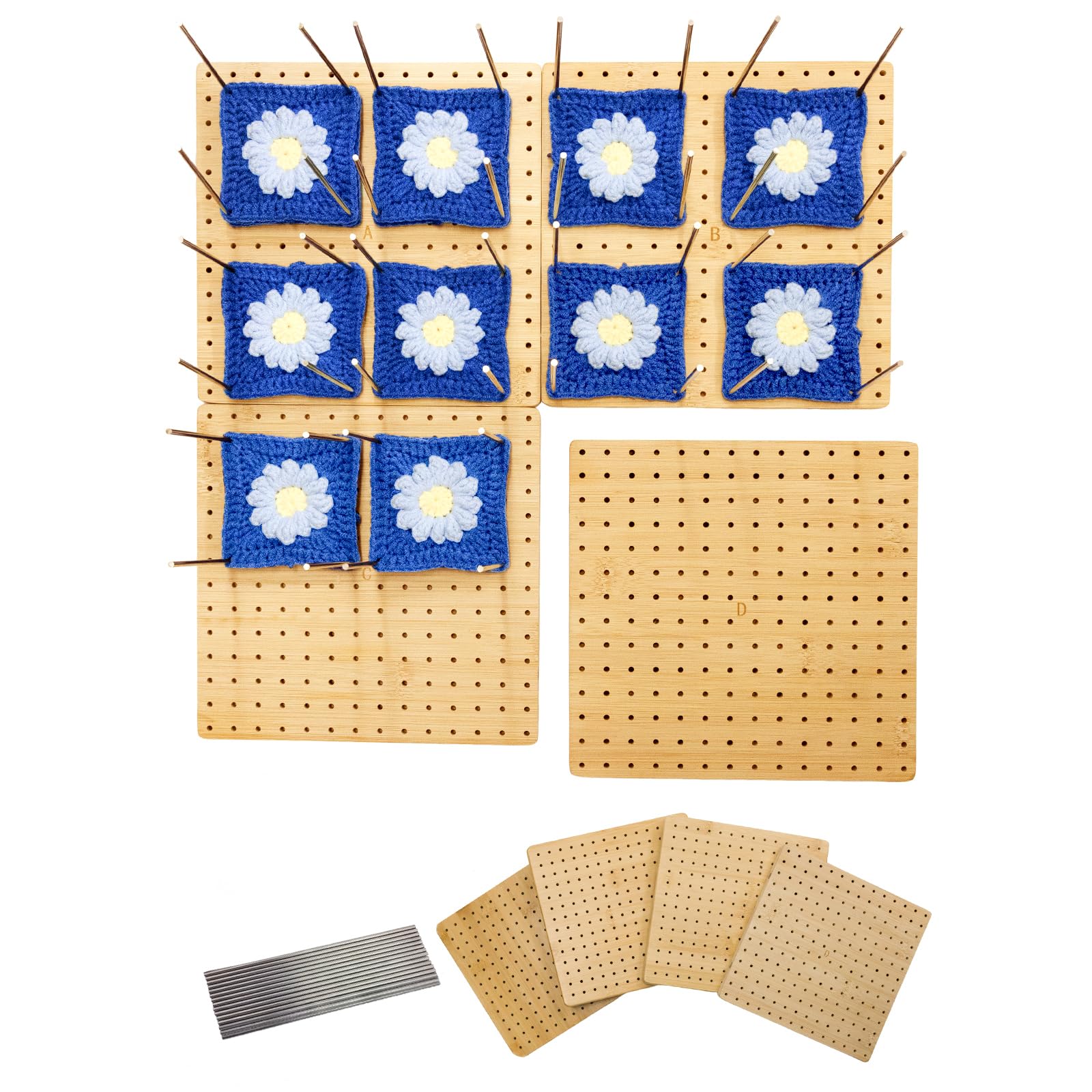
This bamboo board abandons the foam-and-pin approach in favor of a hard surface with stainless steel pegs. Four 8-inch square tiles connect via magnets to form a 16 by 16-inch work area. You stretch a granny square over the pegs, which hold each corner at an exact distance, producing uniform motifs every time. The bamboo is finished with a clear varnish that protects your yarn from snags.
Magnetic splicing keeps the tiles aligned without puzzle-piece tabs, and the smooth surface does not absorb moisture or steam. This is a peg-based system, so it is best for small to medium squares where corner stretching is the goal. Larger items like garments need the surface area and pin flexibility of a foam board.
Users note that the board is thick and heavy enough to stay put on a table. The set works beautifully for granny square blankets where consistency across dozens of squares matters. If your main project is repeating motifs, this dedicated tool can be faster and more precise than pinning each one individually onto a foam mat.
Why it’s great
- Magnetic connection keeps tiles aligned
- Stainless steel pegs for uniform squares
- Hard varnished surface resists moisture
Good to know
- Limited to smaller square projects
- Extra pegs purchased separately
6. Knit Picks Blocking Mats for Knitting and Crochet

Knit Picks uses a rubber compound instead of foam, giving these mats a distinct feel that some fiber artists prefer. The surface is textured, which provides grip and keeps items from sliding as you pin. Each tile is 13 inches square, slightly larger than the standard 12-inch mats, so the total assembled area covers more ground with fewer seams. Nine boards produce a roughly 39 by 39-inch workspace.
The rubber handles starch blocking particularly well. Users report that heavily starched doilies do not stick to the surface, and pins insert and release easily. There is no printed grid, so you rely on a separate ruler or measuring tape to check gauge. The joints fit together securely, and many owners end up buying a second set for oversized projects.
Because there is no grid, these mats are less suited for projects that require precise square alignment. They excel at lace or doily blocking where the shape is defined by the stitch pattern rather than by measured corners. If you do frequent starch blocking, the non-stick rubber surface saves cleanup time.
Why it’s great
- Non-stick rubber for starch blocking
- Larger 13-inch tiles cover more surface
- Textured surface prevents sliding
Good to know
- No printed grid lines
- Slightly thinner than premium 0.75-inch foam
7. Mr. Pen Blocking Mats and Pins

Mr. Pen offers a 9-pack of interlocking mats at a price point that makes it easy to try blocking without a major commitment. Each tile is 12 inches square with a printed 1-inch grid, so you can measure stitch gauge and align edges. The foam is heat- and water-resistant, allowing both wet and steam blocking. One hundred fifty T-pins are included, enough for a medium-size scarf or a set of squares.
The key trade-off is thickness. At 0.38 inches, these mats are roughly half as thick as the premium options. Pins can protrude through the back if you push them in too far, especially on a hard table surface. Users recommend placing a towel or a secondary mat underneath if you plan to stretch heavily. For lightweight lace or small projects where tension is moderate, the thinner foam works fine.
Customer reviews highlight the value for the price and the fact that the mats fit together snugly despite the lower cost. This is a sensible first set for a beginner who wants to learn the blocking process before investing in thicker boards.
Why it’s great
- Very accessible entry price
- Clear 1-inch grid for measurements
- Heat- and water-resistant foam
Good to know
- Only 0.38 inches thick — pins may poke through
- Thin foam may bow under heavy tension
FAQ
Why do some blocking boards use pegs instead of T-pins?
Can I steam block directly on EVA foam mats?
How many tiles do I need for a large sweater?
Final Thoughts: The Verdict
For most users, the best blocking board for knitting winner is the LAMXD Blocking Mats because it delivers a full 0.75-inch thickness, a clear grid, heat resistance, and 200 pins at a mid-range price. If you want a dedicated eco-friendly set without odor, grab the Yrangee mats. And for beginners who want the lowest cost of entry, nothing beats the Mr. Pen kit.