
Our readers keep the lights on and the weekend projects moving. As an Amazon Associate, I earn from qualifying purchases.
Choosing the right tool for tracking your blood oxygen saturation starts with understanding the gap between a quick fingertip spot-check and a continuous overnight monitor. A single reading at the wrong moment can mask dangerous dips or create false alarm, so the device you pick must match both your routine and your body’s signal behavior.
I’m Rikta — the co-founder and writer behind FitlyFast. I’ve spent hours cross-referencing clinical accuracy claims, battery endurance data, and real-world sensor performance to isolate which hardware actually delivers stable readings across different skin tones, circulation levels, and motion environments.
Whether you need a budget-friendly sports companion or a premium medical-grade device for home care, this guide cuts through the spec sheets to help you find the real best blood oxygen monitor for your specific situation.
How To Choose The Best Blood Oxygen Monitor
The right blood oxygen monitor depends on your specific monitoring goal — are you tracking a diagnosed respiratory condition, checking altitude adaptation during training, or simply looking for peace of mind after an illness? The device’s sensor technology, form factor, and data handling all change based on that answer.
Spot-Check vs. Continuous Monitoring
Spot-check fingertip oximeters give you a snapshot of SpO2 and pulse rate in seconds. They are ideal for quick daily checks or use after exercise. Continuous monitors, often in a ring form or a handheld unit with a permanent probe, track your oxygen saturation over hours — essential for detecting overnight desaturation events or recovery trends. If you only need a single reading before and after a workout, a spot-check model suffices. For sleep apnea management or post-COVID recovery, a continuous device is non-negotiable.
Accuracy and Sensor Certification
Not all oximeters read equally. The best devices boast a specification of ±1% for SpO2 in the range of 70-100%. Low-perfusion performance — the ability to read accurately on cold fingers or during low blood flow — separates medical-grade units from cheaper alternatives. FDA clearance is the gold standard for home medical monitoring: it means the device has been independently tested for clinical-grade accuracy. Many budget models carry a disclaimer that they are “for sports and aviation use only,” which means they are not validated for diagnosing medical conditions.
Display, Alarms, and Data Storage
A bright OLED or LED screen with adjustable orientation matters when you’re checking readings in the dark. Adjustable audio alarms for low SpO2 or bradycardia add safety for unsupervised monitoring, especially overnight. Internal memory that stores multiple sessions (or user profiles) saves you from carrying a phone to every reading. If you rely on trends, a device that syncs via Bluetooth to a free smartphone app and exports PDF reports gives you real insight rather than just a number.
Quick Comparison
On smaller screens, swipe sideways to see the full table.
| Model | Category | Best For | Key Spec | Amazon |
|---|---|---|---|---|
| Nonin TruO2 3250 | FDA-Cleared | Medical-grade spot checks | ±1% across skin tones | Amazon |
| MedChirrup C101B1 | Continuous Handheld | Overnight family monitoring | 20-hour log, 500 records | Amazon |
| Manhero C101B1 | Medical-Grade Handheld | Continuous use with alarms | Plethysmograph display | Amazon |
| HOLFENRY JKS50F | Handheld Trend | Multi-user family tracking | Probes for EMS/hospitals | Amazon |
| Medline Soft-Touch | Bluetooth Fingertip | Shareable home data | 300-hour battery life | Amazon |
| Vibeat WearO2 | Continuous Ring | Long-term wear tracking | 12-16 hour rechargeable | Amazon |
| Pepultech 1300-003 | Bluetooth Sports | Fitness & altitude checks | 15-hour battery life | Amazon |
In‑Depth Reviews
1. Nonin TruO2 OTC Pulse Oximeter 3250

The Nonin TruO2 3250 is the only unit in this lineup that carries FDA clearance specifically for over-the-counter home use, backed by the same PureSAT technology used in hospital and military-grade oximeters. Its low-perfusion performance is unmatched — it delivers stable SpO2 readings even when your fingers are cold, shaky, or have poor circulation, which is the exact scenario where budget fingertip models fail or flicker.
The TruO2 offers a bright, auto-activated LED display with four orientation modes and Nonin CorrectCheck, a visual cue that instantly confirms your finger is positioned correctly for a valid reading. With up to 2,200 spot checks on two included AAA batteries, this device prioritizes long-term reliability over gimmicks. It also features secure Bluetooth connectivity to the NoninConnect app for iOS, enabling data sharing via Apple Health or email reports.
On the downside, the plastic build feels flimsy relative to the premium price tag. The clip can pinch during prolonged use, and some units have arrived defective or have developed cracked battery covers over extended use. For critical home monitoring where diagnostic accuracy is paramount, however, its sensor performance justifies the investment over cheaper alternatives.
Why it’s great
- FDA-cleared for OTC medical home use
- Accurate SpO2 across all skin tones and low perfusion
- CorrectCheck finger-position validation
- 2,200 spot checks per battery set
Good to know
- Build quality feels cheap despite high price
- Clip can be uncomfortable for prolonged wear
- iOS-only Bluetooth app support
2. MedChirrup C101B1 Medical Grade Pulse Oximeter

The MedChirrup C101B1 is a rechargeable handheld oximeter designed for continuous monitoring with medical-grade accuracy of ±1% SpO2. Its 2.4-inch HD display shows real-time plethysmograph data, and the unit stores up to 500 data records with 20-hour continuous logs per patient. This is the device to grab if you need overnight trend tracking with customizable audio-visual alarms for both low SpO2 and abnormal heart rates.
Unlike fingertip clip models, the MedChirrup uses a separate adult finger probe connected by wire, which allows for comfortable overnight use without the risk of the probe falling off. The USB-C rechargeable battery delivers about 8 hours of continuous operation, and the device supports multi-language interface options including English, Spanish, Turkish, and Polish.
Some users note that the display does not continuously update in real-time — it refreshes in intervals rather than showing a seamless live stream. The device is also bulkier than a simple fingertip clip, making it less portable for everyday carry. For dedicated home monitoring of elderly family members or post-illness recovery, the MedChirrup offers robust data storage and clear alarms that budget options lack.
Why it’s great
- Medical-grade ±1% SpO2 accuracy
- 500-record storage with 20-hour session logs
- Customizable audio and visual alarms
- USB-C rechargeable, no battery waste
Good to know
- Display is not live continuous
- Bulkier form factor than fingertip clips
- Requires separate probe (included)
3. Manhero C101B1 Continuous Pulse Oximeter
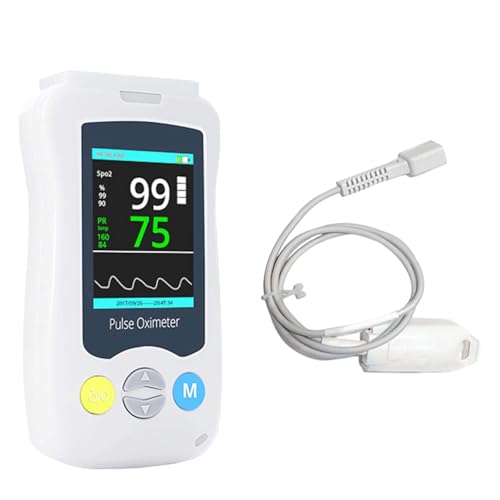
The Manhero C101B1 is a continuous-use handheld oximeter that distinguishes itself by displaying a real-time plethysmograph (pulse waveform) alongside numerical SpO2 and pulse rate. This visual signal validation lets you personally assess measurement stability, which is crucial for catching motion artifact that can skew readings during sleep or light activity. Its accuracy spec of ±1% across 70-100% SpO2 mirrors the MedChirrup but adds the extra transparency of waveform feedback.
The device supports both continuous monitoring and rapid spot-check modes, with adjustable high/low alarms for SpO2 and pulse rate. A key practical feature is its dual power system: it can run on two AA batteries or via an AC power port for uninterrupted overnight use, though the USB cord is notably short and batteries drain within 24 hours of continuous operation.
One common complaint is that the finger probe plug is not secure and can easily disconnect during sleep. The device also does not include batteries or a USB cable in the box, which is an inconvenience for first-time setup. For users who prioritize seeing the pulse waveform to confirm signal quality, the Manhero delivers deeper insight than most competitors at this tier.
Why it’s great
- Real-time plethysmograph for signal validation
- Dual power: batteries or AC plug-in
- Adjustable alarms for SpO2 and pulse
- Spot-check and continuous modes
Good to know
- USB cord too short for bedside tables
- Included batteries? No—buy separately
- Probe plug disconnects easily
4. HOLFENRY JKS50F Handheld Pulse Oximeter
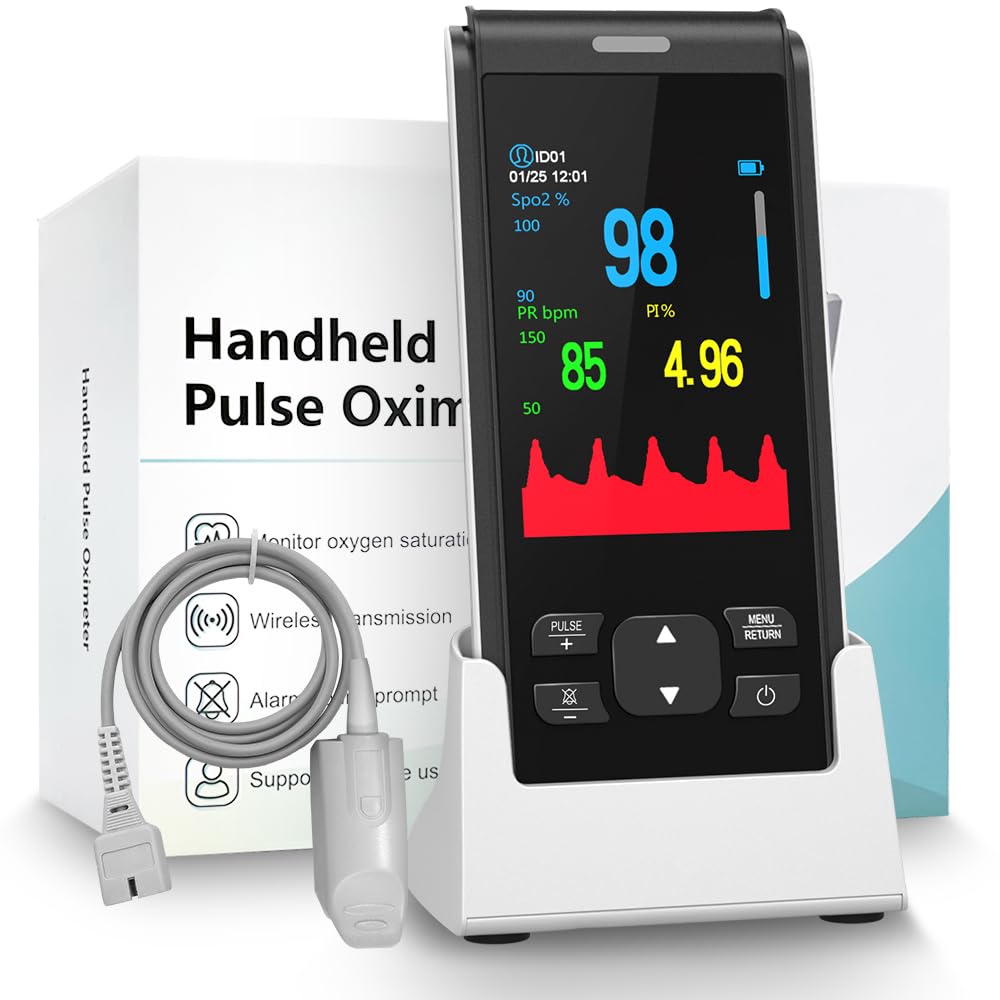
The HOLFENRY JKS50F is a handheld continuous oximeter built for multi-user households. It supports up to 10 separate user IDs, each capable of storing 300 sets of data independently — making it the only device in this lineup that genuinely serves a family without requiring separate purchases. The standard probe port is compatible with EMS and hospital-grade probes, including pediatric wrap-style sensors, so it scales with changing medical needs.
It offers both spot-check and trend record modes, with adjustable audio alarms for low SpO2 and bradycardia. The device charges via a magnetic docking cradle with USB-C, providing 8 hours of continuous use. The “HealthTree” app (free for iOS and Android) syncs data in real-time and supports multi-user profile management, making it easy to track each family member’s trends separately.
Some units have reported intermittent connection issues where the probe loses the pulse signal, particularly during sleep. The magnetic charging dock is non-removable, so if the magnetic contact wears out, the unit cannot be charged. For families needing a centralized monitoring hub with robust data separation, however, the HOLFENRY offers unmatched user management features.
Why it’s great
- 10 user profiles with 300 records each
- Compatible with standard EMS/hospital probes
- Adjustable SpO2 and heart rate alarms
- USB-C rechargeable docking cradle
Good to know
- Probe may lose signal during sleep
- Magnetic charger is non-replaceable
- No hard carrying case included
5. Medline Soft-Touch Bluetooth Fingertip Pulse Oximeter

The Medline Soft-Touch Bluetooth Pulse Oximeter is a premium fingertip spot-check monitor that emphasizes battery endurance — its two AAA batteries deliver up to 300 hours of use, far outlasting every other device in this comparison. It connects via Bluetooth to the Medline Health App for tracking and sharing SpO2 and pulse rate trends, and it matches the accuracy of healthcare-grade units without requiring a prescription.
The soft finger pad and lightweight clip (under 2 ounces) make it comfortable for repeated spot checks throughout the day. The OLED display rotates through 7 viewing directions, so you can read it from any angle without adjusting the device. Medline is a trusted healthcare supplier, and the device’s accuracy matches clinical oximeters within ±1% for SpO2 and ±2 bpm for heart rate.
One limitation: the device is designed for spot checks only, not continuous wear. Some users also note that the app requires mandatory account creation with email and phone verification, which adds friction for quick data logging. The auto-shutoff feature triggers even while the device is on your finger, which can interrupt extended monitoring sessions. For reliable spot-checking with exceptional battery life, the Medline is a solid choice.
Why it’s great
- 300-hour battery life on two AAA cells
- 7-direction OLED display for easy reading
- Matches healthcare-grade accuracy
- Soft finger pad for comfortable use
Good to know
- Spot-check only — not for continuous monitoring
- App requires mandatory account creation
- Auto-shutoff can interrupt extended sessions
6. Vibeat WearO2 Pulse Oximeter Ring

The Vibeat WearO2 is a wearable ring sensor that enables true continuous blood oxygen monitoring without the restriction of a wired probe. The soft silicone ring slips onto your index finger and tracks SpO2, heart rate, and motion for 12-16 hours on a single charge. It vibrates to alert you when oxygen levels drop below a preset threshold, and the intensity and threshold are adjustable through the free “Vihealth” app.
The ring stores up to 4 sessions of 10 hours each locally, so you don’t need your phone nearby during recording. Data syncs via Bluetooth to the app, which generates graphical trend reports and PDF exports compatible with Apple Health. The form factor is ideal for overnight monitoring — comfortable enough to sleep in without the bulk of a handheld unit with a probe.
Accuracy concerns have been raised: some users report readings 5% lower (87% vs 92%) compared to a standard fingertip oximeter, a critical discrepancy for medical monitoring. The device’s battery life also requires daily charging, and the Samsung-style storage system (oldest data overwritten after 4 sessions) can lead to data loss if not synced regularly. It is explicitly not a medical device — labeled for sports and aviation use only.
Why it’s great
- Wearable ring for continuous overnight tracking
- Adjustable vibration low-O2 alerts
- 12-16 hour battery life per charge
- 4 session local storage, no phone needed
Good to know
- Potential 5% reading discrepancy vs fingertip
- Requires daily charging
- Not a medical device
7. Pepultech 1300-003 Bluetooth Fingertip Oximeter
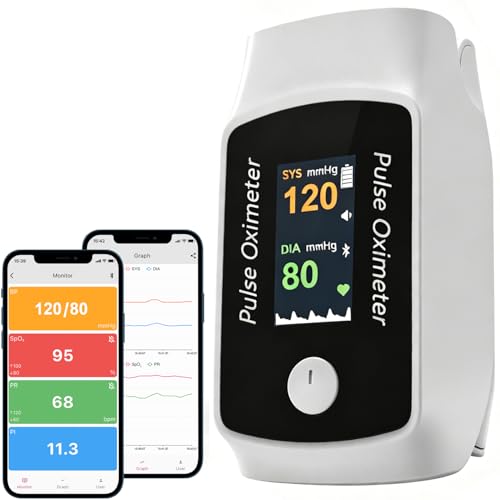
The Pepultech 1300-003 is a no-frills Bluetooth fingertip oximeter aimed at fitness enthusiasts and altitude trainers. It pairs with the Berry Health app to sync real-time readings, and the large OLED display rotates through multiple orientations for easy viewing. With a 15-hour continuous battery life on two AAA batteries (not included), it competes well on endurance for a device at this end of the market.
It offers simple one-button operation and an automatic shutoff after 8 seconds of inactivity, which extends battery life but can interrupt longer monitoring sessions. The device weighs only 63 grams with batteries, making it genuinely portable. Customer feedback consistently praises its SpO2 and heart rate accuracy for the price, with many calling it a reliable daily check tool.
The primary drawback is its intended use limitation: the manual explicitly states it is for sports and aviation use only, not medical applications. The blood pressure function, while included, is widely reported as inconsistent compared to standard arm cuffs. If you need a cheap, lightweight spot-check monitor for gym use or altitude training, the Pepultech delivers solid core performance without the medical certification markup.
Why it’s great
- 15-hour battery life ideal for multi-day trips
- Bluetooth app sync for trend recording
- Bright OLED display with rotation
- Ultra-lightweight at 63g
Good to know
- Sports/aviation use only — no medical certification
- Blood pressure readings are unreliable
- Batteries not included
FAQ
What does “for sports and aviation use only” mean on an oximeter?
Can I use a fingertip oximeter for overnight monitoring?
Why does my oximeter show different readings between my left and right hand?
What is a plethysmograph and why does it matter?
Final Thoughts: The Verdict
For most users, the true best blood oxygen monitor winner is the Nonin TruO2 3250 because its FDA clearance, low-perfusion sensor, and validated accuracy across skin tones make it the only device you can fully trust for medical-grade spot checks. If you want continuous overnight monitoring with robust data storage and customizable alarms, grab the MedChirrup C101B1. And for a budget-friendly fitness companion that pairs with your phone for trend recording, nothing beats the value of the Pepultech 1300-003.