
Our readers keep the lights on and the weekend projects moving. As an Amazon Associate, I earn from qualifying purchases.
A blood pressure cuff that’s too small doesn’t just feel tight—it can inflate your systolic reading by 10 to 40 mmHg, sending false alarms or masking real problems. For anyone with an arm circumference over 16 inches, standard cuffs turn a simple check into a guessing game. The right cuff, sized for your arm, removes that error and gives you numbers you can actually trust.
I’m Rikta — the co-founder and writer behind FitlyFast. I’ve spent hundreds of hours cross-referencing cuff circumference ranges, clinical accuracy data, and user feedback to isolate the monitors that genuinely fit larger arms without compromising reading reliability.
Whether you need a manual sphygmomanometer for professional use or an automatic monitor with Bluetooth tracking, this guide breaks down the specs, fit ranges, and real-world performance of the best options available. Here is your complete resource for the blood pressure cuff for large arms.
How To Choose The Best Blood Pressure Cuff For Large Arms
Picking the right cuff for a larger arm goes beyond just grabbing the biggest one you see. You need to match the cuff’s stated circumference range to your own bicep measurement, decide between manual and automatic operation, and consider whether advanced features like irregular heartbeat detection or smartphone sync matter for your routine. Below are the key decision points that separate a smart buy from a frustrating mismatch.
Understand the Cuff Size Range
Cuffs are labeled with a specific arm circumference range, usually printed right on the box. For large arms, you want a cuff that starts around 13 inches and extends to at least 17 inches, with some XL options reaching up to 21 inches. If your arm is 18 inches around and you buy a cuff that maxes out at 17 inches, you are compressing the bladder beyond its designed capacity—leading to falsely high readings every single time. Always measure your bare upper arm at the midpoint between shoulder and elbow before buying.
Manual vs. Automatic: Which Fits Your Routine?
Manual aneroid monitors (the ones with a dial and a squeeze bulb) are often preferred by medical professionals because they let you control inflation speed and listen for Korotkoff sounds with a stethoscope. They are also more durable and repairable. Automatic digital monitors are easier for solo home use, inflating and deflating at a consistent rate with one-button operation. For large arms, the key difference is that some automatic models include an extra-wide cuff in the box, while manual units usually require buying the cuff separately. If you need precise, professional-grade readings and do not mind learning the manual technique, a manual kit with an XL cuff is a solid choice. If you want convenience and data tracking, go automatic.
Check for Clinical Validation and FDA Clearance
Accuracy is not optional when monitoring blood pressure. Look for devices that are FDA-cleared or have passed clinical validation protocols like ANSI/AAMI/ISO 81060-2. This ensures the monitor has been tested against a mercury sphygmomanometer reference standard. Many budget monitors skip this step, and their readings can drift by 5–10 mmHg over time. The cuffs themselves should also be made of durable, easy-to-clean material—nylon with latex-free bladders is a common hallmark of professional-grade equipment.
Extra Features That Matter for Large Arms
Bluetooth connectivity, dual-user memory, and irregular heartbeat detection are increasingly common on automatic monitors. For a large cuff user, the most valuable extra is simply the inclusion of an XL cuff (13″–21″) in the box so you do not have to hunt for an accessory. Memory storage for at least 100 readings helps you track trends for doctor visits. If you have a history of atrial fibrillation, a monitor with AFib detection can flag irregular rhythms, but note that some brands (like OMRON) will refuse to display a reading if AFib is detected—a safety measure that can frustrate users who just want a number. Weigh that trade-off against your specific health needs.
Quick Comparison
On smaller screens, swipe sideways to see the full table.
| Model | Category | Best For | Key Spec | Amazon |
|---|---|---|---|---|
| OMRON Gold BP5360 | Automatic | AFib detection & app sync | Cuff 9″–17″, AFib detection | Amazon |
| Primacare DS-9185 | Manual Kit | 5 cuff sizes, professional use | 5 cuffs: infant to thigh | Amazon |
| COCACIS U80BH | Automatic | 2 cuff sizes (M/L & XL) | XL cuff 13″–21″ | Amazon |
| AQESO U80BH | Automatic | Large display, 2-user memory | XL cuff 13″–21″ | Amazon |
| Andesfit A02-SEB | Automatic | Bluetooth sync & app tracking | XL cuff up to 21″ | Amazon |
| Urion U80A | Automatic | FSA/HSA eligible, compact | Adjustable wide-range cuff | Amazon |
| McKesson Aneroid | Manual | Large adult cuff, budget-friendly | Cuff 34–50 cm (13.4″–19.7″) | Amazon |
In‑Depth Reviews
1. OMRON Gold Blood Pressure Monitor (BP5360)
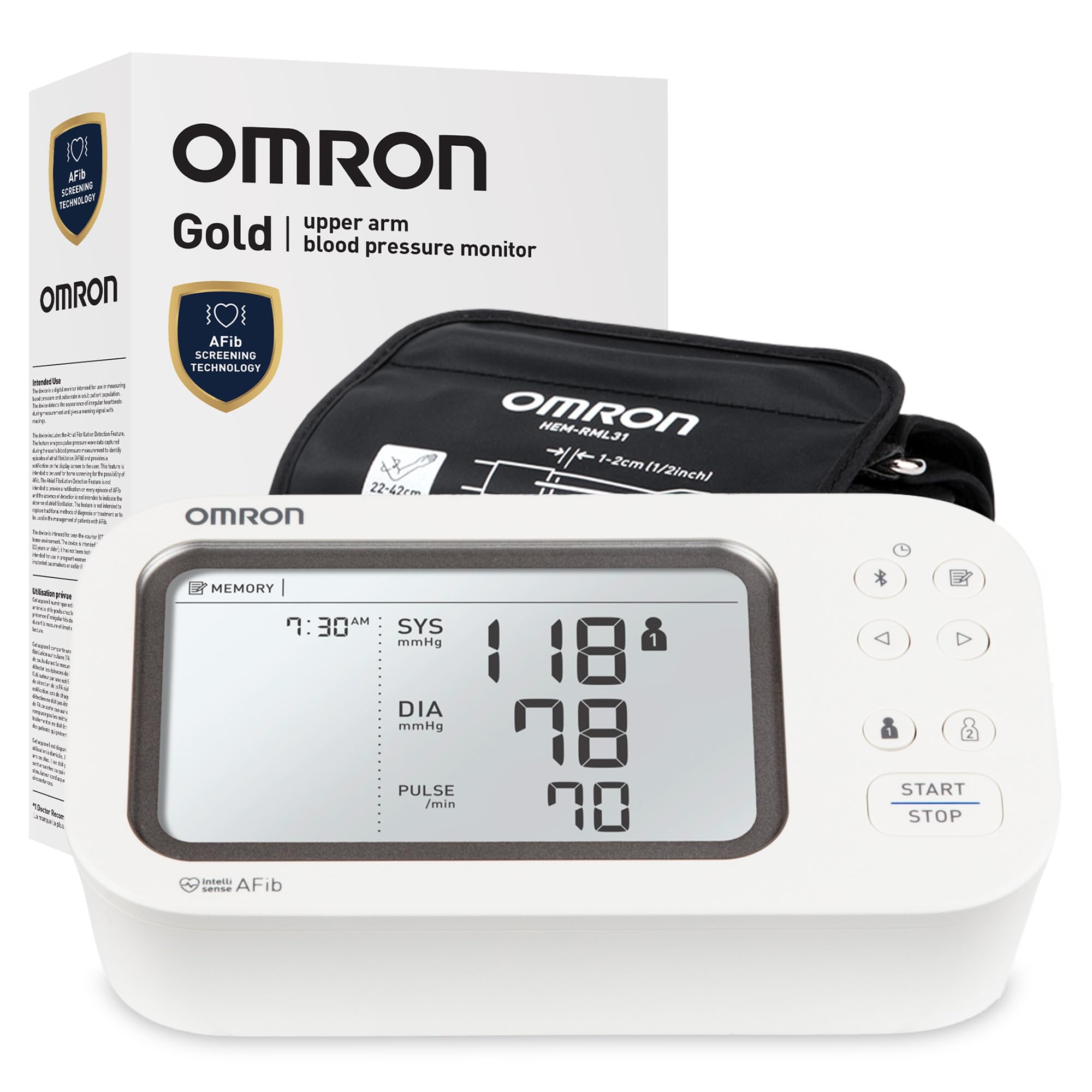
The OMRON Gold is the flagship model from the #1 doctor-recommended brand, and it earns that trust with clinically validated accuracy and a wide-range D-ring cuff that fits arms 9 to 17 inches. The key differentiator here is the built-in Atrial Fibrillation detection—every reading screens for irregular heart rhythms, which is critical for anyone with known or suspected AFib. The cuff itself is well-constructed, inflates quietly, and deflates smoothly, and the Bluetooth sync to the OMRON connect app is seamless for tracking long-term trends.
Where this monitor truly shines is in its Morning Average Indicator, which flags blood pressure spikes that happen soon after waking—a period linked to higher cardiovascular risk. The dual-user memory stores unlimited readings per user in the app, and the unit is compatible with both Apple Health and Google Fit. It comes with batteries, a storage case, and a detailed instruction manual, so you are ready to measure out of the box.
The trade-off: if you have confirmed atrial fibrillation, the AFib detection feature may prevent the device from displaying a reading at all, as noted by several verified buyers. This is a safety design choice by OMRON, but it can be frustrating if you simply want a number. Additionally, the cuff range maxes out at 17 inches, so if your arm circumference exceeds that, you will need to source a separate XL cuff accessory. For most larger arms under 17 inches, this is the most reliable automatic monitor available.
Why it’s great
- Clinically validated accuracy with AFib detection
- Seamless Bluetooth sync with OMRON connect app
- Morning hypertension indicator for cardiovascular risk tracking
Good to know
- AFib detection may block readings for some users
- Cuff only fits up to 17″, not true XL for 18″+ arms
2. Primacare DS-9185 Manual Sphygmomanometer Set

The Primacare DS-9185 is a comprehensive manual blood pressure kit that covers the full spectrum of patient sizes with five nylon cuffs: infant, child, adult, large adult, and thigh. For anyone who needs to measure multiple family members or performs clinical checks at home, this is the most versatile manual option available. The aneroid gauge features a strong transparent face with clear graduation marks, and the built-in calibration screw allows for long-term accuracy adjustments without needing a new device.
The large adult cuff in this kit fits arms up to approximately 19 inches, and the thigh cuff extends even further for bicep measurements on very large individuals. The nylon material is soft against skin and the Velcro holds firm even after repeated use. A waterproof carrying case with a sturdy handle keeps everything organized, and the set also includes a deflation valve that offers fine control for gradual pressure release—essential for getting accurate manual readings.
One important consideration: this is a manual monitor, so you will need a stethoscope and the skill to listen for Korotkoff sounds. The kit does not include a stethoscope, though the carrying case has extra room for one. If you are comfortable with the manual method, this kit is a fantastic value—professional-grade hardware at a mid-range price. If you prefer one-button automation, look elsewhere. But for pure fit versatility and durability, this is tough to beat.
Why it’s great
- Five cuff sizes from infant to thigh for whole-family coverage
- Calibration screw lets you maintain accuracy over years
- Waterproof carry case keeps kit organized and portable
Good to know
- Requires stethoscope and manual technique (not included)
- No automatic inflation or digital readout
3. COCACIS U80BH Blood Pressure Monitor (2 Cuffs)
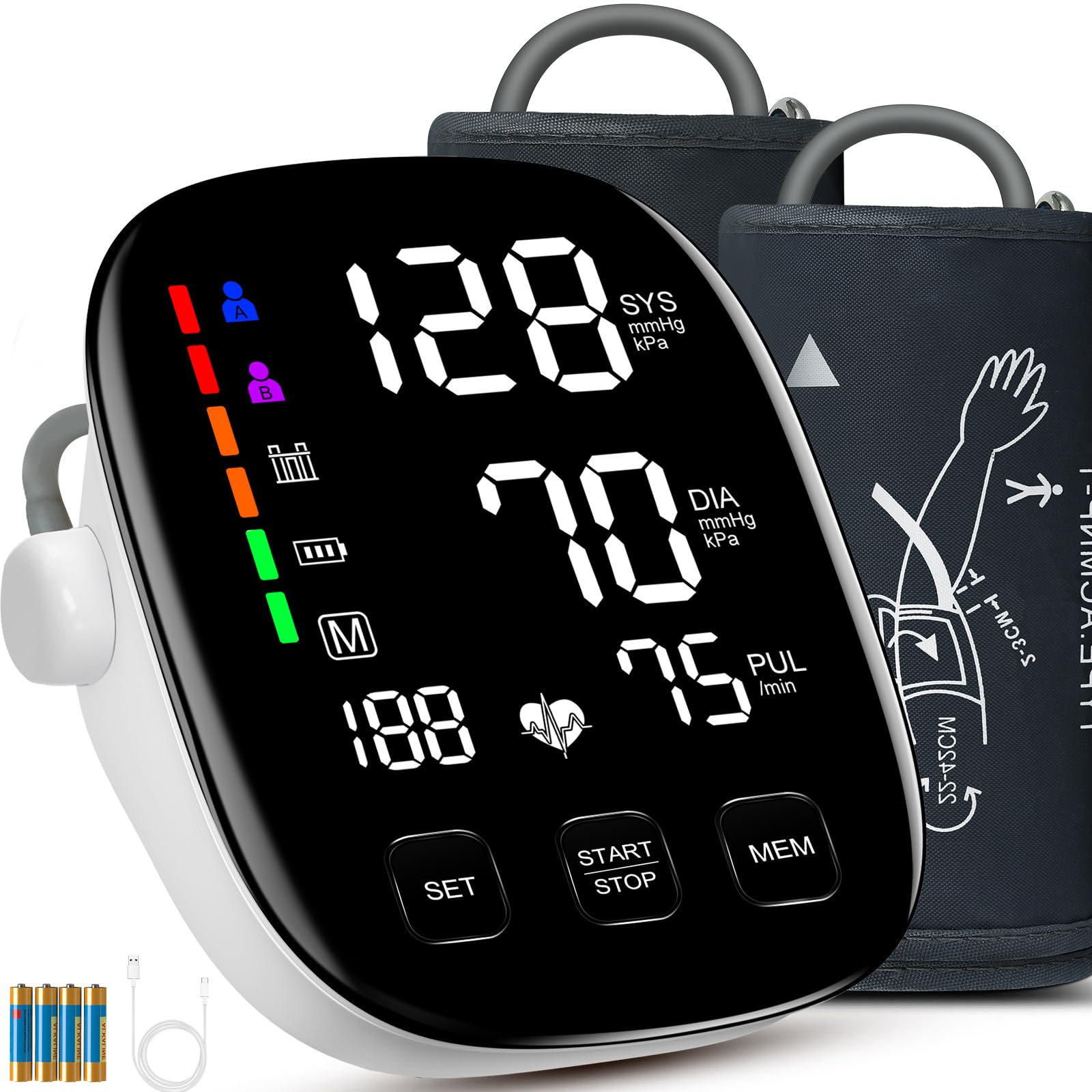
The COCACIS U80BH is built specifically for households with varying arm sizes: it comes with a medium/large cuff (9″–17″) and an extra-large cuff (13″–21″), so a larger-armed user can grab the XL cuff while someone with average arms uses the standard one. This dual-cuff approach eliminates the most common accuracy error—using the wrong size cuff. The unit itself features a 6-inch HD backlit color screen with oversized digits, making it easy to read without glasses, and the WHO color-coded indicator (green/orange/red) gives a quick visual of where your reading falls on the blood pressure spectrum.
Accuracy is driven by an advanced oscillometric chip and a redesigned air socket valve that maintains a tighter connection during inflation. In practice, this means fewer Err messages and more consistent readings. The monitor stores up to 199 readings per user (two users total), and the dual power option—4 AAA batteries or USB-C cable—makes it suitable for both home and travel. A nylon carry bag keeps everything together if you need to move between rooms or pack for a trip.
The caveat: some users initially reported more Err readings than expected, but the manufacturer confirmed that this was typically caused by incorrect cuff placement—the cuff must be positioned so the artery marker aligns with the brachial artery. Once that technique is dialed in, the device delivers readings that match a manual check within 3–4 mmHg. Also, the battery life could be better; using the USB-C power source is recommended for daily home use to preserve batteries for travel.
Why it’s great
- Comes with both M/L and XL cuffs (13″–21″) for whole-family fit
- Large 6-inch backlit display with WHO color indicator
- Dual power: USB-C or AAA batteries for flexible use
Good to know
- Cuff placement is critical—misalignment causes Err messages
- Battery life is modest; USB-C power preferred for home use
4. AQESO U80BH Blood Pressure Monitor

The AQESO U80BH is nearly identical in design to the COCACIS model—both are manufactured by the same OEM—but it offers a few key differences. The standout is memory capacity: 500 readings per user for two users, which is more than double the storage of most competitors at this price point. The large backlit LCD display is clear and readable, and the WHO classification bar gives you a quick benchmark without needing to interpret raw numbers.
The package includes both a medium/large cuff (9″–17″) and an XL cuff (13″–21″), mirroring the COCACIS setup. The cuffs are ergonomically shaped with a pre-formed curve that wraps more naturally around the arm, reducing discomfort during inflation. One-touch operation makes it simple enough for elderly users, and the dual power option (USB-C cable or 4 AAA batteries) keeps it running whether you are at home or in a hotel room.
The main limitation: the device is not rechargeable. You can power it via USB-C, but it requires a continuous connection to a power source—it will not charge internal batteries. This is a minor inconvenience if you have a nearby outlet, but it means you will still need batteries for truly portable use. Also, like the COCACIS unit, proper cuff positioning is essential to avoid Err readings; first-time users should carefully read the manual on artery marker alignment. For the price, this is a very capable and memory-rich monitor for families tracking two people’s health over months.
Why it’s great
- Massive 500-reading memory per user (two users)
- Ergonomic pre-formed cuffs for better comfort and fit
- Clear backlit LCD with WHO classification bar
Good to know
- USB-C powers the unit but does not recharge batteries
- Proper cuff placement is crucial to avoid errors
5. Andesfit A02-SEB Blood Pressure Monitor
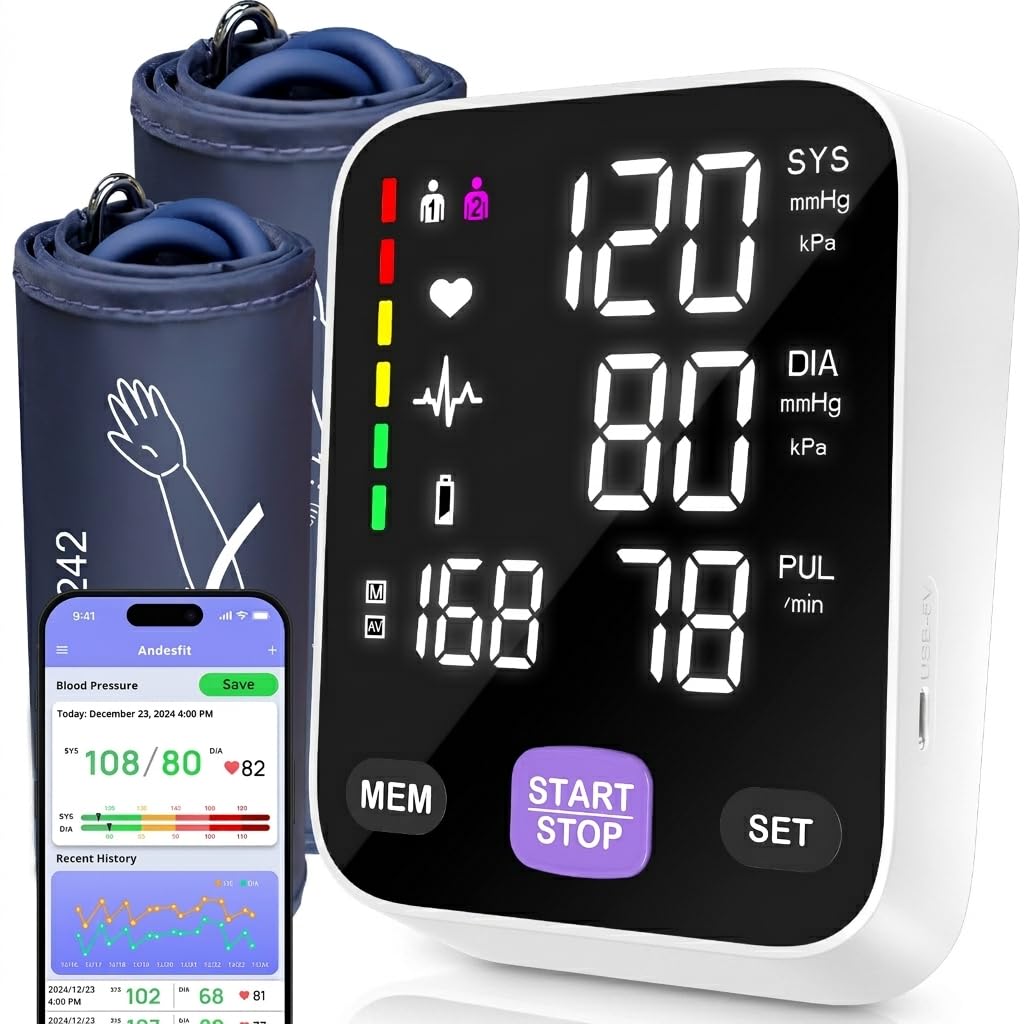
The Andesfit A02-SEB is an FDA-cleared automatic monitor that includes two cuffs: a standard cuff for arms 9″–17″ and an extra-large cuff that extends up to 21 inches. This makes it one of the most accommodating monitors for genuinely large arms—if your bicep is 19 or 20 inches, this is your best bet among the automatic options. The XL cuff is well-made with a wide bladder that ensures even pressure distribution across the artery, reducing the risk of falsely elevated readings.
Bluetooth connectivity pairs with the free Andesfit BP app (available on both App Store and Google Play), which automatically syncs readings to Apple Health or Google Fit. The app stores unlimited data, generates trend graphs, and can export reports as CSV files to share with your doctor. Notably, the app does not require login or personal data input—privacy-first design that keeps your health data on your device. The monitor itself has a large 6-inch color LED display with oversized numbers, and a dual-user mode stores 199 readings per user on the device if you prefer not to use the app.
The primary downside reported by users is occasional pulse reading inconsistency—a few verified buyers noted that pulse readings were significantly off (showing 147 bpm versus an actual 96 bpm during a manual check). The blood pressure readings themselves were consistently accurate, but if pulse tracking is important to you, this is worth being aware of. Also, the unit requires 4 AA batteries (included) and does not have a built-in rechargeable battery; USB-C powers the monitor but does not charge it. For arm fitness and data-sharing convenience, this is a strong contender for large-armed users who want app integration.
Why it’s great
- XL cuff fits arms up to 21″ – best for very large biceps
- Bluetooth syncs with Apple Health and Google Fit
- Privacy-first app requires no login or personal data
Good to know
- Pulse readings can be inconsistent compared to BP accuracy
- USB-C powers the unit but does not charge batteries
6. Urion U80A Blood Pressure Monitor
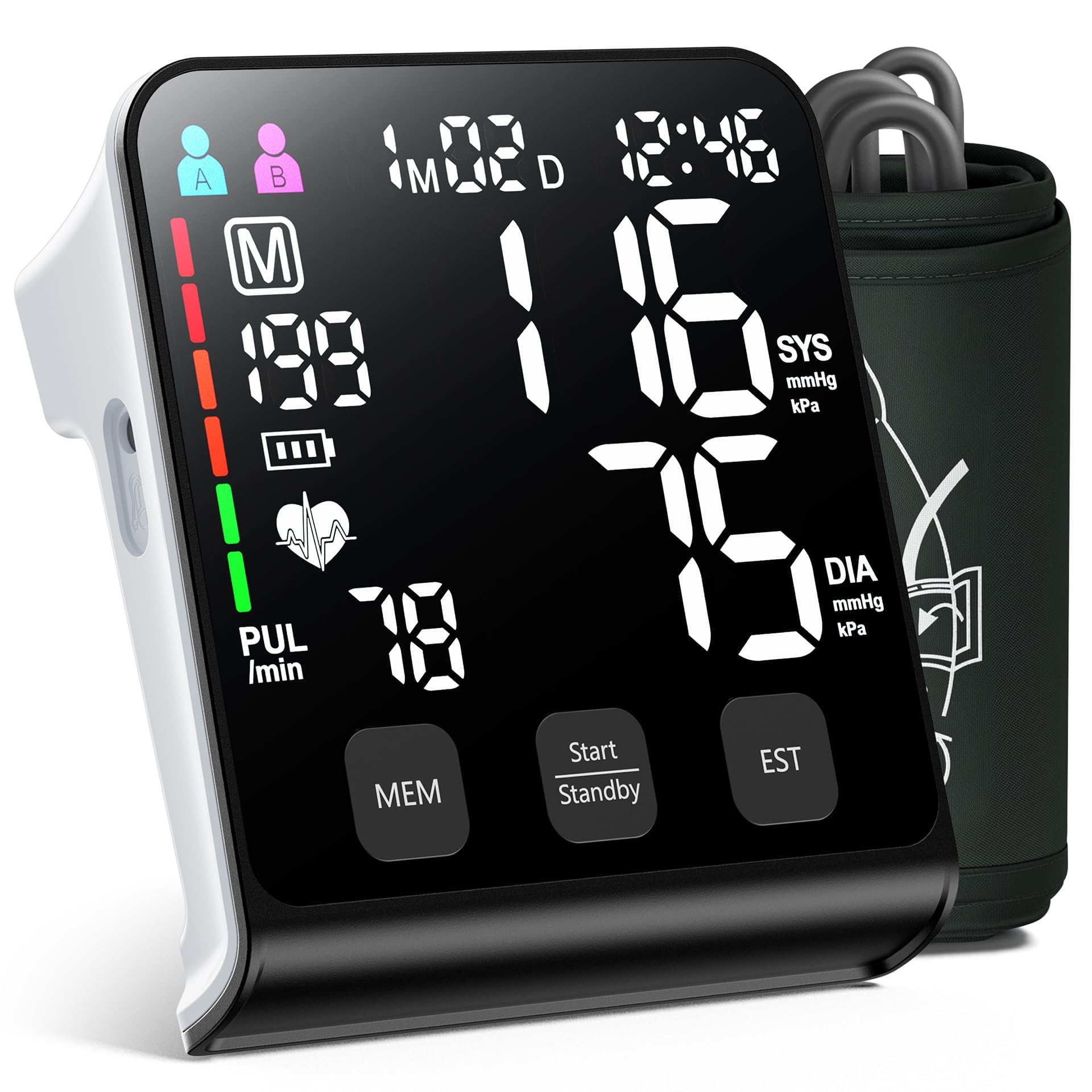
The Urion U80A is a compact, travel-friendly automatic monitor that is FSA and HSA eligible, making it a smart choice if you want to use pre-tax health savings dollars. It features a 4.5-inch bright LED screen with oversized digits and a blood pressure classification indicator, so you can quickly see whether your reading is normal, elevated, or high. The cuff is described as an adjustable wide-range design, and while the exact circumference range is not explicitly stated in the official specs, user feedback confirms it fits larger arms comfortably—including users who previously struggled with standard cuffs.
The key selling point is its simplicity: one-button operation, fast inflation, and readings that typically finish within 30 seconds. The monitor stores up to 199 readings for two users, with a memory recall button that cycles through past results. It also includes an irregular heartbeat detection alert, which flags potential arrhythmias during measurement. The unit is lightweight (just over 1 pound) and runs on either 4 AAA batteries or via USB-C power, making it easy to pack for travel without sacrificing accuracy.
The main compromise is screen size: at 4.5 inches, it is smaller than the 6-inch displays found on the COCACIS and Andesfit models. For users with vision difficulties, the slightly smaller digits may be harder to read from a distance. Additionally, some users mentioned that the cuff, while adjustable, does not feel as premium as the dedicated XL cuffs from other brands—it works, but the material and stitching are noticeably less substantial. However, for the price and FSA eligibility, this is a reliable, no-fuss monitor that gets the job done for daily tracking.
Why it’s great
- FSA and HSA eligible for pre-tax purchase
- Compact and lightweight for easy travel
- One-button operation with fast readings
Good to know
- Screen is smaller (4.5″) than some competitors
- Cuff feels less premium than dedicated XL models
7. McKesson Aneroid Sphygmomanometer

The McKesson Aneroid Sphygmomanometer is a no-nonsense manual monitor with a large cuff designed for adult arms measuring 34 to 50 cm (approximately 13.4 to 19.7 inches). This makes it one of the most affordable ways to get a properly sized cuff for larger arms without the complexity of electronics. The unit features a heavy chrome-plated manometer with expanded graduation marks, which makes reading the dial easier than on cheaper aneroid models, and the filter screen valve helps reduce dust buildup that can throw off calibration over time.
The cuff itself is made from durable nylon in a burgundy color, and the Velcro is robust enough to withstand daily use. It comes with a 3-year inflation warranty and a lifetime calibration warranty, which is exceptional for a product at this price point. Users consistently note that the cuff fits both average and larger arms comfortably—one verified buyer said it was the “perfect fit for larger arms” and praised its accuracy when paired with a Littmann stethoscope. The unit is also lightweight (just over 1 pound) and includes a carrying case.
The obvious caveat is that this is a manual monitor. You need a stethoscope and the knowledge to perform an auscultatory measurement correctly. If you are not trained in the manual technique, the readings will be unreliable regardless of how good the hardware is. Additionally, the cuff is sold as a standalone unit with the manometer and inflation bulb but without a stethoscope—budget extra for a good one if you do not already own it. For medical professionals or dedicated home users who want a durable, accurate, and large-cuff manual monitor, this is an excellent choice at a budget-friendly price.
Why it’s great
- Large cuff fits arms 13.4″–19.7″ at a budget-friendly price
- Lifetime calibration warranty and 3-year inflation warranty
- Heavy chrome-plated manometer with clear graduation marks
Good to know
- Requires stethoscope and manual measurement skill
- No digital display or memory storage
FAQ
What size cuff do I need for a 17-inch arm?
Are manual cuffs more accurate than automatic monitors for large arms?
Can I use a standard cuff if I have a large arm but position it higher?
What does the WHO color indicator on automatic monitors mean?
Will Bluetooth sync work with my phone and doctor’s office?
Final Thoughts: The Verdict
For most users, the blood pressure cuff for large arms winner is the OMRON Gold BP5360 because it combines clinically validated accuracy, AFib detection, and seamless app integration in a durable unit that fits arms up to 17 inches. If you need a cuff for arms larger than 17 inches, grab the Andesfit A02-SEB for its 21-inch XL cuff and Bluetooth tracking. And for professional-grade versatility, nothing beats the Primacare DS-9185 with five cuff sizes in a single kit.