
Our readers keep the lights on and the weekend projects moving. As an Amazon Associate, I earn from qualifying purchases.
A manual blood pressure cuff is the single most essential tool a nursing student owns — it is the instrument you will use to build clinical confidence, pass skills check-offs, and develop the auscultation ear that separates a competent nurse from a nervous beginner. Choosing the wrong one, whether it is a cuff that does not fit diverse patients or a gauge that loses calibration, can derail your practice before it starts.
I’m Rikta — the co-founder and writer behind FitlyFast. I have spent hundreds of hours cutting through the marketing noise and analyzing the real-world specifications of aneroid sphygmomanometers, evaluating cuff ranges, stethoscope acoustics, and valve durability so you can buy with clarity.
This guide is built to help you graduate from guessing to taking reliable vitals. I have cross-referenced cuff sizing, gauge accuracy, and build quality across seven models to deliver the most thorough breakdown of the blood pressure cuff for nursing students available anywhere online.
How To Choose The Right Blood Pressure Cuff For Nursing Students
Picking a blood pressure cuff as a nursing student is different from buying one for home use. You need a tool that survives daily hauling in your clinical bag, fits a wide range of patient arms, and delivers readings you can trust during a skills evaluation. Here is what matters most.
Cuff Size Versatility Is Non-Negotiable
A nursing student does not get to choose the patient. You will encounter thin forearms in the pediatric wing and biceps that exceed twenty inches in the bariatric unit. A single adult cuff that maxes out at sixteen inches will fail you regularly. Look for kits that either include multiple cuffs or offer a large adult cuff spanning up to twenty inches. The Primacare DS-9185 solves this by giving you five separate cuffs from infant to thigh size.
Gauge Calibration and Readability
An aneroid gauge can drift out of calibration if it is dropped or knocked around in a bag — and student kits get knocked around. A gauge with an accessible calibration screw lets you reset accuracy yourself. The transparent polycarbonate face on models like the Primacare also magnifies the numbers, reducing parallax error when you are reading the needle under clinical lighting.
Stethoscope Integration Matters for Auscultation
You need to hear Korotkoff sounds clearly to determine systolic and diastolic pressures. An attached stethoscope, like the one on the HealthSmart, is convenient for self-taking but limits chest-piece positioning on a patient. A separate dual-head Sprague stethoscope, such as the one included with the Elite Medical Instruments kit, gives you better acoustic tuning and the ability to switch between bell and diaphragm modes. For skills check-offs, the dual-head style is preferred.
Quick Comparison
On smaller screens, swipe sideways to see the full table.
| Model | Category | Best For | Key Spec | Amazon |
|---|---|---|---|---|
| Primacare DS-9185 | Multi-Cuff Kit | Clinical rotations with diverse patients | Five nylon cuffs: infant to thigh | Amazon |
| ASA TECHMED Medical Starter Kit | Bundle Kit | First-semester students needing everything | Kit includes stethoscope + EMT shears | Amazon |
| McKesson Aneroid | Large Cuff | Bariatric and larger adult arms | Cuff range 34-50 cm (13-20 in) | Amazon |
| iHealth Track Smart | Digital Monitor | Quick self-checks at home or dorm | Bluetooth, color-coded display | Amazon |
| Novamedic NM-9170-BK | Manual Kit | Budget-friendly clinical starter set | Includes stethoscope and carrying case | Amazon |
| HealthSmart Self-Taking BP Kit | Attached Steth | Learning to take own blood pressure | Attached 22-inch stethoscope | Amazon |
| EMI EBL-430 Royal Sprague | Large Cuff Kit | Students needing a 20-inch cuff range | Dual-head Sprague stethoscope | Amazon |
In‑Depth Reviews
1. Primacare DS-9185 Aneroid Sphygmomanometer Set

This is the only kit in this roundup that solves the universal nursing-student headache: a single patient population cannot be assumed. The Primacare DS-9185 ships with five separate nylon cuffs — infant, child, adult, large adult, and thigh — covering an arm circumference range that begins in pediatrics and extends beyond twenty inches. The transparent gauge face reduces reading errors, and the built-in calibration screw allows you to correct drift without sending the unit back to the manufacturer.
The waterproof carrying case with a sturdy handle keeps all five cuffs organized, which matters when you are rotating through four clinical sites in a semester. The nylon material on the cuffs is soft enough for sensitive skin yet durable enough for frequent inflation cycles. The deflation valve responds smoothly, giving you controlled release during auscultation.
No stethoscope is included, so you will need to supply your own or pair it with the one from the ASA TECHMED kit. But for versatility across every demographic you will encounter in nursing school rotations, this set is unmatched.
Why it’s great
- Five cuff sizes from infant to thigh, covering every patient type
- Calibration screw lets you maintain accuracy without service
- Waterproof carrying case keeps the set organized
Good to know
- Stethoscope not included — you will need a separate one
- Learning curve to switching cuffs quickly between patients
2. ASA TECHMED Medical Starter Kit
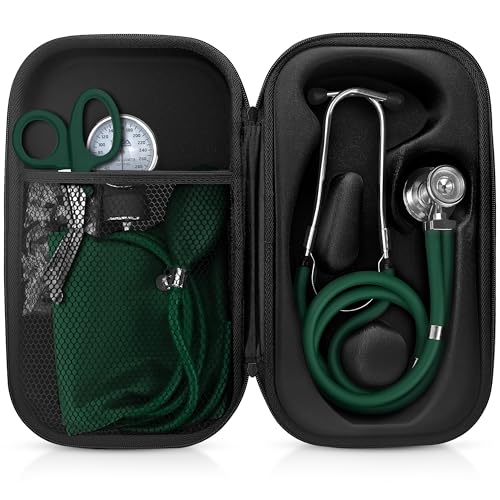
This is the grab-and-go solution for a first-semester nursing student who needs everything in one box. The ASA TECHMED kit bundles a stethoscope, a manual blood pressure cuff, EMT shears, and a protective carrying case. The stethoscope delivers surprisingly clear auscultation of Korotkoff sounds for its price tier — several reviewers compared its performance favorably to much more expensive Littmann units in loud clinical environments.
The manual cuff covers standard adult sizes and pairs naturally with the included stethoscope. The EMT shears are a welcome addition for clinical rotations where you may need to cut dressings or clothing quickly. The hard-sided case protects the instruments from the daily abuse of a crowded clinical bag.
The inflation bulb is on the firmer side, which some users find less comfortable during repeated measurements. For a student who wants a single purchase that covers the essentials of clinical skills gear, this kit is the most complete option on this list.
Why it’s great
- Everything a new nursing student needs in one purchase
- Stethoscope quality punches above its weight class
- EMT shears are a practical bonus for clinical use
Good to know
- Bulb feels stiff, requiring more effort to inflate
- Cuff size range is limited to standard adult arms
3. McKesson Aneroid Sphygmomanometer

McKesson is a brand that hospital supply chains trust, and this aneroid sphygmomanometer reflects that institutional pedigree. The burgundy cuff spans 34 to 50 centimeters — roughly thirteen to twenty inches — making it a strong option for nursing students who will regularly encounter larger adult arms in their clinical placements. The 300-millimeter Hg manometer features heavy chrome plating and a filter screen valve that resists dust accumulation in a busy bag.
One detail that sets this unit apart is the lifetime calibration warranty. If the gauge drifts, McKesson will recalibrate it, which is rare for a manual cuff at this tier. The expanded graduation marks on the dial reduce the risk of misinterpretation during a timed skills exam.
The cuff does not include a stethoscope, and the large size may feel oversized on a slim forearm. If most of your rotation patients have average-sized arms, this cuff may be bulkier than necessary.
Why it’s great
- Large cuff range fits 13-20 inch arms perfectly
- Lifetime calibration warranty protects your investment
- Filter screen valve reduces dust buildup
Good to know
- Stethoscope not included in the package
- Large cuff may feel bulky on smaller arms
4. iHealth Track Smart Upper Arm Monitor
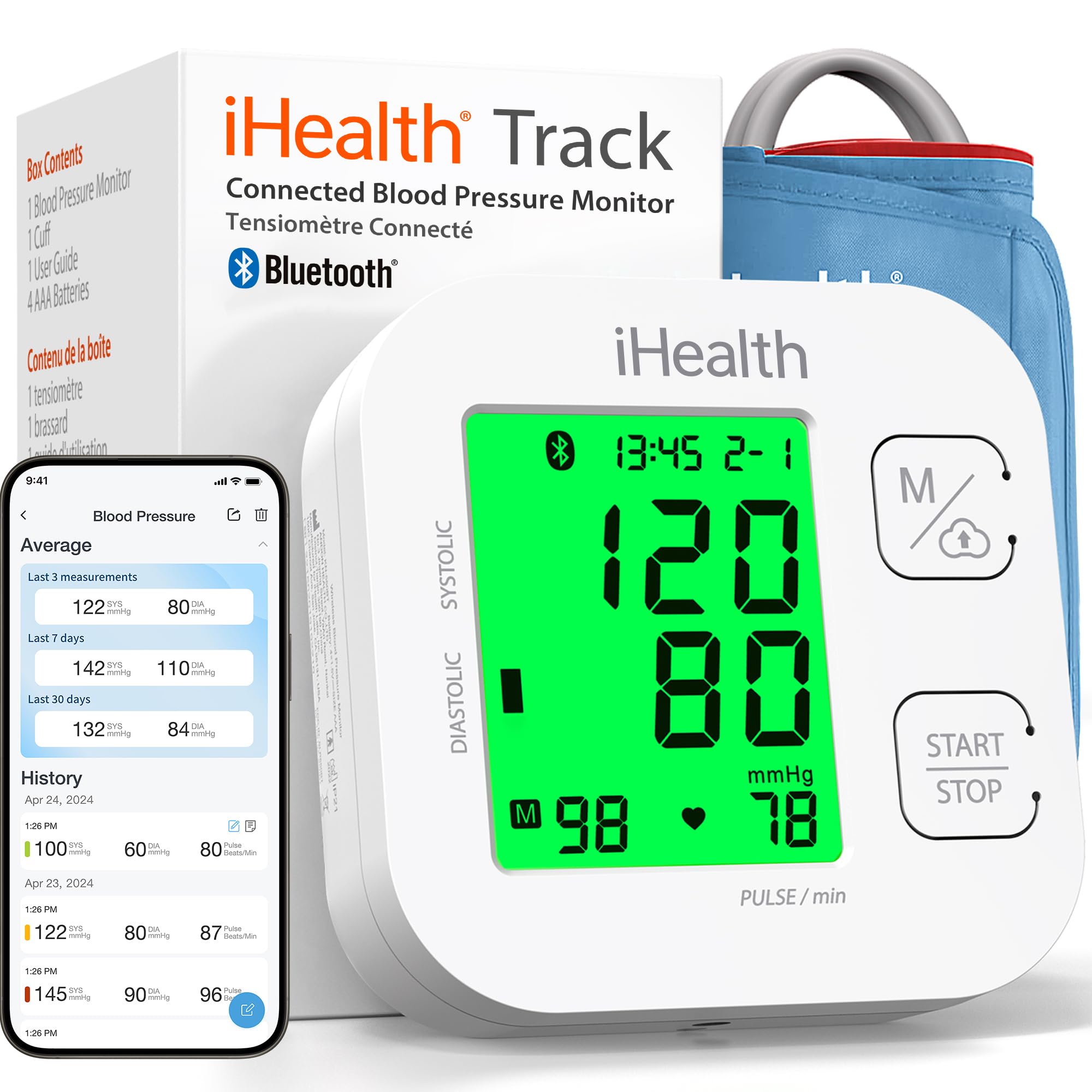
While manual aneroid cuffs dominate nursing skills check-offs, the iHealth Track Smart is the one digital monitor worth considering as a supplementary tool. Its large, multi-color backlit display uses a green-yellow-red coding system that instantly communicates whether a reading is optimal or elevated. The wide-range cuff fits arms 8.7 to 16.5 inches, and the device stores up to 99 readings on board.
Bluetooth connectivity syncs with the iHealth app for tracking trends over time, which is useful for building a log during your own health monitoring or for demonstrating longitudinal data in a community health project. The unit also automatically flags heart rhythm disturbances — a feature that teaches you to look beyond just pressure numbers.
It runs on four AAA batteries with no included AC adapter, and the app has persistent ads that some users find intrusive. This is not a replacement for a manual cuff — your clinical instructor will expect you to know how to use an aneroid gauge — but as a personal tool for quick daily checks, it is the best digital option.
Why it’s great
- Color-coded display makes reading interpretation instant
- Syncs with smartphone app for trend tracking
- Detects irregular heart rhythms automatically
Good to know
- App has persistent advertisements
- Requires AAA batteries — no rechargeable option included
5. Novamedic NM-9170-BK Professional Manual Kit
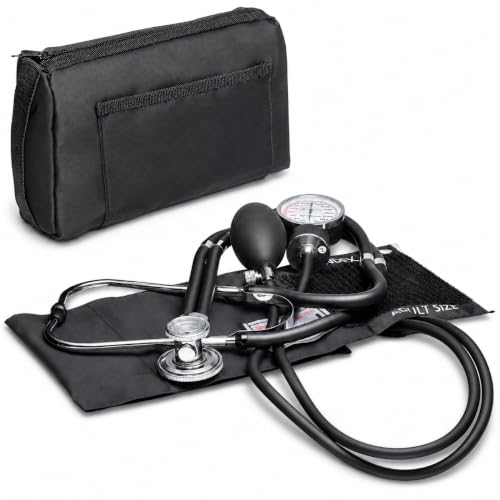
The Novamedic NM-9170-BK is the complete package for students who need to stay within a strict budget but cannot show up to clinicals without a stethoscope and cuff. This kit includes an aneroid sphygmomanometer, an adult arm cuff that fits 8.5 to 16.5 inches, a matching stethoscope, and a black carrying case. It is all you need to pass your first blood pressure skills check-off.
The gauge is easy to read, and the inflation bulb provides smooth pumping action. The cuff attaches securely with a sturdy Velcro strip and fits comfortably on average-sized adult arms. Several reviewers noted that the kit delivers accurate readings right out of the box, which speaks to its calibration consistency at this entry-level tier.
Some users found the cuff runs slightly small for larger arms, and the stethoscope is basic — it works for learning, but the acoustic clarity is not on par with the Sprague-style models. For a temporary starter kit that gets you through foundational courses, it is adequate.
Why it’s great
- Complete kit with stethoscope and case included
- Accurate out-of-the-box readings for skills practice
- Smooth pump action for controlled inflation
Good to know
- Cuff runs snug on larger adult arms
- Stethoscope acoustic quality is basic
6. HealthSmart Manual Self-Taking BP Kit

The HealthSmart kit is designed around self-monitoring, with a stethoscope head permanently attached to the cuff so you can take your own blood pressure one-handed. The metal gauge body feels solid, and the large adult cuff fits arm circumferences of 13 to 17 inches. The zippered storage case keeps everything contained.
This design is particularly useful when you want to practice taking your own readings to build confidence before you move on to classmates or patients. The attached stethoscope eliminates the need to fumble with a separate chest piece, reducing setup time. Accuracy reviews are generally positive, with multiple users reporting readings that match their doctor’s office equipment.
Build quality concerns surface around the rubber tubing, which can dry out and crack over a few semesters of heavy use. The attached stethoscope also limits your ability to position the chest piece independently on a patient’s arm, making it less suitable for clinical skills check-offs where a detached dual-head stethoscope is preferred.
Why it’s great
- Attached stethoscope simplifies self-taking practice
- Solid metal gauge construction for durable use
- Accurate readings consistent with clinical equipment
Good to know
- Rubber tubing may crack over time
- Attached stethoscope limits positioning flexibility
7. EMI EBL-430 Royal Sprague Set
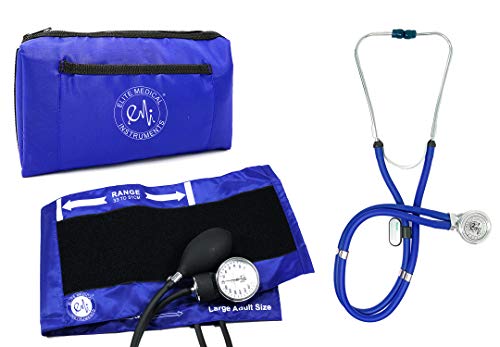
The Elite Medical Instruments EBL-430 addresses one of the most common frustrations nursing students face: the standard adult cuff simply does not fit everyone. This set includes a large adult cuff that spans 33 to 51 centimeters — thirteen to twenty inches — and pairs it with a Sprague Rappaport dual-head stethoscope. The chrome-plated chest piece offers high acoustic sensitivity, and the kit comes with extra ear tips, diaphragms, and bells in a carrying pouch.
The dual-head stethoscope rotates between bell and diaphragm modes, which is exactly what your clinical instructor will expect you to use. The tubing is latex-free and 22 inches long, giving you enough reach for comfortable positioning. Medical assistants and nurses in the reviews consistently praised this kit for its performance in noisy clinic environments.
A small subset of users reported that the cuff does not hold pressure as well over time, potentially requiring faster reading technique. The carrying case is compact but some reviewers wished it were larger for easier repacking.
Why it’s great
- Large cuff fits arms up to 20 inches for bariatric patients
- True dual-head Sprague stethoscope for professional auscultation
- High acoustic sensitivity in noisy environments
Good to know
- Cuff pressure retention may degrade over time
- Carrying case is a tight fit for repacking
FAQ
What cuff size should a nursing student buy for clinical rotations?
Is a digital blood pressure monitor acceptable for nursing students?
Final Thoughts: The Verdict
For most users, the blood pressure cuff for nursing students winner is the Primacare DS-9185 because its five-cuff system prepares you for every patient body type you will encounter in clinicals, and the calibration screw keeps the gauge accurate across semesters of hard use. If you want a complete starter bundle that includes a stethoscope and trauma shears in one box, grab the ASA TECHMED Medical Starter Kit. And for students who primarily work with larger adult arms and want a brand trusted by hospital supply chains, nothing beats the McKesson Aneroid.