
Our readers keep the lights on and the weekend projects moving. As an Amazon Associate, I earn from qualifying purchases.
An irregular heartbeat—specifically atrial fibrillation (AFib)—can go unnoticed during a standard blood pressure reading at the doctor’s office, but it is a leading cause of stroke. The monitors that detect it during every cuff inflation offer a critical layer of daily cardiac defense that standard models simply cannot provide. Choosing the wrong one means missing that detection entirely.
I’m Rikta — the co-founder and writer behind FitlyFast. My focus for this guide has been a deep analysis of clinical validation protocols, oscillometric detection algorithms, and the specific sensor architectures that separate monitors that merely display a pressure number from monitors that actively screen for arrhythmia every time you run a test.
If your goal is to buy one of the best blood pressure monitors with afib detection, you need to know which devices actually flag the irregular rhythm reliably and which ones give you a false sense of security by failing to display a reading when AFib is present.
How To Choose The Best Blood Pressure Monitor With AFib Detection
Not every monitor branded as “AFib compatible” performs the same screening. Some detect an irregular rhythm and then refuse to report a blood pressure number, which creates a frustrating loop for users who actually have AFib. Others log the rhythm irregularity alongside every successful reading. Your choice depends on how you intend to use the data with your cardiologist.
Detection Algorithm vs. Read Blocking
The most common complaint among AFib patients is that certain premium monitors stop the measurement entirely when an irregular pulse is sensed, showing an error instead of a pressure value. That “feature” renders the monitor useless for someone with persistent AFib. Look for devices that flag the detection in the reading log so you can share the frequency and timing with your doctor.
Cuff Fit Is Non-Negotiable
Arrhythmia detection relies on analyzing the waveform of each pulse during deflation. A loose or improperly sized cuff distorts that waveform and triggers false positives or false negatives. Monitors that include three cuff sizes covering 7–21 inches give you a better chance of a consistent seal than a single “one-size-fits-most” band.
Bluetooth and Trend Storage
AFib episodes are intermittent, so a single reading means little. The real value comes from tracking the pattern over weeks. Models that sync to a companion app allow your provider to see the histogram of flagged events rather than relying on your manual log. Onboard memory for separate user profiles also helps when multiple family members need monitoring.
Quick Comparison
On smaller screens, swipe sideways to see the full table.
| Model | Category | Best For | Key Spec | Amazon |
|---|---|---|---|---|
| Omron Gold (BP5360) | Premium | Doctor-verified AFib screening | AFib detection + High Morning Avg | Amazon |
| Withings BPM Vision | Premium | Wi-Fi sync & color-coded feedback | 2.8″ LCD, 1yr battery, Wi-Fi+BT | Amazon |
| Withings BPM Connect | Mid-Range | Compact travel with app integration | Rechargeable, 6mo battery, Wi-Fi | Amazon |
| FDA-Cleared URION U80A | Mid-Range | Large LED display for seniors | 4.5″ LED, ±3mmHg, 199 mem/user | Amazon |
| A&D Medical UA-1040TBLE | Mid-Range | Voice guidance for visually impaired | TriCheck avg, BT, 3 languages | Amazon |
| AQESO U80AH (3 Cuff Combo) | Budget | Family use with 3 cuff sizes | 3-user, 1500 mem, backlit LCD | Amazon |
| AQESO U80AH (1 Cuff Kit) | Budget | Entry-level with carrying case | 3 cuff sizes, 500 mem/user | Amazon |
In‑Depth Reviews
1. Omron Gold Blood Pressure Monitor (BP5360)
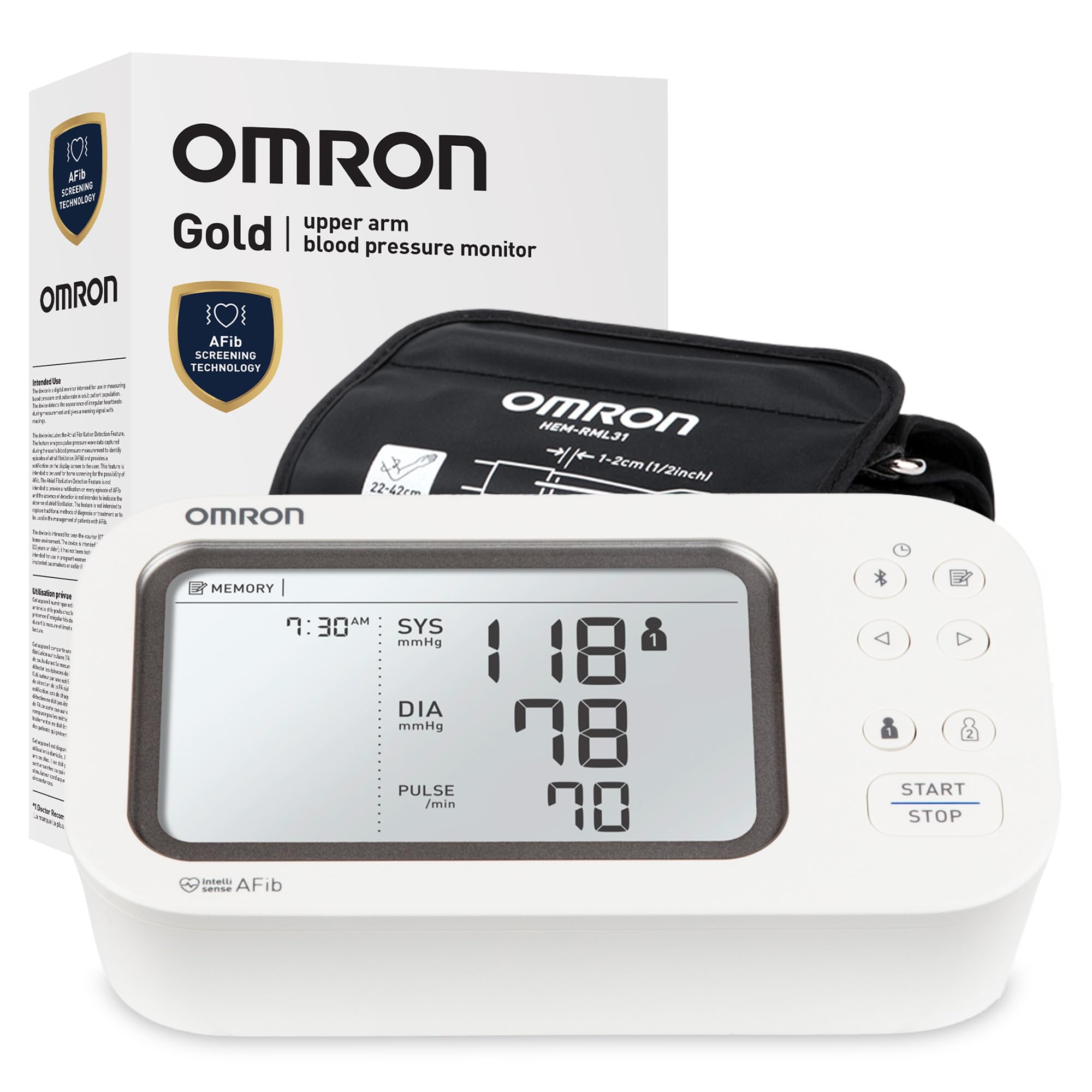
Omron holds the strongest clinical validation position in this category, and the Gold model brings their exclusive AFib detection algorithm that screens during every inflation. The wide-range D-ring cuff fits arms 9–17 inches and the monitor uses the High Morning Average Indicator to flag readings taken within an hour of waking—a period when stroke risk from undetected AFib spikes. The Bluetooth sync to the Omron Connect app is seamless and supports two separate user profiles, each maintaining an unlimited reading history.
The biggest nuance with this unit is that the AFib detection algorithm is aggressive: if an irregular rhythm is sensed, the device will not display a blood pressure reading at all. Several users with confirmed AFib report that the monitor simply shows an error message, which makes it frustrating for anyone who needs daily readings despite the arrhythmia. This is a safety-conscious design, but it can feel like a blocker rather than a feature.
For the user who does not have persistent AFib and wants the highest standard of home screening, the Omron Gold is the benchmark. The device is #1 doctor-recommended, supports dual user modes, and the morning average indicator is a legitimately useful tool for catching the “morning surge” phenomenon that standard monitors ignore.
Why it’s great
- Clinically validated AFib detection with every measurement
- Morning average indicator catches dangerous post-wake spikes
- Two user profiles with unlimited app storage
Good to know
- Refuses to report BP reading when AFib is suspected
- Some users with persistent AFib find the blocking behavior unusable
2. Withings BPM Vision
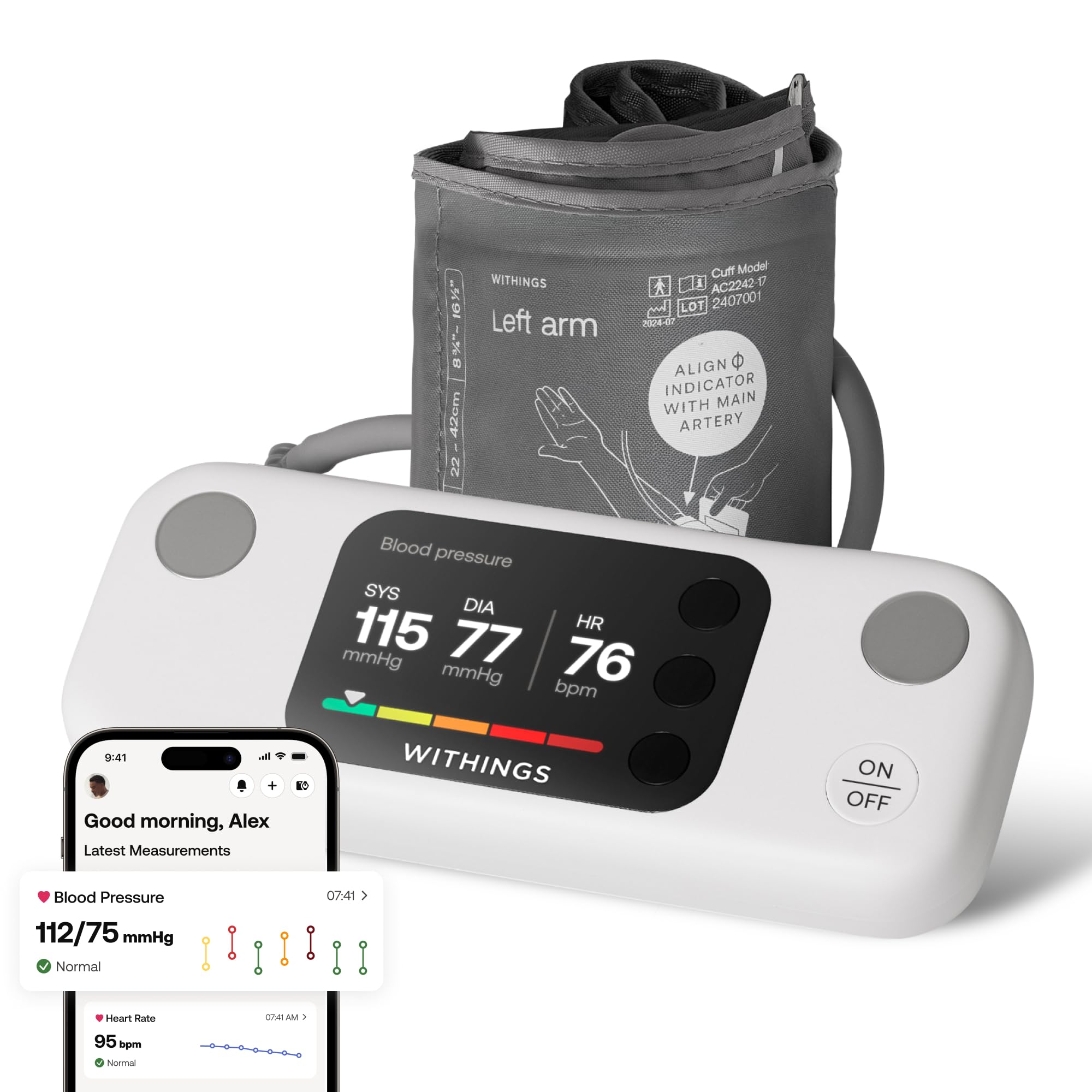
The BPM Vision is Withings’ premium-tier entry, and its defining differentiator is the large 2.8-inch color LCD that provides color-coded feedback—green for normal, yellow for elevated, red for hypertensive—based on American Heart Association thresholds. The device uses Wi-Fi sync in addition to Bluetooth, so readings are automatically stored in the Health Mate app without needing your phone nearby. The cuff range (22–42 cm) covers most adult arms, and the protective case doubles as a stand for tabletop use.
Battery life is a standout spec here: a single set of batteries lasts roughly one year, which is significantly better than rechargeable models that need weekly charging. The on-screen tutorial guides you through proper positioning, which directly improves the reliability of arrhythmia detection. Multiple user profiles are supported, though the app can only connect to one phone at a time.
Some early adopters have reported that the Bluetooth sync is slower than expected and that the average-reading mode sometimes sends the last reading instead of the averaged value to the app. The device is also bulkier than the BPM Connect, making it less travel-friendly. For a home base station where large text and instant visual feedback matter, the BPM Vision is the most user-friendly option on this list.
Why it’s great
- Large color screen with AHA-aligned color coding
- Wi-Fi sync works without a phone nearby
- Year-long battery life reduces maintenance
Good to know
- Bulky design is less portable than competitors
- Bluetooth sync can lag behind Wi-Fi transfer
3. Withings BPM Connect

The BPM Connect takes the premium app integration of Withings and packages it into a smaller, travel-friendly form factor. The cuff rolls up compactly, and the device is powered by a rechargeable battery that lasts roughly six months on a single charge—enough for long trips without hunting for batteries. The color-coded feedback appears on the integrated LCD, and the device syncs via both Wi-Fi and Bluetooth to the Health Mate app, which supports unlimited data storage and easy PDF report generation for doctor visits.
The unit supports up to three user profiles, making it the most family-friendly premium monitor here. Screen readability, however, is a known weak point: the LCD uses a light grey font on a dark background that some users find hard to read outdoors or in bright rooms. The cuff also lacks a stopper ring, so it can slide out of the metal loop during storage.
The clinical accuracy compared to a WelchAllyn reference monitor was within 2 mmHg for systolic and 4–5 mmHg for diastolic in one direct comparison, which is excellent for consumer-grade hardware. The main trade-off against the BPM Vision is the smaller screen and the need for phone proximity during initial setup.
Why it’s great
- Rechargeable battery lasts 6 months
- Compact rolled design is ideal for travel
- Three user profiles with full app integration
Good to know
- Low-contrast LCD can be hard to read in bright rooms
- Strap lacks a stopper to prevent sliding out of cuff
4. FDA-Cleared URION U80A
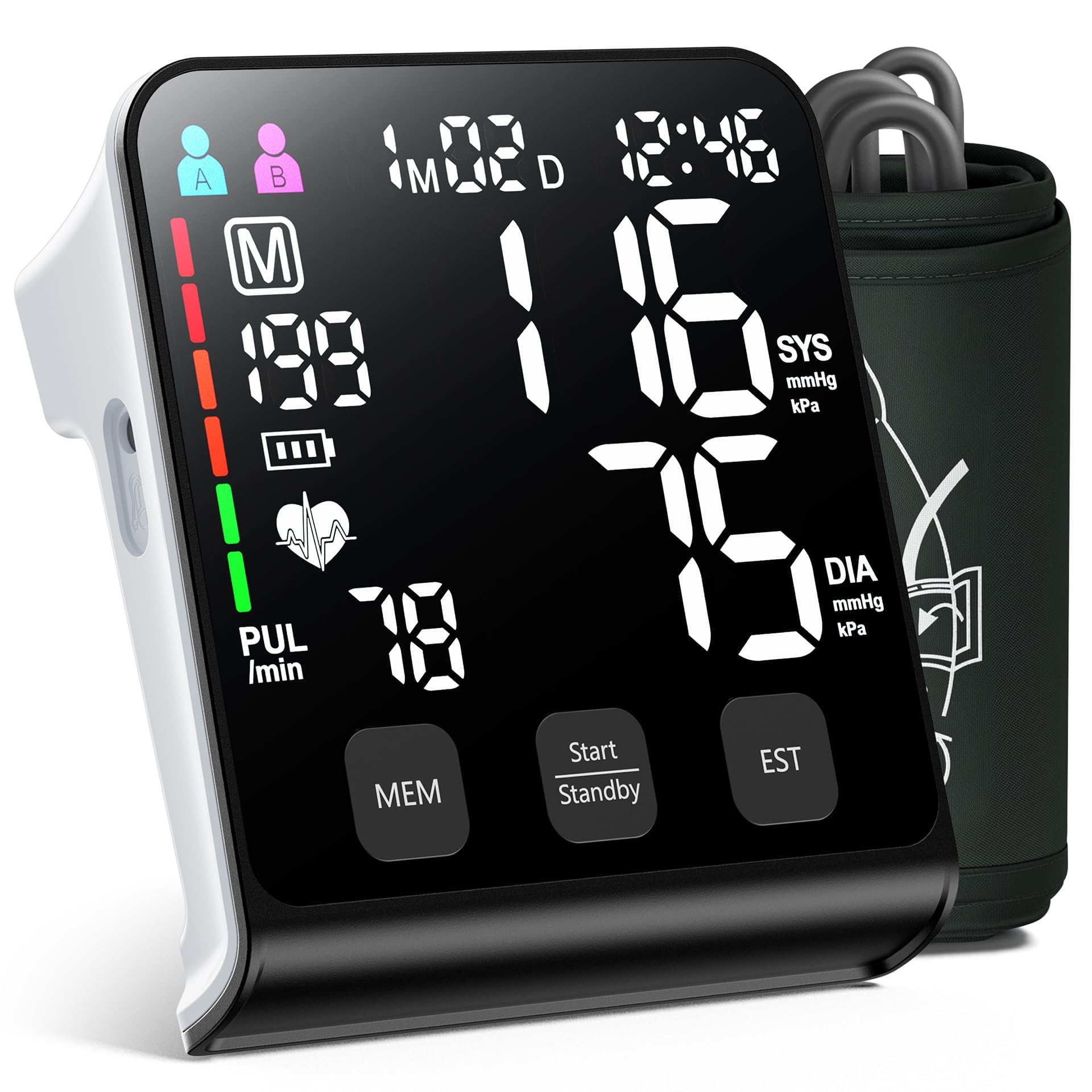
The URION U80A is the only mid-range monitor here that combines a 4.5-inch LED display with an irregular heartbeat alert function. The oversized digits are genuinely large—visible from across a room—and the backlight is bright enough to read without glasses in any lighting condition. The device stores up to 199 readings for each of two users, and the memory recall button is straightforward: no app required, no Bluetooth pairing.
The irregular heartbeat alert is not as sophisticated as Omron’s AFib algorithm—it flags an irregular rhythm without classifying it as atrial fibrillation specifically—but it provides a useful general arrhythmia screen that does not block the reading. The unit also features an adjustable pressure algorithm that stops inflation at the optimal level for your specific arm, which reduces discomfort during measurement.
Power options are flexible: it runs on either four AAA batteries or USB-C (continuous power required for USB mode; no internal rechargeable battery). The scratch-resistant acrylic panel on the front is a nice durability touch. Users looking for basic home monitoring with an arrhythmia flag and no app dependency will find this the most straightforward option.
Why it’s great
- Very large 4.5-inch LED display with bright backlight
- Irregular heartbeat flag does not block the reading
- Dual user memory with 199 readings per user
Good to know
- No Bluetooth or app connectivity
- USB mode requires continuous cable connection
5. A&D Medical UA-1040TBLE
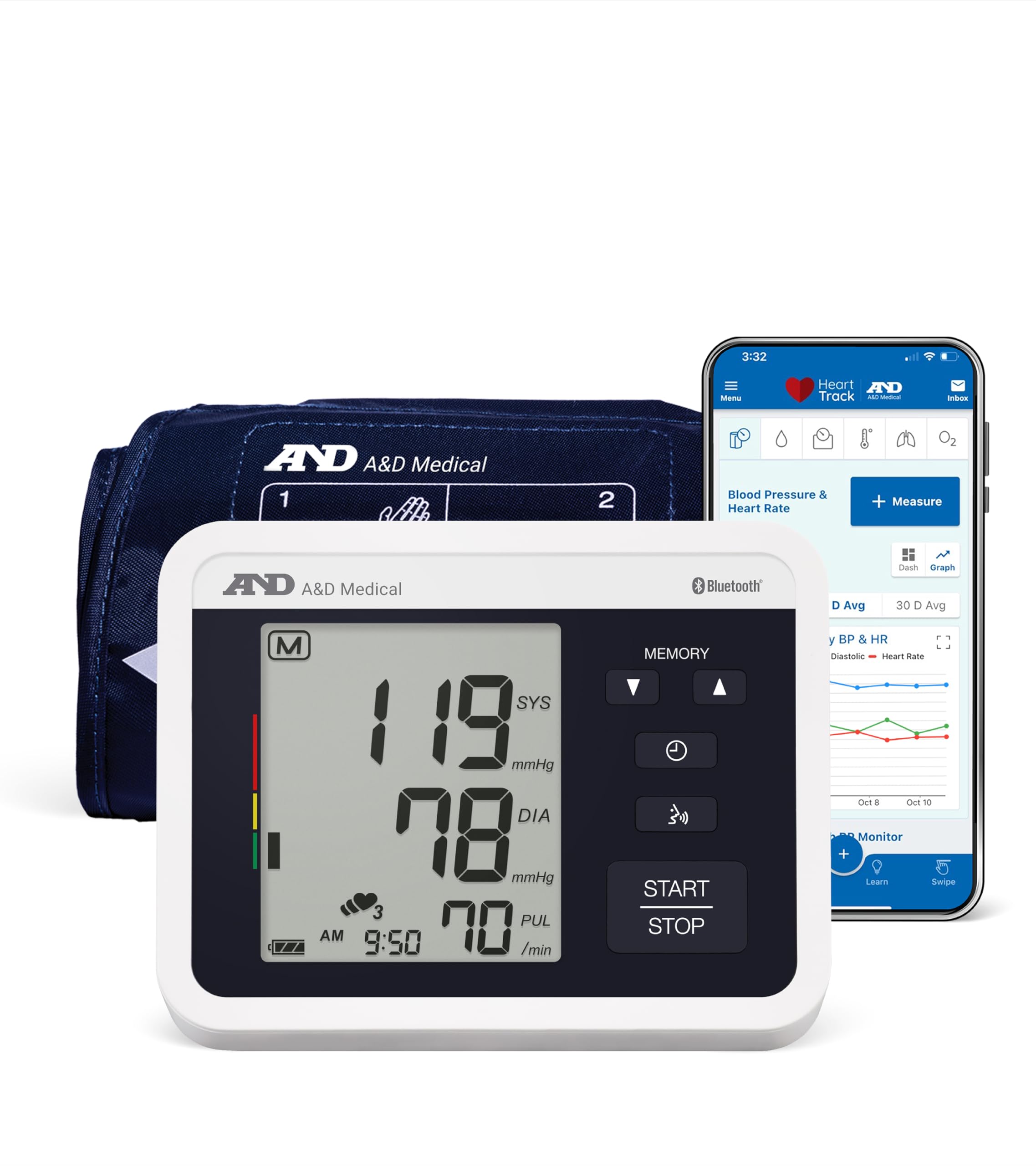
The UA-1040TBLE is specifically designed for accessibility. It announces systolic, diastolic, and pulse readings in English, Spanish, or French at a volume that is loud enough for users with hearing loss, and it works out of the box without any setup. The cuff is pre-formed to help with self-application, and the TriCheck function automatically takes three consecutive readings and displays the average—a protocol that aligns with clinical guidelines for arrhythmia monitoring.
The A&D Heart Track app syncs via Bluetooth and includes a cuff inflation meter that helps you verify a proper fit before the reading starts. The app is well-regarded for its clean interface and fast sync speed, though it requires Android 5.0+ or iOS 12.0+. The monitor also supports adjustable pressure settings for users who find standard inflation uncomfortable.
The wide-range cuff (22–42 cm) is compatible with the brand’s separate small, medium, and large cuffs if the standard fit is off. Battery life is not specified by the manufacturer beyond “typical use,” but the device runs on four AA batteries (included) and can also accept an AC adapter. For visually impaired users or anyone who prefers audible confirmation over squinting at an LCD, this is the most practical option in this guide.
Why it’s great
- Loud, clear voice announcements in three languages
- TriCheck mode averages three consecutive readings
- Pre-formed cuff makes self-application easier
Good to know
- Designed for accessibility, not AFib-specific detection
- AC adapter sold separately
6. AQESO U80AH (3 Cuff Set)

The AQESO U80AH 3-cuff kit solves the single most common source of inaccurate readings: a bad cuff fit. The package includes small (7–9″), medium/large (9–17″), and XL (13–21″) cuffs, covering everything from a slender arm to a bicep that standard cuffs cannot wrap. The monitor supports three user profiles with a total of 1,500 memory slots (500 per user), and the large backlit LCD displays systolic, diastolic, and pulse clearly.
The oscillometric algorithm is fast—typical readings complete in under 30 seconds—and the WHO classification bar on the display gives immediate context for where your number falls. The unit is powered by four AAA batteries or via USB-C continuous connection (no internal rechargeable battery). Users who have struggled with wrist monitors will appreciate the consistency of the upper arm format.
The main drawback is the lack of any arrhythmia or AFib-specific detection. This monitor does not flag irregular heartbeats; it simply reports the BP value and pulse rate. If your primary goal is AFib screening, this is not the right tool. If your primary goal is getting consistent, accurate readings across multiple household members with different arm sizes, the three-cuff inclusion makes this the most versatile budget option.
Why it’s great
- Three distinct cuff sizes fit arms from 7 to 21 inches
- Three user profiles with 500 readings each
- Large backlit LCD with WHO classification bar
Good to know
- No arrhythmia or AFib detection algorithm
- USB mode requires continuous power—no internal battery
7. AQESO U80AH (Single Kit)

This variant of the AQESO U80AH shares the same oscillometric engine and three-cuff set (small, medium/large, XL) as the model above, but it ships with a more basic memory capacity—500 readings per user for three users. The single-kit packaging also includes a carrying pouch and a USB-C cable, making it a slightly better option for someone who plans to move the monitor between home and travel locations.
The large backlit LCD and one-touch operation are identical to the 3-cuff combo version. Users who have compared readings against a doctor’s office reference report that the AQESO is within 3–5 mmHg systolic, which is solid for a budget-tier device. The unit also features a WHO bar on the display for instant classification and an irregular heartbeat icon, though this is a general arrhythmia indicator rather than a clinical AFib detection algorithm.
The power situation is the same: four AAA batteries or USB-C continuous power, but not rechargeable. The date and time reset when the batteries are removed, which can be annoying if you need accurate timestamps on stored readings. For the price, this is a competent entry-level monitor for families who need multiple cuff sizes but do not require app connectivity or advanced arrhythmia analysis.
Why it’s great
- Includes three cuff sizes for diverse arm circumferences
- Carrying case and USB-C cable included
- Simple one-touch operation with large backlit display
Good to know
- Loss of date/time when batteries are removed
- No Bluetooth or app for trend tracking
FAQ
What happens when a blood pressure monitor detects AFib during a reading?
Can I use a blood pressure monitor with AFib detection if I have a pacemaker?
How many readings do I need to take to confirm AFib at home?
Final Thoughts: The Verdict
For most users, the blood pressure monitors with afib detection winner is the Omron Gold (BP5360) because it carries the strongest clinical pedigree and a dedicated atrial fibrillation screening algorithm endorsed by healthcare providers. If you need a large color display with Wi-Fi that works without a phone, grab the Withings BPM Vision. And for an extremely accessible voice-guided option that announces every reading, nothing beats the A&D Medical UA-1040TBLE.