
Our readers keep the lights on and the weekend projects moving. As an Amazon Associate, I earn from qualifying purchases.
That pair of passive bookshelf speakers sitting in your closet or the old tower speakers gathering dust in the garage can be brought back to life with one compact box. A Bluetooth amplifier bridges the gap between your phone’s wireless convenience and the analog power needed to drive wired speakers — no A/V receiver required, no crawling behind the TV with speaker wire. The challenge is separating the units that deliver clean, usable power from those that overstate wattage and distort at moderate volume.
I’m Rikta — the co-founder and writer behind FitlyFast. To build this guide, I spent hours cross-referencing amplifier chip specs, decibel output claims, and real-world user reports on Bluetooth stability and thermal performance to identify which models actually serve wired speakers well.
Whether you need something for a garage workshop or a refined living room setup, finding the right bluetooth amplifier for wired speakers comes down to matching power output to your specific speakers and understanding where the corners were cut.
How To Choose The Best Bluetooth Amplifier For Wired Speakers
Every Bluetooth amplifier is a trade-off between power, features, and build quality. Before you commit, you need to understand what your speakers demand and what the amplifier actually delivers once the Bluetooth connection is live.
Match Power to Speaker Sensitivity and Impedance
Most budget amplifiers advertise peak wattage numbers that are only sustainable for milliseconds. You want to look at RMS (continuous) power per channel at your speakers’ impedance rating, typically 4 or 8 ohms. A pair of 8-ohm bookshelf speakers with 87dB sensitivity will sound decent with 30W RMS per channel, while inefficient 4-ohm towers might need 60W or more to reach satisfying listening levels without clipping.
Bluetooth Generation and Codec Support
Bluetooth 5.0 is the minimum standard you should accept. It offers better range (up to 50 feet in open air) and more stable connections than older 4.x versions. Keep in mind that most budget amplifiers only support the basic SBC codec, which is fine for spoken word, podcasts, and casual music listening. If you are chasing high-resolution audio from streaming services, check if the amplifier supports AAC (for iPhones) or aptX.
Port Selection for Your Specific Setup
Consider every device you plan to connect: TV optical output, turntable with a built-in preamp, USB flash drive, or a microphone for karaoke. While Bluetooth covers your phone, the wired inputs define the amplifier’s versatility. Optical and coaxial inputs are less common on mini amplifiers but critical for clean TV audio. Subwoofer output (RCA or line out) is essential if you plan to add a powered subwoofer later for deeper bass.
Form Factor and Heat Management
Class D amplifiers are the standard for compact designs because they run cooler and more efficiently than Class A/B. Still, a totally sealed metal chassis with no ventilation holes can overheat during extended sessions at higher volumes. Look for models with side vents or a raised bottom to allow passive airflow. If the amplifier is going inside a closed cabinet, prioritize a unit with active cooling or adequate thermal design.
Quick Comparison
On smaller screens, swipe sideways to see the full table.
| Model | Category | Best For | Key Spec | Amazon |
|---|---|---|---|---|
| Fosi Audio BT20A | Mini Class D | Compact daily driver | 100W x 2 max (8 ohm) | Amazon |
| Fosi Audio BL20C | 2.1 Channel | Speakers + subwoofer | 320W max with sub output | Amazon |
| YAMAHA R-S202BL | Full Receiver | Audiophile stereo | 100W x 2 RMS (8 ohm) | Amazon |
| Pyle PDA77BU | 4-Channel | Multi-room karaoke | 800W peak, 4 speakers | Amazon |
| Joengoep BT-398A | Multifunction | Optical/Coaxial use | 900W peak, 60W x 2 RMS | Amazon |
| Romicta AK50 | Compact All-in-One | Karaoke and parties | 400W peak, 50W x 2 RMS | Amazon |
| Pyle PDA22BT | Ultra-Compact | Garage/workshop | 240W peak, 8-ohm | Amazon |
In‑Depth Reviews
1. Fosi Audio BT20A

The Fosi Audio BT20A earns its spot at the top because it nails the essentials without adding features you will never touch. Built around a Class D topology, this 200W max (100W x 2) amplifier drives 8-ohm passive bookshelf speakers with authority, delivering clear dialogue and solid bass extension when paired with TV audio or a music streamer. Users report reliable Bluetooth pairing with phones, laptops, and Echo Dots, with fast reconnection and a stable range that covers most living rooms and garages without dropouts.
The all-black aluminum chassis is remarkably compact — roughly the size of a paperback — yet includes tactile bass and treble knobs that let you tune the output to match your room’s acoustics. The single RCA input is a limitation if you need multiple wired sources, but for a dedicated amp handling one Bluetooth stream plus one aux device, the simplicity is a strength. Customer support from Fosi is frequently praised for responsive replacements when units arrive defective.
Where the BT20A truly shines is in the midrange price bracket: it avoids the cheap-sounding distortion common in ultra-budget amps while staying far below the cost of traditional A/V receivers. If you are powering a single pair of passive speakers in a bedroom, office, or patio setup and want reliable performance, this is the unit to beat.
Why it’s great
- Compact footprint fits any shelf or desk
- Bass and treble controls allow sound customization
- Reliable Bluetooth 5.0 with solid range
Good to know
- RCA input only — no optical or coaxial
- Bluetooth overrides AUX input; manual switching required
- Speaker wire terminals are small; banana plugs recommended
2. Fosi Audio BL20C

The Fosi Audio BL20C steps up the game with a 2.1 channel design, meaning it drives two passive speakers and a powered subwoofer simultaneously. Powered by the STMicroelectronics TDA7498E chip, it delivers a maximum 320W output and supports high-resolution formats like FLAC and APE from a USB drive. Users consistently report clean, distortion-free sound even when pushing floorstanding Polk speakers or Micca RB42 bookshelf speakers to moderate listening volumes.
Unlike the BT20A, the BL20C offers front-panel controls for input selection (Bluetooth, RCA, USB), plus independent bass and treble knobs that allow fine-grained tone shaping. The included remote control and Bluetooth antenna are thoughtful additions. Build quality is solid, with a compact metal chassis that runs surprisingly cool thanks to the efficient Class D architecture. The subwoofer output uses RCA, making it simple to integrate any standard powered sub.
The main compromise here is the tiny speaker wire holes — several reviewers note that even 16-gauge wire is a tight fit, so investing in banana plugs upfront saves frustration. Additionally, the bass and treble controls are sensitive; adjusting them too aggressively at high device output can cause the amplifier to struggle. For a PC gaming setup or a small living room where you want full-range sound with subwoofers, this is a stellar mid-range pick.
Why it’s great
- Dedicated subwoofer output for full 2.1 audio
- USB drive support with FLAC/APE playback
- Cool-running Class D design
Good to know
- Speaker terminals barely fit 16-gauge wire
- Sensitive bass/treble dials require careful tuning
- No optical or coaxial digital input
3. YAMAHA R-S202BL

The YAMAHA R-S202BL is in a different league from the mini Class D amplifiers above. This is a full-sized stereo receiver with a brushed aluminum front panel, a proper AM/FM tuner, and discrete circuitry that delivers a genuine 100 watts RMS per channel into 8 ohms — not peak advertising numbers. Audiophile-leaning users describe the sound as crystal clear with excellent imaging, and the amplifier drives vintage speakers like Large Advents with ease, reaching high volumes without audible distortion.
Bluetooth connectivity is handled by a 4.1 + EDR module, which is older than the 5.0 found on cheaper competitors. In practice, pairing is straightforward, and the range covers a typical room, but expect slightly less stability in congested environments. The receiver includes two sets of speaker terminals for A/B switching, a headphone jack, and an auto-power-standby function that is convenient for daily use. Input selection is refreshingly mechanical and intuitive via the front dial.
The most significant omission is the lack of a dedicated subwoofer output, which limits your ability to integrate a powered subwoofer without an extra splitter or converter. Sound signature is also subjective: some listeners found the bass less tight and defined compared to similarly priced Onkyo units. If you want a traditional stereo receiver with honest RMS power for a dedicated listening room or a 2.0 music system, the YAMAHA delivers where mini amps cannot.
Why it’s great
- True RMS power rating with low distortion
- Speaker A/B switching for two rooms
- Excellent FM tuner sensitivity
Good to know
- No subwoofer pre-out
- Bluetooth 4.1 instead of 5.0
- Volume only fully usable between 45 and 80
4. Pyle PDA77BU

The Pyle PDA77BU is a 4-channel receiver that allows you to power up to four passive speakers independently — perfect for a multi-room setup, a large garage, or a dedicated karaoke space. With an 800W peak rating and Bluetooth 5.0 connectivity, it integrates FM radio, USB, SD card, and dual 1/4-inch microphone inputs with independent volume and echo controls. The front-panel LED display and included remote make it easy to manage from across the room.
Real-world performance is robust for the price bracket. Users have connected turntables, smart TVs, and phones simultaneously, describing the setup as effortless and the sound as loud and clear. The banana plug speaker terminals accept thick gauge wire cleanly, and the mechanical button layout is intuitive. For home office setups needing four ceiling speakers or a workshop with two pairs of bookshelf speakers, the PDA77BU fills a gap that two-channel amps cannot.
The downsides are typical of Pyle’s value-oriented approach: Bluetooth reconnection can occasionally skip with certain smart TVs, requiring a manual repair cycle. The “Karaoke BT Amplifier” sticker on the unit looks cheap, and the white noise floor is slightly higher than pricier alternatives. If you need many channels, microphone support, and Bluetooth in one box at a mid-range price, this is a functional workhorse.
Why it’s great
- Four channels for multi-room audio
- Dual mic inputs with echo control
- Wide range of wired inputs (RCA, 3.5mm, USB, SD)
Good to know
- Bluetooth reconnection can be inconsistent
- Higher noise floor than premium receivers
- Tacky branding sticker on the front
5. Joengoep BT-398A
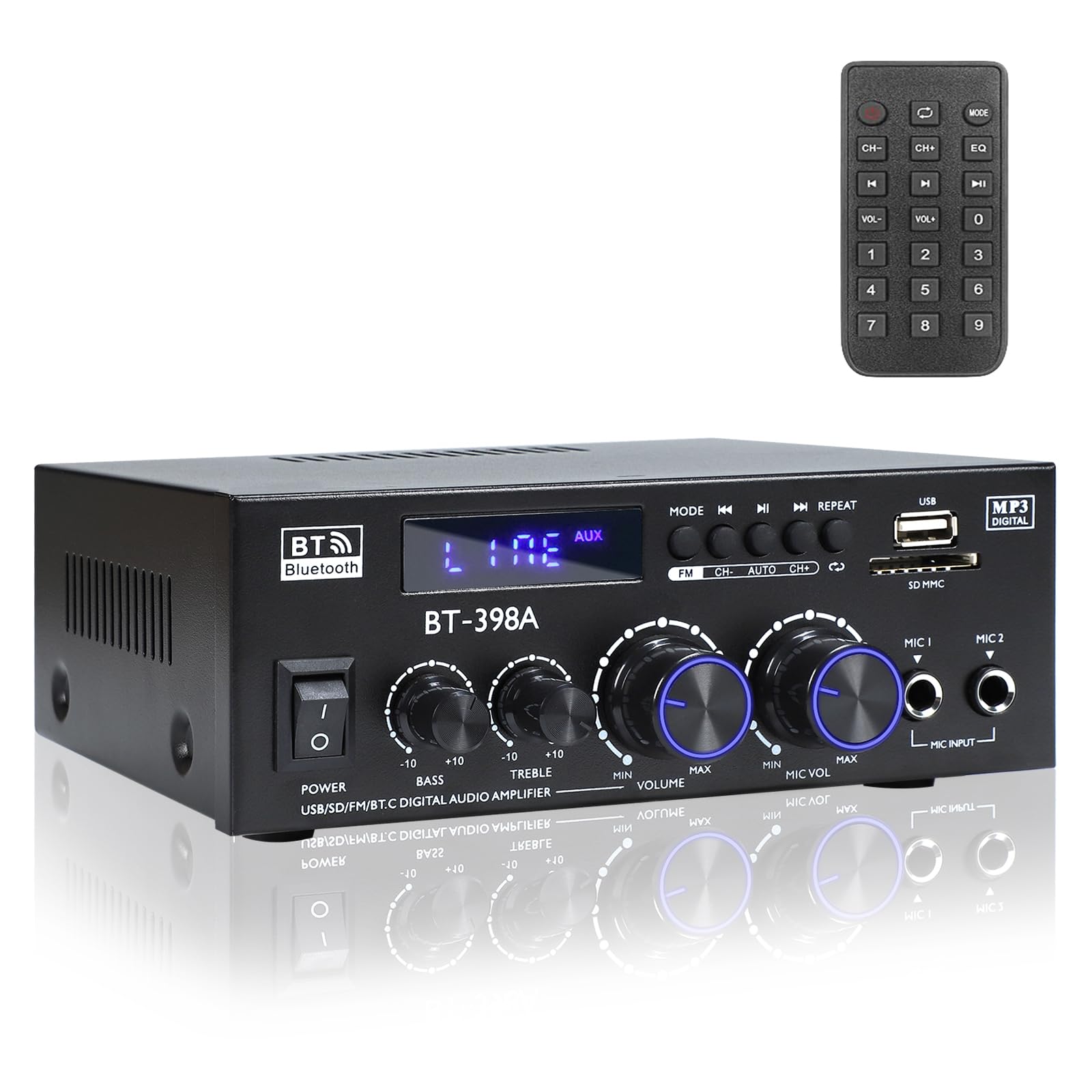
The Joengoep BT-398A stands out in the budget-to-mid-range segment because it includes optical and coaxial digital inputs — rare features at this price. This means you can connect your TV directly via optical cable for clean, uncompressed audio without relying on the TV’s analog output. Bluetooth 5.0, USB, SD card, FM radio, and dual microphone inputs round out the connectivity, making it one of the most versatile mini amplifiers available.
Power delivery is rated at 450W + 450W peak, with an RMS output around 60W x 2 into 4-ohm speakers. In practice, users report that the amplifier easily drives a pair of 6.5-inch speakers in a garage stereo, producing clean sound at moderate volumes. The independent bass, treble, and mic echo knobs are genuinely useful, and the metal chassis includes ventilation slots to manage heat during extended use. The compact size (7.1 inches wide) fits neatly on a shelf.
A known limitation is that the line output and passive speaker output cannot function simultaneously — only one works at a time, which is a design choice that may disappoint users wanting to daisy-chain additional amplifiers. Additionally, the digital inputs do not support Dolby decoding, so TV audio should be set to PCM output. For the price, the Joengoep delivers a feature set that usually costs significantly more.
Why it’s great
- Optical and coaxial digital inputs for TV audio
- Dual mic inputs with reverb control
- Compact metal chassis with good ventilation
Good to know
- Passive speaker and line outputs cannot run simultaneously
- No Dolby decoding on digital inputs
- FM antenna reception can be weak indoors
6. Romicta AK50
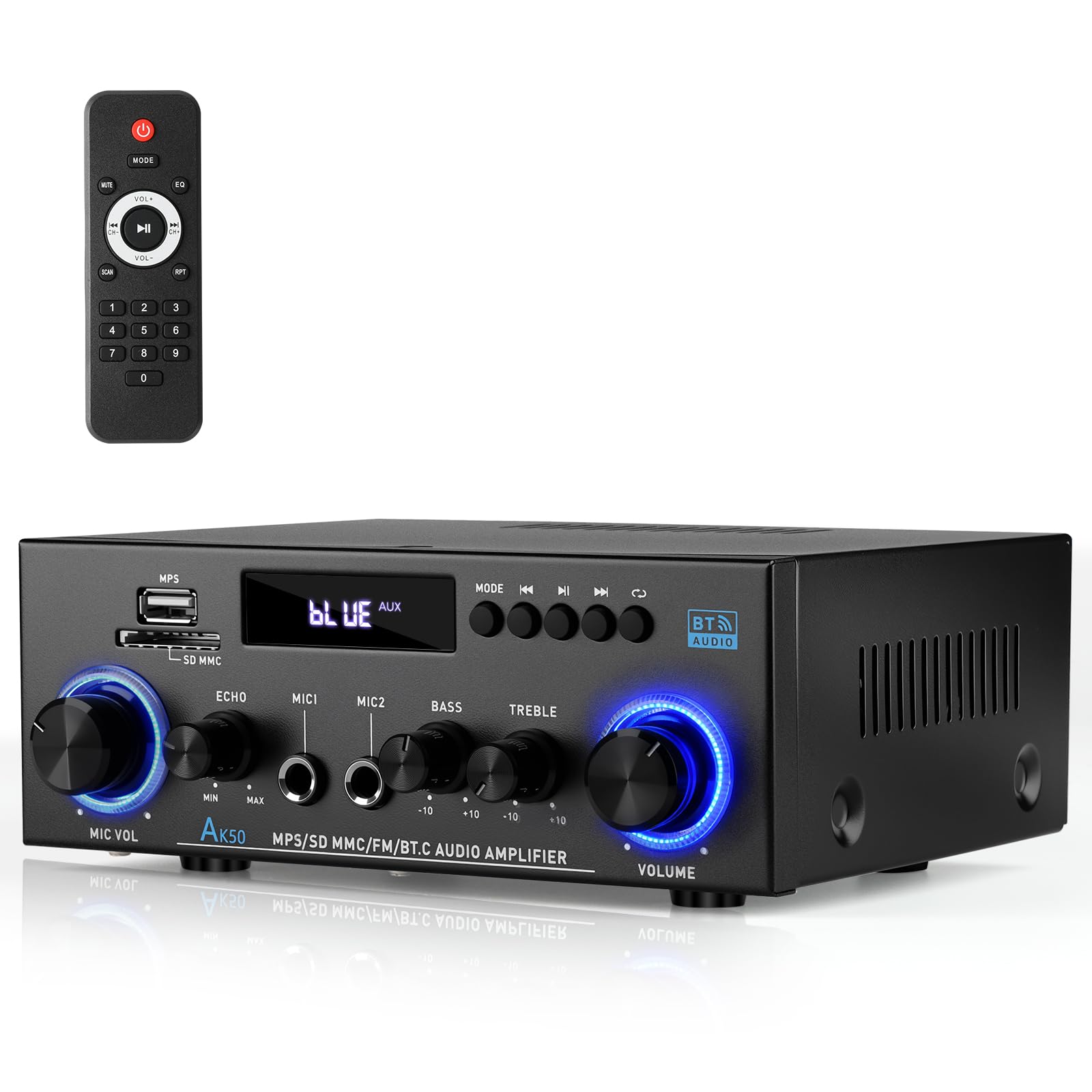
The Romicta AK50 is designed around social audio: karaoke parties, outdoor gatherings, and casual TV watching where you want the ability to plug in a microphone and adjust echo on the fly. It outputs 400W peak (50W x 2 RMS) and can drive passive speakers ranging from 4 to 16 inches, plus a powered subwoofer via the dedicated output. Bluetooth 5.0 provides wireless streaming up to 50 feet, and USB/SD card slots handle MP3 files without a phone.
Sound quality is described by buyers as surprisingly clear for the size and price. The amplifier works well as a compact home theater hub for apartments, bedrooms, and offices, pairing effortlessly with bookshelf speakers. The independent mic volume and echo knobs give you real control over vocal feedback — a feature that is often absent or poorly implemented on similarly priced units. Setup takes roughly five minutes, and the included remote covers all essential functions.
The Bluetooth range is a point of criticism: some users find it drops out beyond 15-20 feet, especially through walls. Build quality is acceptable for the price, but the plastic knobs and lightweight chassis feel less premium than the Fosi alternatives. If your primary use case involves karaoke or hosting small events and you need microphone support in a compact form, the Romicta AK50 offers the best value for that specific scenario.
Why it’s great
- Dedicated mic input with independent echo control
- Supports passive speakers and powered subwoofer
- USB and SD card plug-and-play playback
Good to know
- Bluetooth range is shorter than advertised
- Plastic knobs and lightweight build
- No optical or coaxial digital inputs
7. Pyle PDA22BT

The Pyle PDA22BT is the entry-level champion for anyone who wants to add Bluetooth to a pair of passive speakers with minimal investment. Rated at 240W peak, this micro receiver includes banana speaker terminals, RCA line input, and physical bass and treble control dials. Users have successfully repurposed old cabinet speakers, garage PA boxes, and budget bookshelf speakers with this unit, praising how quickly it pairs with iPhones and Apple TV via Bluetooth.
Performance is adequate for low-to-moderate listening levels. In a workshop, garage, or bedroom, the PDA22BT delivers clear sound without audible noise floor issues. The power supply (a 24V/4.5A adapter) is included, and the included Bluetooth antenna helps maintain a stable connection up to 30 feet. The stereo analog RCA input also allows you to switch between Bluetooth and a wired source like a turntable or CD player, giving you flexibility beyond streaming.
Reliability is the biggest concern here. Several buyers experienced channel imbalance after a few weeks — the left channel becoming noticeably quieter than the right — or complete Bluetooth failure. Customer support from Pyle is frequently described as unresponsive, especially after the return window closes. If you need a throwaway cheap amp for a low-stakes project and can accept the risk, it works fine. For daily listening where dependability matters, save for the Fosi BT20A.
Why it’s great
- Extremely compact for tight spaces
- Physical bass and treble EQ dials
- Works well with TV and projector audio
Good to know
- Reports of channel imbalance after light use
- Customer support is unreliable
- Max volume is lower than most competitors
FAQ
Can I connect a turntable directly to a Bluetooth amplifier?
Will a Bluetooth amplifier work with 4-ohm speakers?
Why does my amplifier sound distorted at higher volumes?
Does Bluetooth audio quality degrade over distance?
Final Thoughts: The Verdict
For most users, the bluetooth amplifier for wired speakers winner is the Fosi Audio BT20A because it delivers clean, reliable Class D power in a tiny footprint, with enough headroom to drive most bookshelf speakers to satisfying levels without distortion. If you want 2.1 audio with a subwoofer output for deeper bass, grab the Fosi Audio BL20C. And for a true audiophile-grade stereo receiver with honest RMS wattage and a design that belongs in a dedicated listening room, nothing beats the YAMAHA R-S202BL.