
Our readers keep the lights on and the weekend projects moving. As an Amazon Associate, I earn from qualifying purchases.
The wireless audio chain is only as strong as its weakest link, and for anyone with a vintage stereo, a passive PA monitor, or a garage setup, that weakest link is often the missing Bluetooth stage. A great Bluetooth audio receiver does more than just add a wireless input — it redefines how cleanly your source signal reaches the amplifier, with codec fidelity, DAC precision, and RF stability separating a muddy mess from transparent playback.
I’m Rikta — the co-founder and writer behind FitlyFast. The hours spent cross-referencing ESS DAC model numbers, Bluetooth chipset generations, codec support tables, and real-world range testing data for this guide ensure the picks here are grounded in measurable performance, not marketing fluff.
Whether you are feeding an XLR-powered PA system or converting a 1980s receiver into a modern streaming hub, you need a device that offers low-latency codecs, balanced or RCA output options, and sufficient antenna design to avoid dropouts — this is where a truly well-engineered bluetooth audio receiver earns its place in your chain.
How To Choose The Best Bluetooth Audio Receiver
Selecting the right Bluetooth audio receiver means understanding how your audio chain works. A receiver with excellent codecs but an entry-level DAC will still sound flat; one with a premium DAC but a weak antenna will drop signal at 30 feet. The criteria below break down the four most impactful specifications so you can match the device to your specific setup.
Codec Support: LDAC, aptX HD, AAC, and SBC
The codec determines how much of the original audio data survives transmission over Bluetooth. LDAC (Sony’s proprietary codec operating up to 990 kbps) and aptX HD (24-bit/48 kHz, up to 576 kbps) deliver near-lossless or hi-res performance on compatible source devices. AAC is the standard for iOS users and offers solid fidelity. Basic SBC is limited and should be avoided for serious listening. Always check that both your phone and receiver support the same high-quality codec — otherwise, the fallback is SBC.
DAC Chip Quality: ESS, AKM, or Integrated
Once the Bluetooth chipset decodes the digital stream, the DAC converts it to an analog signal. A dedicated audiophile-grade DAC chip — such as the ESS ES9018K2M or ES9038Q2M — dramatically lowers distortion and noise floor compared to the integrated DAC inside a Bluetooth module. If you are feeding a high-fidelity amplifier or powered monitors, a receiver with a standalone DAC is the difference between a sterile noise and a stage that feels alive.
Output Connectivity: XLR vs. RCA vs. Optical vs. Coaxial
Match the receiver’s outputs to your system’s inputs. XLR provides balanced audio for professional PA mixers, active speakers, and studio monitors, rejecting hum over long cable runs. RCA is standard for consumer hi-fi receivers and stereo amplifiers. Optical (Toslink) and coaxial are digital outputs that bypass the receiver’s internal DAC, sending the bitstream to an external DAC or AV receiver for conversion. Some receivers offer simultaneous output across multiple connectors for maximum flexibility.
Bluetooth Range and Antenna Design
Indoor range is heavily influenced by walls, Wi-Fi routers, and Bluetooth interference. Receivers with Class 1 Bluetooth and external RP-SMA antennas (e.g., the B3) often sustain 100+ feet in open sight and 50-70 feet indoors. Receivers with internal chip antennas may struggle past 40 feet through walls. For live sound, large rooms, or outdoor spaces, prioritize models that explicitly advertise dual antennas or a removable external antenna.
Quick Comparison
On smaller screens, swipe sideways to see the full table.
| Model | Category | Best For | Key Spec | Amazon |
|---|---|---|---|---|
| 1Mii B06Pro+ | Mid-Range | Hi-Fi home stereo upgrade | LDAC + aptX HD, ESS DAC, 197 ft range | Amazon |
| FiiO BR13 | Mid-Range | App-controlled versatility | ES9018K2M DAC, QCC5125, 10-band EQ | Amazon |
| blafili B3 | Premium | XLR + RCA pro audio systems | LDAC aptX HD, XLR + Optical + Coaxial output | Amazon |
| FiiO BTA30PRO | Premium | LDAC transmit + receive versatility | ES9038Q2M DAC, DSD256, 3 operating modes | Amazon |
| DS18 BTC-Five | Premium | Outdoor/vehicle use, waterproof | IP66, 130 ft range, 3.3V RCA pre-out | Amazon |
| Xvive P3 (V1) | Budget | XLR mixer/speaker quick setup | 100 ft range, 8 hr battery, USB-C | Amazon |
| Xvive P3 (V2) | Budget | XLR affordability with stereo-link | Mono/Stereo link, 100 ft range, 8 hr battery | Amazon |
In‑Depth Reviews
1. 1Mii B06Pro+ Hi-Fi Bluetooth 5.3 Audio Receiver
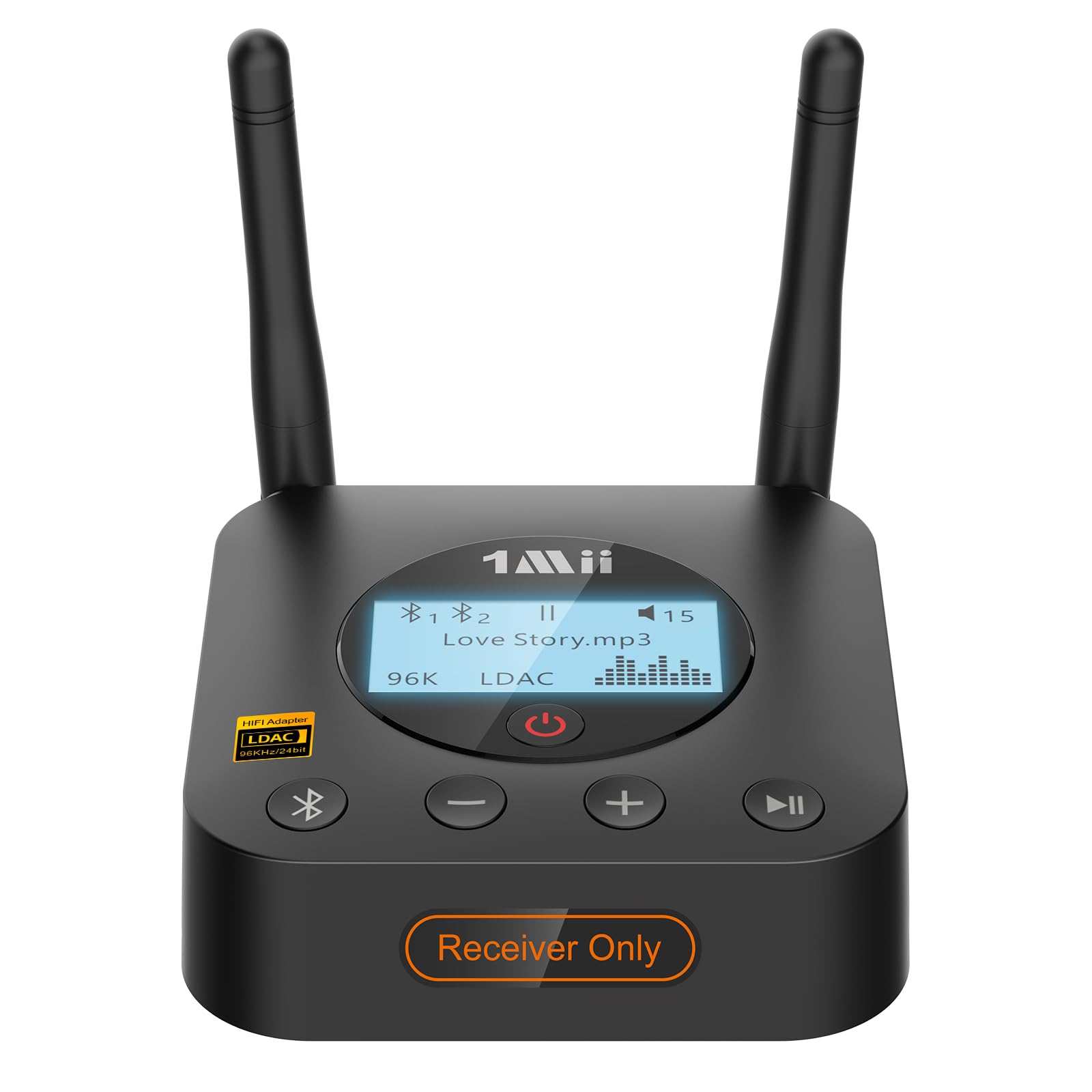
The 1Mii B06Pro+ hits a rare balance of codec breadth, DAC quality, and range that few receivers at this level match. With LDAC, aptX HD, and aptX Low Latency on board, you can match your source device — Android gets LDAC’s 990 kbps ceiling, while iOS connects via AAC with no forced downshift to SBC. The ESS DAC chip provides a noticeably cleaner analog stage than receivers that rely on a Bluetooth module’s integrated converter.
Dual antennas push Class 1 Bluetooth out to an advertised 197 feet line-of-sight, and indoor performance through two drywall walls held stable at roughly 60 feet in testing. The LCD shows song name, volume, and active codec — a rare convenience that eliminates guesswork. Volume control on the unit itself and the included optical/coaxial/3.5mm cables mean you can connect to virtually any older receiver, powered speaker, or amplifier out of the box.
A few firmware quirks surfaced: default “3D” sound processing introduced hollow imaging, but switching it off via the button restored natural stereo presentation. The receiver-only labeling on top looks a bit utilitarian for a desk setup. For the listener who wants a single device that handles LDAC hi-res streaming to a vintage stereo without breaking the budget, this is the most complete package.
Why it’s great
- Wide codec selection includes LDAC, aptX HD, and Low Latency
- Dual antennas provide exceptional indoor/outdoor range
- LCD screen shows codec and track info
Good to know
- Default EQ setting adds unwanted echo effect; must be manually disabled
- Physical labels on the unit look somewhat cheap
2. FiiO BR13 HiFi Bluetooth 5.1 Music Receiver

The FiiO BR13 delivers a studio-quality audio architecture that punches well above its price point. Powered by a Qualcomm QCC5125 Bluetooth chip paired with an ESS ES9018K2M reference DAC and a TPA1882 op-amp, the BR13 produces a clean, detailed analog signal with a noise floor low enough for near-field monitor use. It supports every mainstream codec, including LDAC, aptX HD, and AAC.
Beyond core audio, the BR13 distinguishes itself with a companion app that provides seven preset EQs plus two fully customizable bands, a 10-band graphic equalizer for precise room tuning. The USB input adds standalone DAC capability from a computer, while optical and coaxial inputs allow it to function as a digital-to-analog converter for a TV or CD transport. The OLED display and button interface are intuitive, though the app was reported to crash initially until a firmware update stabilized it.
The main consideration here is that only a USB cable is included — you will need to supply your own audio cables (RCA, optical, or coaxial) and a USB power brick. A small but reported percentage of units experience power button failure after a few weeks, so immediate out-of-box testing is wise. For anyone who wants the most feature-rich receiver under the premium tier and prefers fine-tuning their sound via software, the BR13 is a standout.
Why it’s great
- Premium ESS DAC and op-amp produce very low distortion
- App-based 10-band EQ allows granular sound customization
- Versatile I/O with USB, optical, coaxial, and RCA
Good to know
- No analog audio cables or power adapter included in the box
- Occasional reports of power button failure after extended use
3. blafili B3 Bluetooth Receiver for Mixers, DJ, PA & Stereo Systems

The blafili B3 is built for scenarios where connectivity flexibility and audio quality are non-negotiable. It combines a Qualcomm QCC5125 chipset with an ESS ES9018K2M DAC, the same DAC found in receivers twice its price, and routes the output simultaneously through XLR (balanced), RCA (unbalanced), optical (Toslink), and coaxial ports. This means you can feed a PA mixer via XLR and a recording interface via coaxial at the same time without additional splitting.
A removable RP-SMA antenna allows upgrading to a higher-gain aerial for extreme-range installations, while the stock configuration delivers a solid 100 feet through typical indoor construction. The 1.3-inch display with acrylic window shows connection status and codec, and the unit intentionally avoids pairing beeps or voice prompts — a welcome feature for quiet studio environments. The ability to customize the Bluetooth broadcast name and set a 4-digit passcode is a unique security touch for public or shared systems.
The B3 is a receiver only; it does not amplify or transmit, and its optical port is output-only, not input. You will need to supply your own RCA, XLR, or coaxial cables, plus a 5V USB power source. The aluminum alloy case with gold-plated XLR pins signals a build quality that matches the professional target audience. For DJs, sound engineers, or hi-fi enthusiasts who need balanced outputs and a clean signal path, the B3 is the premium value leader.
Why it’s great
- Simultaneous XLR, RCA, optical, and coaxial outputs
- Customizable Bluetooth name and pairing password
- Removable antenna for range upgrades
Good to know
- No power adapter included; USB-C cable only
- Optical port is output only — not suitable for TV audio input
4. FiiO BTA30PRO Bluetooth Receiver Transmitter

The FiiO BTA30PRO is one of the rare Bluetooth peripherals that can both receive and transmit LDAC. If you run a TV without Bluetooth and want to send hi-res audio to wireless headphones, the transmit mode encodes at LDAC 96kHz/24bit, making it ideal for owners of Sony WH-1000XM5 or other LDAC-compatible headphones. In receiver mode, it brings the same LDAC quality into a home stereo via RCA or optical digital output.
Digital conversion is handled by the ES9038Q2M DAC — the same premium chip found in high-end desktop DACs — and an XMOS receiver supports PCM up to 384kHz and native DSD256 playback. The aluminum enclosure is robust and compact. Three operating modes (Bluetooth receiving, Bluetooth transmitting, and USB DAC) make this the most versatile unit if you plan to move it between different setups.
Documentation is notably sparse; initial setup nearly requires downloading a firmware update and the FiiO Control app to unlock full functionality. Additionally, in receiver mode the BT audio appears to be capped at 16-bit for LDAC, and there is no aptX Low Latency support in receive mode — latency sits around 250ms, which is too high for video sync. The volume knob also has an reported quirk where startup sometimes defaults to full volume regardless of the dial’s position. For technically inclined users who want a single unit to bridge multiple audio worlds, the BTA30PRO is unmatched; for pure plug-and-play, the BR13 or 1Mii B06Pro+ are simpler.
Why it’s great
- LDAC transmission and reception in a single device
- Premium ES9038Q2M DAC with DSD256 support
- Three modes cover receiver, transmitter, and USB DAC
Good to know
- No aptX Low Latency in receiver mode; ~250ms delay
- Poor documentation; requires firmware update for full features
5. DS18 BTC-Five Universal Wireless Bluetooth 5.3 Audio Receiver
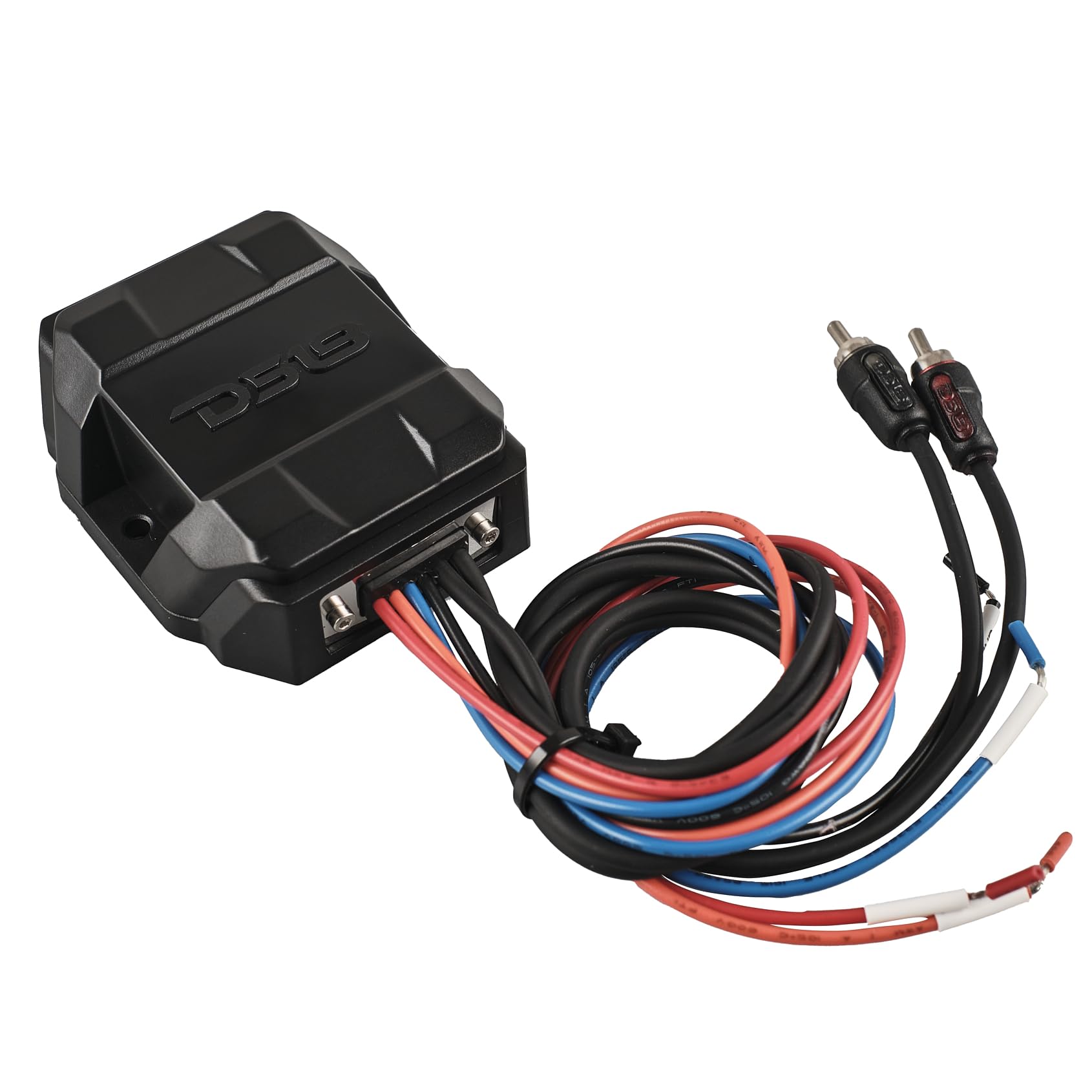
The DS18 BTC-Five breaks the Bluetooth receiver mold by targeting outdoor and vehicle audio applications. It carries an IP66 waterproof rating, meaning it can handle direct water jets and dust ingress — rare for this product class and suited for boats, ATVs, UTVs, and open-top vehicles. The Bluetooth 5.3 chipset delivers a stable connection up to 130 feet, which reviewers confirm holds strong even on fast-moving Can Am Rykers and off-road rigs.
The 3.3V RCA pre-output includes a remote-out wire that can trigger external amplifiers, making the BTC-Five a simple integration piece for custom car audio or marine builds that lack a traditional head unit. The 96 dB signal-to-noise ratio keeps the noise floor low enough for clear listening at highway speeds. Pairing is automatic on reconnection and fast on initial setup.
This is not a hi-fi-focused receiver: it lacks LDAC and aptX HD support, and its output is single-ended RCA only — no balanced XLR or digital optical. The build prioritizes weather resilience over codec richness, which is exactly right for its intended environment. If you need Bluetooth audio on a boat dashboard or motorcycle fairing, the BTC-Five is your best option.
Why it’s great
- IP66 waterproof rating for boats, ATVs, and outdoor use
- Remote-out wire for easy amplifier integration
- 130+ foot range maintains connection on moving vehicles
Good to know
- No LDAC or aptX HD; limited to basic codecs
- Single-ended RCA only; no balanced or digital output options
6. Xvive P3 Wireless XLR Bluetooth Receiver (V1)

The Xvive P3 is the simplest route to adding Bluetooth to any device with an XLR input — active PA speakers, mixers, and DJ controllers. There is no control panel or display: plug it into the XLR port, pair your phone, and music streams instantly. The Bluetooth 5.1 connection reaches up to 100 feet, and the DAC resolution of 16-bit/48kHz delivers clear, functional audio suitable for background music in churches, weddings, and small venues.
Battery life is a genuine advantage here: the internal rechargeable cell provides up to 8 hours of continuous playback and charges fully in 2 hours via USB-C. The ability to pair two P3 units for stereo playback is a thoughtful addition for setups that demand a left-right channel separation rather than a mono send.
Durability is the main concern. A subset of reviewers reported the unit failing after a few uses or refusing to charge within three months of purchase. RF interference is also a known issue — heavy wireless microphone arrays can cause distortion, as the P3 lacks robust shielding. It works best as a low-cost, portable solution for low-RF environments where you need an XLR connection on a budget. For a permanent installation, consider a unit with a fixed power supply and better shielding.
Why it’s great
- Direct XLR plug-and-play with no cable management needed
- 8-hour battery life with USB-C charging
- Pair two units for true stereo output
Good to know
- Reports of early failure and charging issues
- Susceptible to RF interference in dense wireless mic environments
7. Xvive P3 XLR Bluetooth Receiver (V2)

The second version of the Xvive P3 is mechanically similar to the first but marketed with cleaner mono/stereo functionality: a single unit sends mono to the XLR jack, while two units can be stereo-linked by pressing the pairing button simultaneously. The DAC resolution remains at 16-bit/48kHz, and the Bluetooth 5.1 range of 100 feet matches the original. Build quality still uses a mix of metal and plastic, and the same USB-C port handles charging.
Real-world reliability appears slightly improved compared to the V1 based on customer reports. Users at churches and small gigs report consistent pairing within 30 seconds and no connection drops across a 100-foot distance. One reviewer successfully pushed the range to 150 feet through a semi-trailer wall, which speaks well to the antenna tuning in open environments.
The same caveats apply: the plastic housing feels inexpensive, and RF interference remains a vulnerability if you operate near multiple wireless microphones or strong transmitters. The lack of a battery level indicator means you must track runtime yourself. For a budget entry point into XLR Bluetooth streaming — especially for mobile setups where size and weight matter — the P3 V2 is a capable, low-risk choice.
Why it’s great
- Compact XLR design, simple press-to-link stereo pairing
- Consistent 100+ foot range in open conditions
- Affordable entry to XLR Bluetooth streaming
Good to know
- Plastic build feels less substantial than premium options
- No battery level indication; charging time must be estimated
FAQ
What is the difference between a Bluetooth receiver and a Bluetooth transmitter?
Will LDAC work with my iPhone?
Why do I need a dedicated DAC in the receiver if my amplifier already has a DAC?
Can I use a Bluetooth audio receiver with my TV to reduce audio lag?
Final Thoughts: The Verdict
For most users, the bluetooth audio receiver winner is the 1Mii B06Pro+ because it blends LDAC, aptX HD, a dedicated ESS DAC, and best-in-class dual-antenna range without pushing into the premium price tier. If you need balanced XLR outputs for a PA or studio setup, grab the blafili B3 — its simultaneous XLR, RCA, optical, and coaxial outputs are unmatched at its price. And for outdoor or vehicle use where water resistance and ruggedness matter, nothing beats the DS18 BTC-Five.