
An audiophile-grade Bluetooth speaker must reconcile two competing demands: the convenience of wireless streaming and the sonic integrity of a wired system. The challenge is not simply finding a loud speaker—it’s preserving the transient response, soundstage width, and harmonic texture that define high-fidelity reproduction, all while the signal travels over a lossy codec.
I’m Rikta — the co-founder and writer behind FitlyFast. My research in this category focuses on driver topology, amplifier matching, and passive radiator design across the – price band, where the difference between decent and exceptional is measured in clarity, not volume.
After analyzing nine models through their measured performance specifications, user listening impressions, and build quality reports, this guide isolates the four drivers that define the bluetooth audiophile speakers market and matches each to the listener who will actually enjoy it.
How To Choose The Best Bluetooth Audiophile Speakers
Selecting a Bluetooth speaker with audiophile intent requires looking past the marketing wattage numbers and focusing on the physical architecture that actually shapes the sound. A single driver cabinet cannot produce true stereo separation no matter how much DSP you add, and a mediocre codec will always bottleneck a high-resolution source.
Driver Topology & Channel Count
A true two-way or three-way speaker system—separate tweeter, midrange, and woofer—will always reproduce more detail than a full-range single driver. Look for models that physically separate the high, mid, and low frequencies into dedicated drivers. A 2.1 or 3.1 arrangement with a dedicated subwoofer driver delivers the kind of bass control and treble air that defines audiophile listening.
Codec Support & Streaming Protocol
Standard SBC Bluetooth sounds flat and compressed. For critical listening, ensure the speaker supports AAC (iPhone) or aptX HD / LDAC (Android). Even better: Wi-Fi-based streaming via AirPlay 2, Chromecast, or Roon bypasses Bluetooth compression entirely, allowing 24-bit/192kHz playback that reveals the full dynamic range of a master recording.
Input Versatility & Room Correction
A single wireless input is a limitation. The best speakers also provide USB-C, HDMI eARC, optical, or analog aux for connecting a TV, turntable, or high-end DAC. Automatic room calibration—where the speaker measures its environment and adjusts the EQ curve—makes a meaningful difference in spaces with poor acoustics. Without it, a premium speaker can sound boomy or hollow in an untreated room.
Quick Comparison
On smaller screens, swipe sideways to see the full table.
| Model | Category | Best For | Key Spec | Amazon |
|---|---|---|---|---|
| KEF LS50 Wireless II | Premium | Reference monitoring | Uni-Q 12th gen driver array | Amazon |
| KEF LSX II | Premium | Desk & near-field | 24bit/384kHz streaming | Amazon |
| B&W Zeppelin Pro | Premium | Living room statement piece | 5-driver 3-way with 6″ sub | Amazon |
| JBL Authentics 500 | Premium | High-volume party use | 270W 3.1 channel Dolby Atmos | Amazon |
| JBL Boombox 4 | Mid-Range | Portable bass-heavy outdoor | 34-hour battery, IP68, 2 woofers | Amazon |
| Marshall Kilburn III | Mid-Range | Portable 360° sound | 50-hour battery, IP54, 360° audio | Amazon |
| Marshall Stanmore III | Mid-Range | Desktop & home shelf | Plug-in, 30W stereo, RCA input | Amazon |
| Bose SoundLink Plus | Mid-Range | Portable rugged daily carry | 20-hour battery, IP67, SimpleSync | Amazon |
| Harman Kardon Onyx Studio 9 | Mid-Range | Indoor multi-room | 8-hour battery, 130mm woofer, self-tuning | Amazon |
In‑Depth Reviews
1. KEF LS50 Wireless II

The LS50 Wireless II is a true two-way active bookshelf system with dedicated 280W and 100W amplifiers per speaker driving the midrange and tweeter respectively. Its 12th generation Uni-Q driver array places the tweeter at the acoustic center of the midrange cone, creating a single point source that eliminates phase smearing and delivers a soundstage so coherent you can pinpoint individual instruments in the mix. Users consistently report that this level of imaging rivals separates costing three times as much, and the 24-bit/384kHz resolution over Wi-Fi means lossless Tidal masters remain fully intact.
Input versatility is the strongest of any speaker on this list: HDMI eARC for TV passthrough, optical, coaxial, analog aux, and USB-C for laptop lossless playback. The KEF Connect app handles EQ and streaming service integration, though the wireless connection between the two speakers can occasionally glitch and require a power cycle. The warmer-than-neutral voicing makes long listening sessions fatigue-free, a trait that separates audiophile gear from PA-style speakers.
At this price point, the LS50 Wireless II replaces an entire component stack—preamp, DAC, amp, and passive speakers—in one 40-pound package. The trade-off is that you are dependent on KEF’s electronics for the life of the product; if the amplifier module fails, the speaker is non-functional. For listeners who prioritize holographic imaging and a single-cable setup, this remains the benchmark.
Why it’s great
- Holographic imaging and precise soundstage
- Warm, non-fatiguing voicing for long sessions
- HDMI eARC, USB-C, Chromecast, AirPlay 2
Good to know
- Wireless inter-speaker connection can glitch
- Heavy and requires two power cords
- Full system dependent on onboard electronics
2. KEF LSX II

The LSX II shrinks the LS50 recipe into a compact form factor that fits on a desk or bookshelf without sacrificing the Uni-Q driver philosophy. It supports USB-C audio from a laptop, HDMI eARC for TV connection, and wireless streaming via AirPlay 2 and Chromecast, making it a true all-in-one system for a small room or near-field workspace. Users note that the wired pairing between the two speakers yields noticeably cleaner transmission than wireless, so routing the included cable is recommended for critical listening.
The sound signature leans toward detailed imaging with a tight low end, though the smaller cabinet means it lacks the physical weight and room-filling authority of the LS50 II. It works best within a 6- to 8-foot listening distance, where the imaging snaps into focus and the treble remains crisp without sibilance. The subwoofer output allows adding a powered sub for deeper bass, which fixes the only real gap in performance.
The app-based control and setup process has a learning curve, and the lack of on-speaker volume or input buttons can be frustrating in daily use. But for the listener who wants a self-contained, high-resolution system for a small space without running speaker wire to a separate amplifier, the LSX II is the most polished option at its tier.
Why it’s great
- Compact footprint with near-field imaging
- USB-C and HDMI eARC for versatile sources
- Subwoofer output for deeper bass extension
Good to know
- Wired connection sounds better than wireless
- No physical volume or input controls on speaker
- Setup process has a steep learning curve
3. Bowers & Wilkins Zeppelin Pro Edition
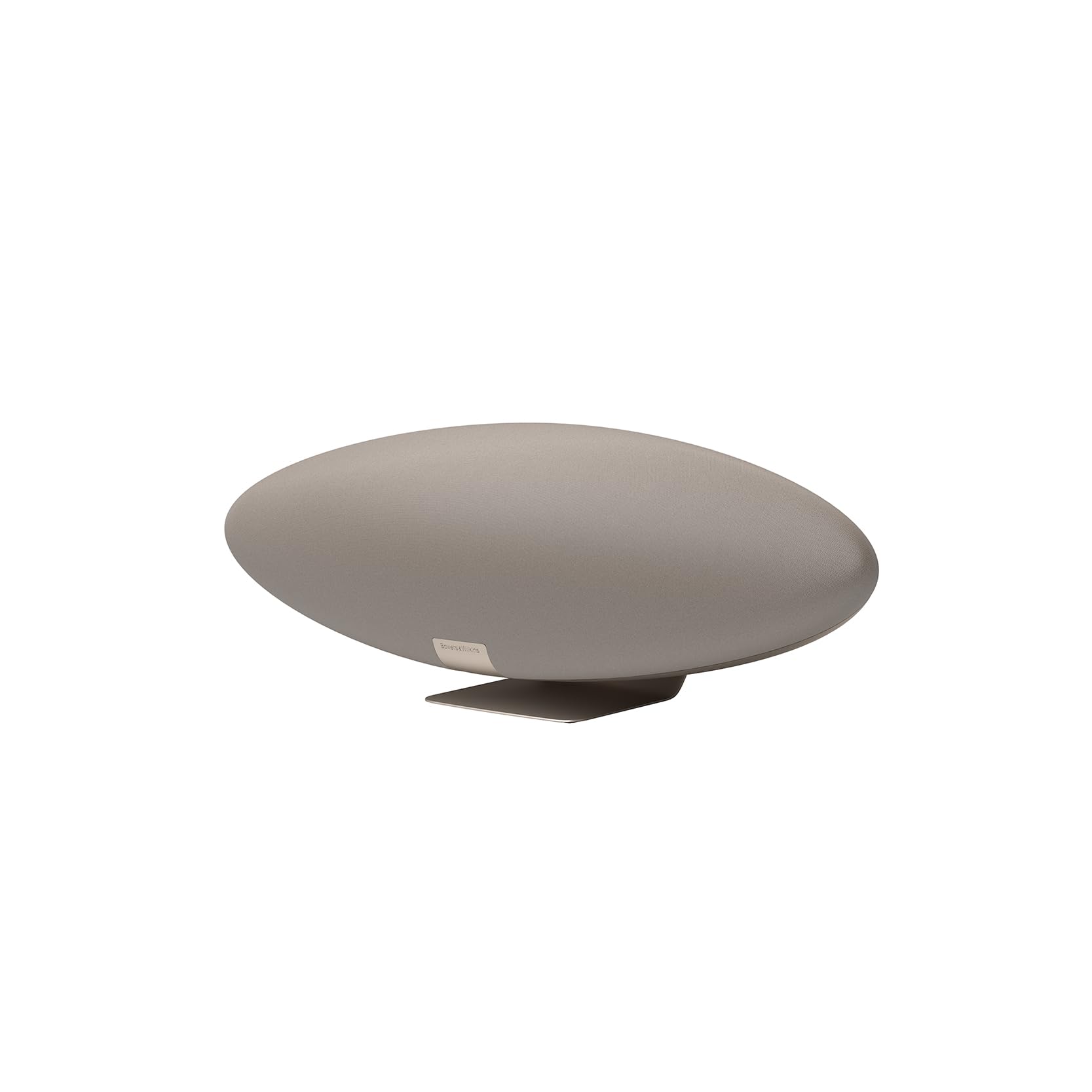
The Zeppelin Pro Edition is a single-cabinet system that houses five drivers—two 1-inch Titanium Dome tweeters, two 3.5-inch midranges, and a single 6-inch subwoofer—in a curved enclosure that functions as both acoustics and furniture. The tweeters are borrowed from the 600 Series loudspeakers, and they deliver a treble airiness that single-speaker cabinets rarely achieve. With 240 watts on tap, the Zeppelin fills a 20×20-foot living room with authority, producing bass extension down to 35Hz that feels physical without being bloated.
Streaming is handled through AirPlay 2, Spotify Connect, or the Bowers & Wilkins Music app, and many users prefer controlling playback directly from their streaming app rather than the B&W interface. The Zeppelin is not a Bluetooth-first device; it relies on Wi-Fi for high-resolution playback, and some users report AirPlay connection failures about 30% of the time, requiring a manual app restart. For listeners who value a non-technical, furniture-grade appearance combined with genuine three-way driver topology, this is the most tasteful option available.
The main limitation is its fixed single-cabinet design: you get excellent stereo imaging from the angled tweeters, but true left-right channel separation is impossible when both groups of drivers sit in the same chassis. This matters only if your listening position is more than 10 feet away or if you are accustomed to the pinpoint imaging of separate left-right speakers.
Why it’s great
- Furniture-grade design with real three-way drivers
- Sub-40Hz bass extension from built-in subwoofer
- Easy Spotify Connect and AirPlay 2 streaming
Good to know
- AirPlay connection can drop ~30% of the time
- No true stereo separation from single cabinet
- Heavy and requires dedicated shelf space
4. JBL Authentics 500

The Authentics 500 is a 3.1-channel speaker with three 1-inch tweeters and three 2.75-inch woofers pushing 270 watts, plus Dolby Atmos virtualization that expands the soundstage vertically. Unlike most Bluetooth speakers, it includes Wi-Fi streaming with AirPlay 2 and Chromecast built-in, along with both Alexa and Google Assistant for hands-free control. The automatic room calibration adjusts the EQ each time you power it on, which compensates for placement in corners or on shelves where bass would normally become muddy.
Listeners describe the sound as V-shaped with controlled bass that never overwhelms the midrange, making it suitable for casual listening at moderate-to-high volumes. At half to three-quarters power in a 1200-square-foot shop, the clarity is impressive, but the sound degrades into distortion at maximum volume. The stereo separation is limited because all drivers sit in a single cabinet, so critical listeners looking for pinpoint imaging will find it lacking compared to a proper two-speaker system.
The retro-styled Quadrex grille and leather-like enclosure make it a visual centerpiece, and the built-in voice assistants are responsive enough for daily use. This is a speaker optimized for people who want a single-box solution for parties and background music, not for the listener sitting in a dedicated sweet spot analyzing a mix.
Why it’s great
- 270W 3.1-channel power with Dolby Atmos
- Automatic room EQ calibration every power-up
- Built-in Alexa and Google Assistant
Good to know
- Sound degrades at maximum volume
- No true stereo separation from single cabinet
- Large footprint bigger than a toaster oven
5. JBL Boombox 4
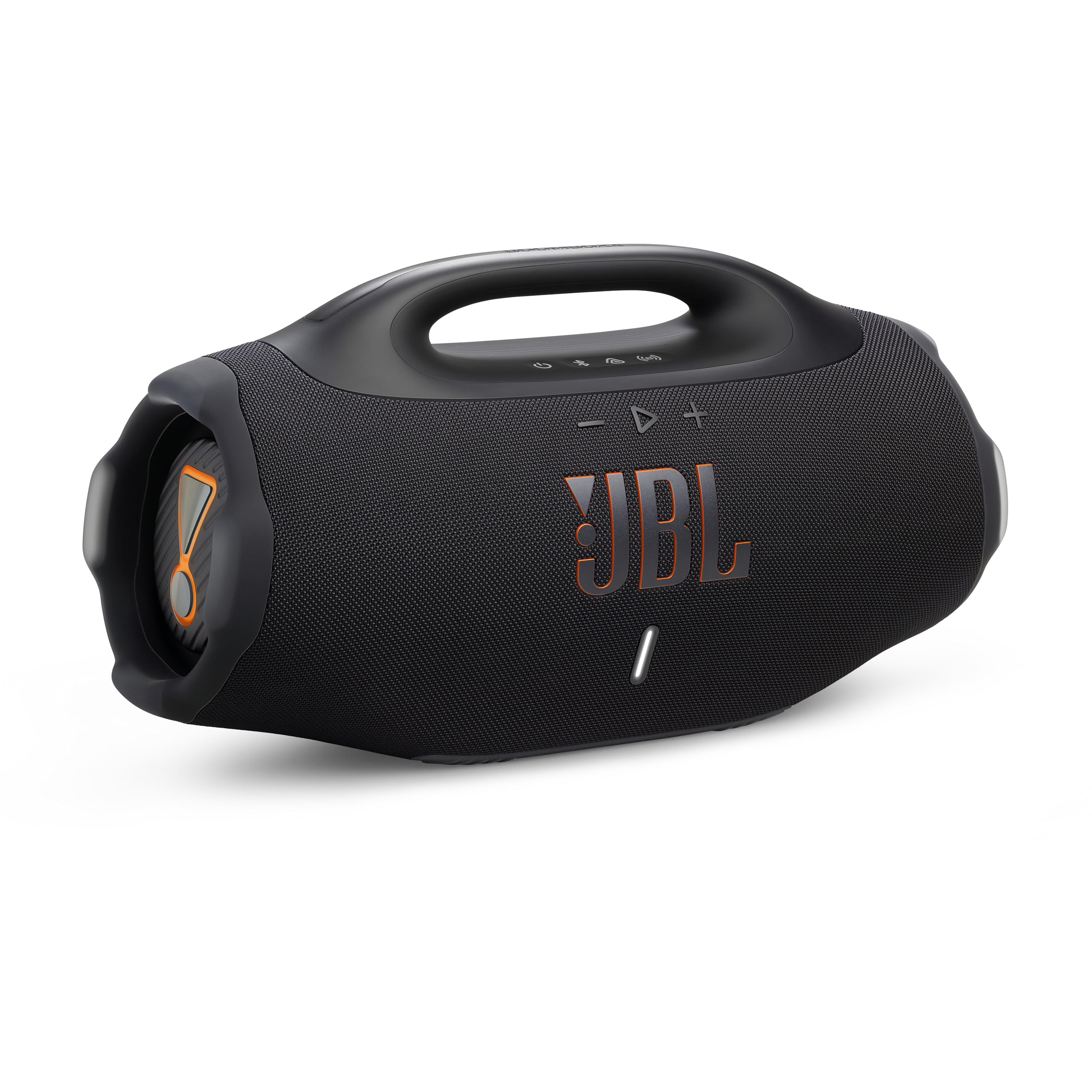
The Boombox 4 takes the portable Bluetooth category to an extreme: two larger woofers, two tweeters, and three passive radiators combine for 200W RMS of output that handles a 60-person outdoor party without strain. The AI Sound Boost algorithm analyzes the music in real time and increases power while reducing distortion, and two selectable bass modes—Deep Bass for sub-40Hz rumble and Punchy Bass for tighter mid-bass—let you dial in the character. Users coming from the Boombox 3 report a massive leap in clarity, with sub-bass extension that rivals small PA systems.
The 34-hour battery and IP68 rating mean this speaker lives outdoors. It is 13 pounds and has a retractable handle, so it is portable but not pocketable. The replaceable battery (sold separately) extends the usable lifespan beyond typical sealed units, a practical detail for heavy users. The lack of a 3.5mm aux input is a meaningful omission for users who want zero latency from a DJ controller or laptop.
For audiophile listening, the Boombox 4 is bass-forward and designed for impact rather than nuance. The custom EQ in the JBL app can tame the low end for indoor use, but the speaker’s core tuning is built for open spaces where bass waves can physically propagate. It is not a substitute for a bookshelf pair, but it is the most capable portable speaker for events where sound pressure matters more than soundstage.
Why it’s great
- 200W RMS with deep, room-filling bass
- 34-hour battery and IP68 rugged design
- Replaceable battery for extended lifespan
Good to know
- No 3.5mm aux input for low-latency use
- Heavy at 13 pounds
- Bass-forward tuning not ideal for critical listening
6. Marshall Kilburn III

The Kilburn III is Marshall’s portable flagship, offering true 360° stereophonic sound from a single cabinet that projects a wider soundfield than any mono Bluetooth speaker. The Dynamic Loudness feature adjusts the EQ curve automatically as you change volume, so the bass and treble remain balanced whether you are listening at conversation level or party volume. Users consistently describe the sound as “mind-blowing for its size,” with bass that rivals a car stereo and enough clarity to separate vocals from instruments at any volume.
The 50-hour battery is the class leader, and the IP54 dust and water resistance means it survives a backyard party or poolside use without worry. The charging bank function lets you top off your phone from the speaker’s internal battery, a rare and useful addition for camping trips. At 7 pounds, it is heavier than most portable speakers, but the built-in handle makes transport easy.
The bass is rich and full, but some listeners find it slightly exaggerated compared to a neutral reference. The Marshall app and physical bass/treble knobs let you dial it back, but the core tuning is built for the Marshall rock-and-roll aesthetic. It is a better outdoor companion than a critical listening station, but for a portable speaker with this much battery life and sound presence, there is no direct competitor.
Why it’s great
- 50-hour battery with charging bank feature
- 360° stereophonic sound projection
- Physical bass and treble knobs on the speaker
Good to know
- Bass-forward tuning, not neutral
- Heavy at 7 pounds
- IP54 water resistance, not fully submersible
7. Marshall Stanmore III

The Stanmore III is a plug-in home speaker that focuses on sheer soundstage width and clarity rather than portability. Its stereo driver array delivers noticeably wider imaging than the Kilburn or any mono Bluetooth speaker, filling a 1300-square-foot house with ease. The vintage controls—physical knobs for bass, treble, and volume—give you immediate tonal adjustment without diving into an app, and the Bluetooth 5.2 chip is ready for future multi-point features.
The RCA and 3.5mm inputs make it record-player compatible, a rare feature in this category that matters for vinyl listeners who want a single powered speaker. Users praise the “house-filling” sound and the premium build quality, noting that the leather-like finish and retro grille exceed expectations at this price. Lacking a battery, the Stanmore III is strictly a home speaker, but its 30-watt stereo output is more than adequate for most living rooms.
It lacks the 360° output of the Kilburn and the bass extension of larger cabinets, so it works best at moderate volumes on a desktop or shelf. The texture switch on top can be confusing for first-time users, but once set, the Stanmore III is as straightforward as Bluetooth speakers get. For the listener who values analog inputs and retro aesthetics over portability, this is a strong mid-range pick.
Why it’s great
- Wide soundstage for a single cabinet
- RCA and 3.5mm inputs for turntable use
- Physical bass/treble knobs on the speaker
Good to know
- No battery, must remain plugged in
- Bass lacks depth compared to larger speakers
- Control switch can be unintuitive at first
8. Bose SoundLink Plus Portable

The SoundLink Plus is Bose’s latest portable effort, delivering bold, resonant audio with a surprising amount of low-end power for its 2.5-pound body. The IP67 rating means it is fully dustproof and can survive submersion in up to one meter of water, and the shock-resistant exterior makes it the most durable speaker on this list for outdoor adventure. The built-in USB-C charge-out port lets you top off your phone from the speaker’s 4500mAh battery, a practical feature for long days away from power.
Bose’s SimpleSync technology allows pairing with compatible soundbars for whole-home audio, and the Bose app provides a five-band EQ for fine-tuning the sound signature. Users describe the audio as “rich and refined” with clear vocal presence and impactful bass that does not distort at high volume. At 3 pounds, it is heavier than typical ultra-portable speakers, but the carrying loop makes it easy to hang from a backpack or tent.
The sound is tuned for broad appeal rather than audiophile precision: it is smooth, non-fatiguing, and slightly warm, but it lacks the micro-detail retrieval of a proper two-way system. If your priority is a rugged, waterproof companion that sounds good everywhere—on a hike, by the pool, or in the shower—this is the most versatile choice. If you need reference-grade detail for critical indoor listening, a bookshelf system will serve you better.
Why it’s great
- IP67 waterproof and dustproof rating
- USB-C charge-out for phone top-ups
- Smooth, non-fatiguing sound signature
Good to know
- Lacks micro-detail compared to bookshelf alternatives
- Heavier than ultra-portable competitors
- 5-hour full charge time
9. Harman Kardon Onyx Studio 9

The Onyx Studio 9 is a portable indoor speaker with a 130mm dynamic woofer that produces deeper, more dimensional bass than its compact frame suggests. Its defining feature is the automatic self-tuning that calibrates the EQ to the room every time you power it on, a technology usually reserved for speakers costing twice as much. This ensures the bass remains tight and the mids stay clear even when the speaker is placed in a corner or against a wall.
The 8-hour battery limits it to indoor portability—moving from room to room rather than taking it on a hike. Users praise the “phenomenal bass” and the ability to fill an entire house without needing maximum volume. The built-in USB charging port lets you keep a phone topped off, and the Auracast multi-speaker connection allows pairing two Onyx Studio 9s for a wider stereo soundstage.
The sound signature is slightly warm and bass-forward, which works well for pop, electronic, and hip-hop but may feel a little colored for classical or acoustic purists. The fabric-mesh exterior looks elegant but picks up dust in storage. For the listener who wants a room-adaptive, bass-rich speaker for daily indoor use without paying premium-tier prices, this is the most balanced performer in its segment.
Why it’s great
- Automatic self-tuning EQ adapts to any room
- Deep, dimensional bass from 130mm woofer
- Auracast multi-speaker pairing for stereo sound
Good to know
- Only 8-hour battery limits outdoor use
- Slightly bass-forward voicing for some genres
- Fabric exterior attracts dust over time
FAQ
Can a single Bluetooth speaker produce true stereo sound?
What does a titanium dome tweeter do for sound quality?
Does automatic room calibration matter for a Bluetooth speaker?
Final Thoughts: The Verdict
For most users, the bluetooth audiophile speakers winner is the KEF LS50 Wireless II because its Uni-Q driver array delivers holographic imaging and a warm, fatigue-free voicing that no single-cabinet speaker can match. If you want a compact desk system that handles USB-C from a laptop, grab the KEF LSX II. And for a portable outdoor bass cannon that still offers replaceable batteries and IP68 ruggedness, nothing beats the JBL Boombox 4.