
Our readers keep the lights on and the weekend projects moving. As an Amazon Associate, I earn from qualifying purchases.
The biggest lie in wireless audio is that you have to sacrifice sound quality for convenience. A phone’s internal DAC is a compromise designed for battery life, not for revealing the depth in your favorite recordings. A dedicated Bluetooth DAC Amp bypasses that bottleneck, upgrading your headphones or speakers to a level you didn’t know they could achieve. This guide cuts through the spec-sheet noise to find the devices that genuinely deliver on their promise of high-fidelity wireless sound.
I’m Rikta — the co-founder and writer behind FitlyFast. I have spent hundreds of hours analyzing DAC chips, amplifier topologies, and Bluetooth codec performance across the entire product landscape to identify the components and designs that produce a genuinely measurable and audible improvement in your listening experience.
Whether you need a compact companion for commuting or a desktop hub for critical listening, choosing the right bluetooth dac amp comes down to understanding which chipset and output stage truly matches your gear.
How To Choose The Best Bluetooth DAC Amp
The market is packed with options, but three core pillars separate a worthwhile purchase from an overpriced dongle. You need to evaluate the DAC and amplifier hardware, the supported Bluetooth codecs, and the output configuration relative to your specific headphones or speakers. Ignoring any of these leads to a mismatch and wasted potential.
DAC Chip & Amplifier Topology
The DAC chip, like the ESS ES9018K2M or the newer ES9039Q2M, is the heart of the sound. It converts the digital Bluetooth signal into an analog waveform. Higher-end chips from ESS or AKM offer lower total harmonic distortion (THD) and higher dynamic range, resulting in a cleaner, more detailed soundstage. The amplifier section then takes that analog signal and provides current and voltage to drive your headphones. A unit with a THX AAA amplifier, for instance, is known for producing massive power with an ultra-black background, free from hiss—critical for sensitive IEMs.
Bluetooth Codec Support
The codec determines the maximum resolution of the audio you can stream. LDAC, supported by most Android devices, offers three bitrate modes up to 990 kbps, which is near-lossless. aptX Adaptive is a strong alternative that dynamically adjusts bitrate for stability. For iPhone users, AAC is the native high-quality codec, and any DAC Amp that processes it well will sound excellent. A device like the FiiO BTR7 or the iFi GO blu supports nearly all codecs, ensuring peak performance regardless of your source device.
Output Power & Connector Type
This is a mechanical and electrical matching game. A 3.5mm single-ended output works for most consumer headphones, but a 4.4mm balanced output can double the voltage swing, providing significantly more headroom for high-impedance headphones like the Sennheiser HD600 series. Check the unit’s output power in milliwatts (mW) at a specific impedance. For hard-to-drive planar magnetic headphones, you will want a device with a desktop mode that unlocks higher power, such as the FiiO BTR17’s 650mW balanced output, which can keep up with full-sized desktop amps.
Quick Comparison
On smaller screens, swipe sideways to see the full table.
| Model | Category | Best For | Key Spec | Amazon |
|---|---|---|---|---|
| FiiO BTR17 | Portable / Desktop | High-power balanced listening | 650mW 4.4mm (Desktop Mode) | Amazon |
| Khadas Tea Pro | Ultra-Portable | MagSafe on-the-go audio | 768kHz/32bit, DSD512 | Amazon |
| iFi GO blu | Ultra-Portable | Compact, warm sound with EQ | 4.4mm Balanced & XBass | Amazon |
| FiiO BTR7 | Portable | MQA and high-res playback | Dual ES9219C DAC | Amazon |
| Blafili B3 | Home Receiver | Adding Bluetooth to hi-fi systems | ESS ES9018K2M & XLR Output | Amazon |
| WiiM Amp Ultra | Streaming Amp | Whole-room wireless system | 100W per Channel + RoomFit | Amazon |
| TOPPING DX5 II | Desktop DAC/Amp | Reference desktop listening | 7600mW x2 Balanced Output | Amazon |
In‑Depth Reviews
1. FiiO BTR17
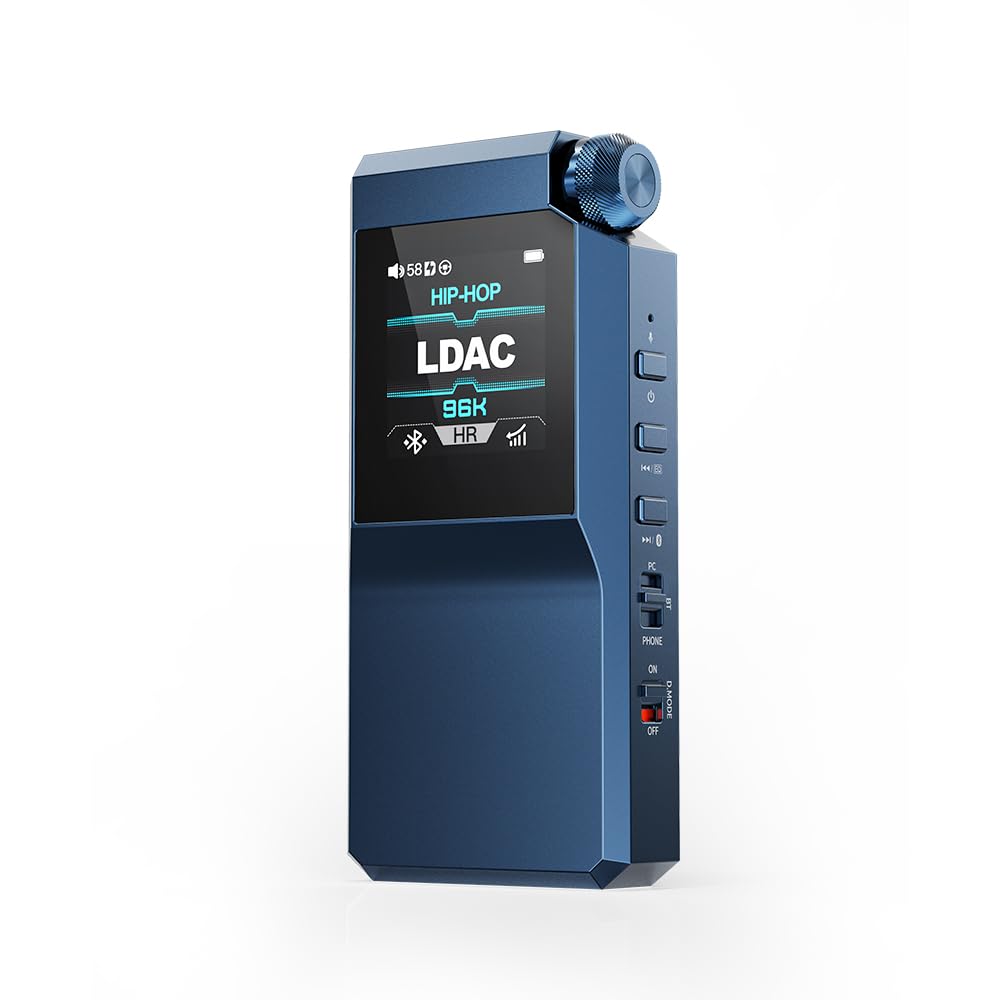
The FiiO BTR17 is the most versatile performer in this guide. Its dual ES9069Q DACs and THX AAA amplifier architecture deliver a clean, neutral sound with an extraordinarily low noise floor. In desktop mode, the 4.4mm balanced output produces 650mW per channel, providing ample headroom for demanding planar headphones like the Hifiman Sundara, something few portable units can claim.
Bluetooth 5.4 with the QCC5181 chip gives you full codec support, including LDAC and aptX Lossless. The three-mode switch lets you toggle seamlessly between a Bluetooth DAC/amp, a USB tail DAC for your phone, and a computer soundcard. The 10-band parametric EQ, accessible via the FiiO Control app, allows precise tuning to match your headphones and personal taste.
The software experience remains the primary friction point. The app can feel a bit sluggish, and some users report minor EQ lock-up glitches. Physically, the unit is well-built with a crisp screen and a satisfying volume dial. If you want a single device that excels in both portable and semi-desktop scenarios, this is the one to get.
Why it’s great
- Desktop mode offers high power for demanding headphones
- Full suite of Bluetooth codecs including aptX Lossless
- Clean, neutral sound with an inky black background
Good to know
- Fiio Control app can be buggy and slow
- Sound signature is very neutral; some may prefer a warmer tuning
2. Khadas Tea Pro
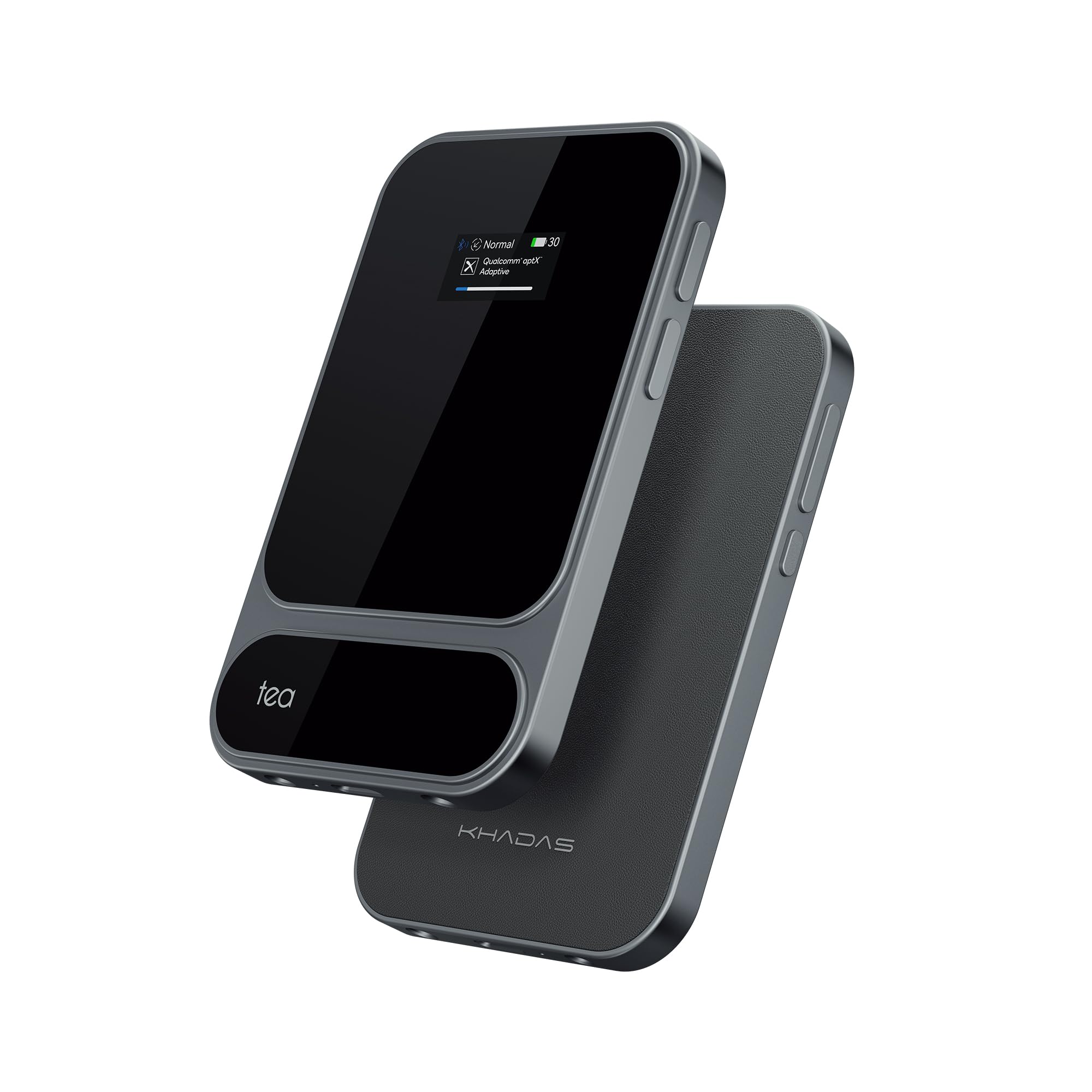
The Khadas Tea Pro is a marvel of engineering for the mobile listener. Weighing only 96 grams and thinner than many phones, it features a built-in magnet that snaps onto MagSafe iPhones for a flush, cable-free setup. The inclusion of a 0.95-inch AMOLED screen on such a slim chassis is a trick rarely pulled off, providing volume, gain, and codec info at a glance.
Its triple-chip architecture pairs the flagship ES9039Q2M DAC with an XMOS XU316 USB controller and a QCC5181 Bluetooth chip for Bluetooth 5.4 and LDAC support. The result is a spacious, detailed soundstage with excellent clarity. The 2100mAh battery provides up to 11 hours of wireless playback, more than enough for a full day of commuting or travel.
The ultra-slim design creates a mechanical quirk: the 4.4mm balanced plug is thicker than the device itself, causing a slight lift that weakens the MagSafe grip. It also cannot fully bypass the iPhone’s internal volume control, requiring you to max out the phone volume for the cleanest signal path. For ultimate portability with a Mac or Android phone, the form factor is unmatched.
Why it’s great
- Ultra-thin and lightweight with convenient MagSafe attachment
- Excellent battery life for a device this size
- High-end DAC chipset delivers clear, detailed audio
Good to know
- 4.4mm plug can interfere with MagSafe stability
- iPhone volume cannot be fully bypassed
3. iFi GO blu

The iFi GO blu is about musicality over sterile transparency. Its sound signature is warm and engaging, and its two analog boost circuits—XBass and XSpace—can add a tactile thump to bass or widen the soundstage for live recordings. It is the only device in this list with a physical rotary volume knob, a feature that audio purists will appreciate for its precision and tactile feedback.
The Qualcomm 5100 Bluetooth chip supports LDAC, aptX HD, and AAC, and the unit features both 3.5mm and 4.4mm outputs. The S-Balanced circuitry on the 3.5mm output cuts crosstalk noise in half, making it a great choice for sensitive IEMs that usually pick up hiss. The built-in microphone offers solid call quality, an often-overlooked feature for a device meant to be your daily driver.
Some users report a weak included clip, and a few units have shown a slight background hiss that was addressed in firmware updates. The battery life, while good, is slightly less than some competitors. If you prefer a more organic, fun sound signature and want physical controls over a screen, the GO blu is an excellent partner.
Why it’s great
- Warm, musical tuning with excellent XBass/XSpace boosts
- S-Balanced output is very clean for sensitive IEMs
- Physical volume knob provides precise control
Good to know
- Included clip is not very robust
- Some units may require a firmware update for background noise
4. FiiO BTR7

The FiiO BTR7 is a direct predecessor to the BTR17 and remains a potent option, especially for users who value MQA rendering. The XMOS XUF208 chip can unfold MQA files up to eight times the sample rate, a feature that sets it apart for Tidal subscribers. The dual ES9219C DACs provide a clean, distortion-free signal with excellent dynamic range.
Bluetooth 5.1 with LDAC and aptX HD ensures high-quality streaming, and the 3.5mm plus 4.4mm dual outputs give you flexibility. Users report it drives the 300-ohm Sennheiser HD660S2 with impressive authority, a testament to its amplifier stage. It also supports cVc 8.0 for clear voice calls, making it a practical all-rounder for commuting.
The main complaints revolve around the user interface. The menu system is described by many as confusing and unintuitive, and the companion app lacks labeled frequency bands on the EQ, making precise adjustments difficult. The switch to a larger color screen also seems to have impacted battery life compared to older models. For MQA fans, it is a strong contender.
Why it’s great
- Supports full MQA 8x unfolding for Tidal users
- Excellent sound quality with enough power for high-impedance headphones
- Good call quality with cVc 8.0 noise cancellation
Good to know
- Menu system is complex and unintuitive
- Battery life is shorter than previous generation
5. Blafili B3

The Blafili B3 is not for your pocket; it is a dedicated home receiver designed to add high-quality Bluetooth to a traditional hi-fi stack. The combination of a Qualcomm QCC5125 chip and an ESS ES9018K2M DAC is a classic, proven pairing that delivers low distortion and high dynamic range. Its standout feature is the simultaneous active XLR, RCA, coaxial, and optical outputs, with the balanced XLR being a rarity at this level for a receiver.
The build quality is excellent, featuring a satin black alloy case and gold-plated XLR pins. The 1.3-inch display provides clean status feedback, and the ability to customize the Bluetooth broadcast name and passcode is a thoughtful touch for shared systems. The range is rated up to 100 feet with the included RP-SMA antenna, which is replaceable if you need even more reach.
It is strictly a receiver—it cannot drive passive speakers directly. The RCA cable and coaxial cable are not included, and the optical port is output-only, not input. Also, it does not support Wi-Fi streaming, so your phone remains the source of control. For adding lossless-quality Bluetooth to a powered speaker or a receiver, this is a robust solution.
Why it’s great
- Balanced XLR output for clean, noise-free signal to pro gear
- ESS DAC and QCC chipset deliver excellent sound quality
- Removable antenna for extended range
Good to know
- Does not drive passive speakers; needs powered inputs
- No Wi-Fi, RCA, or coaxial cables included in the box
6. WiiM Amp Ultra
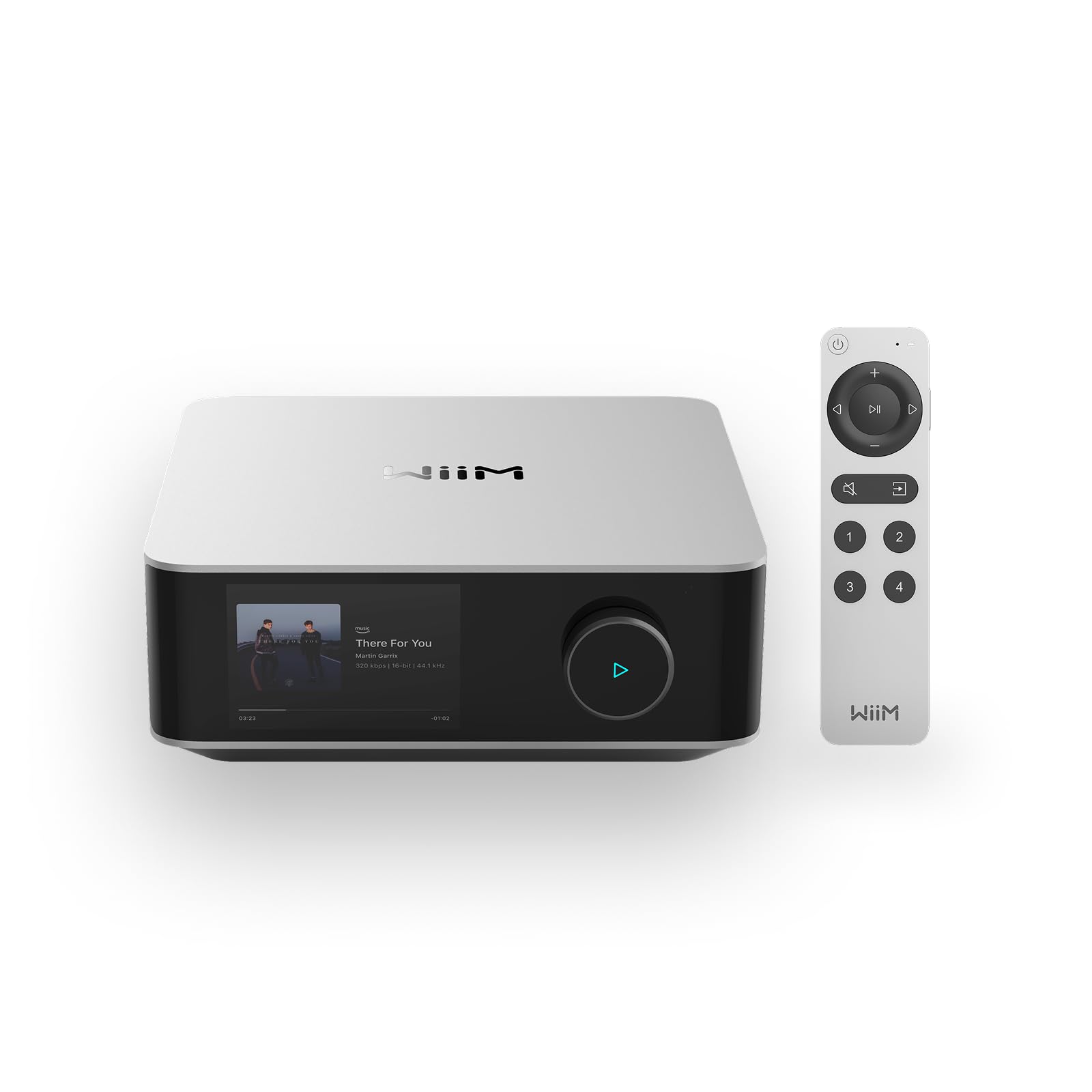
The WiiM Amp Ultra redefines what a Bluetooth DAC Amp can be by integrating a powerful streaming platform. Inside its sleek aluminum chassis, it packs an ESS ES9039Q2M DAC and dual TI TPA3255 amplifiers, delivering a clean 100 watts per channel. This is enough to drive a pair of bookshelf speakers to room-filling levels, and the RoomFit auto-calibration uses your phone’s microphone to adjust the sound profile to your specific room acoustics.
Connectivity is a winner for a modern home. It includes HDMI ARC for seamless TV integration, optical, and RCA inputs. Bluetooth 5.3 with LE Audio handles wireless streaming, but the real power is Wi-Fi 6, enabling multi-room playback with other WiiM devices. It supports virtually every streaming service, including TIDAL, Qobuz, and Spotify Connect, all controllable via a responsive app or the included voice remote.
The WiiM Amp Ultra is not a portable device and does not have a headphone output. Its focus is on powering speakers, and it excels at that. While its feature set is immense, some users find the Bluetooth source input can introduce a delay, which is resolved by disabling Bluetooth as a source for audio. It is the ideal hub for a living room setup built around streaming.
Why it’s great
- Full streaming platform with multi-room and voice control
- Powerful 100W amplifier section for driving speakers
- RoomFit EQ uses your phone for personalized room correction
Good to know
- Not a portable device and lacks a headphone jack
- Bluetooth input can sometimes have minor synchronization issues
7. TOPPING DX5 II
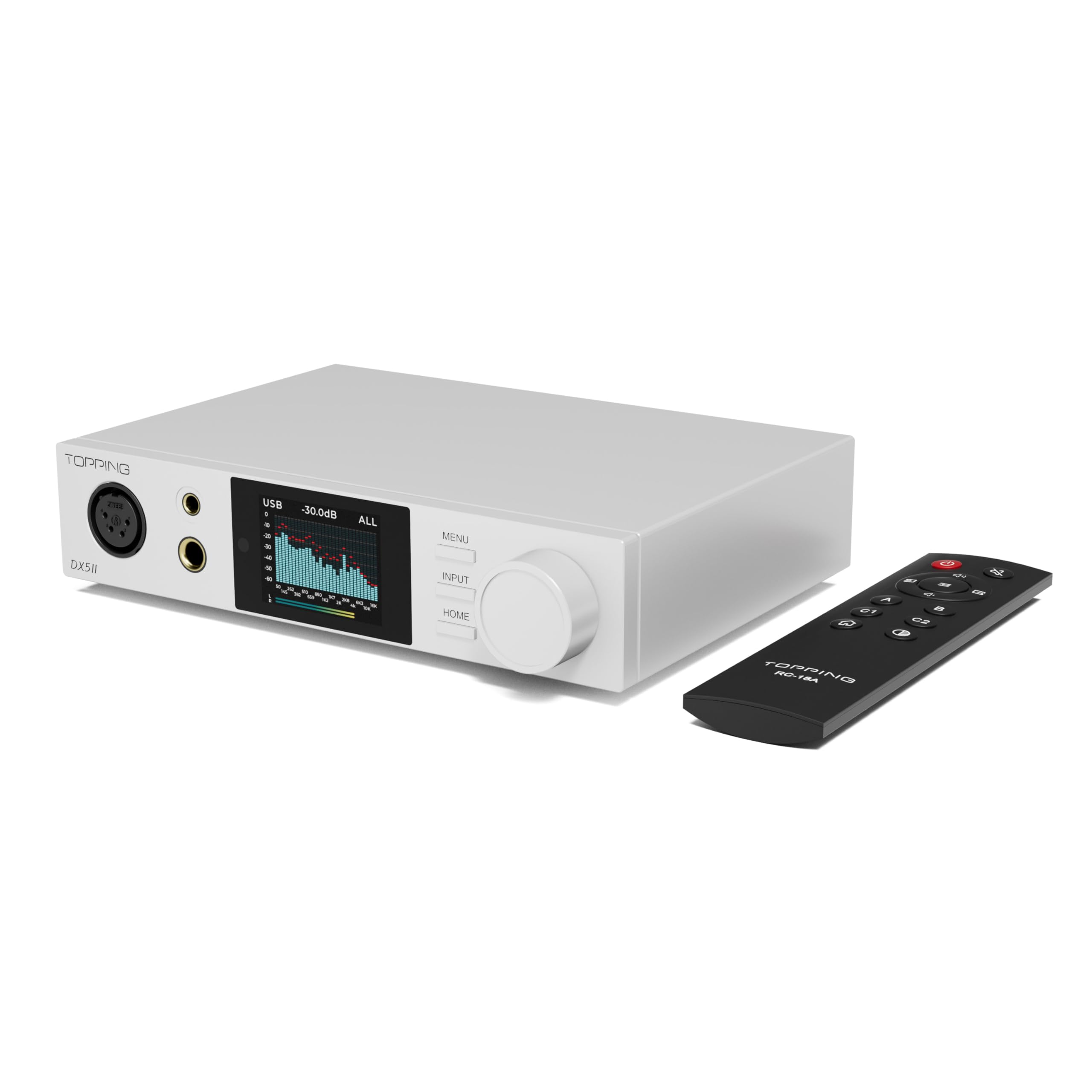
The TOPPING DX5 II is a no-compromise desktop station. Its dual ES9039Q2M DAC chips in a balanced topology create a soundstage with phenomenal width and separation. The X-Hybrid headphone amplifier is a beast, pumping 7600mW x2 into its balanced output, making even the most power-hungry headphones like the Susvara or Abyss work with headroom to spare.
As a Bluetooth DAC, it uses a QCC5125 chip for LDAC and aptX Adaptive, ensuring high-res wireless quality is on par with its wired performance. The 2.0-inch Aurora UI display is crisp and customizable, with a large pressable knob for volume and menu navigation. It supports a 12V trigger for seamless integration with a dedicated amplifier, and the 10-band PEQ is fully adjustable via the Topping Tune app.
Quality control has been flagged as a potential issue, with a small number of reports regarding units developing distortion or bricking after a few months. The menu system can also be dense to navigate without the remote. For a desk-bound audiophile who demands reference-level measurements and enough power to drive any headphone, the DX5 II is a top-tier contender, though you should purchase from a seller with a solid return policy.
Why it’s great
- Extremely powerful amplifier section drives the most demanding headphones
- 10-band PEQ for detailed sound customization
- Clean, transparent sound with excellent channel matching
Good to know
- Quality control can be inconsistent across units
- Menu navigation is complex without the remote
FAQ
Can a Bluetooth DAC Amp power my 300-ohm Sennheiser headphones?
What is the difference between aptX HD and LDAC?
Is there a noticeable lag when watching videos with a Bluetooth DAC Amp?
Final Thoughts: The Verdict
For most users, the bluetooth dac amp winner is the FiiO BTR17 because it combines portable convenience with desktop-grade power and a neutral, transparent sound signature. If you want a MagSafe-compatible ultra-portable for on-the-go listening, grab the Khadas Tea Pro. And for a whole-home streaming amplifier that replaces a traditional receiver, nothing beats the WiiM Amp Ultra.