
Our readers keep the lights on and the weekend projects moving. As an Amazon Associate, I earn from qualifying purchases.
Finding a game that holds the attention of a three-year-old without a screen in sight can feel like a parenting unicorn. The best options ditch complex rules for simple, repeatable actions that build fine motor control, color recognition, and the social skill of turn-taking — all while feeling like pure, unadulterated play.
I’m Rikta — the co-founder and writer behind FitlyFast. I’ve analyzed hundreds of preschool toy specifications, cross-referencing age recommendations, material safety, and the actual developmental skills each game claims to target so you don’t have to guess what works.
You need a game that survives sticky fingers, offers quick rounds for short attention spans, and quietly teaches something valuable. That’s exactly what you will find in this guide to the very best board games for 3-4 year olds.
How To Choose The Best Board Games For 3-4 Year Olds
The best preschool board games share a few non-negotiable traits: they are built from durable materials, feature large pieces that are safe for small mouths, and rely on simple matching or motor skill tasks rather than reading or counting. Here are the specific factors to weigh before you buy.
Prioritize Fine Motor Development
Games that involve squeezing tongs, pulling sticks, or picking up small objects with precision do double duty. They entertain while actively building the hand strength and coordination a child needs for writing and self-care tasks like buttoning a shirt. Look for tools like scissor scoops or tweezers that turn a game into a disguised occupational therapy session.
Check for Material Safety and Durability
Wooden pieces should be smooth and free of splinters. Plastic components need to be thick enough to withstand being dropped, thrown, and chewed. Always verify that the game does not include small parts that could be a choking hazard unless the manufacturer explicitly states the age cutoff. A wooden stick game that is painted with non-toxic finishes is a safer bet than a cheap plastic alternative.
Look for Simple Rules with Quick Rounds
Three-year-olds have notoriously short attention spans. A game round that lasts longer than 10 minutes will likely lose its audience. Games with a single action per turn — spin, pick, place — are ideal. Avoid any game that requires reading, complex strategy, or multi-step instructions that a preschooler cannot remember without help.
Quick Comparison
On smaller screens, swipe sideways to see the full table.
| Model | Category | Best For | Key Spec | Amazon |
|---|---|---|---|---|
| Sneaky, Snacky Squirrel Game | Matching/Motor | Classic fine motor skills | Squirrel squeezer tool | Amazon |
| Numberblocks Race to Pattern Palace | Educational | Pattern recognition | 2 levels of play cards | Amazon |
| Zingo Bingo | Matching | Language development | 72 double-sided tiles | Amazon |
| Ruby’s Gem Quest | Motor/Sorting | Scissor skill practice | Scissor scooper tool | Amazon |
| Grab That Donut! | Motor/Sorting | Therapy & pretend play | 24 mini-donut pieces | Amazon |
| Don’t Break The Ice | Action/Dexterity | Classic family fun | 32 small ice blocks | Amazon |
| Montessori Wooden Stick Game | Educational | Budget-friendly Montessori | 42 natural wood sticks | Amazon |
In‑Depth Reviews
1. Educational Insights The Sneaky, Snacky Squirrel Game

The Sneaky, Snacky Squirrel Game sets the gold standard for preschool board games. The core mechanic — using the squirrel-shaped squeezer to grab colored acorns — directly builds hand strength and pincer grasp in a way that feels like a reward, not a chore. The spinner adds just enough variable luck (windstorms, lost turns, stolen acorns) to keep rounds unpredictable without frustrating a three-year-old.
Parents consistently report that children as young as two and a half can engage with the game, and it remains fun through age five. The tree-shaped game board doubles as its own storage box, which simplifies cleanup and ensures pieces do not vanish between play sessions. Each acorn is thick, brightly colored plastic that survives drops and teeth without cracking.
The only real limitation is the number of players — the game supports two to four, but it shines brightest with two or three players keeping the pace quick. Some families wish the acorns were slightly larger to eliminate any choking concern, though the manufacturer marks the age at three years and up for this reason.
Why it’s great
- The squeezer tool is a brilliant fine motor workout disguised as play.
- Quick 5-10 minute rounds perfectly match a preschooler’s attention span.
- The game board box makes setup and storage effortless.
Good to know
- Acorns are a potential choking hazard for children under three.
- The game is simple enough that a four-year-old may master it within a week.
2. hand2mind Numberblocks Race to Pattern Palace

For families who already love the Numberblocks TV series, this board game feels like stepping directly into an episode. The objective is simple: move your Numberblock pawn along the path by creating the color patterns shown on the pattern cards. The included dice popper adds a satisfying physical trigger that three-year-olds love pressing.
Two levels of pattern cards (introductory and challenge) allow the game to grow with the child. The introductory deck uses two-color repeating patterns, while the challenge deck introduces three-color sequences and more complex arrangements. The bridge tiles that players collect to build their path add a tactile layer that reinforces pattern logic through physical construction.
The game board and cards are made from thick, glossy cardboard that holds up well to enthusiastic handling. Some parents note that the sixteen “Six’s Trick” cards can be confusing for younger players — they interrupt the flow by forcing a player to give back tiles or skip a turn. For very young children, setting those cards aside keeps the game smoother.
Why it’s great
- Dual difficulty levels extend the game’s lifespan well past age four.
- The Numberblocks theme keeps fans of the show instantly engaged.
- Pattern building is a foundational math skill taught without worksheets.
Good to know
- The Six’s Trick cards can frustrate younger players and may need to be removed.
- Requires some adult assistance for children who do not recognize colors fluently.
3. ThinkFun Zingo Bingo

Zingo Bingo successfully adapts the classic bingo format for pre-readers by replacing numbers with picture tiles. The Zinger device — a plastic dispenser that shoots out two tiles at a time — creates a moment of suspense that toddlers find irresistible. Players simply match the picture on the dispensed tile to the pictures on their individual cards.
The double-sided cards offer two levels of play. Side one uses simple image matching, ideal for a three-year-old just learning object identification. Side two includes the printed word beneath the image, gently introducing early reading for four-year-olds who are ready. The full set supports up to seven players, which makes it a strong option for larger families or playgroups.
Customer feedback consistently praises the durability of the thick cardboard cards and plastic tiles. The only minor complaint is that the Zinger device can occasionally jam if tiles are not loaded correctly, but most users find the mechanism reliable with proper loading. The fast-paced nature of the game means a full round rarely exceeds 10 minutes.
Why it’s great
- Teaches image recognition and vocabulary without requiring reading.
- The Zinger device adds an element of surprise that keeps kids engaged.
- Two difficulty levels allow the game to transition from toddler to preschool.
Good to know
- The Zinger can occasionally jam if tiles are not stacked perfectly.
- Some children may find the fast pace overwhelming if they are easily overstimulated.
4. Educational Insights Ruby’s Gem Quest

Ruby’s Gem Quest takes a creative approach to fine motor development by using a dragon-shaped scissor scooper tool. Children must squeeze the scooper to pick up plastic gems and place them into their treasure chest, reinforcing the open-and-close hand motion that directly translates to scissor use. The game board is printed on the inside of the box, which cleverly eliminates a separate board piece.
Gameplay is straightforward: spin the spinner, move your dragon to the matching color space, and use the scooper to collect a gem of that color. The first player to collect one gem of each color wins. The gem pieces are transparent plastic in five bright colors that catch the light, adding visual appeal. The scissor scooper is ergonomically designed for small hands, with a comfortable grip that most three-year-olds can manipulate.
Some parents report that with four players, there are only four gems per color, which means if a player needs a specific color and another player just took it, the game can stall. A simple fix is to add a few extra gems from another set or play with fewer players. The game also requires no batteries and packs down into a compact box for travel.
Why it’s great
- The scissor scooper directly builds the hand strength needed for real scissors.
- The box-doubles-as-board design saves storage space.
- Bright, translucent gems are visually engaging for young children.
Good to know
- Only four gems per color can cause frustration in four-player games.
- The spinner is small and may require an adult to flick it for younger kids.
5. Learning Resources Grab That Donut!

Grab That Donut! operates as both a fine motor game and a pretend play bakery set. The box opens into a donut shop display, and children use easy-grip tongs to pick up colorful miniature donuts and match them to order cards. The double-duty nature of the set means that even when the structured game is over, the donuts and tongs can power an independent bakery scenario that exercises imagination.
The set includes 24 donuts in a variety of colors and frosting patterns, four sets of tongs, ten order cards, a spinner, and additional pieces for the donut shop setup. The tongs are wider and require less precise pressure than the squeezer in the Sneaky Squirrel game, making them slightly easier for children with lower hand strength to use successfully. This makes the game accessible to a wider range of developmental stages within the 3-4 age bracket.
The primary drawback is the box itself. While it transforms into a charming donut shop front, it does not close as neatly as a standard board game box after use, and pieces can shift during storage. Some families simply store the components in a separate container. The donut pieces are also relatively small, so they are best used with supervision around children who still mouth objects.
Why it’s great
- The easy-grip tongs are ideal for children still developing fine motor control.
- Combines structured gameplay with open-ended pretend play.
- Useful as a therapy tool for older children with special needs.
Good to know
- The box storage is not as secure as traditional game boxes.
- Donut pieces are small and require supervision around young toddlers.
6. Hasbro Don’t Break The Ice

Don’t Break The Ice is a dexterity game that has entertained preschoolers for decades. The setup is intuitive: arrange the ice blocks in the frame, place Phillip the Penguin on top, and take turns using the plastic mallet to tap out blocks. The tension builds as the ice field shrinks, and the penguin inevitably drops — a moment that reliably produces squeals of laughter from three and four-year-olds.
The game teaches cause and effect in a concrete way. Each tap either holds or fails, and children quickly learn to observe which blocks are load-bearing. The physical action of tapping with the mallet also develops wrist control and hand-eye coordination. Rounds are very short — often under five minutes — which allows for repeated play without losing interest.
Some reviews note that the current build quality is lighter than the original versions from the 1990s, with plastic that feels thinner. The frame can also be slightly tricky for a three-year-old to assemble independently. However, once assembled, the game holds together well for its intended play session. The blocks are large enough to pose minimal choking risk, and no batteries are required.
Why it’s great
- Instant physical payoff — the penguin drop is always exciting.
- No reading or complex rules required; pure motor action.
- Extremely fast rounds keep even very young children engaged.
Good to know
- Build quality is noticeably lighter than older editions of the game.
- The frame assembly may require adult help each time.
7. Montessori Game Wooden Board Game (Pinshoon)
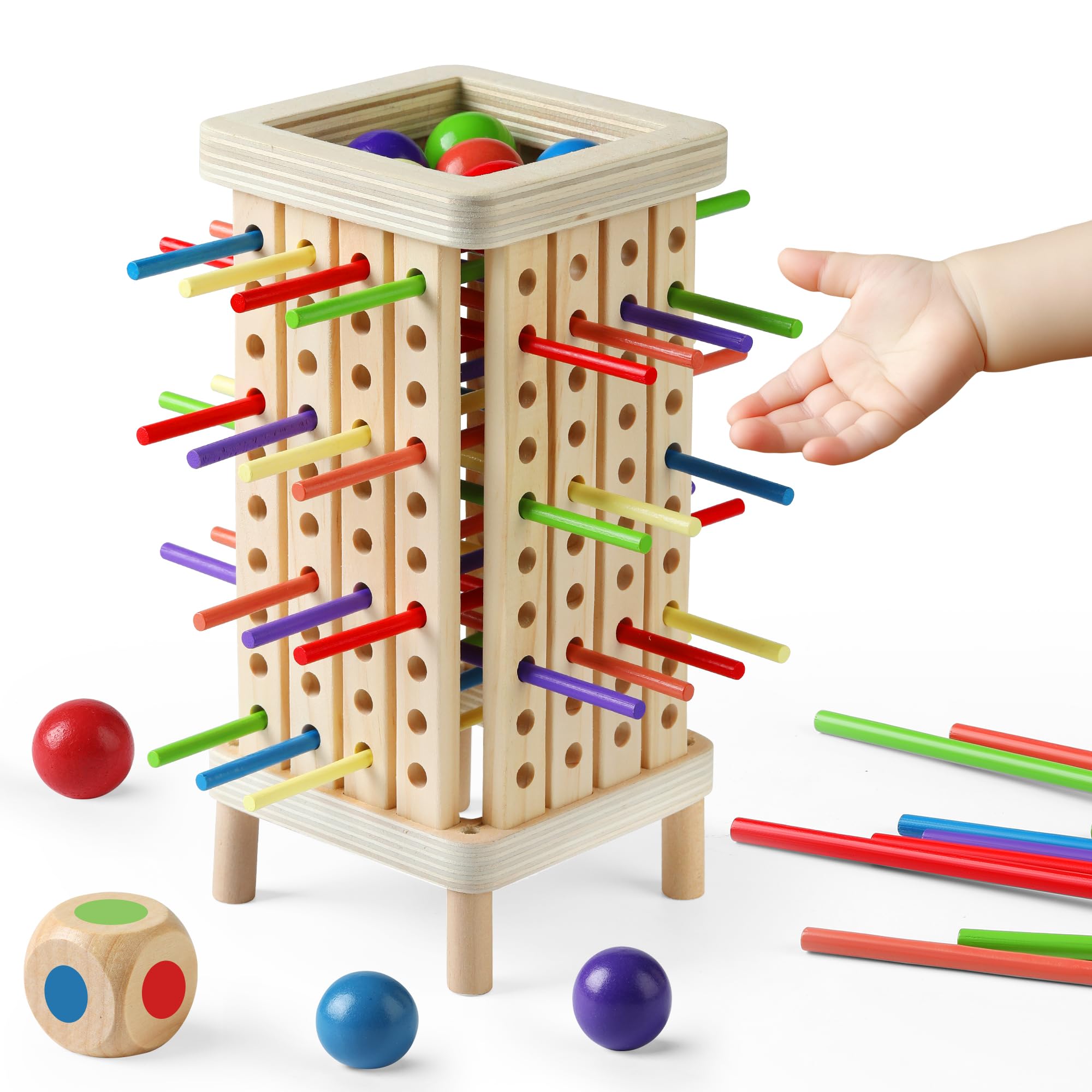
This entry-level wooden stick game offers a solid Montessori-inspired experience at a budget-friendly price point. Players take turns rolling the dice and gently pulling wooden sticks from the stack, being careful not to let the ball on top roll off. The game includes 42 smooth wooden sticks in multiple colors, a wooden ball, dice, and a base.
The sticks are crafted from natural wood with a smooth finish, and the bright colors help with color recognition as children play. The game accommodates 2 to 6 players, making it one of the few options that can handle a larger playgroup without adding extra components. The rule set is simple enough that most three-year-olds grasp it after a single demonstration.
The main limitation is the stick size — each stick measures roughly 4 inches long and is thin enough to potentially be a splintering concern if the wood is not sealed perfectly. While the manufacturer claims a burr-free surface, a quick sanding check by a parent before first use is recommended. The game also does not include storage bags, so the 42 sticks need to be stored together to avoid losing pieces.
Why it’s great
- Natural wood construction is more eco-friendly than plastic alternatives.
- Supports up to 6 players, great for playdates or larger families.
- Reinforces color recognition, counting, and fine motor control.
Good to know
- No included storage bag makes keeping all 42 sticks together tricky.
- Thin sticks may require a quick manual check for smooth edges.
FAQ
How long should a board game round last for a 3-year-old?
Can a 3-year-old play a game designed for ages 4 and up?
What is the best number of players for preschool board games?
Are wooden board games safer than plastic for toddlers?
Final Thoughts: The Verdict
For most users, the board games for 3-4 year olds winner is the Educational Insights The Sneaky, Snacky Squirrel Game because it perfectly balances fine motor skill development, simple color matching, and quick rounds that hold a toddler’s attention. If you want a game that builds pattern recognition and grows with your child into kindergarten, grab the hand2mind Numberblocks Race to Pattern Palace. And for a budget-friendly screen-free option that introduces turn-taking through a classic dexterity challenge, nothing beats the Pinshoon Montessori Wooden Stick Game.