
Our readers keep the lights on and the weekend projects moving. As an Amazon Associate, I earn from qualifying purchases.
Teaching a four-year-old to take turns, match colors, and handle the emotional rollercoaster of winning or losing is a tall order for any parent. The right board game turns that struggle into giggles, but the wrong one leads to tears over complicated rules or tiny parts that vanish under the sofa. You need a game that respects a short attention span, requires zero reading, and uses pieces large enough to survive a toddler’s grip.
I’m Rikta — the co-founder and writer behind FitlyFast. I have analyzed the specs, customer feedback, and developmental benchmarks behind dozens of preschool games to find the ones that deliver real skill-building without the frustration.
Whether you are shopping for a birthday, a family game night upgrade, or a screen-free activity to rotate into the playroom, this guide to the best board games for 4 year olds will help you find the perfect match for your little player.
How To Choose The Best Board Games For 4 Year Olds
Four-year-olds are in a sweet spot: they understand simple rules and love structured play, but they still get overwhelmed by complex instructions. The best games for this age range rely on visual cues, color recognition, and physical actions like picking up pieces or spinning a spinner. Look for games that prioritize fun over winning, with components that can withstand enthusiastic handling.
Prioritize No-Reading Gameplay
At age four, most children cannot read. Any game that requires reading cards or instructions eliminates independent play and forces an adult to guide every turn. The best preschool games use pictures, colors, and symbols so kids can play without help, building confidence and reducing the need for constant adult intervention.
Focus on Fine Motor Skill Development
Games that require picking up small objects with tongs, tweezers, or magnetic wands provide more than entertainment. They strengthen the hand muscles needed for writing, buttoning, and other daily tasks. The best board games for 4 year olds incorporate a physical action — squeezing a squirrel, catching a bug, or collecting a shell — that makes the learning feel like play.
Consider Cooperative vs. Competitive Formats
Some four-year-olds handle competition well, but many struggle with the disappointment of losing. Cooperative games, where all players work together against a shared challenge (like escaping lava or finishing before sunset), eliminate the winner-loser dynamic. They teach teamwork and problem-solving without the tears, making them a safer choice for sensitive kids or mixed-age groups.
Quick Comparison
On smaller screens, swipe sideways to see the full table.
| Model | Category | Best For | Key Spec | Amazon |
|---|---|---|---|---|
| Sneaky, Snacky Squirrel | Fine Motor | Color Matching & Dexterity | Squirrel squeezer tongs; 5 colors | Amazon |
| Sophie’s Seashell Scramble | Pattern Match | Pattern Recognition | Otter squeezer; 5 shell patterns | Amazon |
| Nat Geo My First Safari | Cooperative | Teamwork & Animal Facts | Co-op; 3 difficulty levels | Amazon |
| Baby Dinosaur Rescue | Cooperative | Problem-Solving | Co-op; lava race mechanic | Amazon |
| Diggin’ Doggies | Magnetic | Color & Counting Practice | Magnetic dog noses; 12 bones | Amazon |
| Bed Bugs | Action | Hand-Eye Coordination | Vibrating bed; 36 plastic bugs | Amazon |
| Candy Land Disney Princess | Classic | Simple Color Recognition | Disney-themed; no reading | Amazon |
In‑Depth Reviews
1. Educational Insights The Sneaky, Snacky Squirrel Game

The Sneaky, Snacky Squirrel sits at the top of this list because it combines every developmental milestone a four-year-old needs into one compact, tree-shaped box. Kids use the squirrel-shaped squeezer to pick up acorns in five colors — purple, yellow, blue, red, and green — and place them into their personal log. The spinner adds variety: sometimes you collect one acorn, sometimes you steal from an opponent, and sometimes you lose a turn. This mix of luck and mild strategy keeps the game fresh without overwhelming a young mind.
The squeezer is the star of the show. It requires a firm pinch to operate, building the same hand muscles preschoolers need for scissors and pencils. Parents report their three-year-olds playing eight rounds in a row, a testament to the high engagement level. The acorns are chunky enough to be safe (larger than the fruit pieces in Hi Ho! Cherry-O), and the logs and squirrel are built from thick plastic that survives drops and throws.
Games last roughly five to ten minutes, which is the ideal window for a four-year-old’s attention span. The rules are intuitive enough that kids can play without adult supervision once they have learned the spinner symbols. This is the complete package: fine motor work, color recognition, turn-taking, and sportsmanship, all wrapped in cute woodland theming that appeals to both boys and girls.
Why it’s great
- Superb fine-motor practice with the squeezer
- Sturdy, oversized pieces that survive rough use
- Short rounds keep four-year-olds engaged
- Clear spinner symbols require no reading
Good to know
- Choking hazard for younger siblings who mouth objects
- May feel too simple for kids older than five
2. Educational Insights Sophie’s Seashell Scramble

Sophie’s Seashell Scramble takes the fine-motor concept from The Sneaky, Snacky Squirrel and elevates the cognitive challenge by substituting color matching with pattern matching. Instead of simply finding a red acorn, kids must identify which of the 20 shells (spread across five distinct patterns) matches the one on the spinner. This extra layer of visual discrimination makes it a stronger choice for four-year-olds who have already mastered basic colors and need a next-step challenge.
The otter-shaped squeezer works identically to the squirrel squeezer but feels fresh enough that kids who already own the Squirrel game will not complain about repetition. The game board doubles as the storage box, which simplifies cleanup. Each player collects shells on their own snack mat, and the first to gather five different patterns wins. The spinner includes a special octopus space that adds a fun twist (you steal a shell from another player), which introduces mild competitive tension without causing meltdowns.
Speech therapists and occupational therapists frequently recommend this game because it targets both fine motor control and cognitive flexibility. Parents note that kids ask to play repeatedly, and the pattern-based gameplay holds their attention longer than simple color games. The shells are smooth and easy to grip, and the overall build quality matches the premium standard set by Educational Insights.
Why it’s great
- Pattern matching adds cognitive depth beyond color games
- Otter squeezer builds pincer grip strength
- Board folds into box for tidy storage
- Engaging for speech therapy sessions
Good to know
- Some assembly required (inserting shell posts)
- Small shells could be lost if not stored carefully
3. NATIONAL GEOGRAPHIC My First Safari Board Game

National Geographic brings its reputation for educational quality to this cooperative safari game, and the result is a standout option for parents who want their four-year-old to learn animal facts while playing. In My First Safari, players work together to move five explorer tokens around the board, collect item cards, and see all 21 animals before the sun sets. There is no single winner — either the whole team succeeds together or the sun token reaches the end of the track first and everyone loses together.
The cooperative format eliminates the emotional sting of losing, which makes this a great choice for sensitive kids or for families with a wide age gap. The game includes three difficulty levels, so it can grow with your child from ages four through six or seven. The included Learning Guide is packed with real facts about elephants, cheetahs, giraffes, hippos, and more, turning playtime into a mini biology lesson.
One minor drawback: the explorer tokens can be difficult to snap into their plastic stands, and several parents report that the stands feel fragile. However, once assembled, the components hold up well. The game board and cards feature bright, realistic National Geographic photography rather than cartoon illustrations, which adds a level of authenticity that sets it apart from typical preschool games.
Why it’s great
- Cooperative play removes competitive stress
- Three difficulty levels extend replay value
- Learning Guide teaches real animal facts
- Beautiful National Geographic photography
Good to know
- Token stands are tricky to assemble
- Lava-themed loss may upset sensitive kids
4. Baby Dinosaur Rescue Board Game

Baby Dinosaur Rescue is a cooperative game where players work together to guide baby dinosaurs across a valley to safety on Dinosaur Island before lava fills the path. The theme is inherently exciting for four-year-olds — dinosaurs and lava are an irresistible combination — and the cooperative mechanic ensures that every player feels like part of the team rather than a loser. No reading is required; all actions are driven by image-based item cards that kids can interpret independently.
The game runs roughly 20 minutes per round, which sits right at the upper end of a four-year-old’s attention span. Players practice matching, turn-taking, and communication as they decide which dinosaur to move and which card to play. Because everyone wins or loses together, there is no pressure to perform, and parents report fewer meltdowns compared to competitive games. The artwork is bright and kid-friendly, with cute dinosaur characters that appeal to a broad range of interests.
One common observation from parents is that the Lava cards appear too frequently in the deck, which can lead to games where the lava advances so fast it feels unfair. A simple fix is to remove a few Lava cards from the deck before playing. Also, some kids may find the idea of baby dinosaurs getting caught in lava upsetting — sensitive children might need reassurance that it is just a game. The tokens are on the light side and can blend into the board, so playing on a contrasting surface helps.
Why it’s great
- Cooperative format builds teamwork skills
- Dinosaur theme is highly engaging for this age
- No reading required for gameplay
- Teaches communication and shared decision-making
Good to know
- Too many Lava cards can frustrate players
- Tokens are lightweight and hard to see on the board
5. Game Zone Diggin’ Doggies Board Game

Diggin’ Doggies uses a clever magnetic mechanic that sets it apart from tong-based games. Each plastic dog has a magnet in its nose, and the bones scattered around the board have matching magnetic ends. When a player moves their dog to a space containing a bone, the dog’s nose automatically picks up the bone if the colors match. This satisfying click-and-lift action delights four-year-olds and reinforces color recognition and counting in a way that feels like magic.
The game accommodates two to four players, and each round is quick enough that kids can play multiple times in one sitting. The rules are simple: roll the die, move your dog, and try to collect three bones that match your dog’s color. The first player to collect all three bones and return to the doghouse wins. This structure teaches turn-taking, basic counting, and following sequential instructions without overwhelming a young player.
Parents consistently report that the game holds up well over years of use. The plastic dogs are solid with no sharp edges, the bones are chunky and easy to handle, and the magnetic mechanism remains effective after hundreds of plays. The only caution is that the bones are small enough to pose a choking hazard for children under three, so supervision is necessary if younger siblings are around. For its price point, this is one of the most durable and creative options available.
Why it’s great
- Magnetic nose mechanic is novel and engaging
- Sturdy plastic pieces survive rough play
- Teaches counting, colors, and turn-taking
- Quick rounds hold attention well
Good to know
- Small bones are a choking hazard for children under three
- Colors may be hard to distinguish in dim lighting
6. Bed Bugs Board Game
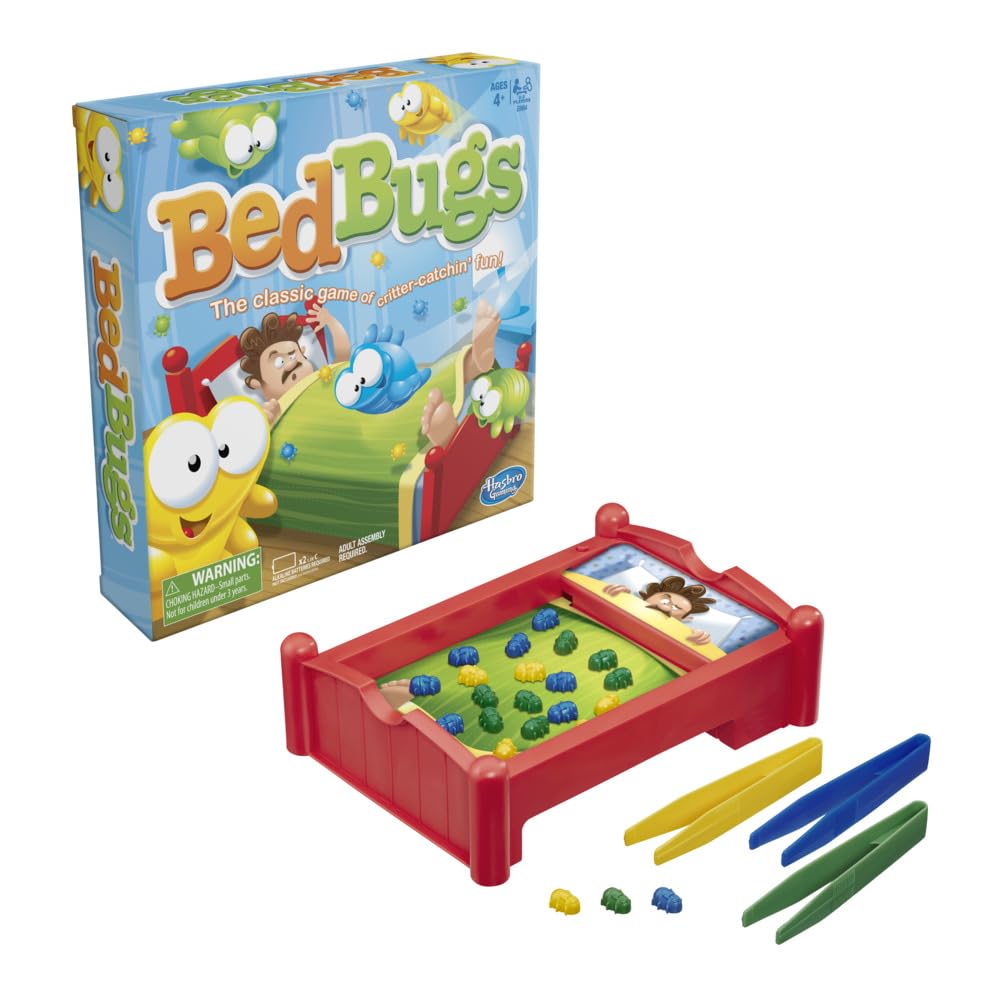
Bed Bugs is a high-energy action game that replaces traditional board-game stillness with a motorized bed that vibrates, sending plastic bugs bouncing and bopping across the surface. Players use tongs to catch bugs that match the color of their tong — blue, yellow, or green — and the first to clear all their bugs out of the bed wins. The vibrating mechanism creates a chaotic, giggly atmosphere that four-year-olds find irresistible, and the 20-minute playtime matches the age group’s endurance perfectly.
The game requires no reading and only the most basic color recognition, making it accessible to younger four-year-olds. The tongs provide excellent fine-motor practice, as kids must coordinate their grip with the unpredictable movement of the bugs. Parents report that the game improves hand-eye coordination and reaction time, and the shared laughter makes it a hit at playdates and family game nights.
The main trade-off is that the motorized bed runs on batteries and can stop vibrating if pressed too hard (a common issue with excited kids). The cards are also on the flimsy side and may bend with heavy use. Additionally, some parents note that the game becomes repetitive after repeated play sessions, as the core mechanic does not change. Still, for pure chaotic fun that gets kids moving, Bed Bugs delivers an experience that no other game on this list can match.
Why it’s great
- Motorized vibration creates unique active play
- Tongs build fine motor and coordination skills
- No reading required; accessible for all
- Fun for playdates and group settings
Good to know
- Motor stops if pressed too hard
- Cards are not very durable
7. Hasbro Gaming Candy Land Disney Princess Edition

Candy Land is a rite of passage for American preschoolers, and the Disney Princess edition adds familiar characters that make the classic formula even more enticing for young children. Players choose from three princess movers — Cinderella, Rapunzel, or Ariel — and race along a rainbow path to reach the enchanted castle. There is no reading, no counting, and no strategy; the entire game is driven by drawing colored cards and moving to the matching space on the board. This extreme simplicity is actually its superpower for the youngest players.
For a four-year-old who loves Disney Princesses, this game is pure joy. The board features artwork from multiple Disney movies, and the familiarity of the characters reduces the learning curve to zero. Parents report that their children ask to play multiple times per day and that the game has helped reduce screen time by providing an engaging alternative. The three player pieces are sized for small hands, and the card-based movement means no batteries or electronics are needed.
That said, the production quality is noticeably lower than other options on this list. The board folds into quarters rather than a single piece, and the cards feel thin and may bend with frequent use. More fundamentally, there is no skill development beyond color recognition — no fine motor practice, no strategic thinking, no counting. For a child who is not a Disney fan, the generic version of Candy Land offers the same gameplay without the branding. However, for the target audience of Disney-loving four-year-olds, the theming makes this a guaranteed hit.
Why it’s great
- Disney Princess theming is highly motivating for fans
- Extremely simple rules that require no reading
- No batteries needed; portable for travel
- Pieces are sized for small hands
Good to know
- Board folds in quarters, less durable than single-piece boards
- Cards feel flimsy and may bend with use
FAQ
What is the best cooperative board game for a 4 year old?
Which board game is best for developing fine motor skills in a 4 year old?
How many players do most preschool board games support?
Are there board games for 4 year olds that work without adult supervision?
Final Thoughts: The Verdict
For most users, the winner of this board games for 4 year olds guide is the Educational Insights The Sneaky, Snacky Squirrel Game because it delivers the perfect balance of fine motor skill development, color recognition, turn-taking practice, and pure fun in a durable package. If you want a cooperative adventure that teaches animal facts and teamwork, grab the NATIONAL GEOGRAPHIC My First Safari Board Game. And for a child obsessed with dinosaurs who needs a low-pressure introduction to structured play, nothing beats the Baby Dinosaur Rescue Board Game.